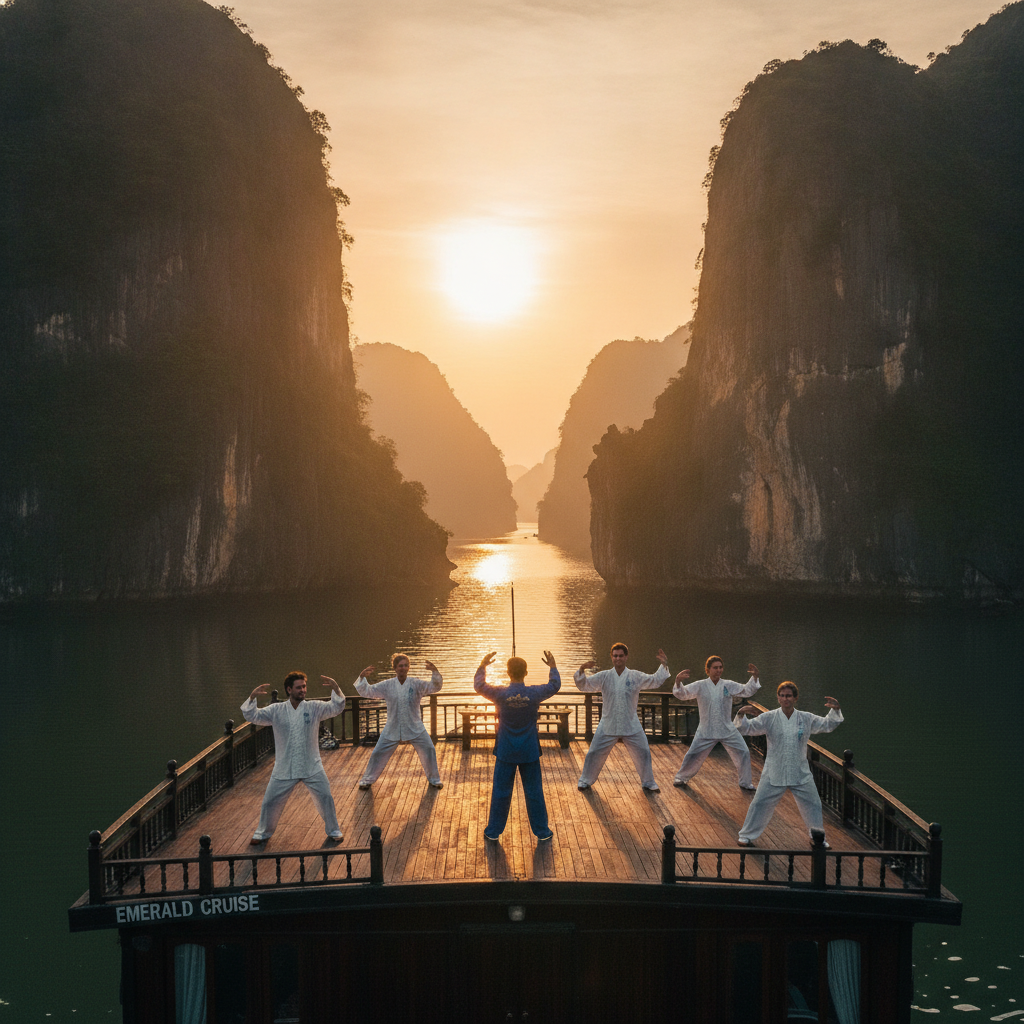


Ha Long Bay's Daily Cycle: The 05:30 Tai Chi Deck, the Stone Beach Limestone Pebbles Between Vertical Karst Walls & the 10-Million-Year Geological Reckoning on the Drive Back to Hanoi
The cruise ritual refined over decades—tai chi at 05:30, cooking class at 14:00, squid fishing at 21:00—as the best operators' structure for maximising the emotional impact of the landscape's natural qualities; Ba Be Lake's 2-day freshwater karst counterpart with the Tày minority stilt house villages at 10% of Ha Long's visitor volume; the stone beaches between 60-metre vertical karst walls providing more visceral scale appreciation than any panoramic viewpoint; July–August jellyfish bloom intensified by wastewater eutrophication; the Ha Long City market at 03:00 where the cruise chef buys the day's squid for the cooking class; and the geological timeline where French colonialism and cruise boats both occupy the same last pixel of 350 million years of limestone.

Ha Long Bay: 1,969 Islands from 350-Million-Year Coral Reefs, the Cave That Stored Mongol-Fleet-Defeating Wooden Stakes & the 1,600 Floating Village Residents Relocated by UNESCO Management
The limestone tower karst's 20-million-year tropical dissolution and the sea level rise 10,000 years ago that drowned the base of the towers creating the present bay; Hang Dau Go's wooden stakes General Tran Hung Dao used in 1288 to impale Kublai Khan's Mongol invasion fleet at low tide; the 6 floating village communities dismantled by provincial government between 2014–2018 as the environmental impact of raw sewage was deemed incompatible with World Heritage status; the Hang Luon hollow island's 2-hectare internal lagoon accessible by kayak through a 50-metre cave; the Cat Ba langur with 60–70 individuals remaining as the most critically endangered primate in Asia; and the seaplane approach from Hanoi at USD 200–300 as the most spectacular arrival in Vietnamese tourism.

Ha Long Bay's Hidden Layers: Nixon Mining Haiphong Harbour in 1972, Akoya Pearls at 40% Below Japanese Prices & the Dragon Mother Legend That Explains Every Island You're Looking At
The Ha Long pearl farm's Pinctada fucata oysters producing AAA Akoya pearls at 40–60% below equivalent Japanese prices in the same bay where the legend says dragon children exhaled jewels that solidified into the karst; Operation Pocket Money's 8 May 1972 mining of Haiphong harbour—Nixon calculating Soviet SALT treaty interest exceeded their Haiphong interest, correctly; water puppetry's 1121 CE Lý dynasty court origin with the dragon scenes depicting the same legend visible in the surrounding landscape; Bai Tu Long Bay named for the dragon children bowing to their mother as she descended; the Aries wreck in Lan Ha Bay sunk as an artificial reef in 2016 now colonised by hard coral; and the return pho in Hanoi Old Quarter as the geological and culinary counterpoint to 350 million years and fresh squid.

Ha Long Bay's Uncomfortable Truths: 500 Diesel Cruise Boats in a UNESCO Heritage Zone, the Dugong Functionally Extinct Since 2010 & the 1288 Battle That Repelled Kublai Khan's Third Invasion
The LED cave lighting that promotes algae growth on stalactites—the theatrical improvement that accelerates the degradation it is installed to showcase; the 1288 Bach Dang River iron-tipped wooden stakes that impaled Kublai Khan's Mongol fleet at the falling tide—the third and final Mongol invasion of Vietnam, all three failed; the dugong's last confirmed sighting in 2010 after the seagrass beds declined 50% from 1990 to 2020; Lan Ha Bay's Dark Cave 300-metre swim in total darkness versus Ha Long Bay's Hang Sung Sot's coloured LED theatrical lighting—same limestone geology, different management philosophies; the squid fleet's LED gantry lights on the horizon at 10 pm as the most surprising Ha Long Bay image; and Bai Tu Long Bay as the experienced traveller's Ha Long Bay.

Ha Long Bay Versus the World: 1,969 Islands Against Phang Nga Bay's 42, the 1992 Indochine Oscar That Built the Bay's European Reputation & the Month-by-Month Guide That Actually Matters
Ha Long Bay's 4× Phang Nga Bay area with 50× more islands but worse environmental management despite the UNESCO designation—the undesignated Thai bay having more effective boat permit limits; the multi-day Lan Ha Bay kayak circuit from Cat Ba Town requiring intermediate sea kayak skills and accessing the floating homestay USD 20–30 per night; the Hà Tu opencast mine producing 3 million tonnes of anthracite annually as the primary sedimentation source for the UNESCO heritage water; WWF Vietnam's RTHL programme membership as the most reliable cruise operator selection criterion; 'The Quiet American' 1955 novel's unnamed northern Vietnamese landscape now firmly identified as Ha Long Bay by literary tourism; and March as the best mist photography month when the temperature differential is right but the summer crowds haven't arrived.

Ha Long Bay's Full Picture: The Cat Ba Langur's 60-Remaining-Individuals Cliff Habitat, Giant Freshwater Prawns in the Cua Luc River & Why the USD 60 Cruise and the USD 200 Cruise Are Different Products
Dawn mist at 05:30 before the day fleet arrives—the conditions producing the floating-islands illusion require the temperature differential of October to March; the Quảng Ninh coal basin's 8 billion tonnes of anthracite and the sedimentation it's causing in the UNESCO heritage water; Cat Ba langur's 60–70 individuals on the island that has a national park dating to 1986 and a tourist town on the same coastline; the Giant freshwater prawn Macrobrachium rosenbergii at 30 cm peak season April–June in Ha Long City wet market versus the budget cruise's engine-room diesel fumes; Typhoon Yagi September 2024 the strongest typhoon to hit northern Vietnam in 70 years; and the Cat Ba Town independent kayak base as the best Ha Long Bay experience for people who have already been once.