Rembrandtplein, Tuschinski & the Amstel: Art, Entertainment, and the Skinny Bridge
The southern part of Amsterdam's historic center — the area between the Muntplein (Mint Square) and the Amstel river — is the part of Amsterdam that most closely resembles a European capital's entertainment district: the Rembrandtplein (Rembrandt Square) with its cafés and nightlife, the extraordinary Tuschinski cinema (the most beautiful cinema interior in the Netherlands), the Magere Brug (the Skinny Bridge, Amsterdam's most photographed landmark), and the Amstel river embankment where houseboats and canal boats provide Amsterdam's most atmospheric waterfront. The area also contains the Hermitage Amsterdam (formerly housed in the Amstelhof building), the Amstelkerk, and the antique and book dealers of the Spiegelkwartier (Mirror Quarter) that extends south from the Rijksmuseum.
- 1
Rembrandtplein — The Entertainment Square
The Rembrandtplein, one of Amsterdam's main squares (the other being the Leidseplein), takes its name from the bronze statue of Rembrandt van Rijn (1852, by Louis Royer) at its center — surrounded, incongruously, by bronze castings of the figures from The Night Watch (2006, by Rus Ligtelijn and Thomas Lapperre), placing the entire central composition of Rembrandt's masterpiece in three dimensions in the square that bears his name. The square is ringed by cafés, bars, clubs, and the Escape nightclub (capacity 2,500, one of Amsterdam's main nightclubs), and by the former headquarters of the Dutch broadcasting company in a 19th-century building (now the Rembrandt Classic Hotel). The best views of the Rembrandtplein are from the upper floors of the Café Schiller (1892), one of Amsterdam's most Art Deco cafés, with its original interior of mirrors, marble, and stained glass intact.
- 2
Tuschinski Theater — The Most Beautiful Cinema in the World
The Tuschinski Theater (now Pathé Tuschinski), designed by Heyman Louis de Jong and opened in 1921 by Abraham Icek Tuschinski (a Polish-born Jewish entrepreneur who arrived in Rotterdam in 1907), is widely considered the most beautiful cinema interior in the world: an Expressionist/Art Nouveau/Amsterdam School building with an extraordinary mixture of influences — Persian carpets, Delft tiles, brass fittings, stained glass, murals by Chris Lebeau — all combined in an interior that makes Hollywood's movie palaces look restrained. Tuschinski, who was deported to Auschwitz and murdered in 1942, created a cinema as an aspiration: 'everything that was beautiful and lavish' for an immigrant audience who had experienced little of either. The main auditorium (1,094 seats) retains its original 1921 decoration; the smaller screens in the building are less remarkable. Major film premieres are held here; the cinema shows both commercial releases and art house programming.
- 3
Magere Brug — The Skinny Bridge
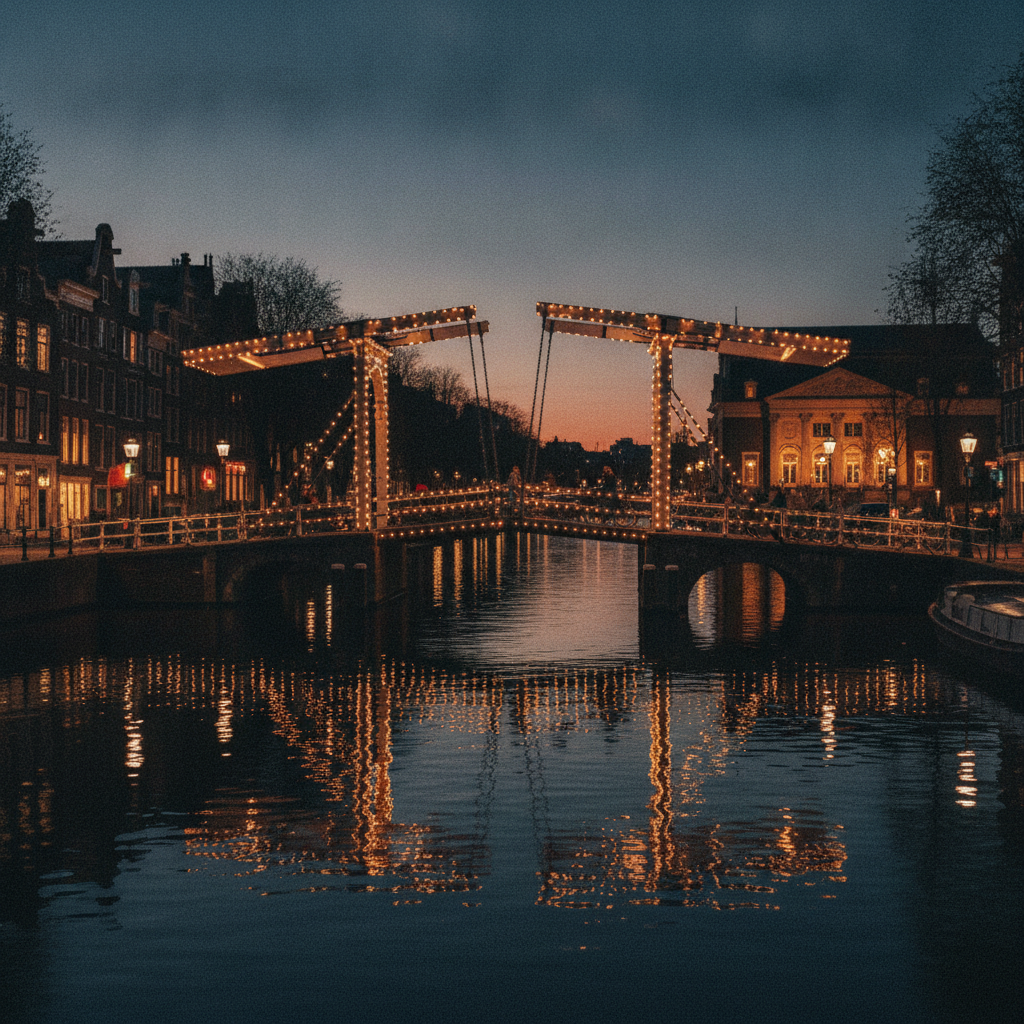
The Magere Brug (Skinny Bridge), a narrow double drawbridge spanning the Amstel river at the Kerkstraat, is Amsterdam's most photographed landmark and one of only a handful of surviving manually operated wooden drawbridges in the city. The current bridge (built 1934, replacing an earlier 17th-century structure) is 14 meters wide — narrow enough that two cyclists can barely pass each other — and is strung with 1,200 small lights that illuminate it after dark. The name derives from the original 17th-century bridge, which was reportedly built by two sisters called Mager (skinny) who lived on opposite sides of the Amstel and wanted a bridge between their houses. The bridge is best seen and photographed after dark, when the reflections of the lights in the dark Amstel water create the most romantic image in Amsterdam.
- 4
Amstel River Embankment — The Quiet Waterfron
The Amstel river, which gave Amsterdam its name (the city began as a dam across the Amstel in the 13th century), flows through the southern part of the city in a broad channel that is unusual in Amsterdam: wider than the canals, less architecturally overwhelming, with a more open quality of light and space. The embankments on both sides of the Amstel — the Amsteldijk to the west, the Weesperzijde to the east — are lined with houseboats, residential buildings, and the occasional café, creating a quieter and more residential waterfront than the tourist-heavy canal ring. The Amstel is also the route for canal boat trips and the Sunday morning Antiques Market on the Looiersgracht that extends to the waterfront. The view south from the Magere Brug, past the Theater Carré (1887, the Netherlands' most famous variety theater, now a music venue) to the point where the Amstel disappears into the polder landscape, is one of Amsterdam's finest.
- 5
Spiegelkwartier — Amsterdam's Antique Quarter
The Spiegelkwartier (Mirror Quarter), the cluster of antique dealers and art galleries along the Spiegelgracht and Nieuwe Spiegelstraat between the Herengracht and the Rijksmuseum, is one of the finest concentrations of art and antique dealers in Europe: approximately 80 galleries and dealers in a 200-meter stretch of streets, dealing in Dutch Golden Age paintings, 18th-century furniture, Chinese porcelain, Art Nouveau objects, Old Master drawings, and Indonesian colonial artifacts. The Spiegelgracht itself is a minor canal (connecting the Prinsengracht and the Keizersgracht) lined with 17th-century buildings whose ground floors have been converted to gallery use, creating an unusually beautiful commercial street. The best time to visit is during the annual Amsterdam Antiques Fair (TEFAF Amsterdam, spring) when the dealers bring their finest pieces forward.
- 6
Amstelkerk & the Residential Southern Canals
The Amstelkerk (Amstel Church), a temporary wooden church erected in 1670 (intended as a placeholder until a stone church could be built, but the stone church was never built and the Amstelkerk has stood, repeatedly modified, for 350 years), stands on the Amstelveld, a quiet square with a weekly flower market (Monday morning) in one of Amsterdam's pleasantest residential neighborhoods. The surrounding streets — Reguliersgracht, Keizersgracht, Herengracht in their southern section — are among Amsterdam's most attractive: fewer tourists than the northern canal ring, more residential in character, with the Amstel church providing a focal point and the seven bridges of the Reguliersgracht providing Amsterdam's most famous multiple-bridge view (visible from a single point). The area is particularly pleasant in the evening, when the bridge and canal lighting creates a sequence of illuminated reflections along the water.
Walk this route with audio
Stories play automatically as you reach each stop — no tapping needed.
More in amsterdam
Rijksmuseum, Van Gogh & Museumplein: The Museum Quarter
Jordaan, Anne Frank & the Canal Ring: Amsterdam's Golden Age Heart
Amsterdam Noord, EYE & NDSM: The Creative Waterfront
De Pijp, Albert Cuyp & Heineken: Amsterdam's Most Diverse Neighborhood
NEMO, Maritime Museum & Eastern Docklands: The Harbor City Reinvented