Anchorage: Alaska Native Heritage, Anchorage Museum, Matanuska Valley, Wildlife, Alaska Highway, and the Aurora Borealis
Anchorage: Alaska Native Heritage Center (1999 11 cultural groups Athabascan Yupik Inupiaq Alutiiq Tlingit and more live demonstrations, Alaska Native 105,000 15% state population 20+ languages Yupik 10,000 speakers, ANCSA December 18 1971 Nixon 44 million acres USD 962.5M largest land claims settlement US history 12 regional 200+ village corporations, Dena ina language of Anchorage area), Anchorage Museum (625 C Street 170,000 sqft USD 69M 2009 David Chipperfield London, Smithsonian Arctic Studies Center only Smithsonian outside DC year-round, Sydney Laurence 1865-1940 Brooklyn NY first major Alaska painter hundreds Denali oils, Russian colonial 1741-1867 Gold Rush 1896 Alaska Highway 1942 2,400km 9 months 10,000 soldiers statehood January 3 1959 ANILCA 1980 53 million acres single act largest US conservation), Matanuska-Susitna Valley (75-100km north Palmer 7,000 Wasilla 10,000, New Deal colonization 1935 203 families Minnesota Wisconsin Michigan 40 acres house barn livestock seed 25-year mortgage, Colony Farm Museum 316 East Elmwood Palmer, Alaska giant vegetables 20+ hour photosynthesis cabbages 65kg world record pumpkins 1,000kg, Alaska State Fair late August-Labor Day giant vegetable competition), wildlife (1,500 moose within Anchorage greater area 300-400 vehicle collisions/year, Alaska brown bear 30,000 largest US population, McNeil River 144 bears single day July chum salmon run most dense on earth, Kenai River world-record king salmon 44.2kg May 17 1985 Les Anderson), Alaska Highway (1942 9 months 2,400km 10,500 military 16,000 civilian 24hrs subarctic winter, Dalton Highway 666km gravel Prudhoe Bay Arctic Ocean Trans-Alaska Pipeline parallel Arctic Circle Mile 115 Atigun Pass 1,450m, Seward Highway National Scenic Byway 235km Turnagain Arm, Homer 350km halibut capital Homer Spit 7km), aurora (61 degrees N auroral oval 120-150 nights/year September-March strongest, green oxygen 100-150km red 200km+ blue purple nitrogen, Anchorage Hillside O'Malley Abbott Road best city viewing, midnight sun June 21 19hr 22min daylight civil twilight no true darkness, 18-20C average high June-August residents outdoors 1-2am blackout curtains).
- 1
The Alaska Native Heritage Center and Indigenous Alaska
The Alaska Native Heritage Center (at 8800 Heritage Center Drive, Anchorage, established 1999): the premier museum and cultural center of Alaska Native peoples, operated by a consortium of Alaska Native organizations and presenting the heritage of the 11 major indigenous language and cultural groups of Alaska -- the Athabascan, Yupik, Cup'ik, Inupiaq, Siberian Yupik, Alutiiq/Sugpiaq, Unangan (Aleut), Eyak, Tlingit, Haida, and Tsimshian peoples -- with traditional dwellings, live demonstrations of traditional crafts (basket weaving, ivory carving, skin sewing, drumming), and the largest collection of Alaska Native art in Alaska. Alaska Native population: approximately 105,000 Alaska Natives (15% of the total Alaska population) speak 20+ indigenous languages (organized into 11 language families, with Yupik the most spoken at approximately 10,000 speakers, followed by Inupiaq at approximately 2,000), live in 229 federally recognized Alaska Native villages and 12 regional Alaska Native corporations established under the Alaska Native Claims Settlement Act (ANCSA, signed December 18, 1971 by President Nixon, the largest land claims settlement in U.S. history, transferring 44 million acres (18 million hectares) and USD 962.5M to Alaska Native people, organized through 12 regional and 200+ village corporations). The Athabascan people of Interior Alaska: the most geographically widespread Alaska Native group, inhabiting the boreal forest and river valleys of interior Alaska from the Brooks Range to the Alaska Range, with the most linguistically diverse language family (11 distinct Athabascan languages including Ahtna, Dena ina (the language of the Anchorage area), Deg Xinag, Holikachuk, Koyukon, Upper Kuskokwim, Gwich in, Tanana, Upper Tanana, Tanacross, and Han).
- 2
The Anchorage Museum and the Alaska Experience
The Anchorage Museum (at 625 C Street, Anchorage, the largest museum in Alaska, 170,000 square feet after the USD 69M expansion completed 2009, designed by David Chipperfield Architects of London): the premier museum of Alaska history, art, and science, with a comprehensive collection of Alaska Native art (the Smithsonian Arctic Studies Center gallery, the only Smithsonian collection outside Washington D.C. displayed year-round), Alaskan landscape painting (the Sydney Laurence collection -- Sydney Laurence (born October 14, 1865, Brooklyn, NY; died December 10, 1940, Anchorage) was the first major Alaskan landscape painter, the most prolific painter of Denali, with hundreds of oil paintings of the mountain from the Palmer Hay Flats, now among the most valued Alaskan paintings in existence), and the history of Alaska from 10,000 years of Native occupation through the Russian colonial era (1741-1867), the Gold Rush (1896-1900), the Alaska Highway construction (1942, 2,400 km built in 9 months by 10,000 soldiers), statehood (January 3, 1959), and ANILCA (the Alaska National Interest Lands Conservation Act of 1980, which added 53 million acres to the US national parks system in a single act -- the largest single conservation action in US history). The Museum of the North (at 907 Yukon Drive, Fairbanks, AK, 550 km north of Anchorage): the University of Alaska Fairbanks museum with the largest collection of Arctic and subarctic specimens in the world, including the Effie bone bed (the woolly mammoth remains), the gold of the Klondike era, and the comprehensive Alaska Native art collection. The Anchorage Museum also presents the Aurora (the Northern Lights) science exhibit, educating visitors on the physics of the aurora borealis -- the electromagnetic storm that creates the light show visible from Anchorage 60+ nights per year.
- 3
Matanuska-Susitna Valley and the Palmer Colony
The Matanuska-Susitna Valley (the broad agricultural valley 75-100 km north of Anchorage, centered on the towns of Palmer (population 7,000) and Wasilla (population 10,000), drained by the Matanuska and Susitna Rivers): the agricultural heartland of Alaska, with the most productive farmland in the state, created by a glacial outwash plain of extraordinarily fertile silt deposits from the Matanuska Glacier system. The Palmer colony (1935): one of the most unusual federal government programs of the Great Depression -- the New Deal colonization of the Matanuska Valley, in which the Federal Emergency Relief Administration (under Harry Hopkins) selected 203 families from the economically devastated agricultural regions of Minnesota, Wisconsin, and Michigan, relocated them to the Matanuska Valley in spring 1935, provided each family with 40 acres, a house, a barn, livestock, seed, and a 25-year government mortgage. The program was controversial (Time magazine called it a New Deal Failure in 1936; historians are more divided), but it established the agricultural foundation of Alaska. The Colony Farm Museum (at 316 East Elmwood Avenue, Palmer): the preserved original 1935 colony farm buildings. Alaska giant vegetables: the Matanuska Valley is famous worldwide for the Alaska state fair exhibits of giant vegetables -- the combination of the 20-hour summer days (the 20+ hours of sunlight during June-July allow continuous photosynthesis, producing vegetables of extraordinary size) and the fertile glacial silt produces cabbages weighing up to 65 kg (143 lbs, world record), pumpkins up to 1,000 kg, and zucchinis up to 30 kg. The Alaska State Fair (in Palmer, held annually the last week of August through Labor Day): the most attended fair in Alaska, with the giant vegetable competition as the signature event.
- 4
Alaska Wildlife - Bears, Moose, Salmon, and the Predator-Prey Web
Alaska wildlife in the Anchorage area: the combination of Chugach State Park, the Kenai Peninsula, the Matanuska-Susitna Valley, and the Cook Inlet shorelands within 2 hours of Anchorage creates one of the densest concentrations of accessible wildlife viewing of any major American city. The moose (Alces alces gigas, the Alaska subspecies of moose -- the largest of all moose subspecies and the largest land mammal in North America, with the Alaskan bull moose averaging 500-700 kg and the largest individuals exceeding 800 kg with antler spans exceeding 2 m): the most commonly encountered large mammal in Anchorage, with approximately 1,500 moose living within the greater Anchorage area (wandering through suburban neighborhoods, causing traffic accidents (300-400 moose-vehicle collisions per year in Anchorage), eating ornamental trees and gardens, and giving birth in backyards). The brown bear (Ursus arctos, the North American grizzly bear subspecies): the Alaska brown bear population (approximately 30,000 bears in Alaska, the largest population in the United States and one of the largest in the world) is concentrated along the salmon streams of the Gulf of Alaska coast -- the McNeil River State Game Sanctuary (at the base of the Alaska Peninsula, 400 km southwest of Anchorage by floatplane, accessible by permit lottery): the highest-density brown bear concentration in the world, with up to 144 individual bears counted at the McNeil River Falls in a single day during the July chum salmon run. The Kenai River salmon (the sockeye, chinook, coho, pink, and chum salmon runs of the Kenai River, 160 km south of Anchorage): the world-famous sport fishing destination, with the world-record king salmon (44.2 kg, caught May 17, 1985, by Les Anderson on the Kenai River) the benchmark of the sport fishing tradition.
- 5
The Alaska Highway, Dalton Highway, and Road Trips from Anchorage
The Alaska Highway (constructed 1942 by the U.S. Army in 9 months as a military supply road, 2,400 km from Dawson Creek, British Columbia to Delta Junction, Alaska, the only road connecting Alaska to the lower 48 states): the engineering achievement that transformed Alaska from a virtually road-free territory to a connected state, built by 10,500 military personnel and 16,000 civilian workers working 24 hours a day through a subarctic winter. The current highway (US-2 in Alaska, Alaska Route 2) is fully paved and maintained year-round, with gas stations every 80-160 km -- the most remote major highway in North America. The George Parks Highway (AK-3, from Anchorage to Fairbanks, 840 km, passing through Wasilla, Talkeetna, Cantwell, and Nenana): the primary highway from Anchorage north, passing Denali National Park at Mile 237 and the gateway town of Healy at Mile 249. The Dalton Highway (the 666-km gravel road from the Elliott Highway junction at Livengood (north of Fairbanks) to Prudhoe Bay on the Arctic Ocean): the most remote publicly accessible road in the United States, running parallel to the Trans-Alaska Pipeline System, crossing the Arctic Circle at Mile 115 (the Arctic Circle marker is the most popular photo stop), crossing the Brooks Range through the Atigun Pass (1,450 m, the highest highway pass in Alaska), and reaching the oil fields of Prudhoe Bay on the Beaufort Sea. The Seward Highway (AK-1, from Anchorage south to Seward, 235 km, running along Turnagain Arm and through the Kenai Mountains): the most scenic paved highway in Alaska (designated a National Scenic Byway), with views of Turnagain Arm, Portage Glacier, and the Chugach Mountains. The Kenai Peninsula road system (AK-1 and Sterling Highway, AK-1): the highway system accessing Homer (350 km south of Anchorage, the halibut fishing capital of the world, with the Homer Spit extending 7 km into Kachemak Bay).
- 6
Aurora Borealis, Winter in Alaska, and the Summer Midnight Sun
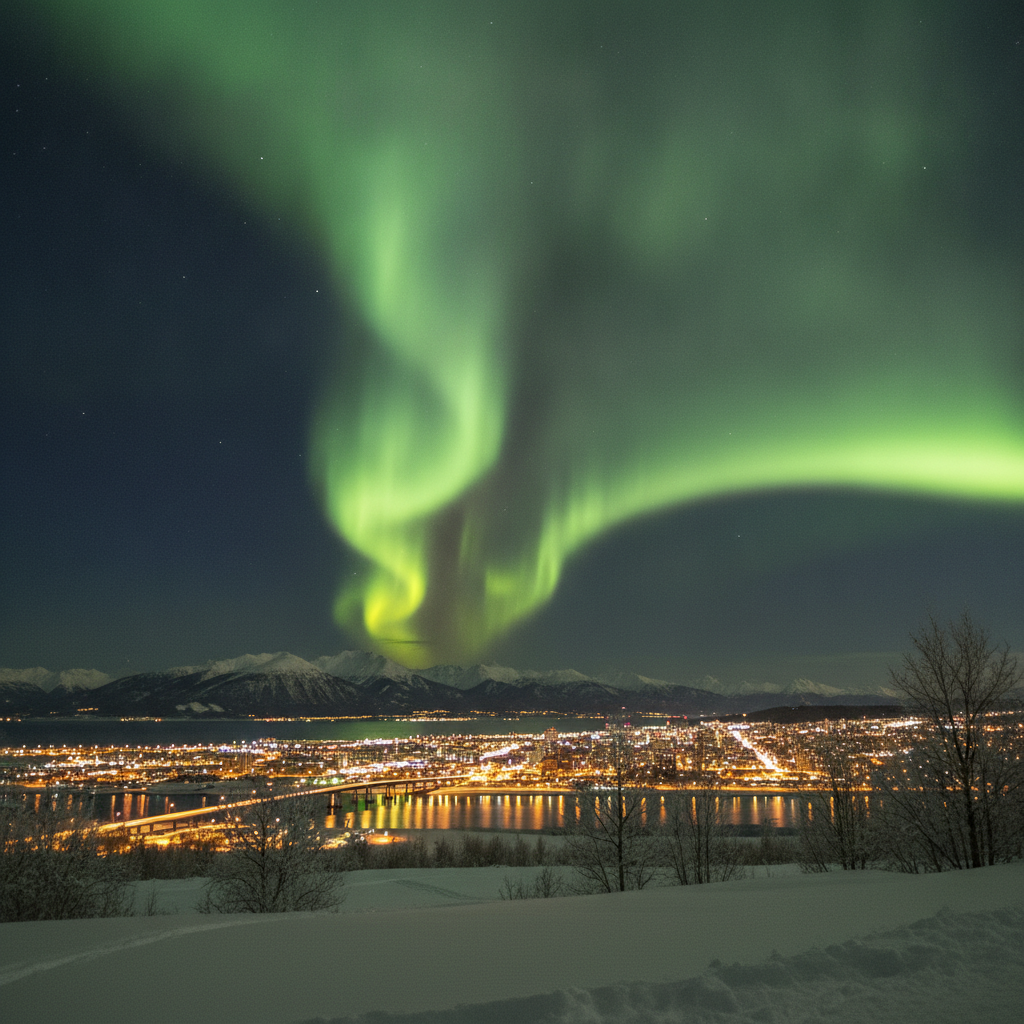
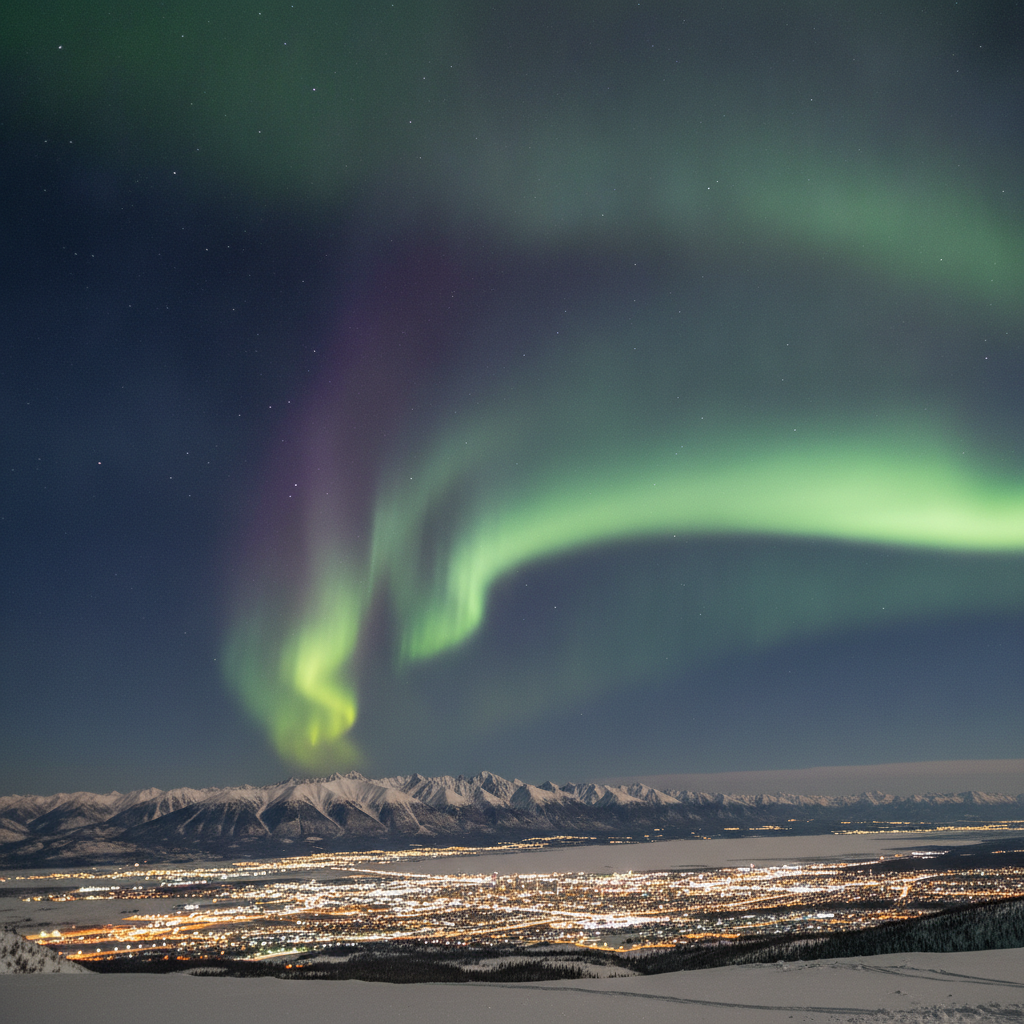
The aurora borealis (the Northern Lights): Anchorage's position at approximately 61 degrees North latitude places it in the auroral oval -- the band of maximum aurora frequency and intensity centered on the magnetic pole rather than the geographic pole. Anchorage experiences approximately 120-150 nights per year with aurora activity, with the strongest displays from September through March when nights are long enough to see the lights (in June-July the sky stays too bright throughout the night). The physics of the aurora: the aurora is produced when charged particles (primarily electrons and protons) from the solar wind are accelerated along the Earth's magnetic field lines into the upper atmosphere at 100-300 km altitude, where they collide with atmospheric nitrogen (producing blue and purple colors) and oxygen (producing green at 100-150 km and red at above 200 km). The strongest aurora displays (G3 and G4 geomagnetic storms) can be seen from Seattle, Portland, and even the northern continental US. The best aurora viewing: the Anchorage Hillside (the residential area at the base of the Chugach foothills, accessed via O'Malley Road or Abbott Road, where the city lights are below and the dark sky begins), or a short drive north to the Matanuska Valley for complete darkness. The midnight sun: on the summer solstice (June 21), Anchorage has 19 hours and 22 minutes of daylight, and civil twilight continues through the remaining 5 hours -- the sky never darkens to true astronomical darkness. The midnight sun effect on Anchorage life: Anchorage residents stay outside until 1-2 am in June and July (a cultural experience that surprises visitors), maintain blackout curtains and sleep masks, and experience the psychological energy of the endless summer day that has made the Anchorage summer (June-August, with average daily high of 18-20C) one of the most pleasant climatic experiences in North America.
Walk this route with audio
Stories play automatically as you reach each stop — no tapping needed.
More in anchorage
Anchorage: Denali, Chugach Mountains, Alaska Railroad, Iditarod, Kenai Fjords, the 1964 Earthquake, and Practical Info
Anchorage: Native Culture, Wilderness City and the World Cargo Hub
Anchorage: Alaska History and Statehood, Seward Highway, Neighborhoods, Glacier Trekking, Economy, and Kenai Salmon Fishing
Anchorage: Kincaid Park, Inside Passage, Climate Change in Alaska, Arts Scene, Winter Northern Lights, and Day Hiking
Anchorage: Fjord Glaciers, Urban Moose and the Earthquake That Changed Building Codes