Anchorage: Kincaid Park, Inside Passage, Climate Change in Alaska, Arts Scene, Winter Northern Lights, and Day Hiking
Anchorage: Kincaid Park (1,500 acres 56km trails mountain biking Nordic ski 1994 Arctic Winter Games biathlon, Coastal Trail 17km paved most used trail Alaska moose at close range all seasons, Earthquake Park Turnagain Heights 1964 liquefaction interpretive, Chester Creek Trail 11km connector, Flattop Mountain 15km downtown 5.4km most-climbed Alaska Cook Inlet Denali views), Inside Passage (Alaska cruise 1.3M passengers 3rd-most-visited cruise destination world after Caribbean Mediterranean, Alaska Marine Highway 35 communities Bellingham to Unalaska 1,600km most scenic public ferry North America, Juneau only US capital no road connection Mendenhall Glacier 13km downtown retreating 30-40m/year most-visited US glacier, Sitka Alaska Purchase ceremony October 18 1867 Russian flag lowered American raised Sitka NHP 1804 Battle of Sitka Tlingit vs Russians), climate change (Alaska warming 2x contiguous US 3x global average Arctic amplification, permafrost 80% Alaska 300+ billion tonnes carbon thawing Newtok Shishmaref relocating villages methane release, Columbia Glacier 25km retreat since 1980 most rapid Alaska, Muir Glacier 48km since John Muir 1890, salmon die-offs 2019 Kuskokwim 20,000-50,000 dead above 21C lethal, spruce bark beetle 4M acres killed since 1990s), arts (Anchorage Symphony 1946 Atwood Concert Hall 2,100 seats Symphony in Park, Alaska Center Performing Arts 1988 4,200 seats three venues, Out North Contemporary 1985 alternative LGBTQ+ platform, Bear Tooth Theatrepub 1230 West 27th 450 seats most popular entertainment venue craft beer independent film converted warehouse), winter (December 21 5hr 28min daylight more than Fairbanks 3hr 42min, aurora September-March 3-4 nights/week Kp3 visible Kp5 spectacular, dog mushing tours Palmer Willow 75-100km north 1-3 hours, Iditarod ceremonial start March first Saturday 50,000+ spectators 4th Avenue, Alyeska Resort Girdwood 60km 1,615m largest vertical single gondola North America 76 runs 635cm annual snowfall), hiking (Chugach State Park immediately adjacent 500,000 acres, Eagle River Nature Center 32750 Eagle River Rd Crow Pass Trail 26km 1,400m crossing to Girdwood, Crow Pass Crossing race July 900m elevation gain waist-deep river, Hatcher Pass 120km north Independence Mine 1937-1951 National Historic Landmark wildflowers September blueberries, Bird-to-Gird Trail 15km paved Turnagain Arm most dramatic fjord paved trail from Anchorage).
- 1
The Wilderness Inside Anchorage - Kincaid Park and the Coastal Trail
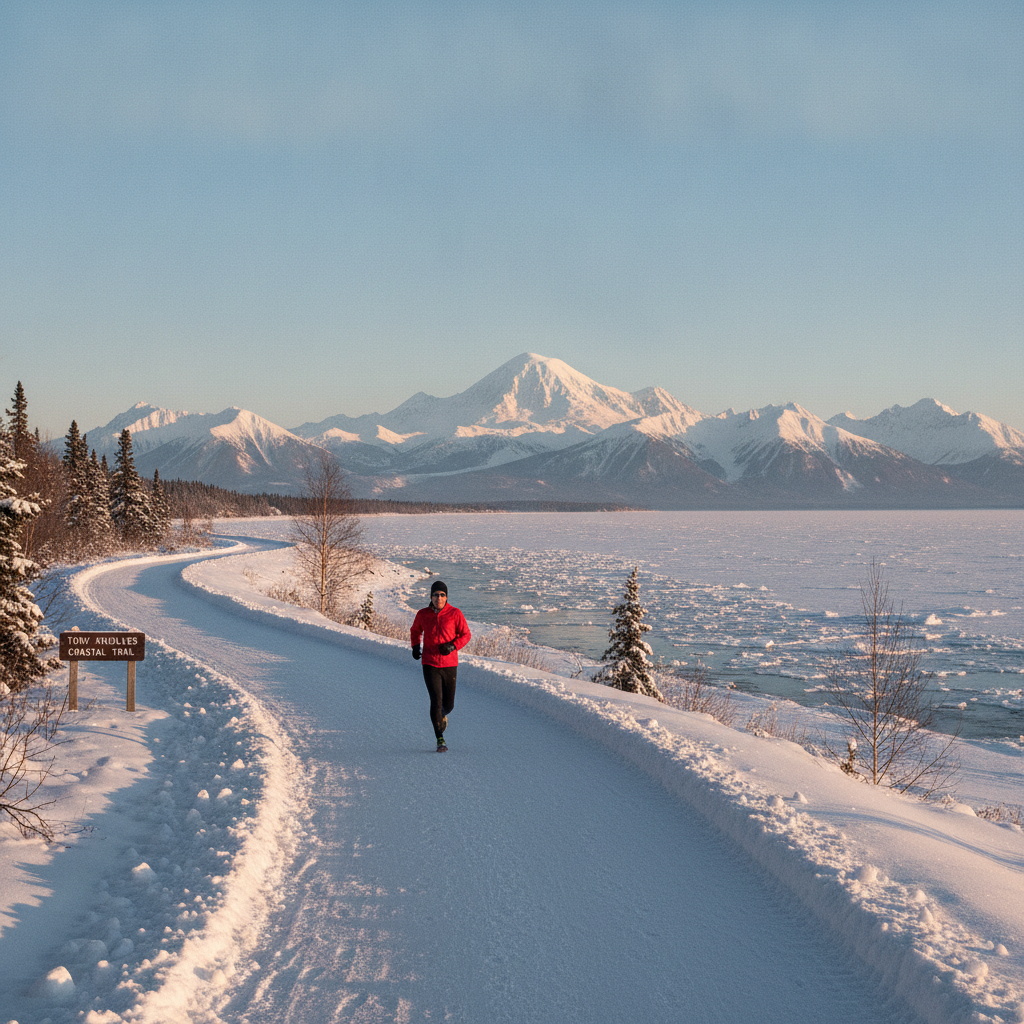
Kincaid Park (at the end of Raspberry Road, West Anchorage, 1,500 acres at the tip of the peninsula between Cook Inlet and Knik Arm): the most beloved park within Anchorage city limits, with 56 km of trails (the finest mountain biking and trail running in the city), the Kincaid Chalet (the warming cabin for the extensive cross-country ski network -- Kincaid hosted the biathlon events of the 1994 Arctic Winter Games and is the training ground for many of Alaska's elite Nordic skiers), the Kincaid Park disc golf course, and the most dramatic urban views of Denali in Anchorage -- on clear days the entire Alaska Range is visible from the Kincaid ridge trails, with Denali's 6,190-m summit rising above the horizon 240 km north. The Tony Knowles Coastal Trail (the 17-km paved trail along the Cook Inlet coastline from the Port of Anchorage area to Kincaid Park): the most used recreational trail in Alaska, with views across Cook Inlet to the Alaska Range, and the place where Anchorage residents walk, run, and cycle with moose on the trail at close range in all seasons. The Earthquake Park (at the western end of Northern Lights Boulevard): the park marking the site where the 1964 earthquake liquefied the Turnagain Heights neighborhood, with interpretive signs describing the 4.5-minute shake and the catastrophic ground failure. The Chester Creek Trail (the 11-km trail running from the Chester Creek Greenbelt at Tudor Road through mid-Anchorage to Westchester Lagoon and then to the Coastal Trail): the connector trail linking the Anchorage trail network interior to the coastal system. The Flattop Mountain trailhead (the most-climbed mountain in Alaska, 15 km from downtown, 5.4 km round-trip, views of Cook Inlet Denali and the Anchorage Bowl, accessible by the Hillside trail network from the upper O'Malley Road trailhead).
- 2
Southeast Alaska Day Trips - Juneau, Sitka, and the Inside Passage
Alaska cruise and ferry system: Anchorage is the primary air gateway for Alaska cruises (the majority of Alaska cruise passengers fly into Anchorage and transfer to Seward or Whittier for the Gulf of Alaska cruise embarkation), and the Alaska Marine Highway System (the state-operated ferry network connecting 35 coastal communities from Bellingham, Washington to Unalaska, AK via the Inside Passage): the most scenic public ferry route in North America. The Inside Passage (the sheltered waterway of the Alexander Archipelago, running 1,600 km from Puget Sound to the Gulf of Alaska, protected from Pacific Ocean swells by the barrier islands of the Alaska Panhandle): the route traveled by cruise ships (approximately 1.3 million cruise passengers pass through Alaska annually, making Alaska the 3rd-most-visited cruise destination in the world after the Caribbean and Mediterranean), the Alaska Marine Highway ferry, and private vessels. Juneau (the Alaska state capital, accessible only by sea or air -- no road connection to the North American highway system, 1,400 km southeast of Anchorage by air): the only US state capital with no road connection to the rest of its state, home to the Mendenhall Glacier (13 km from downtown Juneau, retreating 30-40 m per year, accessible by road -- the most-visited glacier in the US), the Mount Roberts Tramway, and the Alaska State Museum. Sitka (the former capital of Russian America, 700 km southeast of Anchorage by air, on Baranof Island): the site of the Alaska Purchase ceremony (October 18, 1867, at the Sitka National Historical Park, 106 Metlakatla Street, where the Russian flag was lowered and the American flag raised to formalize the transfer of Alaska), with the Sitka National Historical Park preserving Tlingit totem poles and the site of the 1804 Battle of Sitka (the last major conflict between Russian colonizers and Tlingit warriors).
- 3
Climate Change and the Melting of Alaska
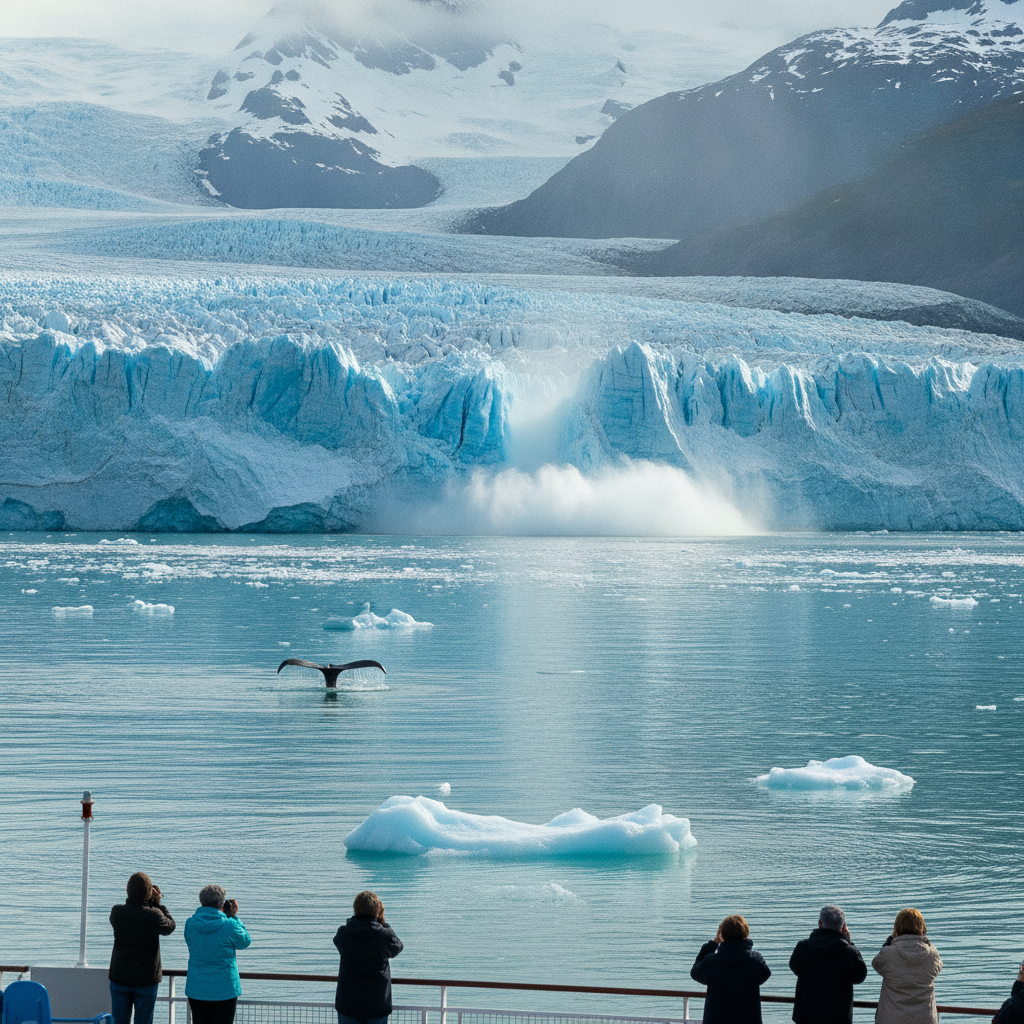
Climate change in Alaska: Alaska is warming at approximately twice the rate of the contiguous United States and three times the global average (the Arctic amplification effect -- the polar regions warm faster than the tropics due to the loss of reflective sea ice, the increased absorption of solar energy by dark ocean water, and feedbacks in the water vapor cycle). The consequences in Alaska: the permafrost (the permanently frozen ground covering approximately 80% of Alaska's land area, storing 300+ billion tonnes of organic carbon in the frozen soil -- more carbon than the entire human civilization has emitted since the Industrial Revolution) is thawing, causing the ground to subside, destabilizing buildings and roads (Fairbanks roads are buckling; Newtok, AK and Shishmaref, AK are relocating entire villages due to permafrost thaw and coastal erosion), releasing methane (the most potent short-term greenhouse gas, released as formerly frozen organic matter decomposes under warming temperatures). The glacier retreat: the glaciers of Alaska are losing ice at rates unprecedented in the human record -- the Columbia Glacier in Prince William Sound has retreated 25 km since 1980 (the most rapid retreat of any Alaskan glacier), and the Muir Glacier in Glacier Bay National Park has retreated 48 km since John Muir described it in 1890. The salmon crisis: the warming of Alaska rivers (17 of 19 major Alaska river systems have recorded record high water temperatures since 2019) has caused mass salmon die-offs (in 2019, the Kuskokwim River saw 20,000-50,000 dead or dying salmon from heat stress -- temperatures above 21C are lethal for Pacific salmon). The Alaskan spruce bark beetle (Dendroctonus rufipennis) has killed approximately 4 million acres of Alaskan spruce forest since the 1990s due to warmer temperatures accelerating the beetle life cycle from 2 years to 1 year.
- 4
Anchorage Arts, Music, and the Performing Arts Scene
Anchorage performing arts: the performing arts scene of Alaska's largest city punches above its weight for a metro of 400,000, with a professional symphony orchestra, opera company, ballet, and multiple theater companies. The Anchorage Symphony Orchestra (established 1946, performing at the Atwood Concert Hall in the Alaska Center for the Performing Arts, 2,100 seats, 621 West 6th Avenue): the oldest performing arts organization in Alaska, with a 40-week season including classical subscription concerts and the popular Symphony in the Park summer outdoor concerts at Town Square Park. The Anchorage Opera (at the Atwood Concert Hall): the only professional opera company in Alaska, presenting 2-3 fully staged operas per season with imported principal singers and a locally assembled chorus and orchestra. The Alaska Center for the Performing Arts (at 621 West 6th Avenue, the complex of three performance spaces including the Atwood Concert Hall, the Discovery Theatre, and the Evangeline Atwood Concert Hall, completed 1988, total capacity 4,200 seats in three venues): the most significant performing arts infrastructure in Alaska. The Out North Contemporary Art House (at 3800 DeBarr Road, Anchorage, founded 1985): the alternative performance space presenting experimental theater, dance, and visual art that has been the primary platform for LGBTQ+ arts in Alaska. The Anchorage Museum presents temporary exhibitions of contemporary Alaska art. The Bear Tooth Theatrepub (at 1230 West 27th Avenue, Anchorage, the 450-seat independent cinema and brewpub): the most popular entertainment venue in Anchorage, combining independent and international film screenings with locally brewed beer and food -- a quintessentially Anchorage experience of film and craft beer in a converted warehouse.
- 5
Alaska in Winter - Northern Lights, Dog Mushing, and the Dark Season
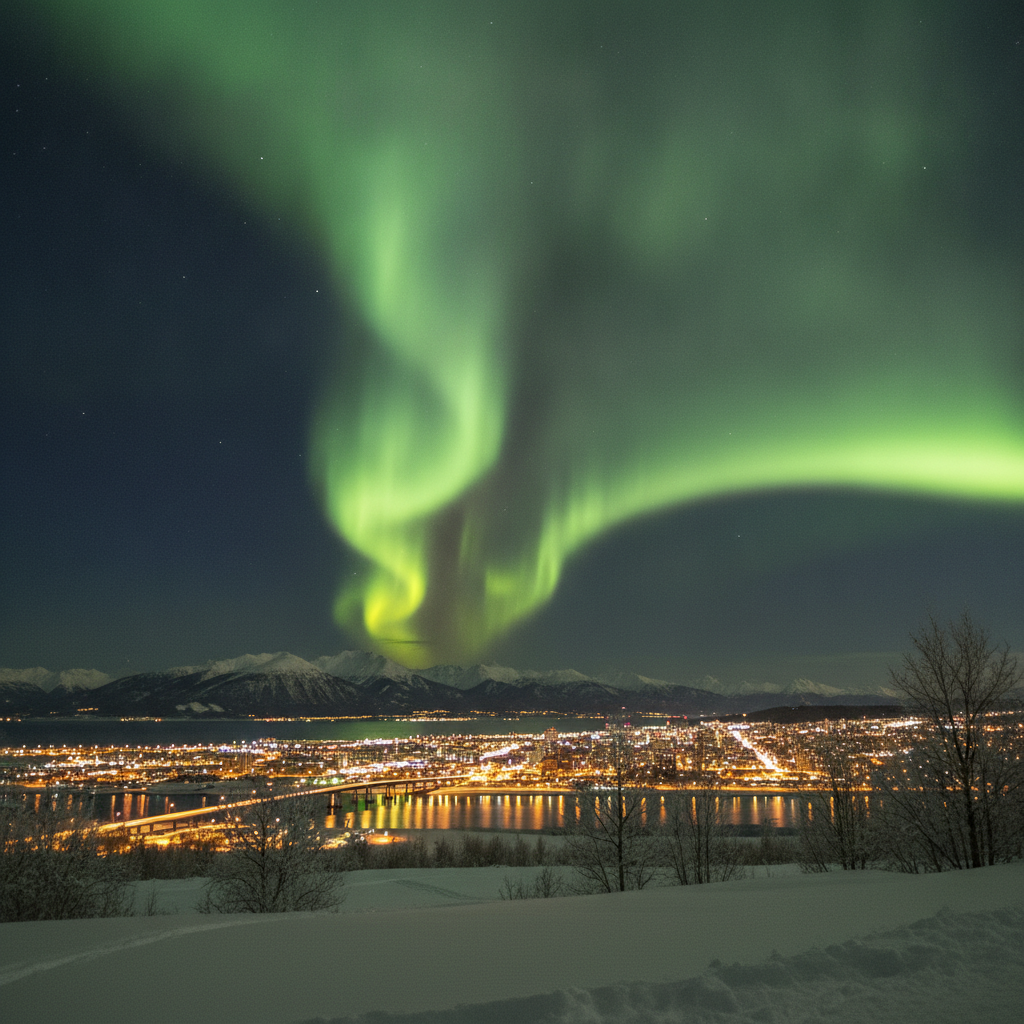
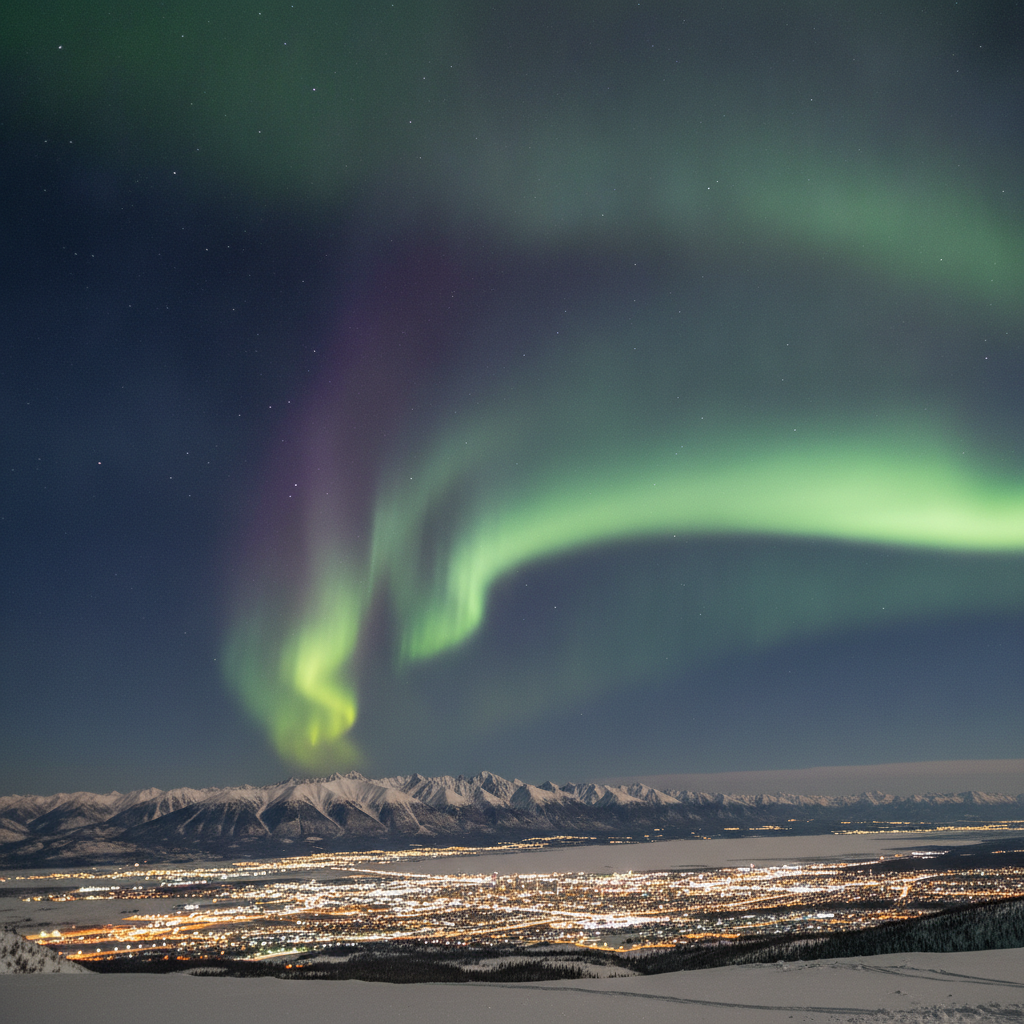
Winter in Anchorage: the Alaska winter (November through March) is darker, colder, and more beautiful than most lower-48 Americans expect, and has become a major attraction for visitors seeking the Northern Lights, dog mushing experiences, and the quiet drama of the subarctic winter landscape. The winter daylight: Anchorage has 5 hours 28 minutes of daylight on the winter solstice (December 21), but this is considerably more than Fairbanks (3 hours 42 minutes), and the winter solstice is celebrated in Anchorage with the Solstice Festival (the ski at night event at Kincaid Park, with illuminated trails and the city's commitment to remaining a winter-outdoor-activity city regardless of conditions). The aurora viewing: the winter (September through March) is the primary aurora season, with the aurora borealis visible approximately 3-4 nights per week from the Anchorage Hillside when skies are clear. The Kp index (the geomagnetic activity index, measured on a 0-9 scale): a Kp of 3 or higher produces visible aurora in Anchorage; Kp 5 or higher produces spectacular multi-color displays visible even in areas with some light pollution. Dog mushing tours (available from multiple operators in the Palmer and Willow areas, 75-100 km north of Anchorage): the 1-3 hour mushing tours allowing visitors to drive a team of Alaskan Huskies on a trail through the boreal forest. The Iditarod ceremonial start (first Saturday of March, downtown Anchorage): one of the most festive public events in Anchorage, with 50,000+ spectators lining 4th Avenue as the 50-70 dog teams make their way through the downtown course before the restart in Willow. Winter skiing: Alyeska Resort (at 1000 Arlberg Avenue, Girdwood, AK, 60 km south of Anchorage on the Seward Highway, the premier ski resort in Alaska, 1,615 m vertical drop -- the largest vertical in North America accessible by a single gondola): the 15-minute gondola ride from sea level to the summit, with 76 runs and an average annual snowfall of 635 cm.
- 6
The Alaska Range and Day Hikes Near Anchorage
Day hikes and trail running from Anchorage: the combination of Chugach State Park (immediately adjacent to the city), the Hillside trail network (the 190 km of trails in the foothills directly above south Anchorage), and the Seward Highway recreation areas makes Anchorage one of the finest trail cities in North America for wilderness access within a metropolitan area. The Eagle River Nature Center (at 32750 Eagle River Road, Eagle River, 30 km northeast of downtown Anchorage, at the head of the Eagle River valley in Chugach State Park): the most popular trailhead for multi-day backcountry hiking near Anchorage, with the Crow Pass Trail (26 km, crossing the 1,400-m Crow Pass through the Chugach Mountains to Girdwood on the other side) as the signature route. The Crow Pass Crossing: the annual Crow Pass Crossing race (held in July): a 26-km mountain race over Crow Pass with 900 m of elevation gain, a waist-deep river crossing of Eagle River, and the most demanding single-day mountain running course within a day's drive of Anchorage. Flat Top Mountain (the 1,077-m summit overlooking the Anchorage Bowl, 5.4 km round-trip from the Glen Alps trailhead at 2000 Upper Huffman Road, 20 minutes from downtown): the most-climbed mountain in Alaska with 60,000+ ascents per year. The Hatcher Pass (at the northern end of the Matanuska-Susitna Valley, 120 km north of Anchorage via the Parks Highway and Hatcher Pass Road, 1,370 m at the summit of the pass): the alpine tundra recreation area with the Independence Mine State Historical Park (the gold mine complex of 1937-1951, now a National Historic Landmark), wildflower meadows in July-August, and blueberry picking in September. The Bird-to-Gird Trail (the 15-km paved trail from the Bird Creek trailhead on the Seward Highway to the town of Girdwood): the flat, paved trail along Turnagain Arm with the most dramatic fjord scenery of any paved trail accessible from Anchorage.
Walk this route with audio
Stories play automatically as you reach each stop — no tapping needed.
More in anchorage
Anchorage: Denali, Chugach Mountains, Alaska Railroad, Iditarod, Kenai Fjords, the 1964 Earthquake, and Practical Info
Anchorage: Native Culture, Wilderness City and the World Cargo Hub
Anchorage: Alaska History and Statehood, Seward Highway, Neighborhoods, Glacier Trekking, Economy, and Kenai Salmon Fishing
Anchorage: Alaska Native Heritage, Anchorage Museum, Matanuska Valley, Wildlife, Alaska Highway, and the Aurora Borealis
Anchorage: Fjord Glaciers, Urban Moose and the Earthquake That Changed Building Codes