Antananarivo: Tsingy de Bemaraha, Avenue of the Baobabs, Isalo National Park, French Colonial History, and Malagasy Music
Madagascar nature and culture: the Tsingy de Bemaraha limestone pinnacle UNESCO site, the Avenue of the Baobabs at Morondava, the Isalo sandstone canyon and natural swimming holes, the French colonial legacy and 1947 uprising, and Malagasy music (valiha, salegy) and famadihana funerary tradition.
- 1
The Tsingy de Bemaraha - The Stone Forest UNESCO World Heritage Site
The Tsingy de Bemaraha (UNESCO World Heritage Site): the most dramatic landscape in Madagascar, located in the Melaky Region of western Madagascar (approximately 600 km northwest of Antananarivo, accessible by a challenging road or by charter flight to Antsalova). The Tsingy (the word means the place where one cannot walk barefoot in Malagasy): the extraordinary karst limestone pinnacle landscape, where centuries of erosion have created a razor-sharp forest of vertical limestone needles (some up to 30 meters high). The Grand Tsingy (the more spectacular and remote section) and the Petit Tsingy (the more accessible section) are connected by a circuit of via ferrata ropes and bridges allowing visitors to walk above and through the limestone needles. The Tsingy habitat: the lemurs (Decken sifaka and the sportive lemur) and birds adapted to the vertical limestone environment live within the tsingy needles. The sunset from the top of the Tsingy: one of the most dramatic panoramic views in Madagascar.
- 2
The Avenue of the Baobabs - The Most Iconic Madagascar Landscape
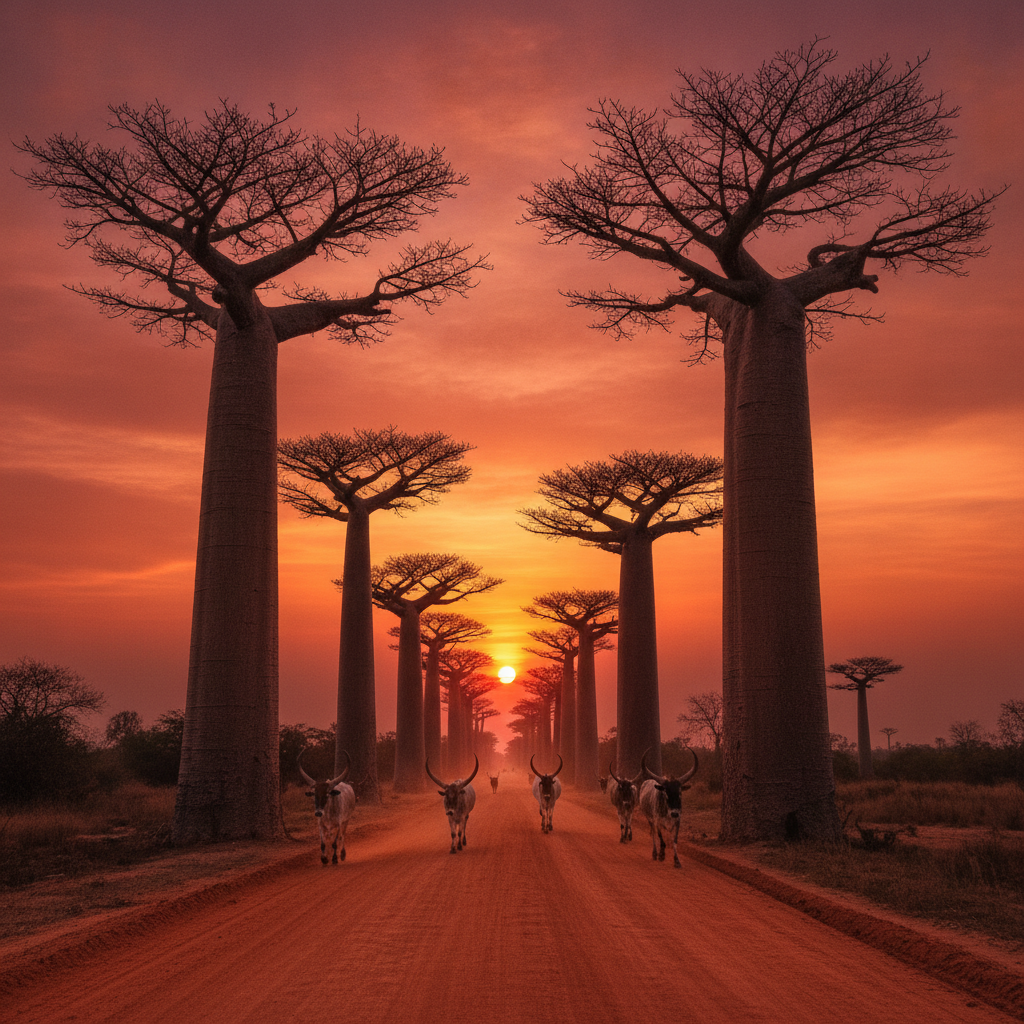
The Avenue of the Baobabs (the Allee des Baobabs): the most photographed landscape in Madagascar, located near the town of Morondava on the western coast (approximately 600 km west of Antananarivo, accessible by road (the most scenic but challenging route) or by charter flight to Morondava airport). Approximately 25 massive baobab trees (Adansonia grandidieri: the giant baobab, endemic to Madagascar) line a dirt track, their enormous grey trunks (up to 30 meters circumference) and minimal foliage creating a primeval avenue at dawn and sunset. The baobabs are ancient: the largest specimens are estimated to be 800-2,000 years old. The baobab is called the upside-down tree (the sparse crown looks like roots). The Madagascar baobab species: Madagascar has 6 of the world 8 baobab species (the other 2 are in Africa and Australia). The Adansonia grandidieri (the giant Madagascar baobab) is the most iconic and the species of the Morondava avenue.
- 3
The Isalo National Park - The Sandstone Canyon and the Swimming Holes
The Isalo National Park (approximately 700 km south of Antananarivo in the Ihorombe Region): the most accessible major national park along the southern Route Nationale 7. The Isalo landscape: a massif of deeply eroded Jurassic sandstone formations, creating a landscape of canyons, natural swimming pools, and rock arch formations. The natural swimming holes (the Piscine Naturelle): the turquoise rock pools hidden within the canyon gorges, fed by permanent springs and surrounded by lush riparian vegetation in contrast to the dry surrounding plateau. The Isalo orchids (the endemic Cynorkis orchids that grow in the rock crevices of the sandstone). The Ringtail lemur (Lemur catta): the most reliably seen lemur in Isalo, where habituated groups have lost their fear of visitors. The sifaka lemur (the Verreaux sifaka: the large white lemur that moves on the ground by sideways hopping with its arms spread): regularly seen in Isalo.
- 4
The French Colonial Legacy and the Malagasy Independence
The French colonization of Madagascar (1896-1960). The Merina Kingdom had maintained independence under Queen Ranavalona I (who expelled all foreigners and missionaries in 1835) and attempted to modernize under Radama II and subsequent rulers through British and French influence. France declared a protectorate over Madagascar in 1885 and fully colonized the island in 1896, abolishing the Merina monarchy and exiling the last queen, Ranavalona III, to Algiers. The Madagascar colonial capital: the French built a colonial administration in Antananarivo, and the colonial architecture (the Palais de la Reine reconstruction, the French public buildings) still defines parts of central Tana. The 1947 Malagasy Uprising: the armed uprising against French rule in which an estimated 11,000-90,000 Malagasy were killed in the French suppression (the number remains disputed; France has not fully acknowledged the scale of the repression). Independence: 26 June 1960. The Malagasy constitution designates both Malagasy and French as official languages.
- 5
The Malagasy Music and Cultural Traditions
Malagasy music: a unique hybrid of Austronesian and African musical traditions. The valiha: the national instrument of Madagascar, a bamboo tube zither (the strings are cut from the outer layer of the bamboo tube and stretched longitudinally), producing a distinctive bright melodic sound. The accordion and the kabary (the traditional Malagasy oratory art): the kabary is a highly formalized public speech form used at ceremonies and celebrations, with complex rhetorical conventions. The salegy music (the popular music of northwestern Madagascar): the most internationally recognized Malagasy popular music style, featuring the characteristic off-beat rhythm and the traditional melodic scales of the Sakalava people. The hiragasy (the traditional variety performance of the Merina highlands): a group performance combining music, song, and moralistic stories. The famadihana (the turning of the bones): the Merina funerary tradition of periodically exhuming the bones of ancestors, rewrapping them in fresh silk shrouds, and dancing with them before reinterment: one of the most unusual funeral traditions in the world.
- 6
Antananarivo Two Routes Complete and Madagascar Overview
Antananarivo two routes complete. Route 1: Madagascar (fourth largest island, 90% endemic wildlife), the Rova Merina royal palace, lemurs (most threatened mammal order, 105+ species), the Malagasy Austronesian-African culture, Ranomafana rainforest, practical guide. Route 2 (this route): Tsingy de Bemaraha UNESCO (razor-sharp limestone pinnacles), the Avenue of the Baobabs near Morondava, Isalo National Park sandstone canyons, the French colonial history and the 1947 uprising, Malagasy music (valiha, salegy) and famadihana funerary tradition. Routes 3-6 still needed. Madagascar overview: population approximately 30 million, GDP per capita approximately USD 500 (one of the poorest countries in the world despite extraordinary natural wealth), the deforestation crisis (approximately 90% of the original forest has been cleared for slash-and-burn agriculture: the primary driver of lemur extinction). The Madagascar paradox: the most biologically unique country on earth is simultaneously one of the poorest and most environmentally degraded. The conservation challenge: protecting the remaining 10% of the original forest while addressing the poverty that drives deforestation.
Walk this route with audio
Stories play automatically as you reach each stop — no tapping needed.
More in antananarivo
Antananarivo: Madagascar Chameleons, the Fossa Predator, Route Nationale 7, Malagasy Food Markets, and Humpback Whales
Antananarivo: The Aye-Aye, Andasibe Indri Call, Queen Ranavalona, the Malagasy Language Origins, and the Fady Taboo System
Antananarivo: Nosy Be Beach Resort, Madagascar Rainforest Crisis, Spiny Forest, Vanilla Industry, and the Poverty Paradox
Antananarivo: The Red Island, the Rova Royal Palace, Lemurs, Malagasy Culture, Ranomafana Rainforest, and Practical Guide