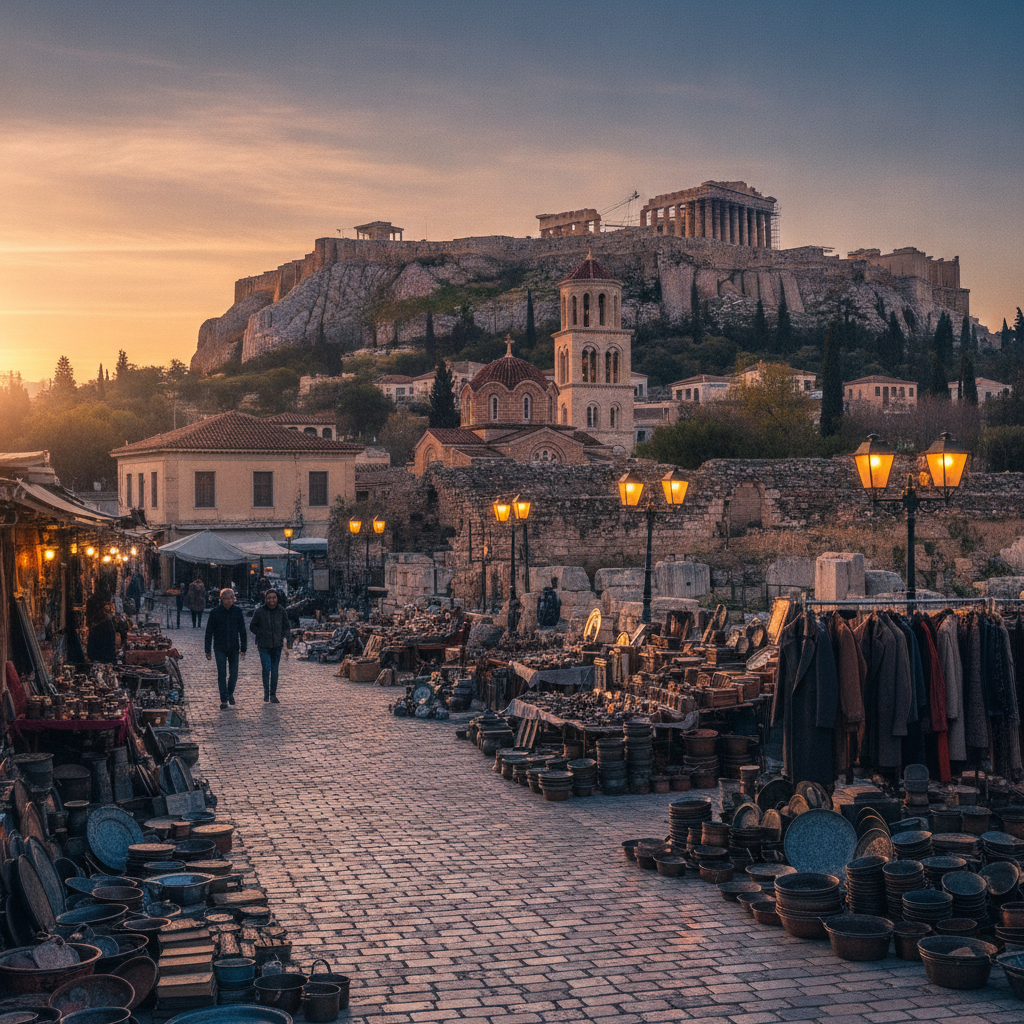
Plaka, Monastiraki & Psyrri: Athens Beneath the Acropolis
Plaka — the 'neighborhood of the gods', draped across the north and east slopes of the Acropolis — is the oldest continuously inhabited urban neighborhood in Europe: its street plan preserves the routes of ancient Athens beneath layers of Byzantine, Ottoman, and 19th-century neoclassical building. Adjacent Monastiraki and its famous flea market, and the post-industrial creative neighborhood of Psyrri, together form the liveliest and most historically layered few square kilometers in Greece.
- 1
Plaka Neighborhood & Anafiotika
Plaka (the word may derive from Albanian plaka, 'old woman', or from a neighborhood family name) is the best-preserved pre-modern neighborhood in Athens, occupying the slopes beneath the Acropolis north face. The narrow streets — Adrianou, Kydathinaion, Mnisikleous — still follow the layout of ancient Athens' residential district. The Anafiotika quarter, wedged against the Acropolis rock above the main Plaka streets, was built from the 1840s onward by workers from the Cycladic island of Anafi who came to construct the new Greek capital; their 40 small whitewashed houses — Cycladic in style, with bougainvillea and cats — create an improbable miniature island village on the Athens hillside. The Tower of the Winds (Horologion of Andronikos Kyrrhestes, c. 50 BC) — an octagonal Pentelic marble tower that served as the world's first known weather station and water clock, housing a hydraulic clock mechanism fed by a stream from the Acropolis — stands in the Roman Agora just north of Plaka.
- 2
Roman Agora & Tower of the Winds
The Roman Agora of Athens (1st century BC – 1st century AD), distinct from the earlier Ancient Greek Agora to the west, was built with a donation from Julius Caesar and completed under Augustus — the commercial center of Roman-era Athens. The Gate of Athena Archegetis (11 BC), with four Doric columns still standing, is the main entrance. Within the Roman Agora stands the Tower of the Winds (Horologion of Andronikos Kyrrhestes, c. 50 BC) — an extraordinary octagonal marble tower, 12 meters tall, with eight relief figures on its frieze representing the eight wind directions: Boreas (North), Kaikias (Northeast), Apeliotes (East), Euros (Southeast), Notos (South), Lips (Southwest), Zephyros (West), and Skiron (Northwest). The tower also contained a water clock (clepsydra) and a sundial. During the Turkish occupation it served as a tekke (dervish lodge) — the interior was used for religious dancing.
- 3
Monastiraki Square & Tzistarakis Mosque
Monastiraki Square — the convergence of the metro, the flea market, the Roman Agora, and several major Athens streets — is one of the busiest and most historically layered urban spaces in Greece. The Tzistarakis Mosque (1759), built by the Ottoman voivode Tzistarakis in the center of the square, is now the Kyriazópoulos Collection of Greek Folk Ceramics (a branch of the Museum of Greek Folk Art). The building of the mosque famously required the demolition of one of the columns of the Temple of Olympian Zeus for lime — an act so scandalous that Tzistarakis was recalled to Constantinople and his position stripped. The Monastiraki metro station, opened 2000, excavated through 16 centuries of urban stratigraphy and displays the found archaeological layers through glass walls on the platform.
- 4
Monastiraki Flea Market (Avissinias Square)
The Monastiraki Flea Market — centered on Plateia Avissinias (Abyssinia Square) and spilling into the surrounding streets of Ifestou, Adrianou, and Pandrossou — is the largest antiques and secondhand market in Greece. Its permanent shops trade in furniture, silverware, icons, military antiques, copper goods, vinyl records, coins, and Byzantine-era objects of uncertain provenance; the street stalls outside deal in everything from counterfeit goods to genuine archaeological fragments sold under the counter. The market is busiest on Sundays (from 7am), when it extends across the entire quarter. The smells — coffee from the tavernas, cedar dust from old furniture, diesel from delivery trucks — are as recognizable as any sensory experience in Athens. Pandrossou street, the old market street of the Turkish bazaar (part of which is preserved), contains a concentration of shops selling tourist goods alongside genuine Byzantine and Ottoman antiques.
- 5
Psyrri & Central Athens Street Art
Psyrri (the name derives from 'psiroi', itinerant craftsmen who sold their work by the street in the 19th century) was Athens' oldest working-class artisan neighborhood — metalworkers, shoemakers, hat-makers — that underwent rapid gentrification from the 1990s as its cheap warehouse spaces attracted galleries, bars, and restaurants. The neighborhood's warehouses, now mostly converted to restaurant and nightlife use, contain some of the most dense and technically accomplished street art in Europe — a concentration of large-scale murals by Greek and international artists (Blaqk, Alexandros Vasmoulakis, Seth Globepainter) that has turned the grid of streets between Ermou and Kerameikou into an informal outdoor gallery. Plateia Iroon ('Heroes' Square'), the central square of Psyrri, is the neighborhood's social center.
- 6
Ermou Street & Kapnikarea Church
Ermou (Hermes) Street — the main pedestrianized shopping street of central Athens, running from Syntagma Square to Monastiraki — is the busiest retail street in Greece, lined with international chain stores, shoe shops, and the occasional surviving neoclassical building. Embedded in the middle of Ermou Street at its eastern end, the Byzantine Kapnikarea Church (11th century AD, restored 19th century) sits marooned on a traffic island — one of the oldest surviving Byzantine churches in Athens, built on the foundations of an ancient temple. The church's central dome, decorated with Byzantine mosaics added in 1950 by the painter Fotis Kontoglou, makes it one of the most visited Byzantine monuments in the city despite being surrounded by chain stores on all sides. The name 'Kapnikarea' may derive from kapnikon, a Byzantine tax levied on houses (kapnos: smoke).
Walk this route with audio
Stories play automatically as you reach each stop — no tapping needed.
More in athens
Keramikos, Gazi & Thisseio: Ancient Cemeteries, Creative Districts & Democratic Hills
Piraeus, Mikrolimano & the Saronic Riviera: Athens' Ancient Port and Yacht Harbor
Panathenaic Stadium, Zappeion & National Garden: Olympic Legacy and Royal Athens
Cape Sounion & the Attica Coast: Poseidon's Temple Above the Aegean
National Archaeological Museum & Exarcheia: Greece's Greatest Treasures