Syntagma, Parliament & Kolonaki: Athens' Neoclassical Heart
The area stretching from Syntagma (Constitution) Square northeast to the slopes of Lycabettus Hill encompasses the political, diplomatic, and social elite of Athens — the Hellenic Parliament in the former Royal Palace (1843), the embassies along Vasilissis Sofias Avenue, the upscale Kolonaki neighborhood, and several of Athens' finest museums including the Benaki Museum, the Cycladic Art Museum, and the War Museum.
- 1
Syntagma Square (Πλατεία Συντάγματος)
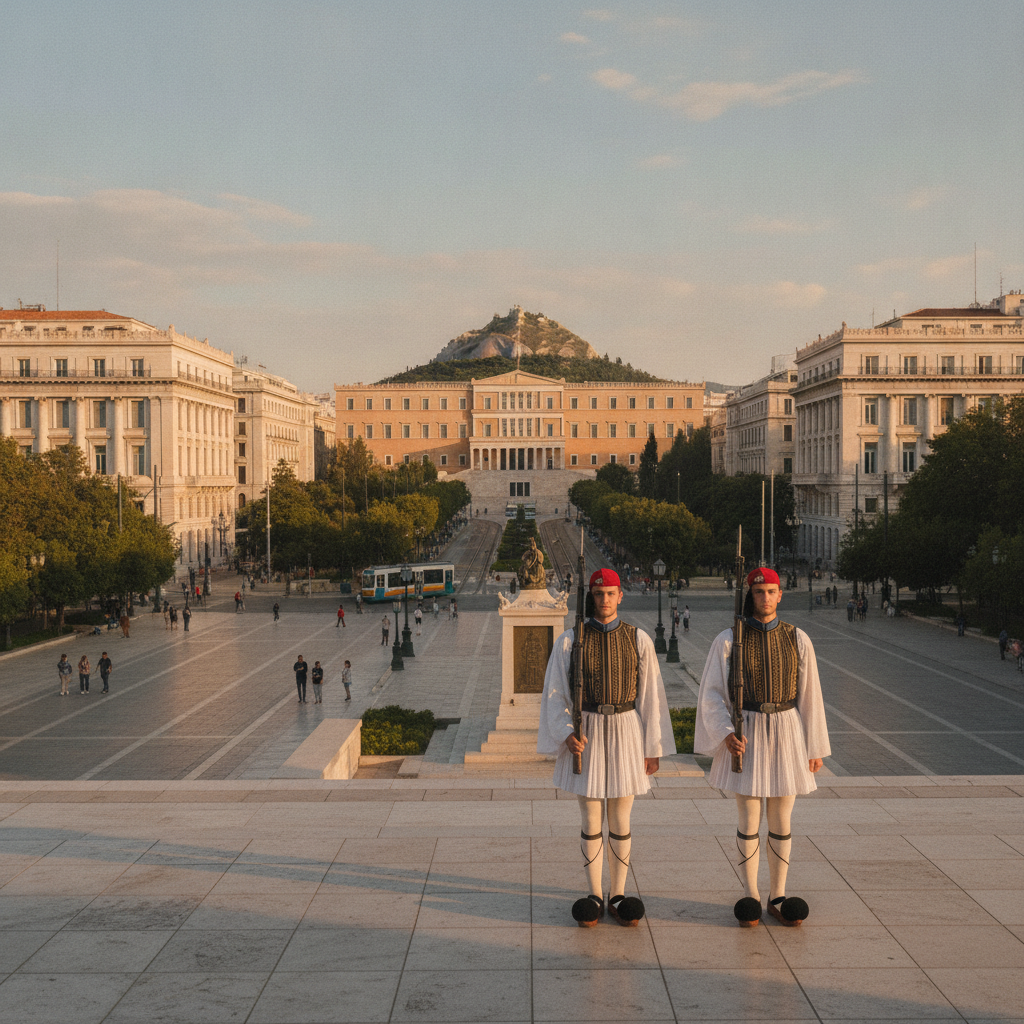
Syntagma (Constitution) Square is the central public space of modern Athens and the focal point of Greek political life — the constitution was granted here by King Otto on September 3, 1843, under popular pressure following a military uprising, and every major political demonstration in the 20th and 21st centuries (student protests against the 1967-1974 junta, the anti-austerity protests of 2010-2012) has taken place here. The square is dominated on its east side by the neoclassical facade of the Hellenic Parliament building (the former Royal Palace, built 1836-1843 for the Bavarian King Otto by Friedrich von Gärtner); on the north by the Grande Bretagne Hotel (1874, the most historic hotel in Greece, temporary headquarters of allied commanders in both World Wars); and on the south by the Athens metro station Syntagma (1904 surface railway, 2000 underground metro), whose glass atrium displays an exposed archaeological excavation from the construction, showing stratigraphy from the 5th century BC through the Byzantine period. The square's underground metro concourse also contains the largest display of archaeological finds from the Athens metro excavations.
- 2
Tomb of the Unknown Soldier & Evzone Guard
The Tomb of the Unknown Soldier (Μνημείο του Αγνώστου Στρατιώτη) — built in 1932 at the base of the Hellenic Parliament's main facade, designed by sculptor Emmanouil Lazaridis — is guarded around the clock by the Presidential Guard (Προεδρική Φρουρά), a ceremonial military unit colloquially known as Evzones (a 19th-century elite infantry formation). The evzone uniform — the white foustanella (pleated kilt of 400 pleats, one for each year of Ottoman occupation), white tights, red beret (tsarouhi), and wooden-soled shoes (tsarouchi) with large black pom-poms — is the national costume of Greece, derived from the traditional dress of the mountain fighters of the Greek War of Independence (1821-1829). The ceremonial change of the guard takes place on Sundays at 11:00 AM, accompanied by a marching band; daily (without band) at the top of each hour. The tomb relief depicts a dying warrior in the style of an ancient Greek grave stele.
- 3
Vasilissis Sofias Avenue & Embassy Row
Vasilissis Sofias (Queen Sophia) Avenue — the grand Haussmanian boulevard running northeast from Syntagma through Kolonaki to Ampelokipi — was designed as part of the neoclassical masterplan for Athens developed after independence (1834) by architects Stamatios Kleanthis and Eduard Schaubert under commission from the Bavarian regency. The avenue is lined on both sides with the finest 19th-20th century neoclassical mansions in Athens — many now serving as national embassies (US Embassy at 91 Vasilissis Sofias, British Embassy at 1 Ploutarchou, French Embassy at 7 Vasilissis Konstantinou) — interspersed with the principal cultural institutions of the Greek state. The avenue between Syntagma and Megaro Mousikis (Athens Concert Hall) constitutes the core of the 'Museum Mile' that makes Kolonaki one of the most culturally dense neighborhoods in Europe. The Evangelismos Hospital (1884) and the Byzantine & Christian Museum (1930, housed in the Duchess of Plaisance's neoclassical villa) are also on this avenue.
- 4
War Museum of Athens (Πολεμικό Μουσείο)
The War Museum of Athens — opened in 1975 at 2 Rizari Street, Kolonaki — occupies a purpose-built brutalist building housing one of the most comprehensive military history collections in the Mediterranean. The collection spans Greek military history from prehistoric times (Mycenaean bronze weapons) through antiquity (replica hoplite armor, triremes), the Byzantine period (chain mail, siege engines), the Ottoman period (janissary equipment), the Greek War of Independence (klephtic weapons, flags, portraits of the revolutionary heroes), the Balkan Wars (1912-1913), both World Wars (including significant material from the Battle of Crete 1941 and the Greek resistance), and the Civil War (1946-1949). The outdoor exhibition includes historic aircraft (Spitfire MkIX, F-84 Thunderjet, F-104 Starfighter), artillery pieces, tanks (Sherman M4), and a restored WWII-era destroyer. The museum's rooftop terrace offers a panoramic view of central Athens with the Acropolis in the background.
- 5
Kolonaki Square & Neighborhood
Kolonaki (from the Greek for 'small column' — a reference to an ancient column stump that marked the neighborhood boundary) is Athens' most prestigious residential and commercial neighborhood, occupying the lower slopes of Lycabettus Hill between Vasilissis Sofias Avenue and the summit. The neighborhood was developed in the late 19th and early 20th centuries as the residence of the Athenian upper bourgeoisie — diplomats, professors, politicians, and wealthy merchants — and retains its character as Athens' upscale shopping and café district. Tsakalof Street, Skoufa Street, and Kolonaki Square itself contain the highest concentration of designer boutiques (Greek and international), fine-dining restaurants, and artisan coffee shops in Athens. The neighborhood is also notable for its concentration of private art galleries and the presence of major cultural institutions: the Gennadius Library (American School of Classical Studies, founded 1926; the most important Byzantine and modern Greek library outside Greece), and the British School at Athens.
- 6
Benaki Museum (Μουσείο Μπενάκη)
The Benaki Museum — housed in the neoclassical mansion of the Benakis family (built 1867, extensively renovated 1929-1931 and 2000) at 1 Koumbari Street, Kolonaki — is the largest private museum in Greece, founded by Antonis Benakis (1873-1954), a cotton merchant and art collector born in Alexandria, Egypt. The collection of 120,000 objects spans from the Paleolithic to the 20th century and is unique in encompassing both ancient Greek art (Neolithic figurines, Mycenaean gold, Classical sculpture), Byzantine art (6th-15th century icons, jewelry, silk textiles, religious manuscripts), and post-Byzantine art through the Greek War of Independence and the Metaxas period. The Benaki's collection of historical Greek costumes (approximately 22,000 garments from all regions of Greece and the diaspora) is the finest in existence. The museum's rooftop café is one of the most pleasant in Athens, with a view over the National Garden to the Acropolis. The Benaki has several annexes: Islamic Art Museum (Kerameikos), Toy Museum, and the Benaki at Pireos Street (a converted industrial building for contemporary art and temporary exhibitions).
Walk this route with audio
Stories play automatically as you reach each stop — no tapping needed.
More in athens
Keramikos, Gazi & Thisseio: Ancient Cemeteries, Creative Districts & Democratic Hills
Piraeus, Mikrolimano & the Saronic Riviera: Athens' Ancient Port and Yacht Harbor
Plaka, Monastiraki & Psyrri: Athens Beneath the Acropolis
Panathenaic Stadium, Zappeion & National Garden: Olympic Legacy and Royal Athens
Cape Sounion & the Attica Coast: Poseidon's Temple Above the Aegean