Poblenou, 22@ & the Design Hub: Barcelona's Creative Frontier
Poblenou — the Barcelona district bounded by the Eixample grid to the west, the sea to the south, and the Forum area to the north — was, from the 1840s through the 1980s, the industrial heart of Catalonia: a dense concentration of textile mills, chemical plants, metalworks, and factories that earned it the nickname 'the Manchester of Catalonia'. Its rapid deindustrialization in the 1980s–1990s left a vast landscape of brick factory buildings, empty lots, and working-class housing. The 2000 urban plan 22@ (the zip code of the former industrial zone, pronounced 'twenty-two at') launched one of Europe's most ambitious urban reinvention projects: converting 200 hectares of obsolete industrial land into a technology and creative district while retaining 20% of the housing stock and the neighborhood's social character. This route explores the result: contemporary architecture, innovative cultural institutions, and the traces of the industrial past that the transformation has preserved.
1. Museu del Disseny de Barcelona — Design From Pre-History to 3D Printing
- 1
Museu del Disseny de Barcelona — Design From Pre-History to 3D Printing
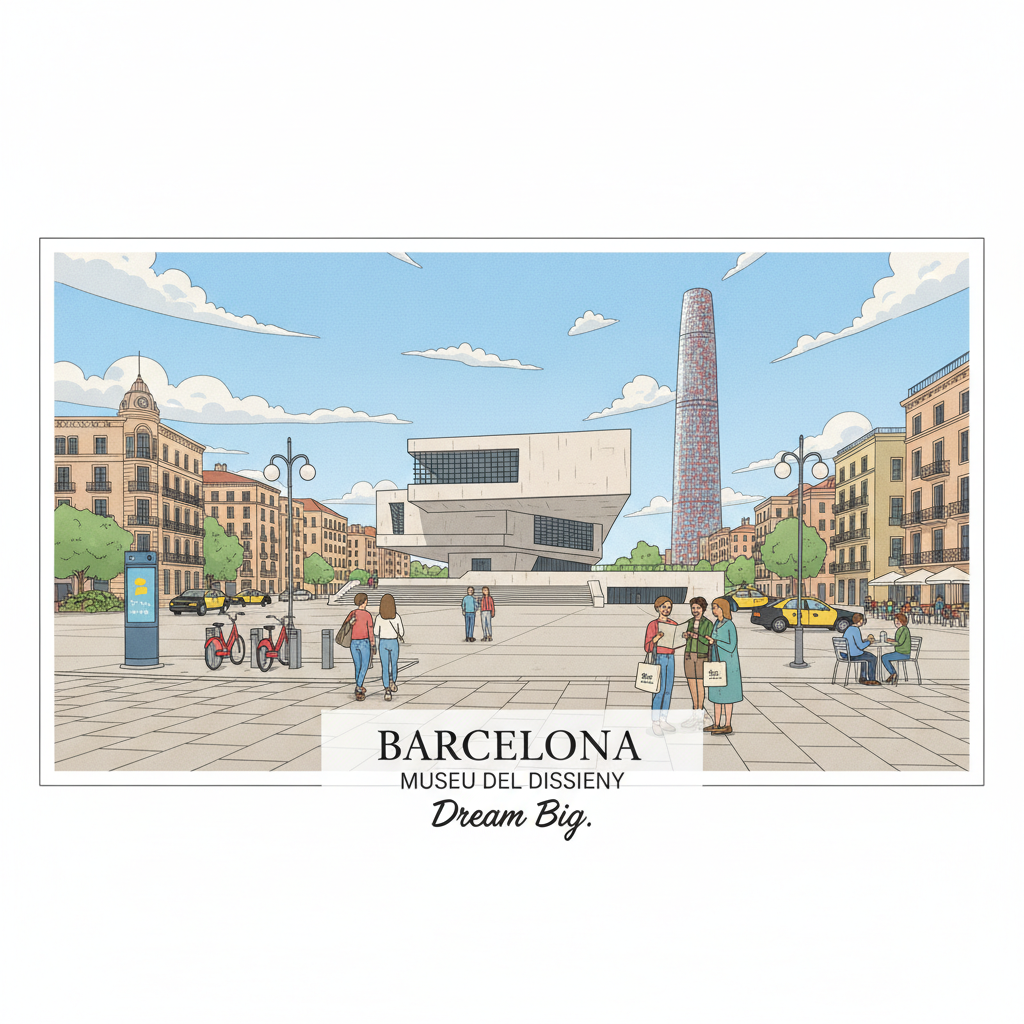
The Museu del Disseny de Barcelona (Design Museum of Barcelona), inaugurated in 2014 in a new building by MBM Arquitectes (Martorell, Bohigas, Mackay) at the Plaça de les Glòries Catalanes, consolidates four previously separate collections into a single comprehensive institution: the Museu Tèxtil i d'Indumentària (50,000 pieces of clothing and textiles, from a 4th-century Coptic Egyptian tunic to Paco Rabanne's chainmail dresses), the Museu de les Arts Decoratives (decorative arts and design from the Renaissance to the present), the Museu de Ceràmica (1,000 years of Catalan and Spanish ceramics, including Gaudí's mosaic materials), and the Gabinet de les Arts Gràfiques (graphic design, posters, and visual communication). The building itself, buried in a concrete platform above an underground bus station and parking structure, has been controversially nicknamed 'la Gratadora' (the grater) or 'la Enciclopèdia' (the encyclopedia) by Barcelona residents — but its collection, from 4th-century textiles to contemporary 3D-printed objects, is one of the most comprehensive design surveys in Europe.
- 2
Rambla del Poblenou — The Neighborhood's Own Rambla
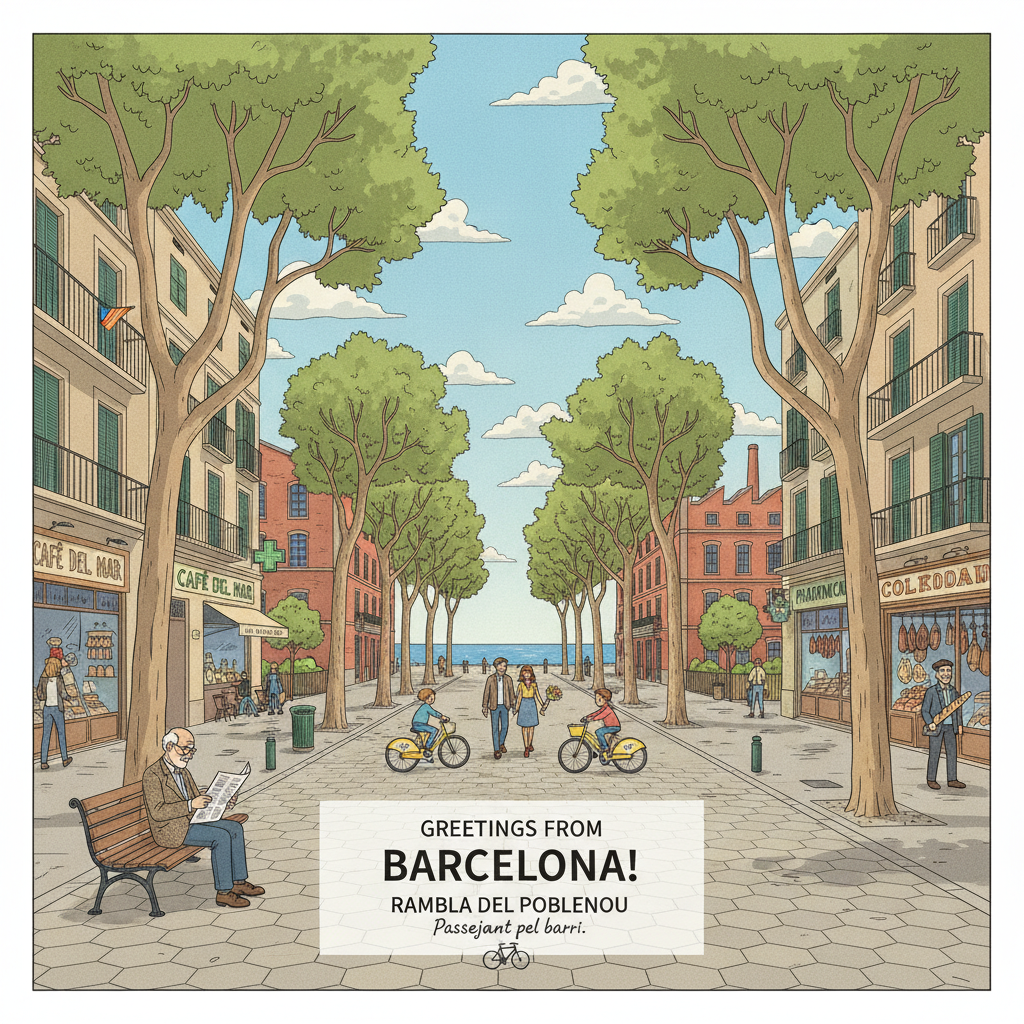
The Rambla del Poblenou, a tree-lined pedestrian boulevard running from the Carrer del Taulat to the sea, is the social spine of the old Poblenou neighborhood: a quieter, more working-class version of La Rambla, with local restaurants, bars, and shops serving the residents rather than tourists. Unlike La Rambla, which has largely been taken over by tourist commerce, the Rambla del Poblenou retains the character of a neighborhood promenade: bakeries, pharmacies, local cafes, older residents on benches, children on bicycles. The contrast is instructive — the same urban typology (tree-lined pedestrian boulevard) producing completely different social outcomes depending on tourist pressure. The nearby streets of old Poblenou — around Carrer del Pallars, Carrer de Sancho de Ávila — retain significant 19th-century industrial architecture: brick factory buildings now converted to studios, offices, and co-working spaces.
- 3
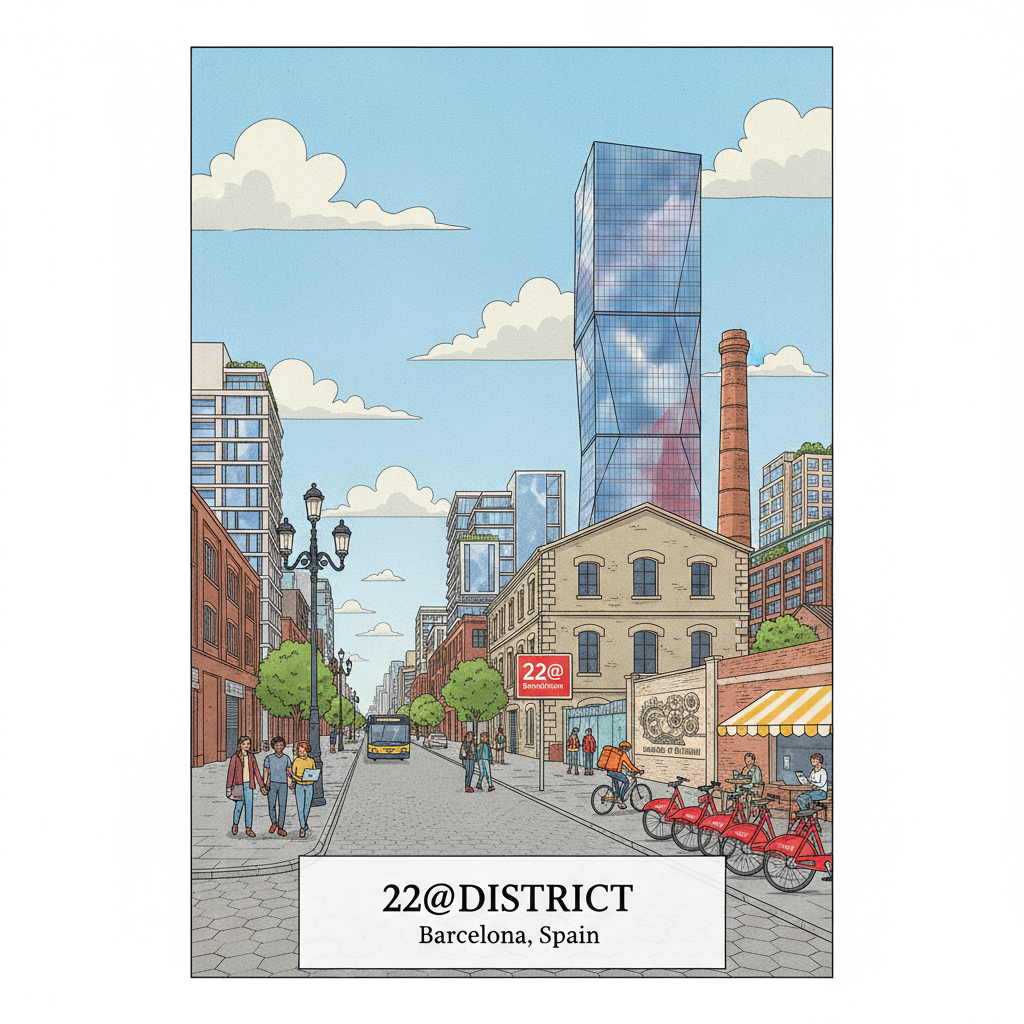
22@ District — Europe's Most Ambitious Urban Reinvention
The 22@ Innovation District, covering 115 city blocks (200 hectares) of former industrial land in Poblenou, was launched in 2000 with the aim of creating a 'city of knowledge' within the existing urban fabric of Barcelona. The plan allowed significantly higher building densities (floor area ratio 2.2 compared to the surrounding Eixample's 2.85, but with taller buildings allowed) and required that 20% of new residential space be affordable housing and 10% of the land be reserved for green space and community facilities. The result, 25 years later, is a genuine mixed-use district: major corporate campuses (Amazon, Twitter/X, Glovo, Spotify), design schools, co-working spaces, restaurants and cafes serving a daytime population of 100,000 workers, and old factory buildings converted to creative studios. The social tension between the original working-class neighborhood and the new knowledge economy is visible: old residents' associations have organized against gentrification; the balance between innovation and displacement remains contested.
- 4
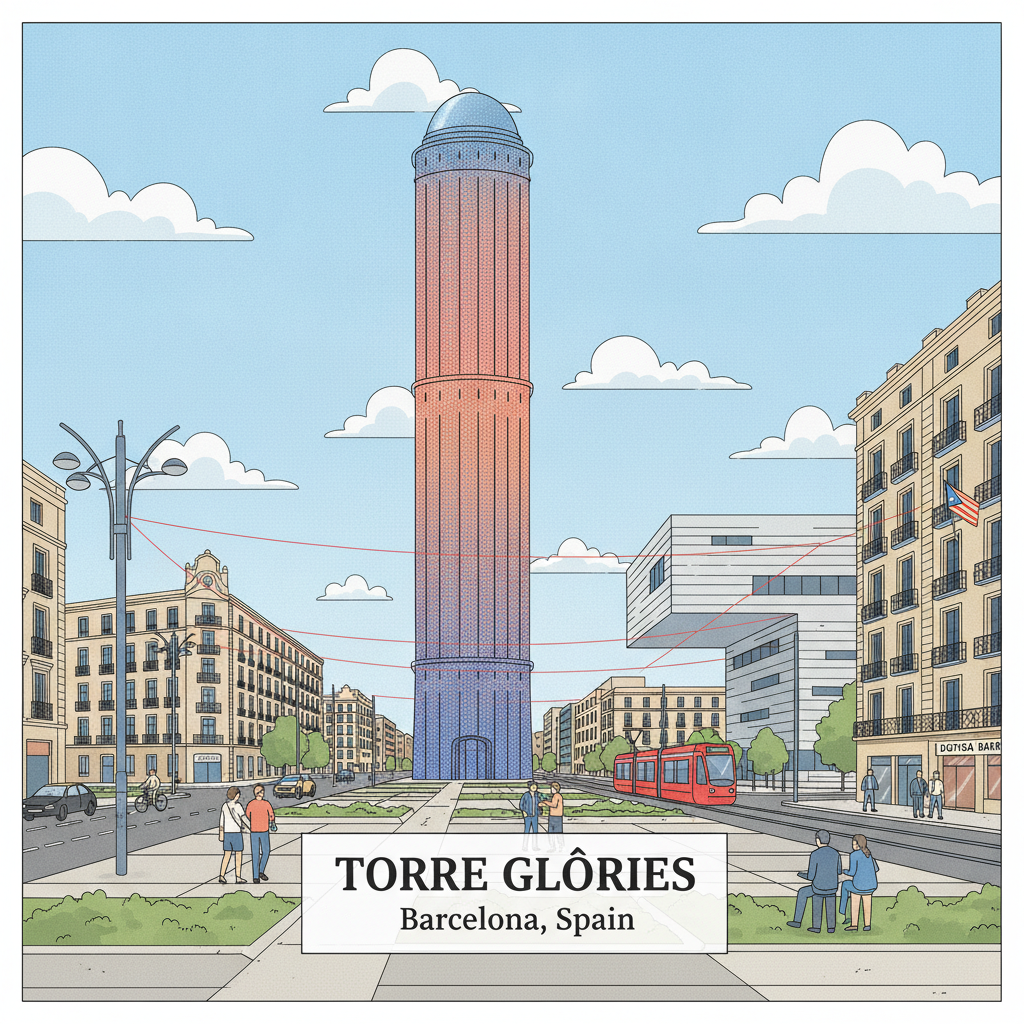
Torre Glòries (Torre Agbar) — Nouvel's Luminous Bullet
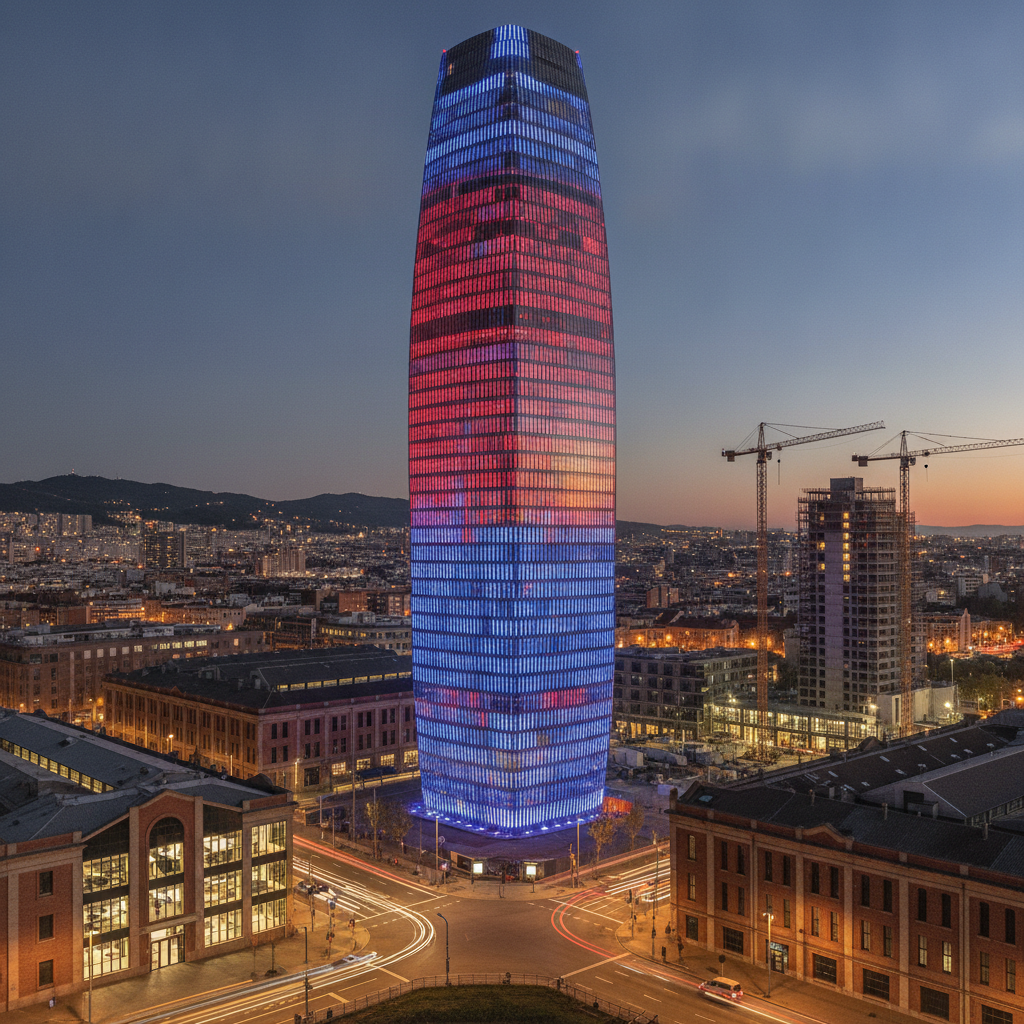
The Torre Glòries, designed by French architect Jean Nouvel and completed in 2005 (originally named Torre Agbar for the water utility that commissioned it, renamed when the building changed tenants), is the most discussed contemporary building in Barcelona after the Sagrada Família: a 142-meter, bullet-shaped tower clad in 56,000 aluminum panels and 4,500 glass louvers that create a pixelated, shimmering surface — intended by Nouvel to evoke water and the Mediterranean light, though critics have compared it to various other shapes. The tower's most impressive moment is after dark: 4,500 LED lights embedded in the facade can be programmed to create shifting patterns of color across the entire surface. Nouvel's stated inspiration was Montserrat (the serrated mountain west of Barcelona) and the geysers of Yellowstone — the idea being a natural form, a column of water or rock, rising from the urban plain. The building is currently used as an office tower for various technology companies.
- 5
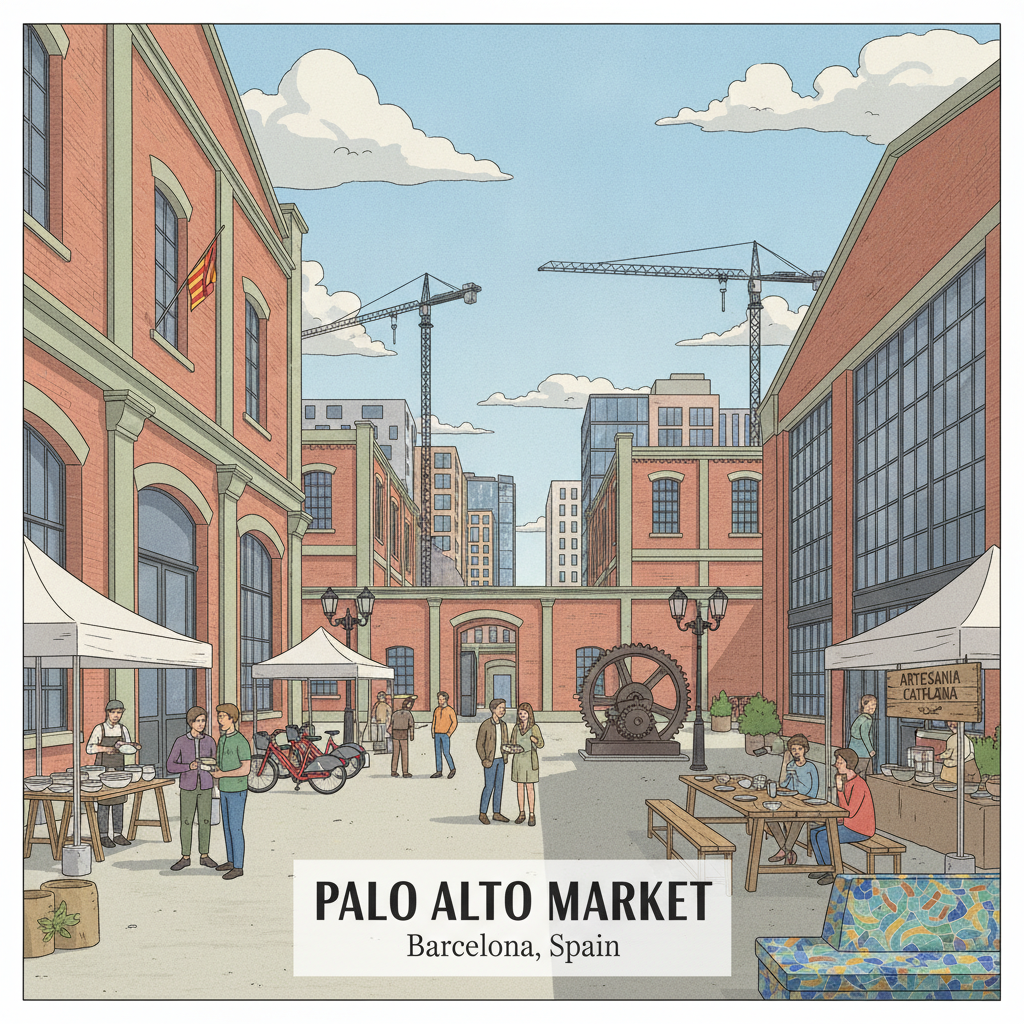
Palo Alto Market & Poblenou's Creative Studios
The Palo Alto Market, held in the courtyard of a converted factory complex at Carrer dels Pellaires, is the best design market in Barcelona and an emblem of the 22@ transformation: a curated gathering of around 100 artisans, designers, and food producers in a beautiful industrial space (red brick, iron columns, original machinery preserved as sculpture) held the first weekend of each month. The surrounding streets — Carrer dels Pellaires, Carrer de Pallars, Carrer de Roc Boronat — contain the highest concentration of converted factory studios in Barcelona: architecture firms, graphic design studios, product designers, film production companies, and tech startups occupying former metalworks, textile mills, and ceramic factories. Walking these streets between the remaining industrial buildings and the new construction cranes is the best way to understand the 22@ transformation in progress.
- 6
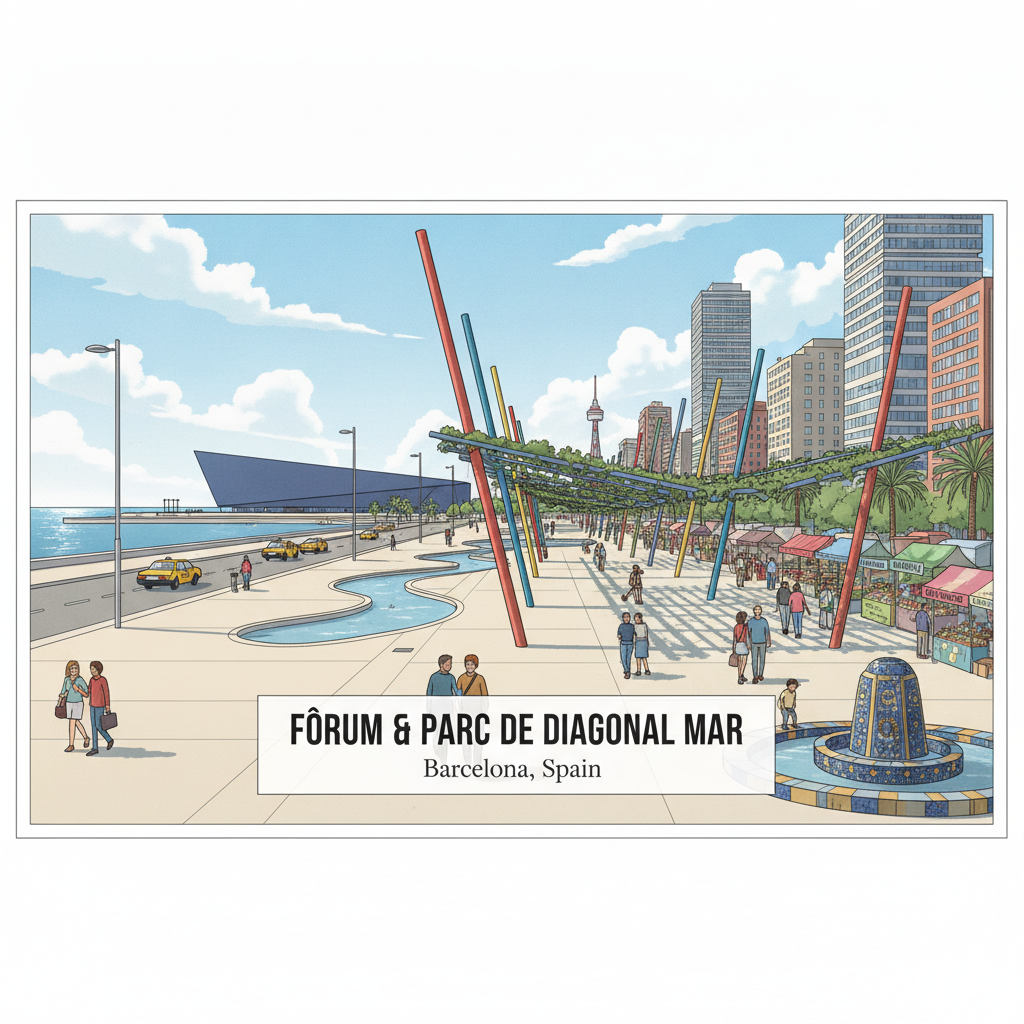
Fòrum & Parc de Diagonal Mar — The North End of the Sea Front
The Fòrum area, at the northern end of Barcelona's seafront, was developed for the 2004 Universal Forum of Cultures: an event of ambiguous success that nevertheless left behind a significant transformation of the industrial waterfront. The most impressive permanent intervention is the Parc de Diagonal Mar, designed by Enric Miralles (who also designed the Scottish Parliament in Edinburgh) and completed posthumously in 2002 after his death in 2000: a landscape of distinctive inclined steel columns supporting vine-covered pergolas, connected by meandering paths and ponds over a platform above the ring road. The Fòrum building itself (Herzog & de Meuron, 2004), a vast triangular platform on the waterfront, hosts major concerts and events. The Els Encants market (the traditional Barcelona flea market, relocated here in 2013) now operates under a spectacular mirrored canopy — the reflective ceiling creating infinite optical illusions of the market below.
Walk this route with audio
Stories play automatically as you reach each stop — no tapping needed.
More in barcelona
Pedralbes, Camp Nou & Sarrià: Barcelona's Quiet Upper City
Palau de la Música & Sant Pere: The Greatest Concert Hall in Spain and the City of Iron
Barceloneta & the Olympic Waterfront: From Columbus to the Mediterranean
La Rambla, Boqueria & El Raval: The Street, the Market, and the Other Barcelona
Tibidabo, Collserola & Pedralbes: Above the City, Beyond the Grid