Bergen — Bryggen UNESCO Wharf, the Fish Market & the Fløibanen Funicular to the Mountain
Bergen (the second-largest city in Norway, population 280,000, the former medieval capital and Hanseatic trading city, the gateway to the Norwegian fjords, the city with the most rainfall of any European city — approximately 2,250mm per year — the Bergen people taking pride in their 'liquid sunshine', the city surrounded by the seven mountains — de syv fjell — the UNESCO-inscribed Bryggen wharf the defining image of the city)
- 1
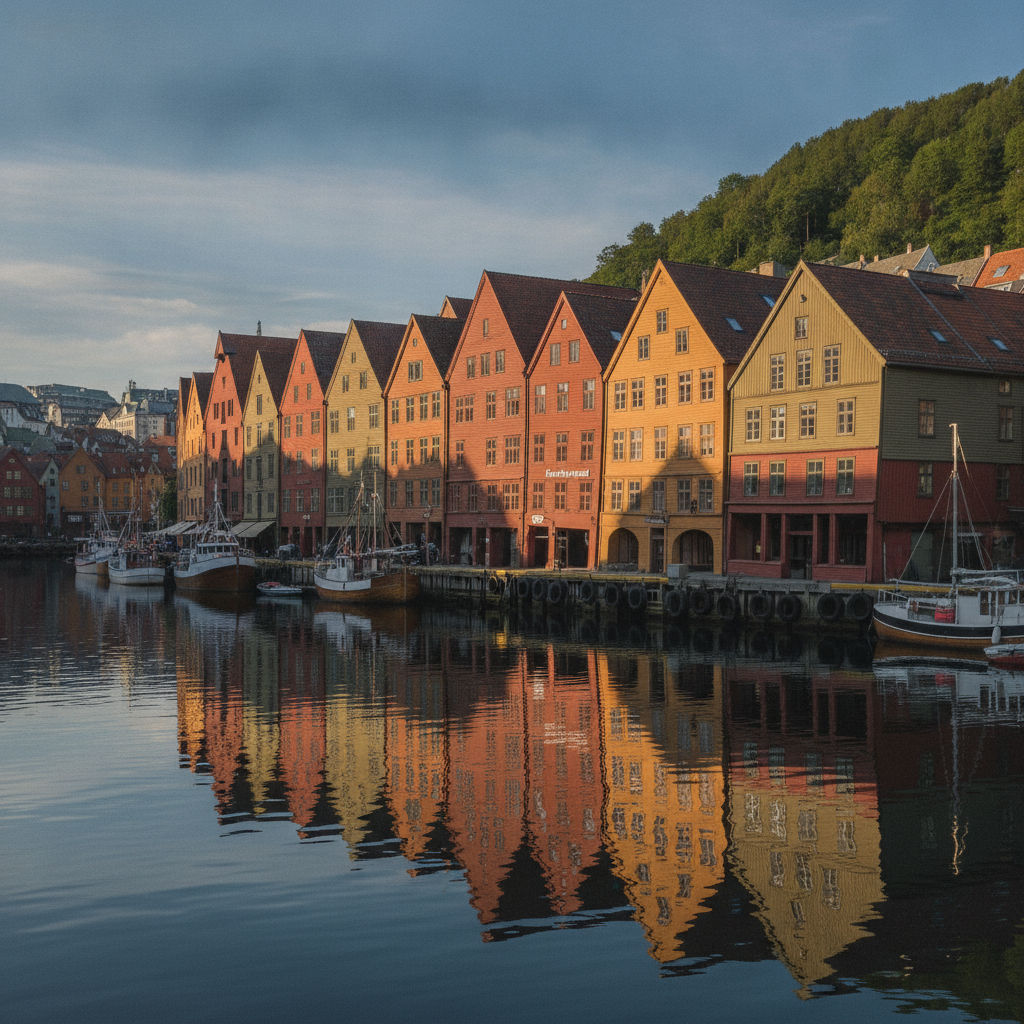
Bryggen — the UNESCO Hanseatic Wharf
Bryggen (Tyskebryggen — the German Wharf, the UNESCO World Heritage Site inscribed 1979, the medieval Hanseatic merchant houses on the east side of the Vagen harbour, the most internationally recognized building group in Norway — the colourful wooden gabled buildings the canonical image of Bergen, the buildings originally built by the Hanseatic League merchants who controlled Bergen's fish trade 1360-1754, the current buildings dating from the rebuilding after the fire of 1702 — fires the recurrent disaster of Bergen's wooden city, the buildings rebuilt 8 times in the same structural form, the current buildings the most complete surviving Hanseatic merchant complex in the world): the building structure (the narrow gabled buildings arranged in parallel rows running perpendicular to the harbour, the passages between the rows — the schøtstuegangen — the daily work spaces of the Hanseatic merchants, the upper floors the private sleeping quarters, the ground floor the trading and storage level, the buildings leaning with the settled timber foundations at angles of 3-15 degrees from vertical — the most architecturally distinctive aspect of the Bryggen streetscape after the colours, the lean visible from the harbour when the buildings are viewed from the correct angle), the Bryggen Museum (Bryggen 3, the archaeological museum built on the excavation of the 1955 fire site, the 800,000 artefacts from the 12th-14th century settlement visible in the exhibition, the runic inscriptions — the Bergen runic messages the largest collection of medieval runic texts in Scandinavia, the messages ranging from love notes to shopping lists, €10 adults, daily 10am-5pm in summer) and the Hanseatic Museum (Finnegårdsgaten 1a, the preserved merchant's house of the 18th century, the sleeping berths, the trading room, the kitchen, €10 adults, the best-preserved interior of the Hanseatic period, closed for renovation — check current status at bymuseet.no).
- 2
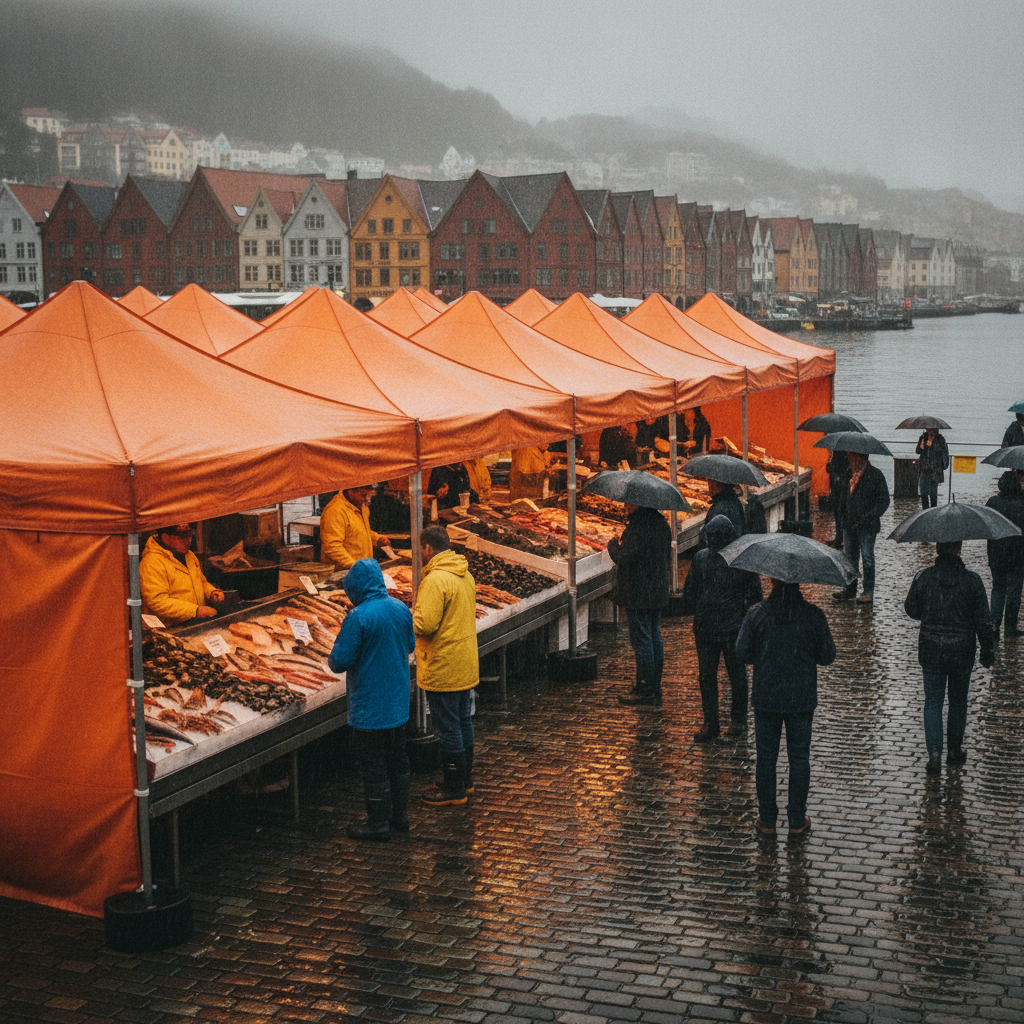
Bergen Fish Market — the Torget
Torget (the Bergen Fish Market, the square at the head of the Vagen harbour, the outdoor market operating continuously since the Middle Ages — the fish sellers of Bergen among the most characterful market vendors in Scandinavia, the market the social hub of the Norwegian fishing economy for 700 years, the tourist market version operating May-September daily 7am-7pm, the local fish sellers outside the tourist peak hours 7-10am the most authentic version): the market products (the Norwegian king crab — kongekrabbe, the Red King Crab from the Barents Sea, the largest crab species in Norway at up to 1.8m claw-to-claw, the market vendors cracking the crab on the spot and serving the legs with the lemon and the mayonnaise at €15-25 per portion, the most spectacular and most expensive market experience in Bergen — the Bergen salmon, the fresh farmed Atlantic salmon from the Norwegian fjords, the highest quality salmon production in the world, the Bergen market serving it as sashimi-quality slices on ice — the fish cake — fiskekake — the traditional Norwegian fishcake prepared at the market stalls, the most authentically Bergen street food at €3-5 per cake), and the indoor Fish Market Hall (the Fisketorget indoor market behind the outdoor stalls, the fish and shellfish shop with the full range of Norwegian seafood products — the gravlaks, the røkelaks, the stockfish, the lutefisk in season — alongside the cheese, the bread, and the local produce, the correct address for purchasing Norwegian food products to take home, the fish market shop open year-round Monday-Saturday 9am-5pm) and the market restaurants (the market stalls themselves serving the fish at the standing tables at €15-30 per dish, the most atmospheric meal location in Bergen in good weather, the Bergen weather being the primary variable — the Bergen umbrella the most purchased tourist accessory).
- 3
Fløibanen — the Funicular to the Mountain Top
Fløibanen (the funicular railway from the city centre to the Fløyen mountain, the most used public transport in Bergen by visitor volume — 3 million trips per year, the funicular departing from Vetrlidsallmenningen adjacent to Bryggen every 15-30 minutes, €12.50 adults return, daily 7:30am-11pm in summer, 7:30am-10pm in winter, the 8-minute journey ascending 320m from the harbour level to the Fløyen summit): the view from Fløyen (the panoramic view of the Bergen city centre, the Vagen harbour, the Bryggen wharf visible from directly above, the seven surrounding mountains of Bergen, the Byfjorden inlet and the islands of the outer fjord system, the most complete view of Bergen available from a single position, the correct photography position the lookout terrace immediately at the funicular upper station rather than the crowded main summit area 200m further), the Fløyen mountain walks (the network of marked hiking trails from the Fløyen summit across the Ulriken mountain range — the most used trail the 5km loop around the Skomakerdiket lake returning to the Fløyen summit in 1.5 hours at a relaxed pace, the trails well-maintained and signposted, the trails free and always accessible for those willing to walk up — the 4km path from the city centre to the summit via the Fløyvegen path takes 45 minutes uphill, the walking descent the alternative to the return funicular ticket) and the Fløyen summit facilities (the Fløyen restaurant and kiosk at the summit, the Norwegian waffles with the sour cream and the strawberry jam at €5 the correct summit food, the children's playground and the goat farm the family attractions at the summit, the goats the most photographed animals in Bergen).
- 4
The Seven Mountains — Hiking Above Bergen
De syv fjell (the seven mountains surrounding Bergen — Fløyen, Ulriken, Rundemanen, Blåmanen, Lyderhorn, Damsgårdsfjellet, and Sandviksfjellet — the mountains the defining topographic fact of Bergen, the city growing in the valleys between the mountains from the medieval settlement to the present, the mountains the most used recreational space in Bergen for the population of a city that hikes by tradition and by proximity): Ulriken (the highest of the seven mountains at 643m, the Ulriksbanen cable car from the Ulriksbanen AS base station at Haukelandsveien 40 — accessible by bus from the city centre in 20 minutes — to the summit in 7 minutes at €17 adults return, daily 9am-9pm in summer, 9am-5pm in winter, the summit restaurant the highest-altitude restaurant in Bergen at €25-45 per main, the 360-degree view of the western Norwegian fjord landscape the finest of any of the seven mountains), the city-to-mountain hiking tradition (the Bergen people's attachment to the mountains a cultural identity — the most common response to the question 'what do you do in Bergen at the weekend?' is 'we go hiking', the Bergen Turlag — the Bergen chapter of the Norwegian Trekking Association — maintaining the 1,000km of marked hiking trails in the Bergen mountains, the Fjellet for alle — 'the mountains for all' — programme the most attended regular hiking event in Norway, 3,000+ participants per event) and the Bergen mountain code (the Norwegian mountain safety rules: take a map, know the weather forecast, turn back in time, bring warm clothes and emergency food, the rules taught to every Norwegian child, the seven mountains accessible enough that first-time hikers frequently underestimate the exposure and the weather change speed — the Bergen weather the most relevant risk, the sunshine converting to rain and wind in 30 minutes being the normal condition).
- 5
Edvard Grieg and the Norwegian Music Tradition
Edvard Grieg (1843-1907, the most internationally recognized Norwegian composer, the composer of the Peer Gynt Suite, the Piano Concerto in A minor, and the Lyric Pieces — the music that defined the international image of Norway in the late 19th century, the Peer Gynt Suite the most performed orchestral work by any Scandinavian composer — 'In the Hall of the Mountain King' the most recognized short piece, the imagery of the Norwegian mountain trolls and the fjord landscape transposed into music, Grieg the national composer of Norway in the way Sibelius is of Finland): Troldhaugen (Troldhaugenvegen 65, the Grieg Museum in the composer's home 8km south of Bergen centre, accessible by bus 4 to Hop in 20 minutes then walk 10 minutes, €14 adults, May-September daily 9am-6pm, October-April Monday-Friday 10am-4pm, Saturday-Sunday 10am-6pm): the Composer's House (the 1885 villa where Grieg and his wife Nina lived summers 1885-1907, the studio cabin — hytta — at the lakeside where Grieg composed, the bedroom with the original furnishings, the piano — Grieg's Steinway Concerto Grand of 1892, the piano the most visited object in the museum, the Grieg personal objects and correspondence in the museum room), the Troldhaugen Concert Hall (the 200-seat venue beside the villa, the summer concert series June-August with the Grieg piano concerto programme performed by international soloists, tickets €30-50 at troldhaugen.no, the performances in the acoustic hall designed for the Grieg repertoire the most atmospheric in the Grieg calendar) and the gravesite (the Grieg and Nina graves carved into the rock face above the Nordåsvannet lake, the graves embedded in the living rock at the composer's request, the location the most unusual composer's tomb in Europe).
- 6
Bergen Practical — the Fjord Gateway and the Rain
Bergen practical: access (the Bergen Airport Flesland 20km southwest of the city centre, the light rail Bybanen to the city centre in 45 minutes at €4, the most reliable and cheapest airport transport in Norway, the airport with direct connections to London Gatwick, Amsterdam, Copenhagen, Frankfurt, and 20+ European destinations, the SAS and Norwegian flights the primary carriers; the Bergen Line train from Oslo 6.5 hours at €30-70 in advance — the Bergen Railway the most scenic rail journey in Europe, crossing the Hardangervidda plateau 1,222m above sea level through the snow even in late May), city transport (the Bergen city bus and the light rail, the single trip at €38 NOK / €3.50, the Bergen Card the tourist card at €280 NOK / €25 per 24 hours covering all public transport and museum entry to 20+ attractions), the Bergen rain (2,250mm per year making Bergen the wettest major city in Europe, the rain arriving most consistently from the southwest as the Atlantic weather systems make landfall on the Norwegian coast — the Bergen weather the primary planning factor for any visit, the dry spells real but unpredictable, the correct visitor approach the waterproof jacket as a permanent accessory, the Bergen umbrella available at every supermarket for €5-10, the Bergen people's pride in their rainfall encapsulated in the phrase 'Vi er ikke redd for litt regn' — We are not afraid of a little rain), the Bergen Card (the tourist pass available at the Bergen tourist information office at Strandkaien 3, the airport, and the Bryggen), and the Bergen Light Festival (the city-wide light installation event held every February, the most visited cultural event in Bergen, the installations illuminating the Bryggen and the city centre in the darkest month — bergenlightfestival.no for the programme).
Walk this route with audio
Stories play automatically as you reach each stop — no tapping needed.
More in bergen
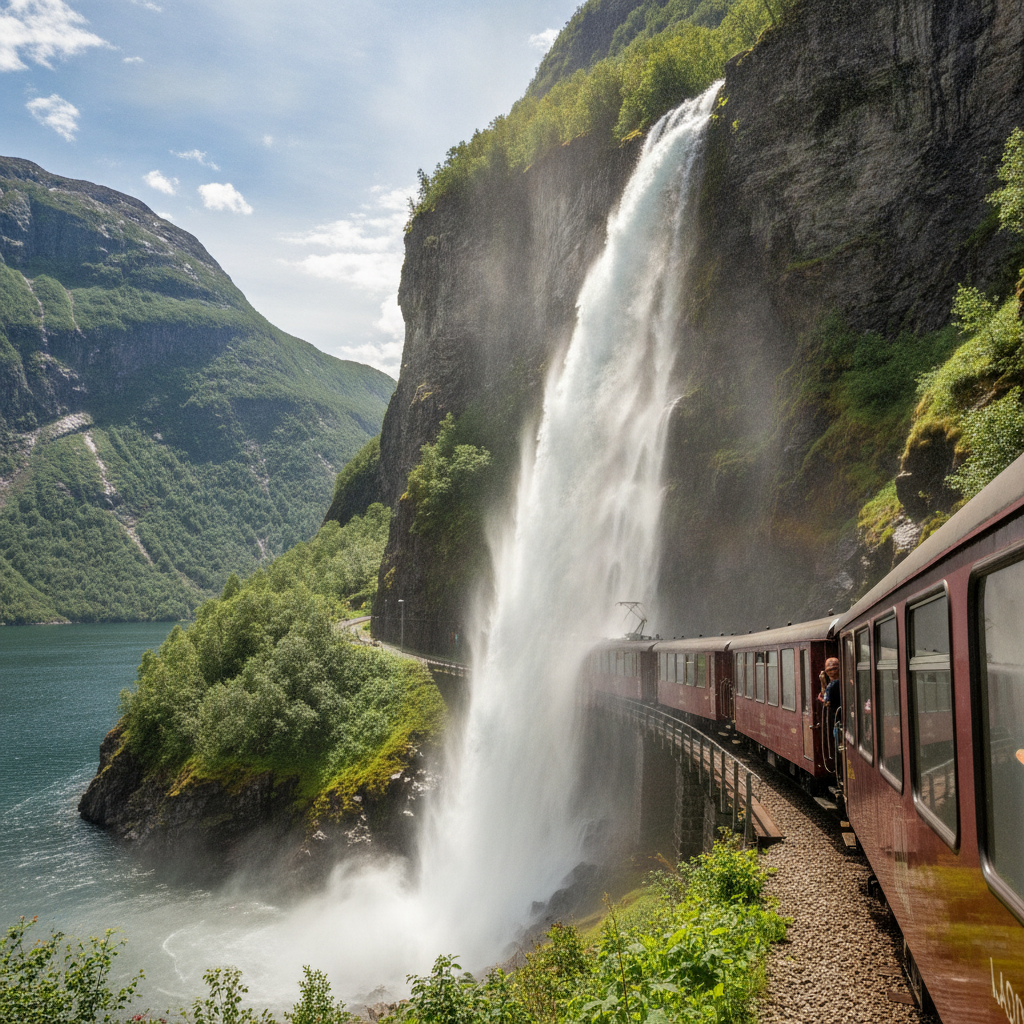
Bergen to the Fjords — the Flåmsbana Railway, Sognefjord & the Norway in a Nutshell Circuit
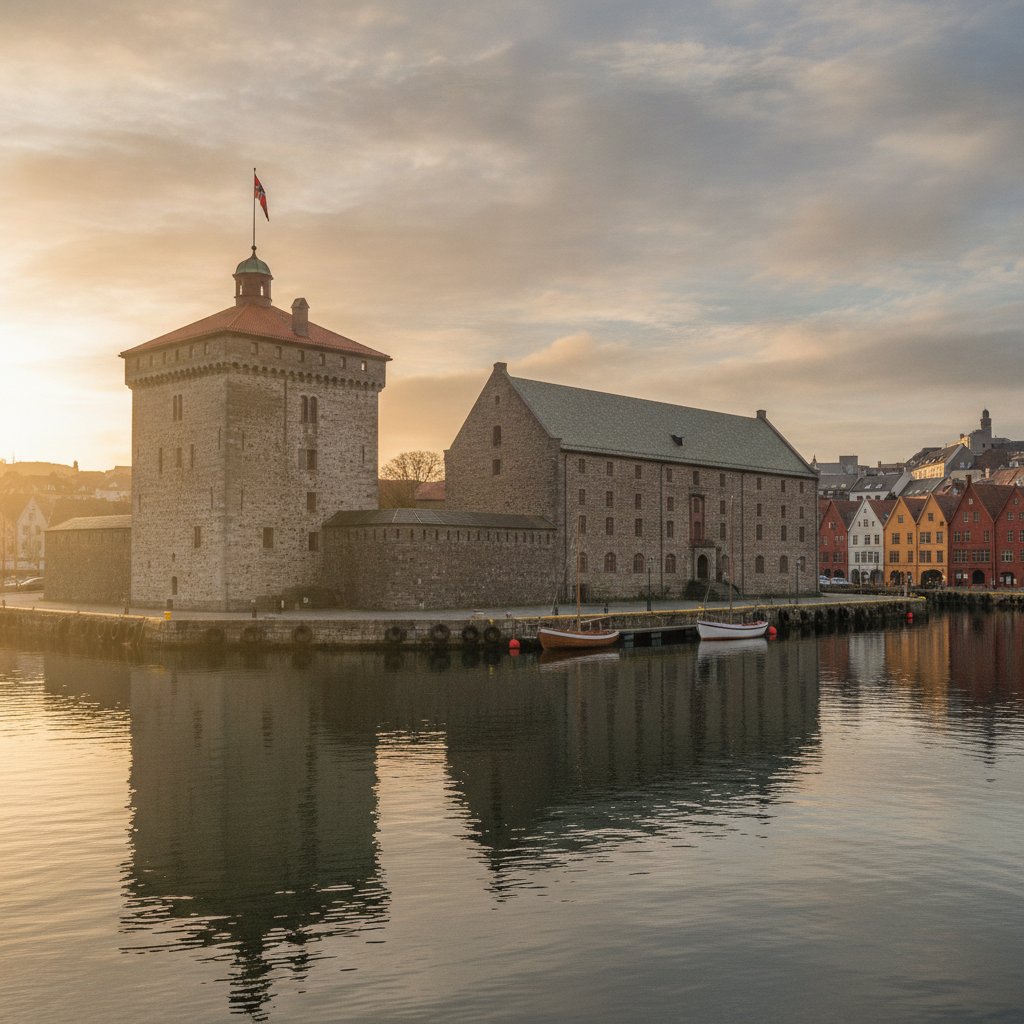
Bergen Medieval History — Bergenhus Fortress, Håkonshall & the Norwegian Royal Past
Bergen Music — Edvard Grieg, Troldhaugen & the Norwegian Musical Tradition
Bergen Art & Architecture — KODE Museums, Norwegian Design & the City Life of Bergen