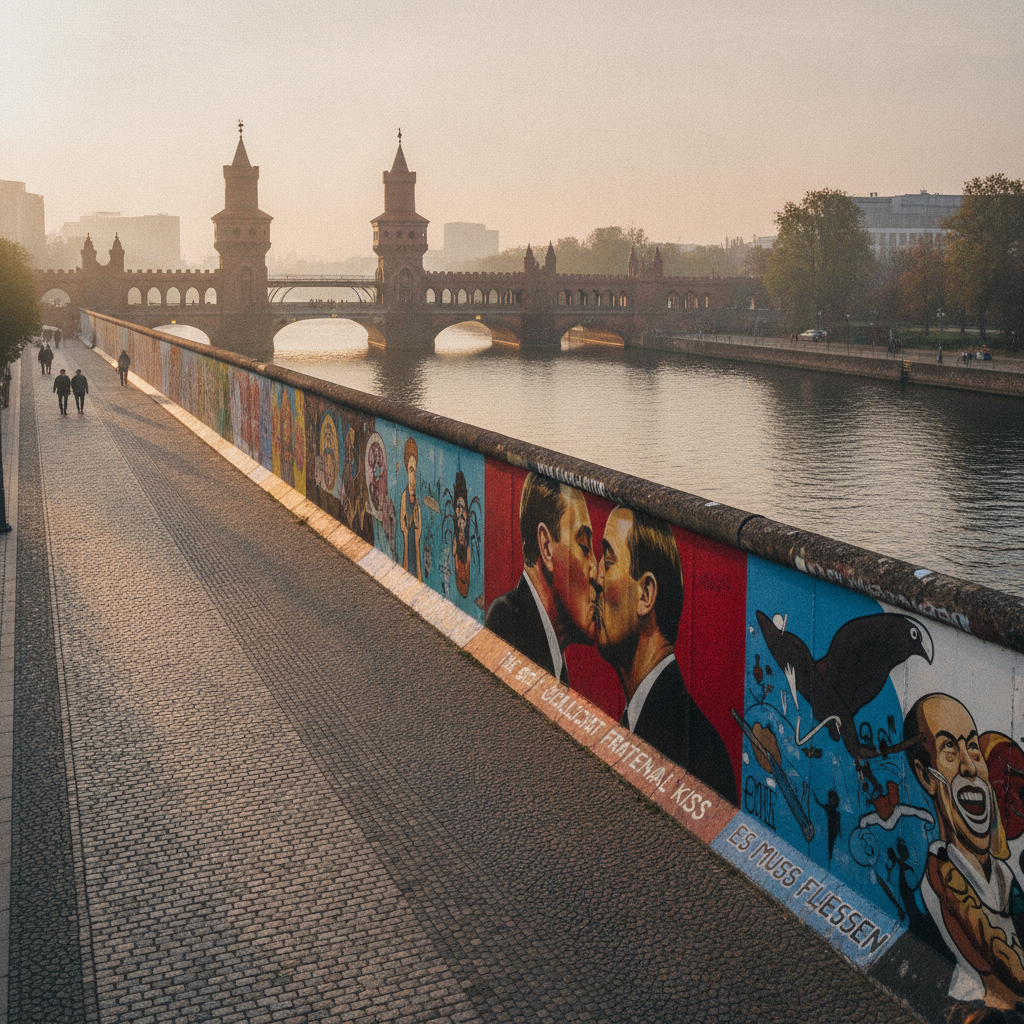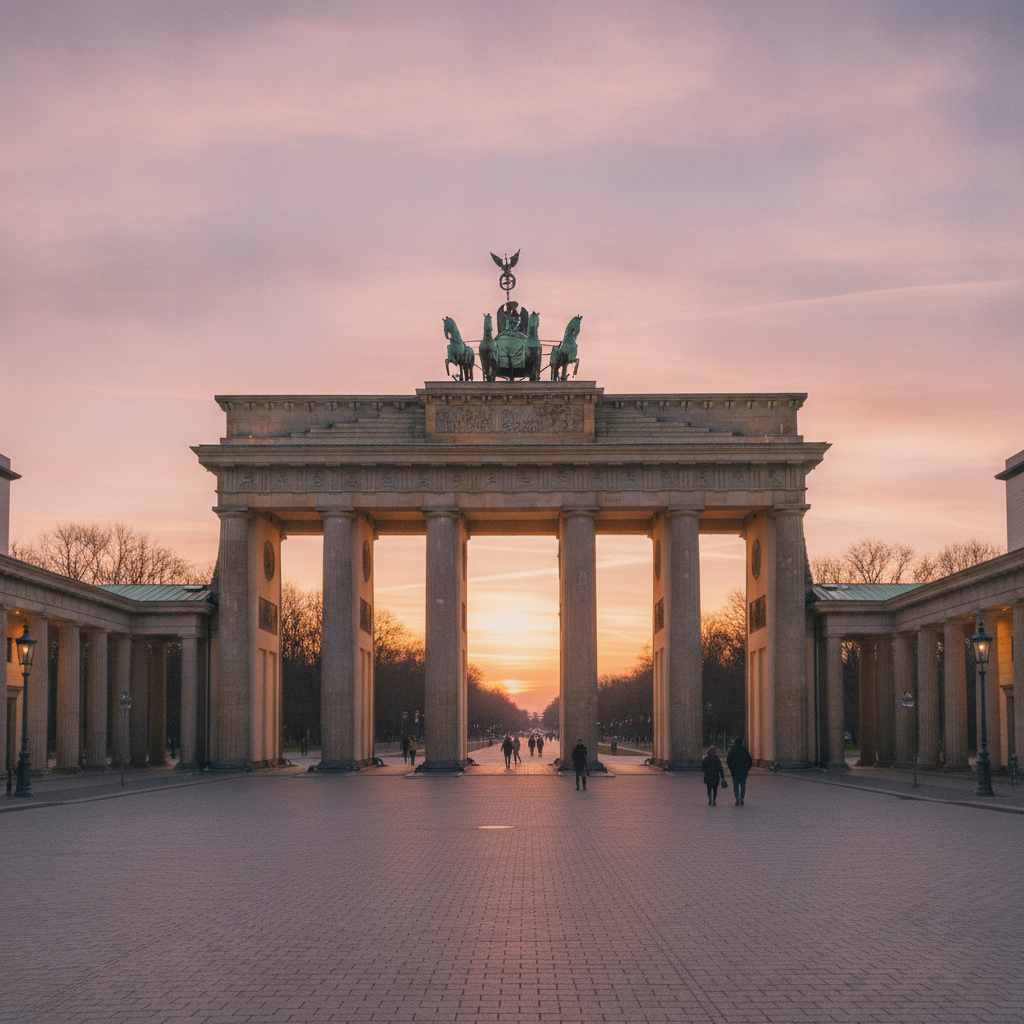
Brandenburg Gate, Reichstag & Tiergarten: The Heart of Reunified Berlin
The monumental axis running west from the Brandenburg Gate through the Tiergarten to the Victory Column — and north to the Reichstag dome — concentrates more symbolic weight per square kilometer than almost anywhere else in Europe: the gate that divided East and West for 28 years, the parliament that witnessed empire, republic, dictatorship, ruin, and rebirth, and the park that was stripped bare for fuel and is now Berlin's green lung.
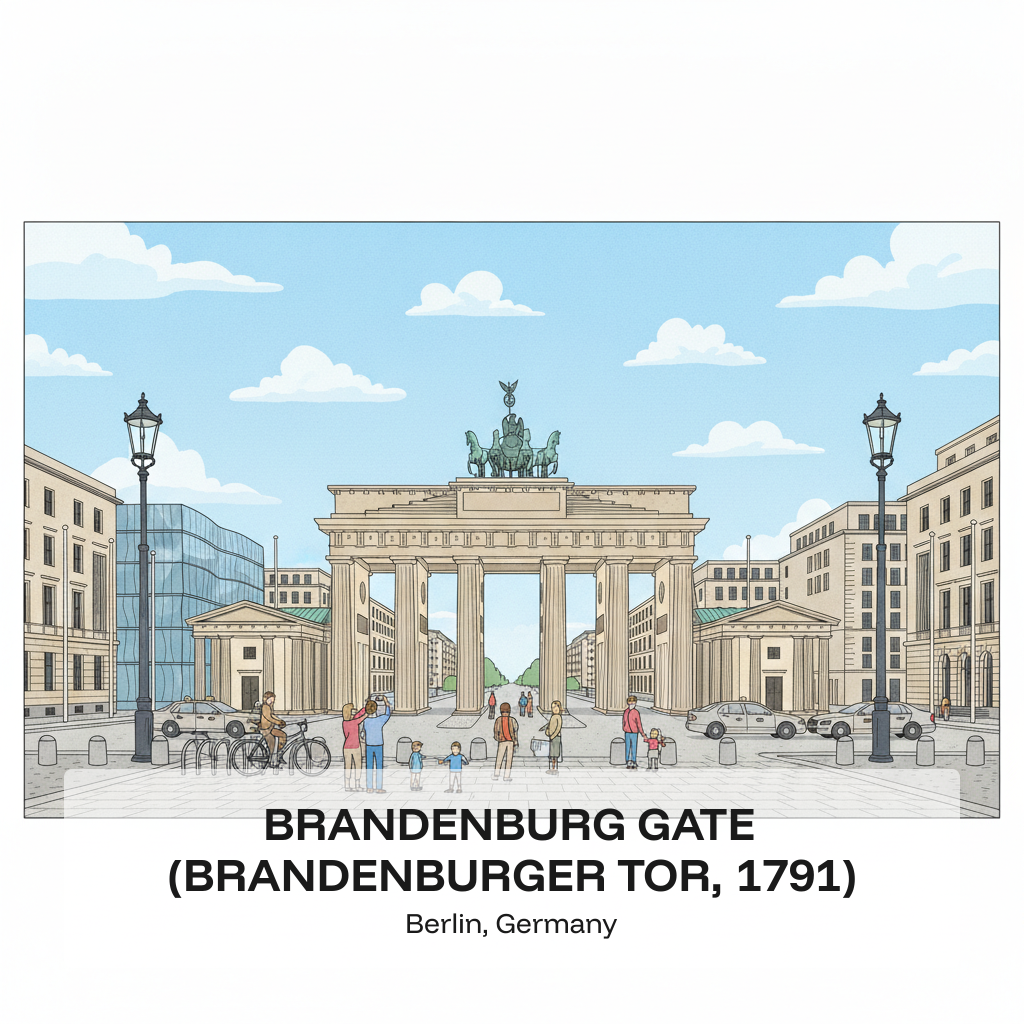
1. Brandenburg Gate (Brandenburger Tor, 1791)
- 1
Brandenburg Gate (Brandenburger Tor, 1791)
The Brandenburg Gate — the only surviving city gate of the original 18 that pierced the Berlin customs wall — was built 1788-1791 by Carl Gotthard Langhans for Friedrich Wilhelm II of Prussia as a triumphal arch in the neoclassical style, modeled on the Propylaea of the Athenian Acropolis (six Doric columns on each face, 11 meters high). The gate became history's most loaded architectural symbol when it stood at the epicenter of the Cold War division: the Berlin Wall was built 100 meters to its east in August 1961, sealing the gate in the death strip between East and West for 28 years; when the Wall fell on November 9, 1989, crowds flooded through it in the most telegenic scene of the 20th century's end. The Quadriga — the four-horse chariot sculpture on top — is driven by Eirene (the goddess of peace) carrying the Iron Cross-topped staff; the original was seized by Napoleon in 1806, returned in 1814, and the current version is a 1958 copy. The surrounding Pariser Platz contains the embassies of France, USA, and UK, the DZ Bank (designed by Frank Gehry, 2000), and the Hotel Adlon Kempinski (rebuilt 1997 on the site of the legendary 1907 original, where Kaiser Wilhelm II greeted Roosevelt and Chaplin filmed City Lights).
- 2
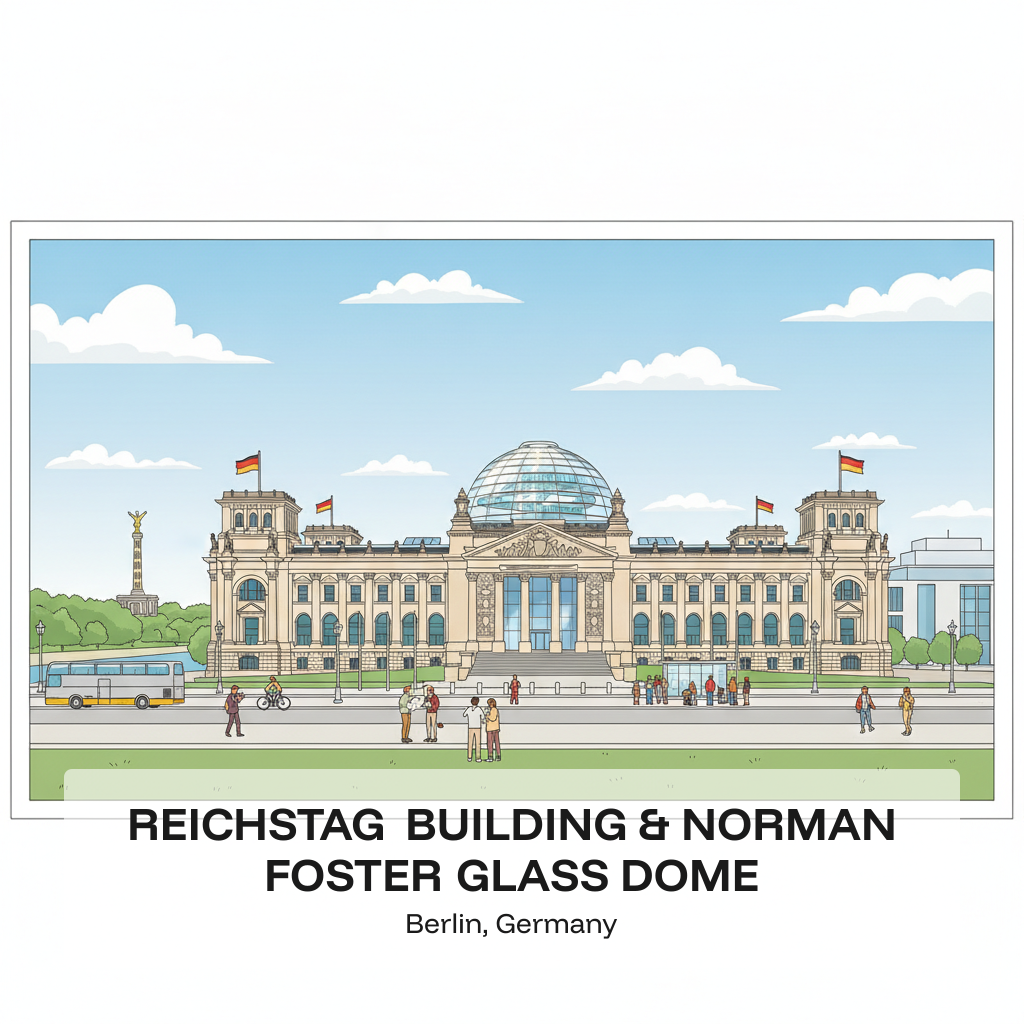
Reichstag Building & Norman Foster Glass Dome
The Reichstag (Reichstagsgebäude) — the seat of the German parliament (Bundestag) since 1999, when the federal government relocated from Bonn to Berlin following reunification — has a history that reads like a compressed German tragedy: built 1884-1894 for the imperial parliament (the inscription 'Dem Deutschen Volke' / 'To the German People' added only in 1916 under wartime pressure); burned on February 27, 1933 in the arson that gave Hitler his pretext for emergency decrees dissolving civil liberties; bombed into a ruin in 1945, restored (without the original dome) from 1961 for West German ceremonial use; wrapped in silver fabric by Christo and Jeanne-Claude in June 1995 (two weeks, 5 million visitors, the most-visited public art event of the century); and finally rebuilt by Norman Foster (1995-1999) with the famous glass dome — a 23-meter-diameter transparent cupola housing a 360° public walkway and a central funnel of mirrors that reflects daylight into the plenary chamber below and is a metaphor for the transparency of democracy. The dome receives 3 million visitors annually; advance reservations (free) are mandatory. Foster's renovation also added the 'Biosphere' solar panels and exposed the layers of graffiti inscribed by Soviet soldiers in 1945 (preserved behind glass).
- 3
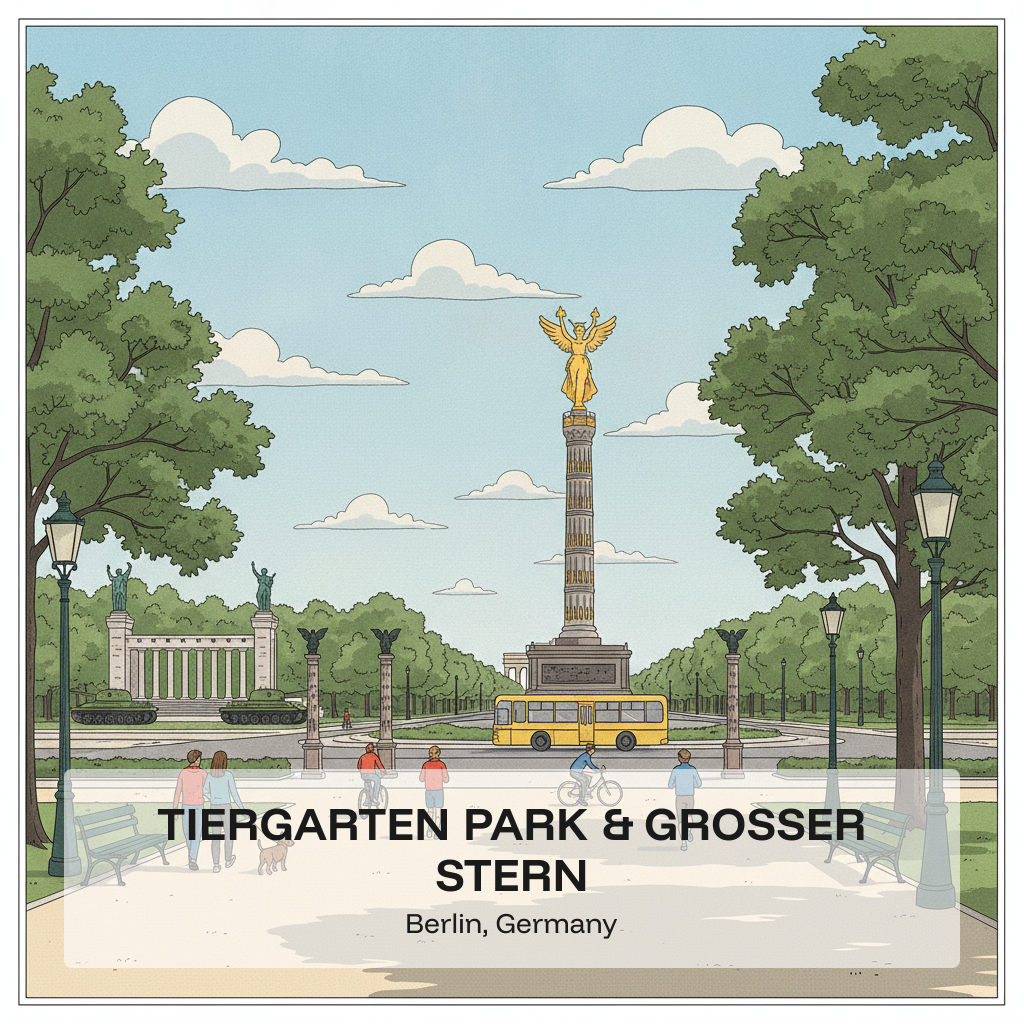
Tiergarten Park & Großer Stern
The Tiergarten (Animal Garden, 210 hectares) — Berlin's largest inner-city park, bisected by the Straße des 17. Juni avenue and containing the Großer Stern (Great Star) traffic circle at its center — began as the electoral hunting forest of the Hohenzollern dynasty in the 16th century, was redesigned as a formal English landscape garden by Peter Joseph Lenné in 1833-1840, stripped entirely bare by Berliners desperate for fuel in the catastrophic winter of 1945-1946 (aerial photographs show a completely treeless wasteland), and replanted from 1949 onward, largely with seedlings donated by West German cities. The park contains numerous important monuments: the Soviet War Memorial (built 1945 from marble taken from Hitler's Reich Chancellery; two flanking T-34 tanks; 2,500 Soviet soldiers are buried beneath); the Monument to the Murdered Jews of Europe (Holocaust Memorial, adjacent); and memorials to the Sinti and Roma victims, to gay and lesbian victims, and to disabled victims of National Socialism.
- 4
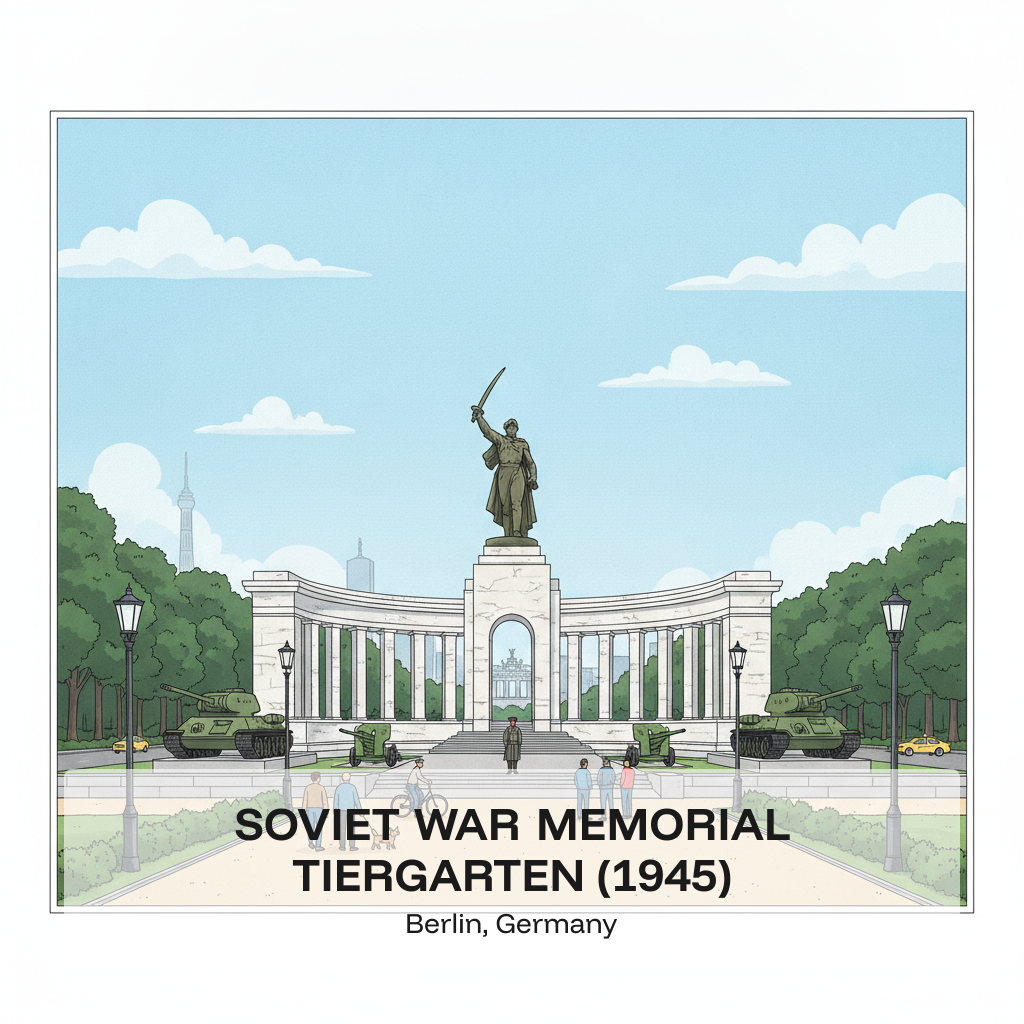
Soviet War Memorial Tiergarten (1945)
The Soviet War Memorial in the Tiergarten — one of three Soviet war memorials in Berlin (the others at Treptower Park and Schönholzer Heide) — was built with extraordinary speed in the months immediately following the German surrender, completed in November 1945. The memorial — a 12-meter-high curved colonnade with a bronze Soviet soldier at the apex flanked by two T-34 tanks and two ZiS-3 artillery pieces — was built from marble quarried from the ruins of Hitler's Reich Chancellery on Voßstraße, which was being systematically demolished by Soviet engineers. The memorial stands in the British sector of divided Berlin (it lies west of the Brandenburg Gate), and by the terms of the post-war occupation agreements, Soviet soldiers were entitled to march through British territory to relieve the guards at the memorial — a peculiar Cold War choreography that continued until 1990. Approximately 2,500 Soviet soldiers killed in the Battle of Berlin are interred in the grounds.
- 5
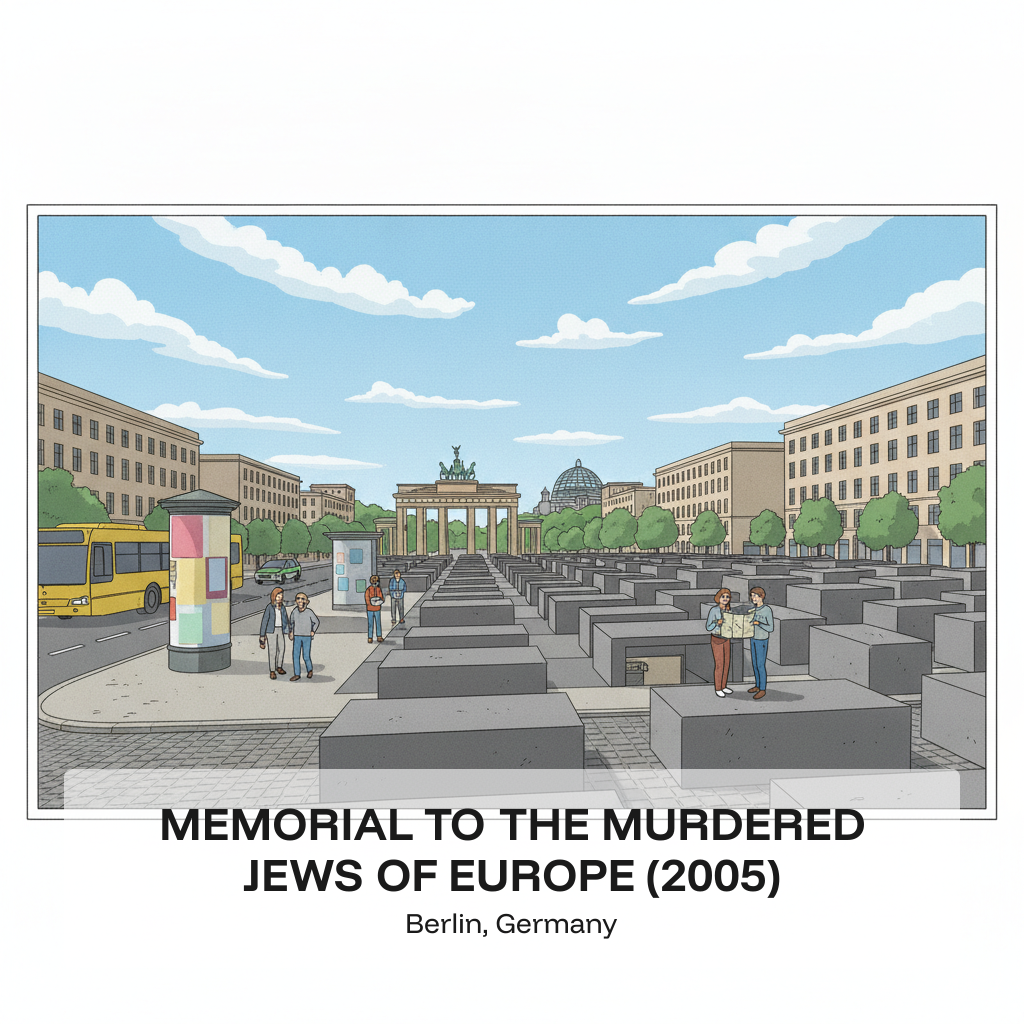
Memorial to the Murdered Jews of Europe (2005)
The Memorial to the Murdered Jews of Europe (Denkmal für die ermordeten Juden Europas) — officially opened on May 10, 2005, designed by the American architect Peter Eisenman — occupies a 19,000 m² site immediately south of the Brandenburg Gate, within sight of the former path of the Berlin Wall, on the former 'Ministergärten' (Ministers' Gardens) of the Nazi government. The memorial consists of 2,711 concrete stelae (rectangular slabs) of identical plan dimensions (92 cm × 238 cm) but varying heights (from 0 to 4.7 meters), arranged in a regular grid on undulating ground — the tilted topography creating a disorienting effect as you move through the interior, where the stelae tower above and the sounds of the city disappear. There is no explicit symbolic content in the memorial; Eisenman designed it as an abstract field that visitors interpret individually. The underground Information Centre (Ort der Information) beneath the memorial, by contrast, is explicitly documentary: it contains the names of all known Jewish Holocaust victims (collected by Yad Vashem), room-sized maps of massacre sites across Europe, and the stories of individual families.
- 6
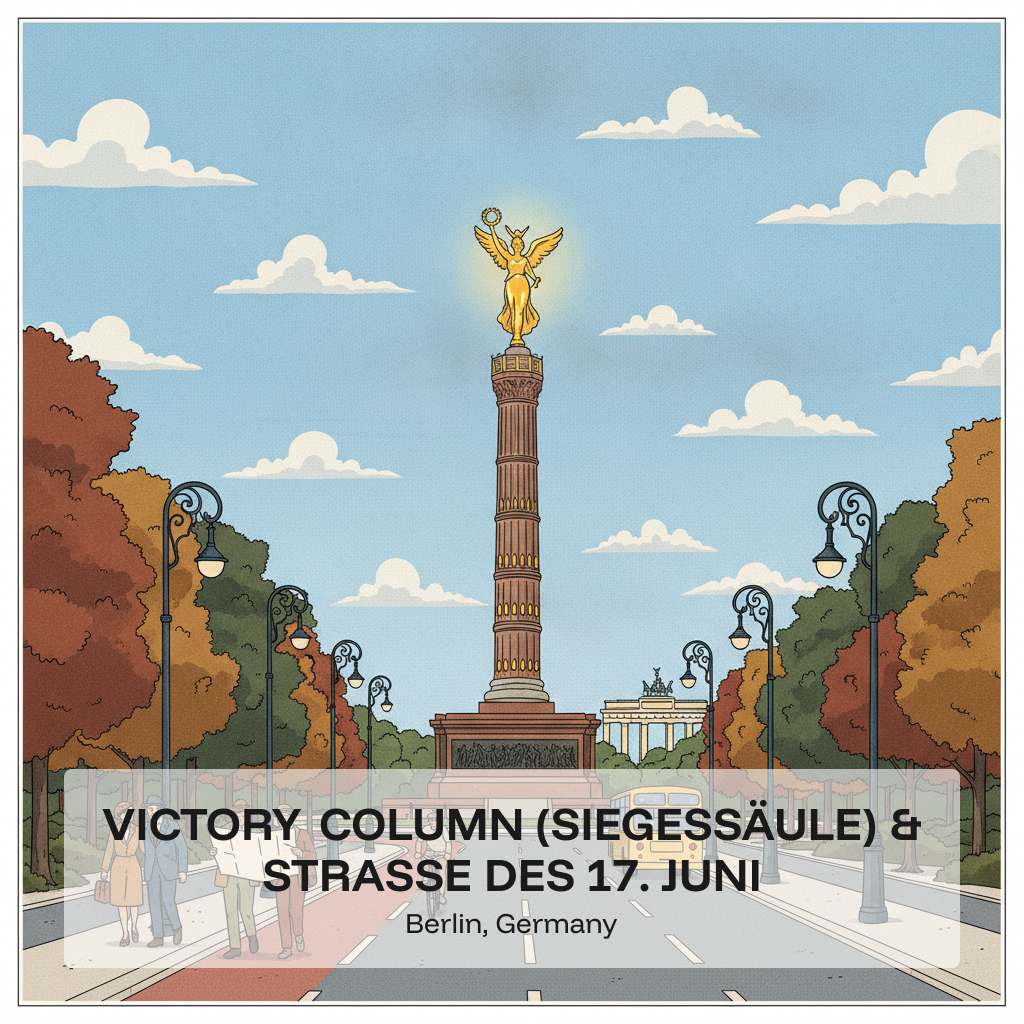
Victory Column (Siegessäule) & Straße des 17. Juni
The Victory Column (Siegessäule, 67 meters total height including base) — built 1865-1873 to commemorate Prussian victories over Denmark (1864), Austria (1866), and France (1870-71) — was moved by Albert Speer from its original position in front of the Reichstag to its current location at the Großer Stern in 1939 as part of Hitler's monumental redesign of Berlin (the column was also heightened by one drum section, giving it its current height). The gilded Victoria ('Goldelse' to Berliners, affectionately named after Elisabetha) on top holds a wreath and an eagle standard; the column base has a mosaic interior open to the public. The Straße des 17. Juni (Street of June 17th) — renamed in 1953 after the East German workers' uprising of that date, brutally suppressed by Soviet tanks — runs arrow-straight from the Brandenburg Gate 3.5 km west to the Ernst-Reuter-Platz, bisecting the Tiergarten; it is Berlin's grand processional axis, used for the Love Parade (1989-2006), the FIFA World Cup final screening (2006), and the Obama speech (July 2008, 200,000 people).
Walk this route with audio
Stories play automatically as you reach each stop — no tapping needed.
More in berlin
Kreuzberg: Turkish Market, Landwehrkanal & Urban Culture
Hackescher Markt, Scheunenviertel & Prenzlauer Berg: Berlin's Bohemian Heart
Schöneberg, Steglitz & South Berlin: Kennedy's Stage, Bowie's Flat
Charlottenburg Palace & Kurfürstendamm: West Berlin's Royal Mile
Museum Island & Unter den Linden: Berlin's UNESCO Cultural Heart