Charlottenburg Palace & Kurfürstendamm: West Berlin's Royal Mile
West Berlin developed its own urban identity during the Cold War, centered on the Kurfürstendamm (Ku'damm) as the commercial and cultural spine of the free city. This route connects the western centerpiece — Charlottenburg Palace, the most complete surviving Hohenzollern royal residence in Berlin — with the bombed-but-rebuilt Kaiser Wilhelm Memorial Church and the legendary Kaufhaus des Westens (KaDeWe), Europe's second-largest department store.
- 1
Charlottenburg Palace (Schloss Charlottenburg, 1699-1746)
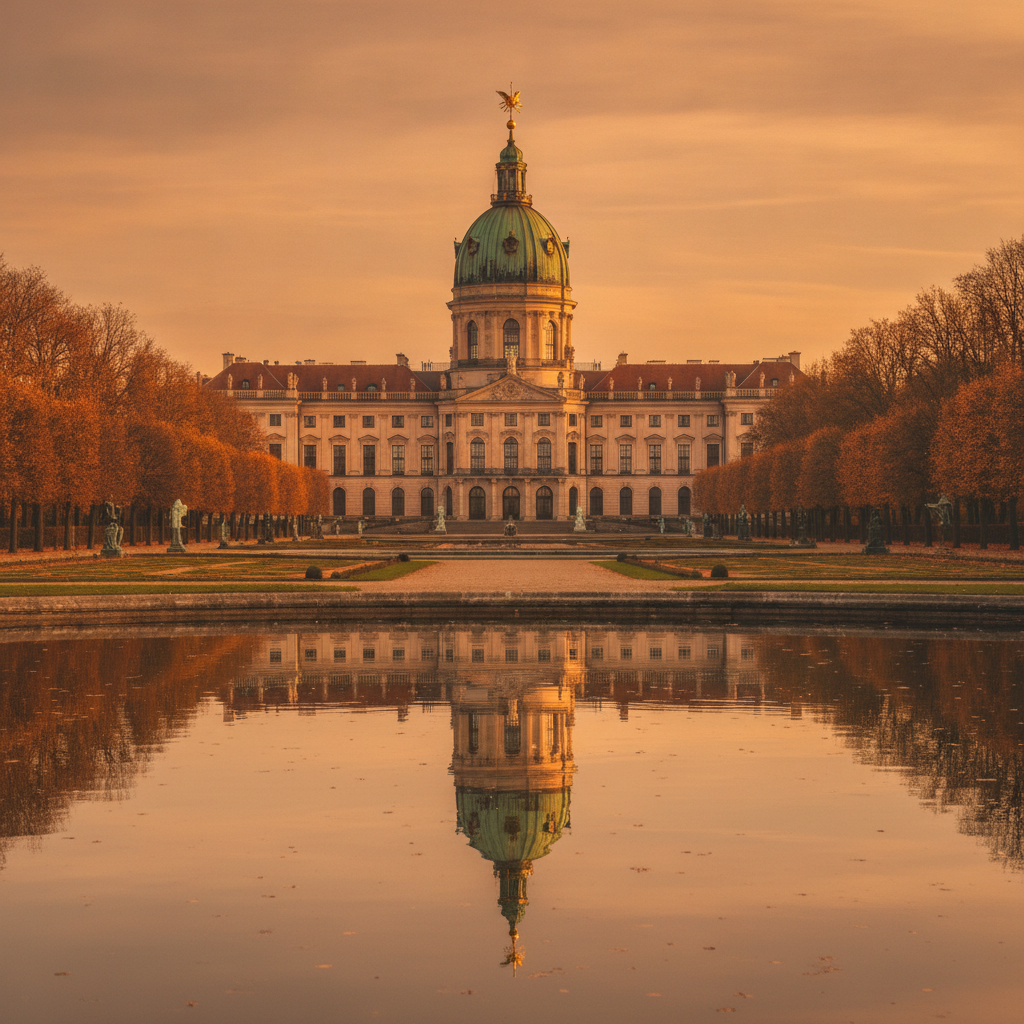
Charlottenburg Palace — the largest and most significant Hohenzollern palace remaining in Berlin (the Berlin Palace/Stadtschloss in Mitte was demolished by the GDR in 1950 and only rebuilt in 2021 as the Humboldt Forum) — was built beginning 1695 by Elector Frederick III (who crowned himself Frederick I, King in Prussia, in 1701) for his wife Sophie Charlotte, after whom the palace and district are named. The palace grew through successive additions: the original building by Eosander von Göthe (1699-1713), the great Orange Tower with its copper dome and the gilded Fortuna weathervane, the New Wing (Knobelsdorff, 1740-1746) added by Frederick the Great, and the Belvedere tea pavilion (1788) and Mausoleum (1810). The palace was severely damaged in World War II (fire 1943) and reconstructed between 1952 and 1970 in a citizen-funded effort. The interior contains the most important collection of French decorative arts in Germany: the Porcelain Cabinet (a room entirely covered in blue-and-white Chinese and Japanese porcelain, a monument to the Baroque Chinoiserie fashion), the Crown Jewels Room, and Antoine Watteau's painting 'L'Enseigne de Gersaint' (1720-21, one of the masterpieces of French Rococo painting, acquired by Frederick the Great in 1745). The formal French garden (Baroque, with later English landscape additions) extends 500 meters behind the palace to the Spree.
- 2
Schlosspark Charlottenburg & Palace Grounds
The Charlottenburg Palace gardens — extending 500 meters from the palace's north facade to the Spree — are the largest palace garden in Berlin and among the finest in Germany. The formal French parterre directly behind the palace (with its geometric beds, fountains, and sculptures) was laid out by Siméon Godeau (court gardener) in the French manner around 1697, then redesigned in the English landscape style in the early 19th century by the royal garden director Peter Joseph Lenné (who also designed the Tiergarten and Sanssouci park). The park contains the Belvedere (1788, Langhans, now the Berlin Porcelain Museum with one of the most comprehensive KPM collections in the world), the Mausoleum (1810, containing the sarcophagi of Queen Louise — who died 1810, the most beloved Prussian queen — King Frederick William III, Emperor Wilhelm I, and Empress Augusta), and the New Pavilion/Schinkel Pavilion (1825, Karl Friedrich Schinkel, his most personal architectural work, now a Schinkel museum). The western districts of Charlottenburg-Wilmersdorf surrounding the palace are the most prosperous in Berlin, with Savignyplatz at their heart.
- 3
Savignyplatz & Charlottenburg Restaurants
Savignyplatz — the leafy square in the heart of Charlottenburg framed by early 20th-century apartment buildings — is the social center of western Berlin's bourgeois culture: a network of bookshops, galleries, wine bars, and restaurants that embodies the intellectual and gastronomic tradition of pre-war West Berlin. The square takes its name from the Prussian jurist Friedrich Carl von Savigny (1779-1861), the most important German legal scholar of the 19th century; his family house was in Charlottenburg. The arcades of the S-Bahn viaduct on the square's eastern edge are occupied by a string of galleries and workshops, a remnant of the 1970s urban-art movement that colonized the empty arches. The streets around Savignyplatz (Grolmanstraße, Knesebeckstraße) still contain Berlin's finest collection of independent bookshops, including the Literaturhandlung (specialist in German literature), and restaurants that have been operating since the 1960s and 1970s, serving the western Berlin emigrant and artistic community.
- 4
Kurfürstendamm & Breitscheidplatz
The Kurfürstendamm (Ku'damm) — the 3.5 km Champs-Élysées-inspired boulevard running from Breitscheidplatz west to Halensee, developed from a sandy riding path to a bourgeois promenade in the 1880s under Bismarck's direction — was the main commercial artery of West Berlin during the Cold War and the symbolic counter to East Berlin's Stalinallee (Karl-Marx-Allee). The eastern end of the Ku'damm at Breitscheidplatz (the square named for the SPD politician Richard Breitscheid, murdered at Buchenwald in 1944) is anchored by the Europa-Center (1965, the first major West Berlin skyscraper, crowned by the Mercedes-Benz star, now housing offices and shops) and the iconic damaged tower of the Kaiser Wilhelm Memorial Church. The Ku'damm retains its luxury retail character (Louis Vuitton, Rolex, Cartier alongside German jewelers Wempe and Bucherer) though the commercial center of unified Berlin has shifted east; the western stretch near Halensee has diversified into international restaurants and clubs.
- 5
Kaiser Wilhelm Memorial Church (Kaiser-Wilhelm-Gedächtniskirche, 1895/1961)
The Kaiser Wilhelm Memorial Church — the bombed-out ruin of the neo-Romanesque church built 1891-1895 by Franz Schwechten, deliberately preserved as a war memorial and now flanked by Egon Eiermann's striking hexagonal new church and tower (1961) — is the most powerful war memorial in Berlin and one of the most recognizable structures in the city. The original church, commissioned by Kaiser Wilhelm II to honor his grandfather Kaiser Wilhelm I, was hit by British incendiary bombs on November 22-23, 1943, and burned out; the tower shell (63 meters) survived and was retained as a memorial after considerable debate in the 1950s (there were proposals to demolish it entirely). Eiermann's additions — a new octagonal nave (1961) with walls of blue stained glass and the freestanding tower — are among the finest examples of postwar religious architecture in Germany. Inside, the original mosaics in the tower ruin are partially visible and lit at night; the church contains a Coventry Cross of Nails (the German-British reconciliation symbol) and a Russian Madonna icon, gift of Russian Orthodox Christians.
- 6
KaDeWe (Kaufhaus des Westens, 1907-present)
KaDeWe (Kaufhaus des Westens, 'Department Store of the West') — opened 1907 by Adolf Jandorf on Tauentzienstraße, acquired by Hermann Tietz in 1926, confiscated from the Tietz family (Jewish) by the Nazi regime in 1933, bombed and rebuilt multiple times (1943, 1996 fire), and now owned by the Thai Central Group — is Europe's second-largest department store (after Harrods, London) with 60,000 m² of retail space across 7 floors. The legendary 6th floor food hall — the Feinschmeckeretage ('gourmet floor') — is the most famous food market in Germany: 33,500 m² containing 1,800 cheese varieties, 1,200 meats and sausages, 400 breads, a 30-meter long oyster bar, caviar counters, and multiple gourmet restaurants. KaDeWe's existence in West Berlin had political significance during the Cold War — it was the most visible demonstration of West German consumer abundance, and East Germans who obtained permission to visit West Berlin typically spent part of their visit here. The store reopened in 2024 after extensive renovation following the 2019 roof collapse.
Walk this route with audio
Stories play automatically as you reach each stop — no tapping needed.
More in berlin
Kreuzberg: Turkish Market, Landwehrkanal & Urban Culture
Hackescher Markt, Scheunenviertel & Prenzlauer Berg: Berlin's Bohemian Heart
Schöneberg, Steglitz & South Berlin: Kennedy's Stage, Bowie's Flat
Brandenburg Gate, Reichstag & Tiergarten: The Heart of Reunified Berlin
Museum Island & Unter den Linden: Berlin's UNESCO Cultural Heart