East Side Gallery, Checkpoint Charlie & Jewish Museum: Berlin's History of Division
The Berlin Wall — built August 13, 1961, fallen November 9, 1989 — left more physical and psychological traces in Berlin than almost any structure in modern history. This route follows the most significant surviving remnants and monuments to the division: the East Side Gallery (the longest preserved wall section, a 1.3 km open-air gallery of murals), Checkpoint Charlie (the most famous crossing point), and the Jewish Museum (Daniel Libeskind's architectural masterpiece of memory).
- 1
East Side Gallery (1990-present)
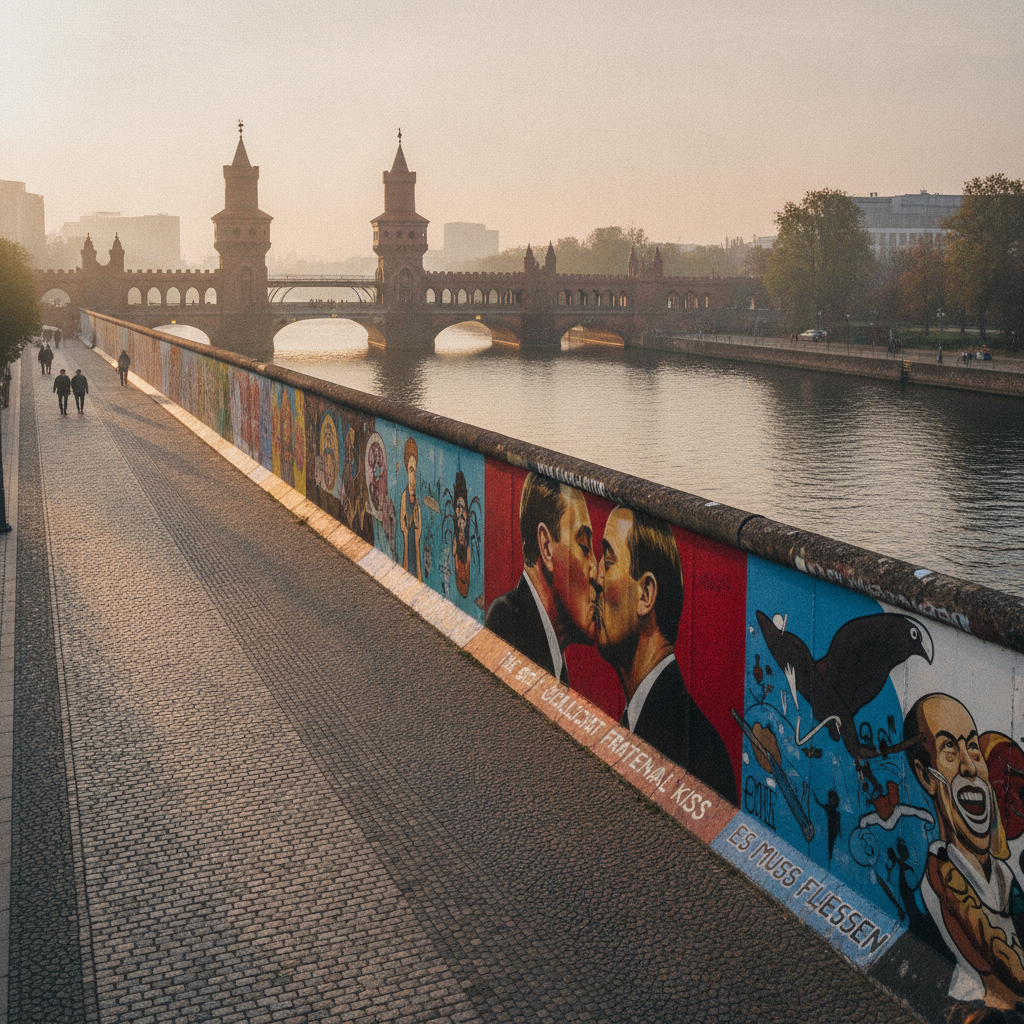
The East Side Gallery — a 1.3 km section of the Berlin Wall along the east bank of the Spree river between Ostbahnhof and Oberbaumbrücke, preserved and painted in 1990 by 118 artists from 21 countries — is the longest surviving section of the Berlin Wall (of the original 155 km of the wall system, including the death strip, approximately 3 km of the inner wall survives in situ; the East Side Gallery section is the largest single piece). The 105 murals include some of the most reproduced images in the world: Dmitri Vrubel's 'My God, Help Me to Survive This Deadly Love' (showing the 'fraternal kiss' between Brezhnev and Honecker, based on a 1979 photograph, the most reproduced image from the Wall, regularly restored), and Birgit Kander's 'Test the Rest' (the Trabant car breaking through the wall). The wall section faces the Spree — the river that marked the border of the GDR — and the cranes of the former freight port at Osthafen are visible across the water; the area around the gallery has become one of the most intensively developed urban zones in Berlin (Mercedes-Benz Arena, Zalando headquarters, East Side Mall).
- 2
Oberbaumbrücke (1896) & Warschauer Strasse
The Oberbaumbrücke — the double-deck red-brick Gothic Revival bridge over the Spree connecting the districts of Friedrichshain (east) and Kreuzberg (west), built 1894-1896 by the city architect Otto Stahn — is Berlin's most beloved and photographed bridge. During the Cold War, the bridge served as a pedestrian border crossing for West Berlin residents (the upper level was closed; only the lower arch span was used under guard); the U-Bahn (U1) crossed on the upper level, but passengers could not alight at Warschauer Strasse on the GDR side. After reunification, the bridge was restored (1993-1995) with the involvement of the Spanish architect Santiago Calatrava (who designed the central steel span replacing the damaged original section). The bridge is traditionally the site of the annual New Year's Eve flour-and-egg battle between Friedrichshain and Kreuzberg residents, a festive tradition that began spontaneously after reunification. The Warschauer Strasse area — the neighborhood around the bridge on the Friedrichshain side — is now Berlin's most concentrated clubbing and live music district (Berghain/Panorama Bar, the world's most famous techno club, is 800 meters north at the former heating plant on Rüdersdorfer Strasse).
- 3
Checkpoint Charlie (1961-1990)
Checkpoint Charlie — the most famous of the three Allied checkpoint crossing points in the Berlin Wall (Alpha at Helmstedt, Bravo at Dreilinden, Charlie at Friedrichstraße) — was the only crossing point for non-German foreigners and diplomats between West Berlin and East Berlin, and the site of the most dramatic incidents of the Cold War division. The name 'Charlie' derived from the NATO phonetic alphabet (the third checkpoint was 'C'). The checkpoint was the site of the US-Soviet tank standoff of October 1961 (21 days after the Wall was built, Soviet T-54 tanks and US M48 Patton tanks faced each other at point-blank range for 16 hours in the only direct military confrontation between the superpowers during the Cold War); the escape of East German border guard Conrad Schumann (who jumped the barbed wire on August 15, 1961, in the famous photograph by Peter Leibing); and numerous other escape attempts. The original checkpoint building was removed in June 1990 (its removal was itself a historic event, the first after the Wall fell); a replica stands at the original location, with actors in American uniforms for tourist photographs. The adjacent Haus am Checkpoint Charlie museum (1963) contains the most comprehensive documentation of escape attempts and the history of the division.
- 4
Topography of Terror (Topographie des Terrors, 2010)
The Topography of Terror — an outdoor and indoor documentation center built on the excavated foundations of the former SS headquarters complex (Prinz-Albrecht-Gelände) in the Niederkirchnerstraße, designed by Ursula Wilms and Heinz W. Hallmann (2010, permanent outdoor exhibition since 1987) — is the most important memorial site documenting the crimes of the National Socialist state. The Prinz-Albrecht-Gelände (the 'block of terror') contained the SS main headquarters (Reichssicherheitshauptamt), the headquarters of the Gestapo (Geheime Staatspolizei, Germany's secret police), and the SD (Sicherheitsdienst/Security Service of the SS) — in a single city block, the administrative center of Nazi terror. The 800-meter stretch of original Berlin Wall that stands along the northern edge of the site (the last surviving inner-city section of the Wall in its original location in the city center, preserved since 1990) provides a powerful visual connection between Nazi terror (1933-1945) and the Cold War division (1961-1989). The documentation center (Peter Zumthor was the original architect, 1993-2004, before the project was abandoned and restarted) receives 1.2 million visitors annually and admission is free.
- 5
Jewish Museum Berlin (Jüdisches Museum Berlin, 2001)
The Jewish Museum Berlin — designed by the Polish-American architect Daniel Libeskind (Studio Libeskind, his first major built project, opened 2001) — is one of the most significant works of architecture built anywhere in the world in the late 20th and early 21st centuries, and the most important museum of Jewish history and culture in Europe. The building — officially an extension of the adjacent Berlin Museum (the older building, 1735, Baroque) — is a titanium zinc-clad deconstructivist form that looks like a shattered Star of David from above. Libeskind's design is programmatically symbolic: the building contains three axes (the Axis of Exile, the Axis of Holocaust, and the Axis of Continuity), five voids (empty spaces that pierce the building vertically, inaccessible, lit only from above, representing the absence of Jewish life in Berlin), and the Holocaust Tower (an isolated concrete tower, unheated, partially lit from a narrow slit in the ceiling, that visitors enter alone — the most emotionally affecting architectural space in Berlin). The permanent exhibition covers 2,000 years of German Jewish history; the most moving room is the Garden of Exile (49 slanted concrete pillars on sloping ground, each filled with earth from Israel — for the 48th column — and Berlin — for the remaining 48 — representing displacement and diaspora).
- 6
Martin-Gropius-Bau & Niederkirchnerstraße
The Martin-Gropius-Bau — a Renaissance Revival exhibition hall built 1877-1881 by Martin Gropius (uncle of Walter Gropius, founder of the Bauhaus) and Heino Schmieden, gutted by bombing in 1945, restored 1977-1981, and now one of Berlin's premier international exhibition venues — stands adjacent to the Topography of Terror on Niederkirchnerstraße. The building hosts major international exhibitions (David Bowie Is, 2014, which originated here; Helmut Newton retrospective, 2020). Niederkirchnerstraße (the street separating the two sites) still retains an 80-meter section of the original Berlin Wall in its original position — the best-preserved section of the Wall in the city center, with the death-strip gravel visible on the GDR side. This section is now backed by a permanent outdoor exhibition of photographs from the Wall years on the fence along the Topography of Terror's perimeter.
Walk this route with audio
Stories play automatically as you reach each stop — no tapping needed.
More in berlin
Kreuzberg: Turkish Market, Landwehrkanal & Urban Culture
Hackescher Markt, Scheunenviertel & Prenzlauer Berg: Berlin's Bohemian Heart
Schöneberg, Steglitz & South Berlin: Kennedy's Stage, Bowie's Flat
Charlottenburg Palace & Kurfürstendamm: West Berlin's Royal Mile
Brandenburg Gate, Reichstag & Tiergarten: The Heart of Reunified Berlin