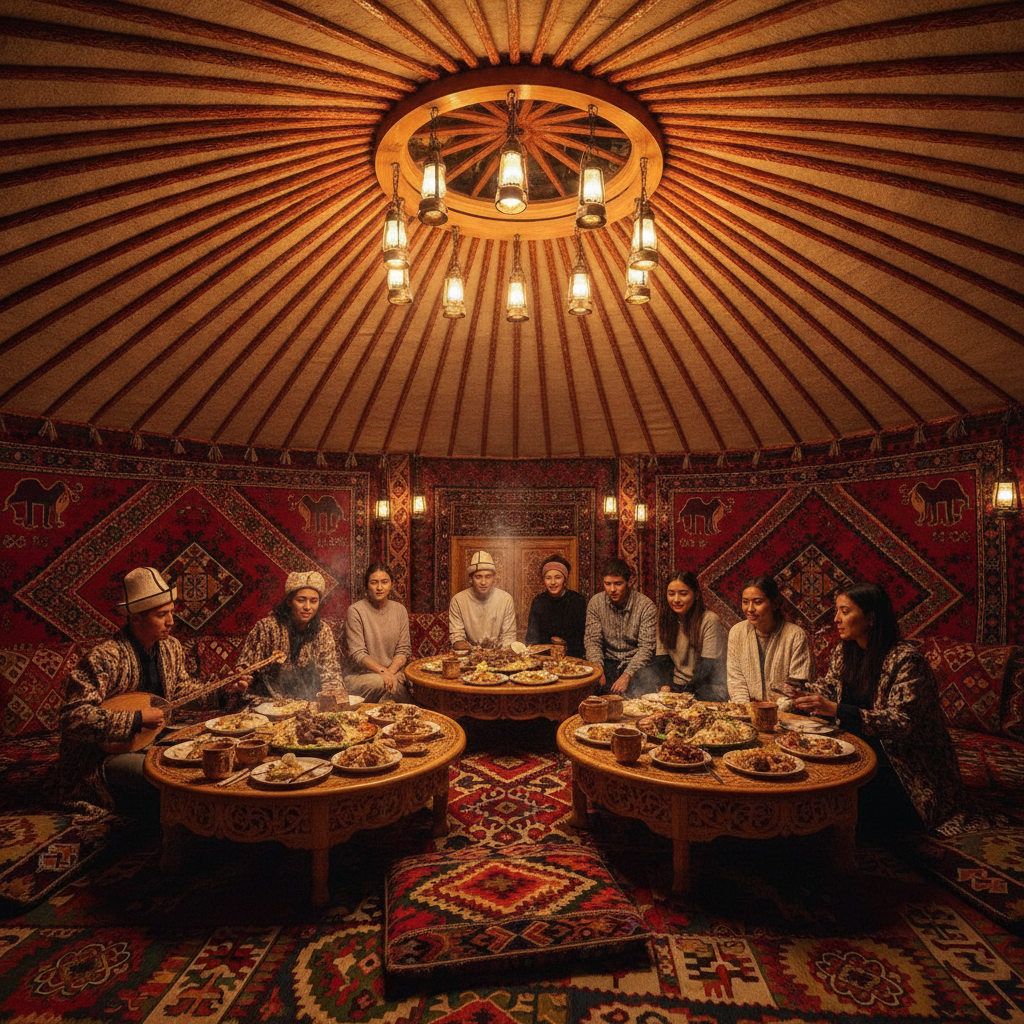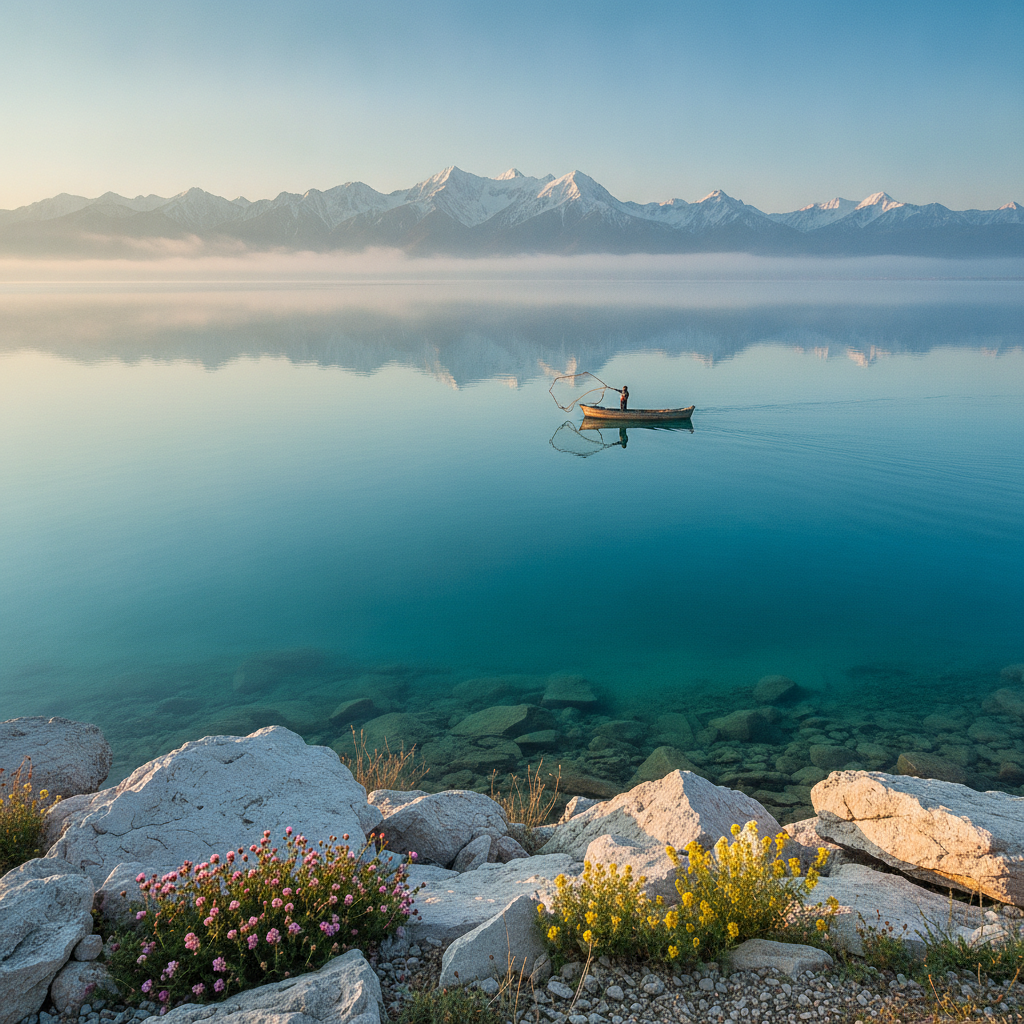
The Manas Epic at 500,000+ Lines Longer Than the Iliad and Mahabharata Combined, Issyk-Kul Never Freezes at 1,608m Due to Its 668m Depth & Son-Kul Summer Yurt Camps at 3,016m
Manaschi Sayakbay Karalaev performing 500,000+ line Manas epic from memory (the Soviet folklorists recording over 2 million total Manas verses); Issyk-Kul never freezing despite Tian Shan winters because its 668m depth acts as a thermal reservoir; the beshbarmak sheep's head ceremony distributing the eye to the youngest for vision and the ear to the elderly for hearing; shyrdak patchwork felt carpets (UNESCO 2012) requiring 15–20 hours of work per carpet; Kyrgyzstan's unique record of two presidents removed by popular uprising (2005 Tulip Revolution, 2010 April Revolution); and Son-Kul high-altitude pasture with bar-headed geese crossing the Himalayas during migration.
- 1
The Epic of Manas – The World's Longest Oral Epic
The Manas epic tradition (the Kyrgyz national epic — the longest oral epic in the world at over 500,000 lines — the most important cultural product of the Kyrgyz people): the epic heritage guide. The Manas (the Epic of Manas (Манас дастаны) — the oral epic cycle of the Kyrgyz people: the epic (the Manas epic is a trilogy: (1) Manas (the founding hero): (2) Semetei (the son of Manas): (3) Seitek (the grandson of Manas): the Manas epic in its complete form is over 500,000 lines of verse — compared to the Iliad (15,693 lines) and the Mahabharata (200,000 lines): the content (the epic describes the life and wars of the hero Manas — a Kyrgyz warrior who united the forty Kyrgyz tribes against the Oirat Chinese and the Kalmyk invaders: the 40 Kyrgyz tribes are referenced in the 40-ray tunduk pattern on the Kyrgyz flag): the manaschi (the Манасчы — the professional performer of the Manas epic — a manaschi memorizes the entire epic (or major portions of it) and performs it in chanted verse with musical accompaniment and physical performance: the training of a manaschi takes a minimum of 10 years: the most celebrated manaschi in Kyrgyz history was Sayakbay Karalaev (1894–1971) who could perform the entire Manas trilogy (500,000+ lines) from memory and was recorded by Soviet folklorists in the 1930s–1960s: the Manas recording project (the Soviet ethnographer Karl Reichl estimated that the total recorded Manas verses in the Kyrgyz archives exceed 2 million lines).
- 2
Issyk-Kul Lake – The Jewel of the Tian Shan
The Issyk-Kul Lake heritage (the world's most spectacular alpine lake and the primary natural attraction of Kyrgyzstan — the destination that defines Kyrgyz domestic tourism): the lake heritage guide. The Issyk-Kul (Ысык-Кол — Hot Lake in Kyrgyz): the lake (Issyk-Kul is the second-largest alpine lake in the world after Lake Titicaca (Peru/Bolivia) — altitude 1,608m, length 182 km, width 58 km, depth 668m (the deepest lake in Central Asia): the name (the name Issyk-Kul (Kyrgyz: Ысык-Кол — Hot Lake) refers to the fact that the lake never freezes despite the severe Tian Shan winters at 1,600m altitude — the lake's enormous depth (668m) acts as a thermal reservoir preventing the surface from reaching freezing point even in January): the clarity (Issyk-Kul is one of the clearest large lakes on earth — the visibility in the water is 20m+ — comparable to Lake Baikal): the ecology (Issyk-Kul has no surface outlet — the water exits only by evaporation, concentrating dissolved minerals over millions of years: the lake's salinity is 0.6% (approximately one-sixth of ocean salinity — below the taste threshold for most people but sufficient to affect the ecology)): the history (Issyk-Kul was on the primary branch of the Silk Road through the Tian Shan — the lake was a major waypoint for caravans traveling between Central Asia and China: the sunken cities (underwater archaeological investigations have found submerged Bronze Age and medieval settlements on the Issyk-Kul lake bed — including what may be the ruins of the medieval city of Chigu, the capital of the Wusun people (2nd century BCE)).
- 3
Kyrgyz Cuisine – Beshbarmak & the Nomadic Kitchen
The Kyrgyz culinary tradition (the most completely nomadic food culture in the former Soviet Union — the Kyrgyz cuisine is the most direct expression of the Inner Asian pastoral nomadic food system): the cuisine guide. The beshbarmak (the Бешбармак (Five Fingers — from Kyrgyz besh (five) + barmak (finger) — the national dish of Kyrgyzstan: the dish (the beshbarmak is boiled lamb or horse meat (or both combined) served over large flat diamond-shaped noodles (zhupka — the noodles are made from flour, egg, and salt, rolled flat and cut into diamond shapes 10cm wide): the name origin (the name Five Fingers refers to the nomadic tradition of eating the dish with the right hand without utensils — a practice now largely ceremonial in urban settings but still common in rural yurt settings: the serving ceremony (in the traditional beshbarmak ceremony, the sheep's head is presented to the most honored male guest — the guest distributes the portions of the head: the eye goes to the youngest person at the table to improve their vision; the ear goes to an older person to help them hear their children; the palate goes to children to improve their speech): the oromo (the Kyrgyz dumplings — large cylindrical steamed dumplings similar to the manti of Central Asian tradition but rolled into a cylinder rather than a pinched sphere): the jashyl chay (green tea with milk and salt — the primary beverage of the Kyrgyz nomadic household — the practice of drinking green tea with milk and salt (rather than sweet) is a cultural marker distinguishing Kyrgyz from Uzbek tea culture).
- 4
Kyrgyzstan's Political Revolutions – The Tulip Tradition
The Kyrgyzstan political revolution tradition (the extraordinary series of popular revolutions that has made Kyrgyzstan the most democratically turbulent state in Central Asia — the only Central Asian country to have removed two presidents by popular uprising): the political history guide. The First Revolution (the Tulip Revolution (March 24, 2005) — the popular uprising in Bishkek that overthrew President Askar Akayev (who had ruled since 1991): the revolution began when the opposition accused Akayev of rigging the 2005 parliamentary elections — protesters stormed the White House (the Kyrgyz government building on Erkindik Boulevard) on March 24 and Akayev fled to Russia: the name (the Tulip Revolution was named by Western media in parallel with the Rose Revolution in Georgia (2003) and the Orange Revolution in Ukraine (2004)): the Second Revolution (the April Revolution (April 7, 2010) — the second popular uprising that overthrew President Kurmanbek Bakiyev (who had come to power after the Tulip Revolution): the April 7 uprising was sparked by a sharp increase in electricity and fuel prices: at least 85 protesters were killed when security forces opened fire on the crowd storming the White House: the Bakiyev government fled to Belarus where he received political asylum: the Third Political Crisis (the 2020 Kyrgyz political crisis — the mass protests following disputed parliamentary elections in October 2020 led to the resignation of President Sooronbay Jeenbekov (who had ruled since 2017): Sadyr Japarov (who had been in prison on kidnapping charges) was released by protesters and appointed interim president, then elected president in January 2021).
- 5
Shyrdak Felt Carpets & Kyrgyz Traditional Crafts
The Kyrgyz traditional craft heritage (the most internationally celebrated craft tradition of Kyrgyzstan — the felt-making tradition that combines utility with extraordinary artistic expression): the craft heritage guide. The shyrdak (the Шырдак (shyrdak) — the most celebrated Kyrgyz craft product: the shyrdak is a patchwork felt carpet made by cutting two pieces of differently colored felt into interlocking mosaic patterns and sewing them together: the technique (the felt is made by spreading cleaned raw wool on a reed mat, applying hot water and soap, and rolling the mat tightly — the repeated rolling (with foot pressure) causes the wool fibers to interlock without weaving: the shyrdak is typically 2m x 3m or larger — a full shyrdak requires 15–20 hours of work): the motifs (the shyrdak motifs are drawn from the nomadic cosmological vocabulary: the kochkor muyuz (ram's horn spiral) representing strength and fertility; the tabak motif (the round plate pattern) representing the full moon and abundance; the ala motif (the spotted or dappled pattern) representing the Ala-Too mountains; the bird wing motif (kush kanadı) representing freedom): the ala-kiyiz (the ala-kiyiz (Ала-кийиз) — the simpler variant of the felt carpet made by pressing colored wool tufts directly into the wet felt base before the rolling phase — the ala-kiyiz produces a softer effect with more organic flowing patterns than the shyrdak): the UNESCO inscription (the art of Kyrgyz shyrdak and ala-kiyiz felt carpets was inscribed on the UNESCO Representative List of Intangible Cultural Heritage in 2012).
- 6
Son-Kul Lake – High Alpine Pasture at 3,016m
The Son-Kul Lake experience (the most authentic high-altitude nomadic pasture experience accessible from Bishkek — the summer yurt encampments around Son-Kul Lake at 3,016m altitude): the Son-Kul guide. The lake (Son-Kul (Сон-Куль — Last Lake in Kyrgyz) — a high-altitude endorheic alpine lake at 3,016m altitude in the central Tian Shan mountains: the lake dimensions (Son-Kul is 28 km long and 18 km wide — the lake is completely frozen from October to May: the summer season (the summer pasture season at Son-Kul runs from mid-June to mid-September — during this period the Kyrgyz herder families bring their livestock (sheep, horses, and yaks) to the alpine pasture (jailoo) surrounding the lake: approximately 150 yurt camps are established around the lake during the summer season): the access (Son-Kul is accessible from Kochkor (the nearest town, 155 km south of Bishkek) by 4x4 vehicle — the road climbs from 1,800m (Kochkor) to 3,016m (lake) over a 60 km pass road: in summer (July–August) the road is passable by any vehicle with good clearance: the CBT guesthouses (the Community Based Tourism network (CBT Kyrgyzstan) organizes yurt homestay accommodation around Son-Kul at USD 20–30 per person including meals — the meals include beshbarmak, fresh kumys, jashyl chay (salted green tea with milk), and fresh flatbread (boorsok)): the wildlife (the Son-Kul plateau is habitat for: the bar-headed goose (Anser indicus) — the highest-altitude migratory bird in the world that crosses the Himalaya and Tian Shan during its migration: the Eurasian wolf (Canis lupus) that preys on the herders' livestock: the red fox (Vulpes vulpes): short-eared owl (Asio flammeus)).
Walk this route with audio
Stories play automatically as you reach each stop — no tapping needed.
More in Bishkek
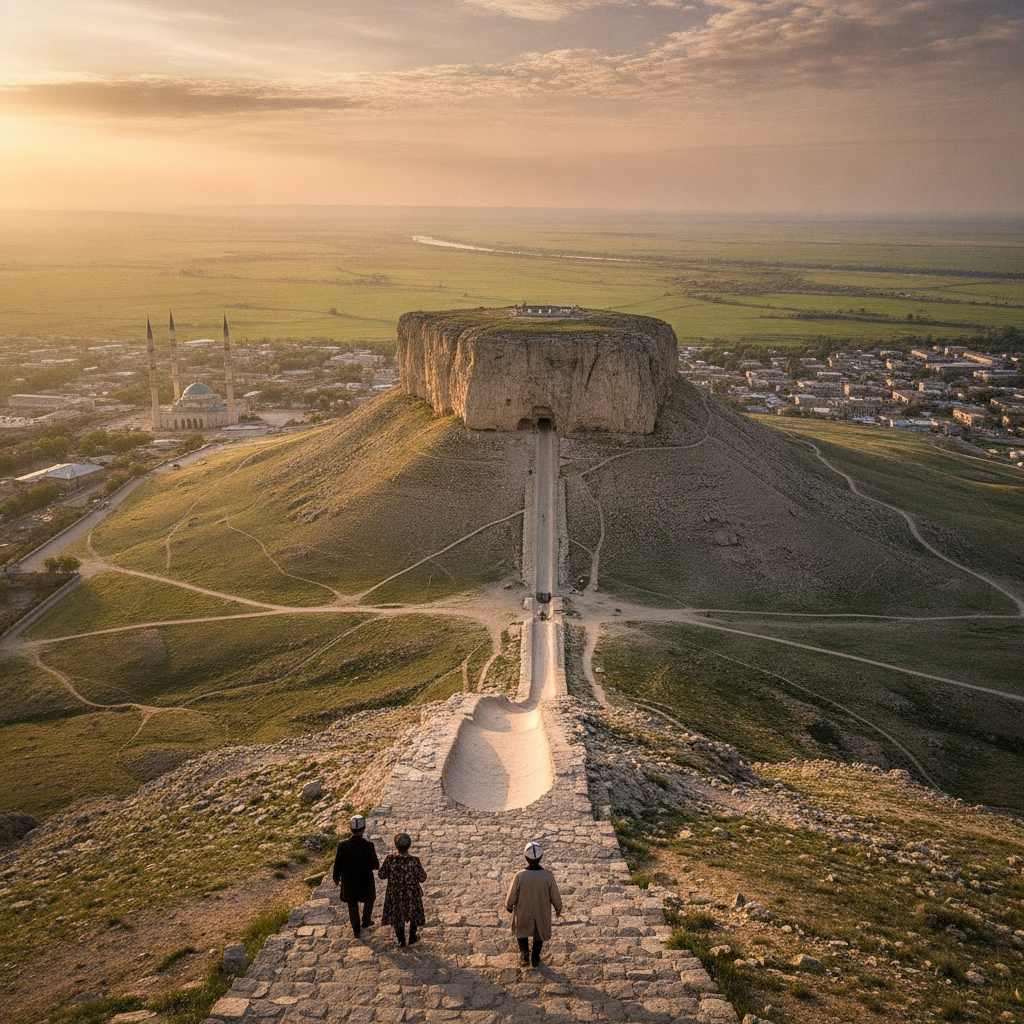
Babur Founded the Mughal Empire After Ruling Osh and Leaving His Mark on the Suleiman-Too Cave Mosque, the Kyrgyz Horse Surviving -40°C by Digging Through Snow (Tebineu) for Frozen Grass & the Burana Tower Oldest Monument in Kyrgyzstan
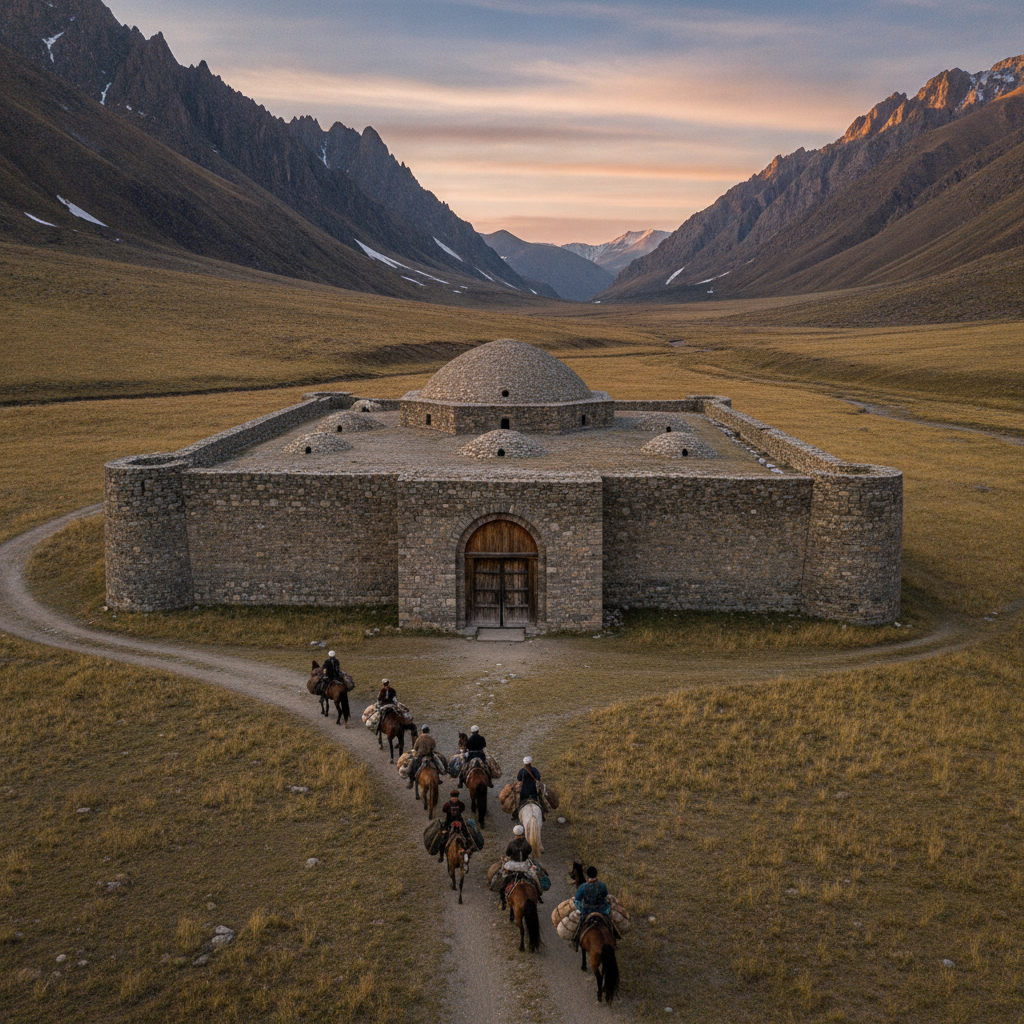
The Battle of Talas 751 CE Where Captured Chinese Papermakers Transferred Paper-Making Technology to the Islamic World, the Tash-Rabat Caravanserai Built at 3,200m Without Mortar & Kyrgyzstan's 700,000 Migrant Workers Sending 35% of GDP Home from Russia
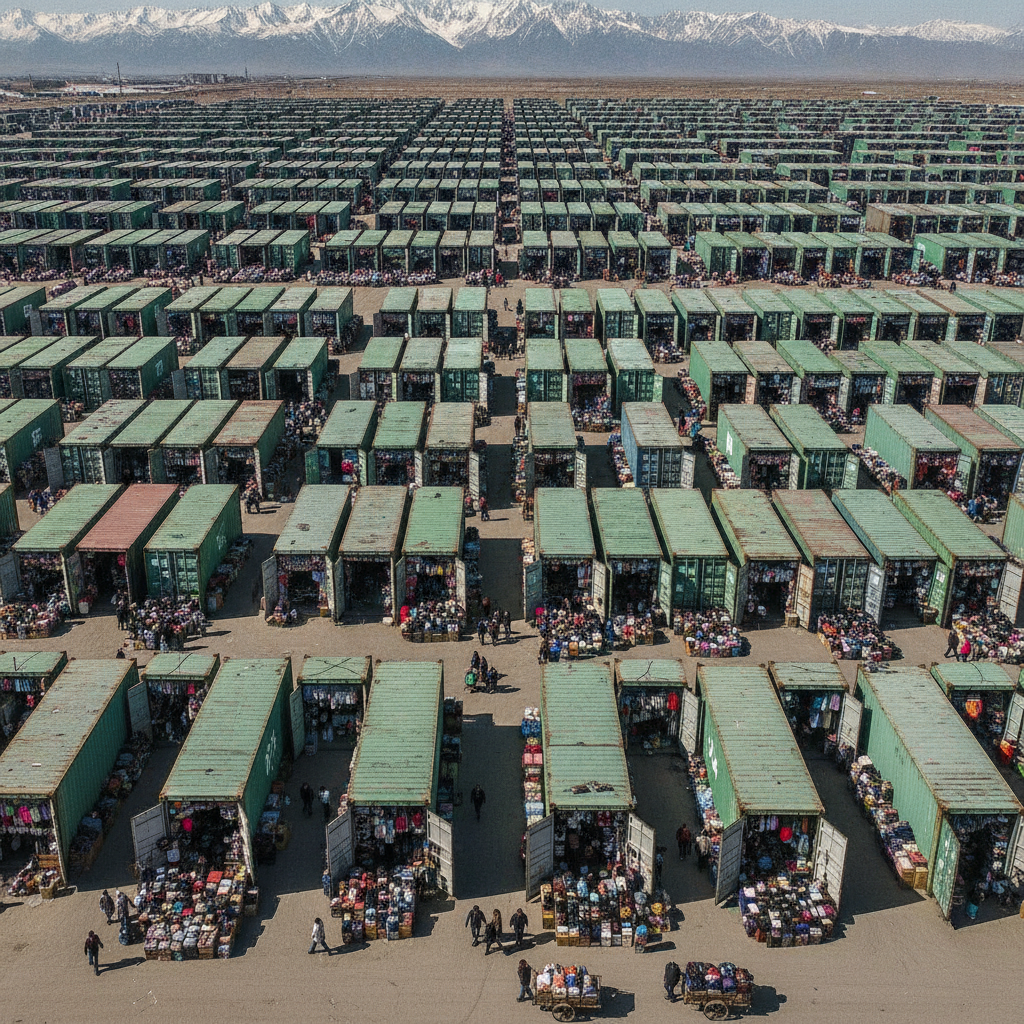
The Dordoi Bazaar 30,000 Container Stalls Handling USD 3-5 Billion Annually, Kyrgyz Yenisei Khaganate Briefly the Largest Turkic State in 840 CE & the CKU Railway Planned Since the 1990s Still Unbuilt
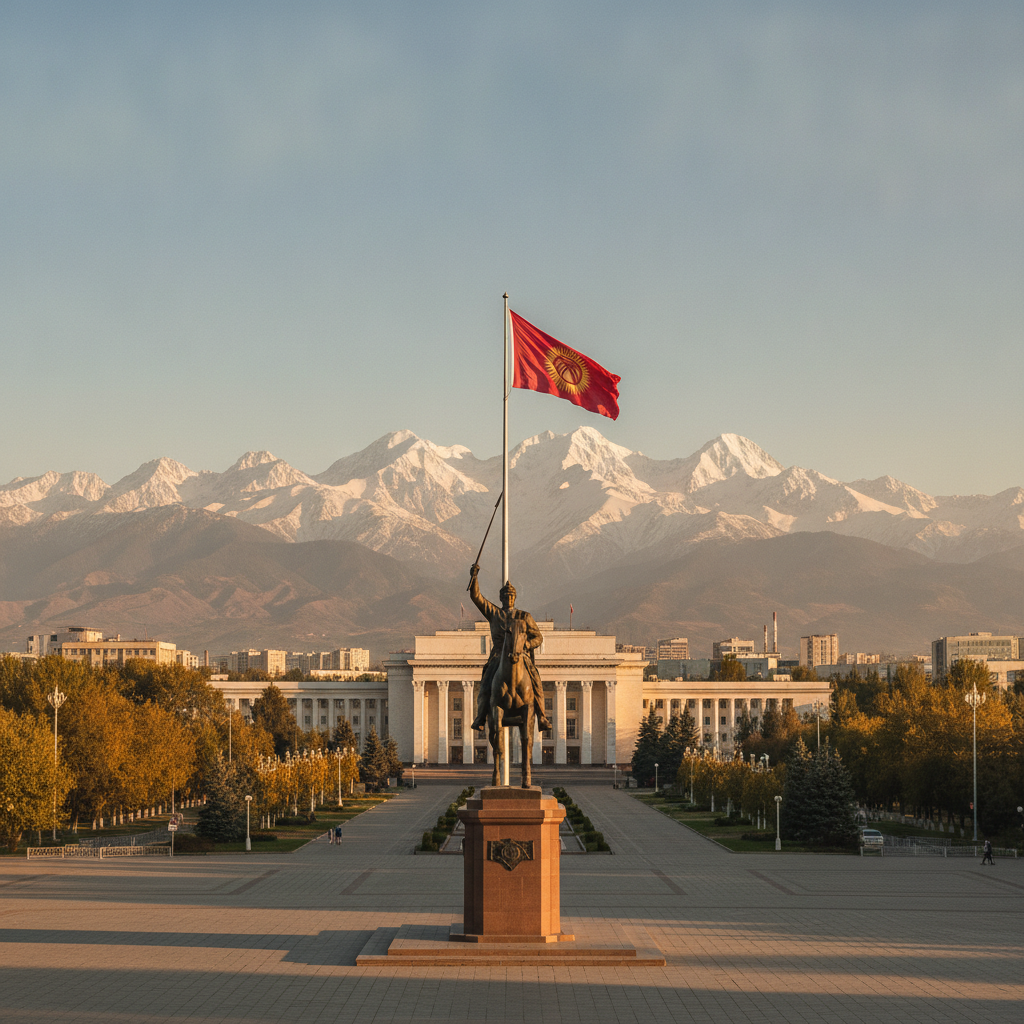
The Kyrgyz Tunduk Roof Ring on the National Flag, the Osh Bazaar Kumys Fermented Mare's Milk & Ala-Archa Glacier 45 km from Central Bishkek