Boise: Treasure Valley Food Scene, Nez Perce War, Lewis and Clark, BSU Blue Turf, Idaho Potatoes, and Basque Heritage
Boise: food (Basque foundation Bar Gernika Leku Ona Basque Market, Ballard Family Dairy Buhl Idaho Idiazabal-style Churra sheep only outside Basque Country, Fork farm-to-table Treasure Valley seasonal, Bittercreek Alehouse 1997 30 Idaho Pacific NW beers, Alavita most acclaimed Italian Idaho, Saturday Farmers Market 8th and Idaho 150+ vendors), Nez Perce War 1877 (750 Nimiipuu led Chief Joseph born 1840 died 1904, 2,000km flight across Idaho Wyoming Montana 3.5 months 13 battles, Clearwater Battle August 9-10 1877 near Kamiah largest battle, bear Paw Mountains October 5 1877 60km from Canada Tell General Howard I know his heart I will fight no more forever, Nez Perce NHP 38 sites Spalding HQ 330km north, most significant Lewis Clark Native allies horses food guidance to Pacific), Lewis and Clark (Meriwether Lewis born 1774 died 1809 William Clark born 1770 died 1838, Idaho westbound 1805 eastbound 1806, Lemhi Pass August 12 1805 River of No Return impassable, Lolo Trail 11 days near killed expedition September 1805, Sacajawea born 1788 Idaho purchased by Charbonneau indispensable interpreter infant son Jean-Baptiste born February 11 1805 signaled peaceful no war party has woman and child), BSU (26,000 students R1 2020 first Idaho R1, Albertsons Stadium 36,387 seats blue turf 1986 first colored artificial turf Smurf Turf, 2007 Fiesta Bowl January 1 BSU beat Oklahoma 43-42 Statue of Liberty Ian Johnson 48.2 Nielsen highest ever bowl), potatoes (Luther Burbank 1849-1926 Russet Burbank 1871, Snake River Plain volcanic loam altitude 900-1,500m diurnal range Snake River Aquifer 100M acre-feet, 5.5B lbs/year 30% US production, Lamb Weston Eagle ID and J.R. Simplot Boise two largest processors world, Idaho Potato Museum Blackfoot world largest potato chip 25x58cm 1991 Pringles), Basque history (oldest people Western Europe language isolate no relation any other language family, 3M Basque identity, 1890s sheepherders high desert sagebrush like Pyrenean mendialdeak, sheepherder wagon mobile home wood stove fold-down bed 2,000 sheep months alone, Jaialdi every 5 years 30,000+ stone lifting wood chopping txalaparta trikitixa).
- 1
Boise Food Culture - Farm to Table in the Treasure Valley
Boise food scene: the combination of Treasure Valley agricultural abundance, the Basque cultural tradition, and the influx of food-sophisticated California and Pacific Northwest migrants has produced a restaurant culture that consistently surprises visitors expecting a mid-sized Intermountain West city. The Basque food traditions (described in R1): Bar Gernika, Leku Ona, and the Basque Market set a distinctive culinary baseline. The local producers: Ballard Family Dairy and Cheese (in Buhl, Idaho, 190 km east of Boise): the Idaho artisan cheese producer making traditional Basque Idiazabal-style smoked sheep cheese from Churra sheep -- the only producer of this traditional Basque cheese outside the Basque Country. Hendersons Canyon Organic Farm (in Nampa, 35 km west of Boise): one of the largest certified organic vegetable farms in Idaho. The Boise restaurant highlights: Ten Barrel Brewing Company (at 826 West Bannock Street, downtown Boise): the craft brewery founded in Bend, Oregon in 2012 with a Boise tap room that has become one of the defining gathering places of downtown Boise. Fork (at 199 North 8th Street, Boise): consistently named one of the best farm-to-table restaurants in Idaho, with a menu driven by Treasure Valley seasonal produce. Bittercreek Alehouse (at 246 North 8th Street, Boise, established 1997): the original champion of Idaho craft beer in downtown Boise, with rotating taps of 30 Idaho and Pacific Northwest beers and a menu built around local ingredients. Alavita (at 680 South Cole Road, Boise, the Roman-inspired Italian restaurant): the most critically acclaimed Italian restaurant in Idaho. The Saturday Farmers Market at 8th and Idaho (at 8th Street and Idaho Street, downtown Boise, May through December, 150+ vendors): the most attended regular market event in downtown Boise.
- 2
Boise and the Nez Perce National Historic Trail
The Nez Perce War of 1877: the military campaign fought between the U.S. Army and a band of approximately 750 Nez Perce people (Nimiipuu -- the Real People -- in their own language) led by Chief Joseph (born 1840 approximately, Wallowa Valley, Oregon; died September 21, 1904, Colville Reservation, Washington, of a broken heart according to his doctor), who attempted to escape U.S. Army pursuit by fleeing 2,000 km across Idaho, Wyoming, and Montana toward Canada, fighting 13 battles and skirmishes against pursuing Army forces over 3.5 months (June 17 to October 5, 1877). The Clearwater Battle (August 9-10, 1877, near Kamiah, Idaho): the largest battle of the Nez Perce War, fought 500 km north of Boise, in which General O.O. Howard attacked the Nez Perce encampment and was repelled for two days before the Nez Perce escaped east over the Bitterroot Mountains. Chief Joseph's surrender speech (at Bear Paw Mountains, Montana, October 5, 1877, approximately 60 km from the Canadian border -- the Nez Perce had nearly reached safety): the speech that begins Tell General Howard I know his heart... From where the sun now stands, I will fight no more forever -- one of the most eloquent statements of defeat and survival in American history. The Nez Perce National Historical Park (with 38 sites across Idaho, Oregon, Washington, and Montana, the park headquarters at 39063 US Highway 95, Spalding, ID, 330 km north of Boise): the park interpreting the history of the Nez Perce people from the Sacajawea-era Lewis and Clark expedition contact (1805-1806) through the 1877 war and the present. The Nez Perce were the most significant Native American allies of the Lewis and Clark Expedition, providing horses, food, and guidance that enabled the Corps of Discovery to reach the Pacific Ocean.
- 3
Lewis and Clark in Idaho and the Corps of Discovery
The Lewis and Clark Expedition in Idaho (the expedition of Meriwether Lewis (born August 18, 1774, Ivy, Virginia; died October 11, 1809, Tennessee, by suicide or murder -- the circumstances remain debated by historians) and William Clark (born August 1, 1770, Caroline County, Virginia; died September 1, 1838, St. Louis) from 1804-1806, traversing what is now Idaho twice (westbound in 1805 and eastbound in 1806)): the most significant exploratory expedition in American history, commissioned by President Thomas Jefferson to explore the Louisiana Purchase territory and find a route to the Pacific Ocean. The Idaho crossing: the Corps of Discovery crossed Idaho from east to west via the Lemhi Pass (on the Idaho-Montana border, August 12, 1805), down the Salmon River canyon (which they found impassable -- the River of No Return), across the Bitterroot Mountains via the Lolo Trail (a harrowing 11-day crossing through snow and cold that nearly killed the entire expedition in September 1805), and down the Clearwater River to the Snake River and then the Columbia River to the Pacific Ocean. The Shoshone guide Sacajawea (born approximately 1788, Salmon River, present-day Idaho; died approximately December 20, 1812, Fort Manuel, present-day South Dakota, possibly age 24, though some accounts suggest she lived to 1884): the Shoshone woman purchased as a wife by French-Canadian trapper Toussaint Charbonneau (born March 20, 1767; died approximately 1843), who served as an indispensable interpreter and cultural mediator for the Lewis and Clark expedition through the Shoshone-speaking territories of Idaho and Montana. Her presence with an infant son (Jean-Baptiste Charbonneau, born February 11, 1805, Fort Mandan) signaled to Native peoples that the expedition was peaceful -- no war party travels with a woman and child.
- 4
Boise State University, the Blue Turf, and Bronco Football
Boise State University (at 1910 University Drive, Boise, established 1932 as Boise Junior College, became a 4-year institution 1965, became a state university 1974, enrolled 26,000 students in 2024): the largest university in Idaho by enrollment and one of the fastest-growing universities in the American West, with a Carnegie R1 (Doctoral Universities -- Very High Research Activity) designation achieved in 2020 -- the first Idaho university to reach R1 status. The Albertsons Stadium blue turf (the artificial turf playing field of Albertsons Stadium, 1400 Bronco Lane, Boise, 36,387 seats, the blue polyester turf installed in 1986 -- the first colored artificial turf in the history of college football, replacing the original 1970 turf when the program could not afford green turf and chose school colors instead): the single most recognizable feature of Boise State athletics, so distinctive that it is sometimes called Smurf Turf (from the blue animated TV characters) or The Blue. The Boise State Broncos football program: a perennially ranked Football Bowl Subdivision program that achieved national fame with the 2007 Fiesta Bowl (played January 1, 2007, at the University of Phoenix Stadium, Glendale, Arizona): Boise State defeated the heavily favored Oklahoma Sooners 43-42 in overtime, with the winning play a Statue of Liberty option pass from backup running back Ian Johnson -- the most dramatic bowl game ending in college football history, making BSU (a Mountain West Conference school) the national storyline of the 2007 season and permanently establishing the program on the national stage. The game had a 48.2 overnight Nielsen rating, the highest for a college bowl game in the Nielsen era.
- 5
Idaho Potatoes and Agriculture of the Snake River Plain
The Idaho potato: no other US state's agricultural product is as closely tied to its identity as the Idaho potato -- the Russet Burbank variety (developed by horticulturist Luther Burbank (born March 7, 1849, Lancaster, Massachusetts; died April 11, 1926, Santa Rosa, California) in 1871 from a mutation of the Early Rose potato variety, and named for its russet (brown) skin and the Burbank name when it became the dominant Idaho variety in the early 20th century). The Snake River Plain (the volcanic plain stretching 600 km across southern Idaho): the ideal potato-growing environment due to the combination of volcanic loam soil (high porosity for drainage, high mineral content for nutrition), altitude (900-1,500 m, providing the diurnal temperature range of warm days and cool nights that maximizes starch production), clean irrigation water from the Snake River Aquifer (one of the largest freshwater aquifers in North America, holding approximately 100 million acre-feet of water), and low pest pressure in the high desert climate. Idaho grows approximately 5.5 billion pounds of potatoes per year (30% of all US potato production), with the primary producing areas in the Magic Valley (Twin Falls area, 220 km east of Boise) and eastern Idaho (Rexburg, Idaho Falls, Blackfoot). The Idaho Potato Museum (at 130 NW Main Street, Blackfoot, ID, 400 km east of Boise): the museum in the potato capital of the world, with the world's largest potato chip (25 cm x 58 cm, a Pringles promotional chip made in 1991 and donated to the museum), the world's largest potato, and a comprehensive history of the Russet Burbank in Idaho agriculture. The potato economy: the Idaho potato industry generates approximately USD 5B in annual economic activity, with Lamb Weston Holdings (headquartered at 599 South Rivershore Lane, Eagle, ID, 15 km west of Boise) and J.R. Simplot Company (headquartered at 999 Main Street, Boise) as the two largest potato processing companies in the world.
- 6
The Basque History - From the Pyrenees to the High Desert
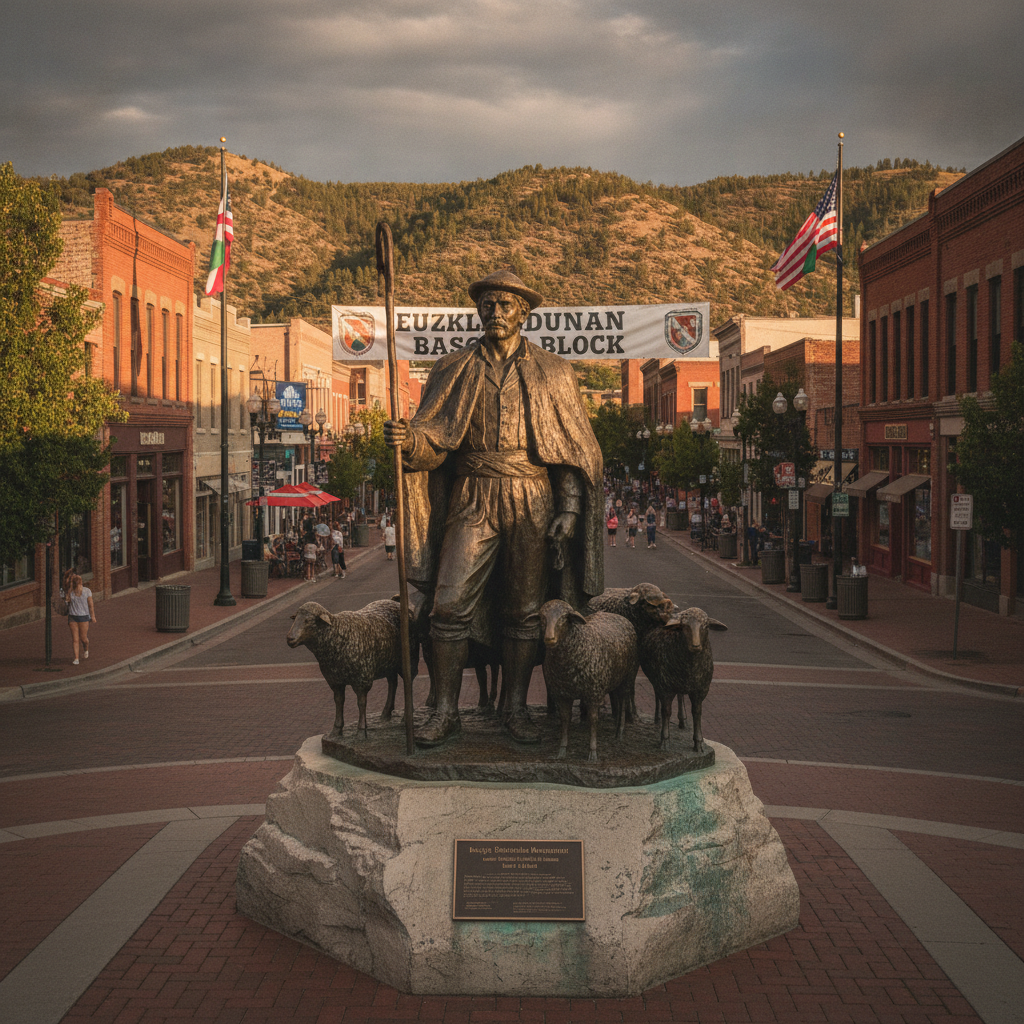
The Basque immigration to Idaho (the migration of Basque sheepherders from the Basque Country -- the autonomous region straddling the French-Spanish border in the western Pyrenees -- to the high desert rangelands of Idaho, Nevada, and Oregon beginning in the 1890s and continuing through the 1960s): the most significant Basque diaspora community in the Western Hemisphere, concentrated in Boise, Mountain Home, and Nampa. The Basque people (Euskaldunak -- those who speak Euskara -- in their own language): the oldest living people in Western Europe, with a language (Euskara or Basque) that is a language isolate -- the only pre-Indo-European language surviving in Western Europe, with no established genetic relationship to any other language family on earth. The Basque homeland: the 20,664-square-km Basque Country (Euskal Herria) spans northern Spain (the Basque Autonomous Community and Navarre) and southern France (the Northern Basque Country in the Pyrenees-Atlantiques department), with approximately 3 million people of Basque identity. The reason for Idaho: the Spanish Basques who immigrated to Idaho in the 1890s found the high desert sagebrush steppe similar to the mountain pastures (mendialdeak) of the Basque Country, and the sheepherding tradition was directly transferable -- Basque sheepherders could manage large flocks of sheep across the open range of the Snake River Plain using the same techniques and instincts developed in the Pyrenees. The sheepherder wagon (the mobile home invented for the western sheep range, a covered wagon with a wood stove, fold-down bed, and storage for a sheepherder to live alone with a flock of 2,000 sheep for months at a time): the Basque sheepherder wagon is preserved at the Basque Museum in Boise. The Jaialdi festival (held every 5 years in Boise, the largest Basque cultural festival in the United States, drawing 30,000+ Basque-Americans from across the West): the festival of Basque traditional sports (stone lifting, wood chopping, bale tossing, tug of war) and music (txalaparta percussion, trikitixa accordion).
Walk this route with audio
Stories play automatically as you reach each stop — no tapping needed.
More in boise
Boise: Egyptian Theatre, Sagebrush Trails and the Semiconductor City
Boise: Salmon River of No Return, Stanley and Sawtooths, Julia Davis Park, Idaho Politics, Eastern Idaho, and Yellowstone
Boise: Greenbelt, Basque Block, Oregon Trail, Outdoor Recreation, Craters of the Moon, and the Tech Economy
Boise: Astronaut Training Lava Fields, Blue Football Turf and a Food Scene on the Rise
Boise: Snake River Raptors, Sun Valley, Arts Scene, Owyhee Mountains, River Floating, and Practical Info