Harvard, MIT & the World's Greatest University Culture
The Boston-Cambridge metropolitan area contains the highest concentration of world-class universities in any comparable geographic area on Earth — Harvard University (founded 1636, consistently ranked 1st or 2nd in global university rankings), MIT (founded 1861, ranked 1st in the world in science and engineering), Tufts, Boston University, Northeastern, and Boston College, among many others, making Greater Boston the most influential intellectual environment in the United States.
- 1
Harvard Yard & the World's Most Famous Campus
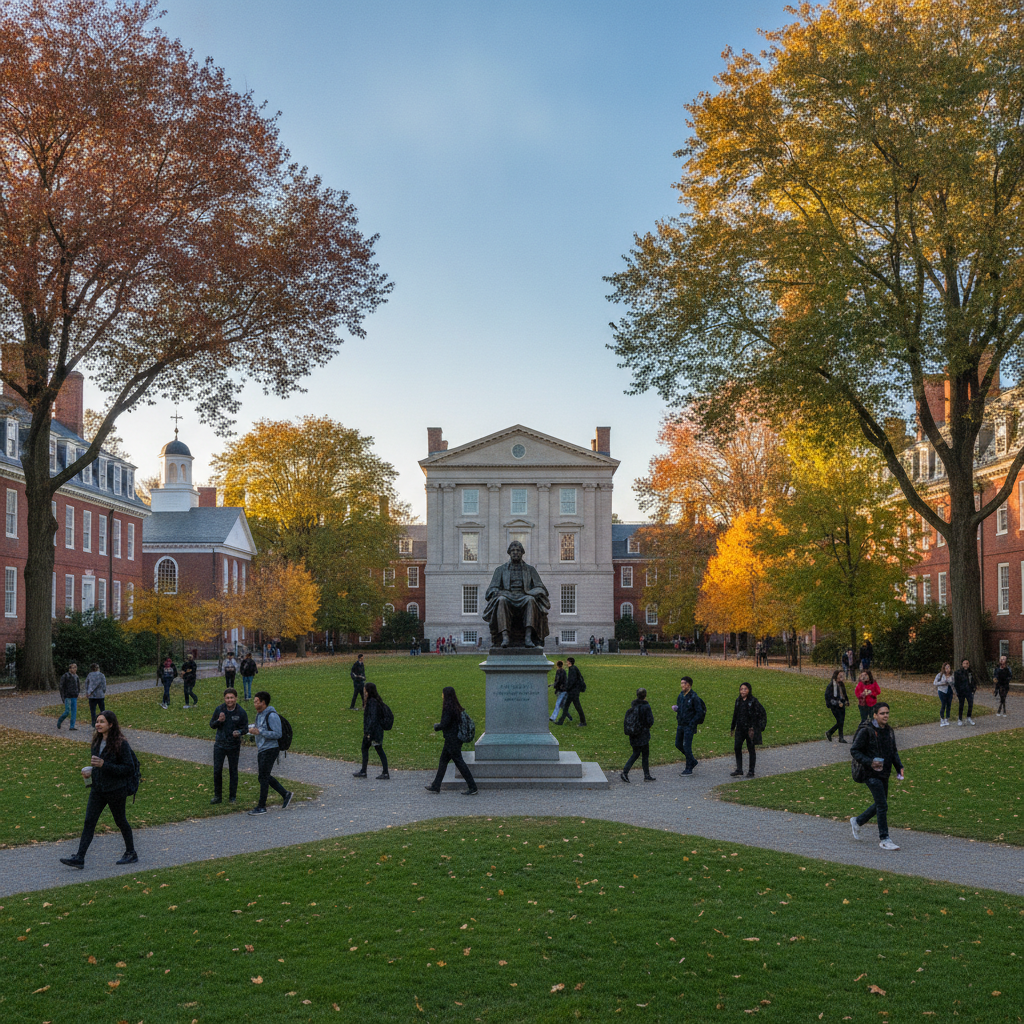
Harvard University (founded 1636 in Cambridge, Massachusetts — the oldest institution of higher education in the United States and consistently ranked among the top three universities in the world): Harvard Yard (the original 9-acre (3.6-hectare) historic core of the Harvard campus — the 'Old Yard', the 'New Yard' (also called 'Tercentenary Theatre' — the area between University Hall, the Widener Library, and Sever and Emerson Halls), and the 'Science Yard'): the most historically significant buildings in Harvard Yard are: Massachusetts Hall (1720 — the oldest surviving university building at Harvard and the second-oldest academic building in the United States, originally used as a student dormitory and now housing the President of Harvard's administrative offices), Holden Chapel (1742 — the oldest college chapel in continuous use in the United States, now used as a rehearsal space for the Harvard Choruses), and the Harry Elkins Widener Memorial Library (1915 — the central library of Harvard University, housing approximately 3.5 million volumes in its 57 miles (92 km) of shelves — the largest university library building in the world, built as a memorial to Harry Elkins Widener (1885-1912, a Harvard graduate and book collector who drowned when the RMS Titanic sank on April 15, 1912)): the Harvard Natural History Museum (the Peabody Museum of Archaeology and Ethnology and the Harvard Museum of Natural History — the finest collection of natural history and anthropological objects in the northeastern US, including the Glass Flowers (the Blaschka Glass Flowers — the collection of 847 botanically accurate glass models of plants created by Leopold Blaschka (1822-1895) and Rudolf Blaschka (1857-1939) in Dresden between 1887 and 1936 — the most technically extraordinary art-science objects in any museum)).
- 2
MIT — The World's Greatest Science & Technology University
Massachusetts Institute of Technology (MIT — 77 Massachusetts Avenue, Cambridge — the world's leading university in science and technology education and research (consistently ranked #1 in the world in engineering and technology by the QS World University Rankings, with 97 Nobel Prize laureates, 26 Turing Award winners, and 8 Fields Medal recipients among faculty and alumni)): the MIT campus (the 168-acre (68-hectare) campus in Cambridge directly on the Charles River (the infinite corridor — the 251-metre (825-foot) main corridor of the MIT campus, running east-west through the main academic buildings and connecting the major departments in a single continuous space — the longest straight corridor in any academic building in the United States): the architectural highlights of the MIT campus are: the Great Dome (the 54-metre (177-foot) neoclassical dome of the Barker Engineering Library, the primary architectural icon of MIT — visible from the Boston side of the Charles River), Building 20 (the 'Magic Incubator' — the temporary wooden building (1943-1998) that housed the wartime Radiation Laboratory and post-war became the incubator for some of the most important research in the history of science: the development of radar, the invention of the transistor radio, the development of Chomskyan linguistics, the development of the first practical video game ('Spacewar!'), and the research that led to the founding of Akamai Technologies and numerous other companies): MIT's Media Lab (the research laboratory at 75 Amherst Street — the most influential interdisciplinary research laboratory in the world for human-computer interaction, digital media, and technology).
- 3
The Charles River & Cambridge's Intellectual Landscape
The Charles River (the 130 km (80 mile) river flowing from Hopkinton, Massachusetts east through the Boston metropolitan area to Boston Harbor — the defining geographic feature of the Boston-Cambridge divide, the river that separates the City of Boston (south bank) from the City of Cambridge (north bank)): the Charles River Esplanade (the linear park along the Boston bank of the Charles River, from the Museum of Science to the Longfellow Bridge — the 5 km (3 mile) path system that is the most popular outdoor running, cycling, and leisure area in the Boston metropolitan area): the Charles River Basin (the section of the Charles River between the Charles River Dam (the New Charles River Dam, completed 1978 — the dam that keeps the basin water fresh regardless of tidal action, transforming the tidal marsh that the basin was before the dam into the recreational lake that it is today) and the Watertown Dam (the head of tide): the rowing culture (the Charles River is one of the most active rowing venues in the world — the Head of the Charles Regatta (the annual two-day rowing regatta held on the third weekend of October — the largest two-day rowing event in the world, with approximately 11,000 athletes from approximately 2,000 crews competing over the 4.8 km (3 mile) course from the Boston University Bridge to the Weeks Footbridge — the most spectacular annual event on the Charles River)) is the most visible recreational culture of the river.
- 4
Boston Common & the Public Garden — The Green Heart of the City
Boston Common (the 50-acre (20-hectare) public park between Tremont Street and Park Street in downtown Boston, established 1634 — the oldest public park in the United States, the starting point of the Freedom Trail, and the central gathering space of Boston): the Common (the park that has served as a common pasture (the original use — Boston's citizens grazed their cattle here until 1830), a military training ground (the British Army camped on the Common before the Battles of Lexington and Concord in April 1775), a public execution site (the Puritans of colonial Boston hanged convicted criminals and supposed witches at the Gallows area of the Common), and the city's primary outdoor public gathering space (protest rallies, concerts, civic ceremonies, and the annual First Night Boston New Year's Eve celebration have all been held on the Common)): the Boston Public Garden (the 24-acre (9.7-hectare) formal garden adjacent to Boston Common on its west side, established 1837 — the first public botanical garden in the United States): the Public Garden (famous for the Swan Boats (the pedal-powered passenger boats in the form of white swans that have operated on the lagoon in the centre of the Garden since 1877 — the oldest tourist attraction in Boston still in operation), the bronze 'Make Way for Ducklings' statues (the eight bronze duckling statues based on the 1941 Robert McCloskey children's book — the most-photographed public sculpture in Boston), and the seasonal flower plantings (the formal seasonal plantings of tens of thousands of bedding plants in the geometric flower beds surrounding the lagoon — the finest formal garden display in New England)).
- 5
Harvard's Museums — Art, Science & the Blaschka Glass Flowers
Harvard Art Museums (32 Quincy Street, Cambridge — the combined Harvard Art Museums complex (the Fogg Museum, the Busch-Reisinger Museum, and the Arthur M. Sackler Museum), redesigned by Renzo Piano and reopened 2014, containing approximately 250,000 works of art across all periods and cultures — the finest university art museum in the world): the Fogg Museum collection (the strongest component of the Harvard Art Museums, with particular strengths in Italian Renaissance painting (the Raphael, Fra Angelico, and Botticelli panels), Northern European 15th-17th century painting (the Rembrandt, Van Dyck, and Flemish still-life works), and Impressionism (the Monet, Renoir, Degas, and Cézanne works)); the Harvard Museum of Natural History (Oxford Street, Cambridge — the public-facing component of the Harvard natural history collections): the Glass Flowers (the Ware Collection of Blaschka Glass Models of Plants — the 847 botanically accurate glass models of flowering plants, representing approximately 780 species, created by the German glass artist Leopold Blaschka (1822-1895) and his son Rudolf Blaschka (1857-1939) in their studio in Hosterwitz, Germany, between 1887 and 1936, for the Harvard Botanical Museum — the most extraordinary fusion of science and art in any museum in the world, each model an exact replica of a specific plant species with every botanical detail reproduced in glass).
- 6
Kendall Square — The World's Most Innovative Square Mile
Kendall Square (the area of Cambridge around the Kendall/MIT MBTA Red Line subway station, bounded by Main Street, Broadway, and the MIT campus — the most concentrated cluster of biotechnology and technology companies in the world, often described as 'the most innovative square mile on the planet'): Kendall Square (the area that has transformed since the 1980s from a post-industrial wasteland (the former factory district and railroad yards adjacent to the Charles River) into the global epicentre of biotechnology (the companies headquartered or with major research facilities in Kendall Square include: Biogen (the $45 billion biotechnology company that developed the first disease-modifying treatments for multiple sclerosis), Amgen Cambridge, Genzyme, Novartis Institutes for Biomedical Research, Pfizer Cambridge, AstraZeneca Cambridge, Google Cambridge, Amazon Lab126, Microsoft New England R&D Center, and over 200 other biotech and technology companies within walking distance of MIT): the commercial real estate density (the approximately 10 million sq ft (930,000 m²) of lab and office space in Kendall Square — the highest density of lab space of any urban district in the world) and the resulting intellectual culture (the lunchtime and after-work mingling of Nobel Prize laureates, venture capitalists, MIT professors, and startup founders at the restaurants and coffee shops of Kendall Square) make it the most consequentially innovative single neighbourhood in the world.
Walk this route with audio
Stories play automatically as you reach each stop — no tapping needed.
More in boston
South Boston, Dorchester & Boston's Working-Class Irish Soul
Boston Seafood — Lobster, Clam Chowder & New England Cuisine
Boston Harbor Islands, Whale Watching & the Harbor's Rebirth
South End, Brookline & Boston's Victorian Architecture and Arts
Freedom Trail, Beacon Hill & Boston's Revolutionary Soul