Grand-Place, Manneken Pis & the Lower Town of Brussels
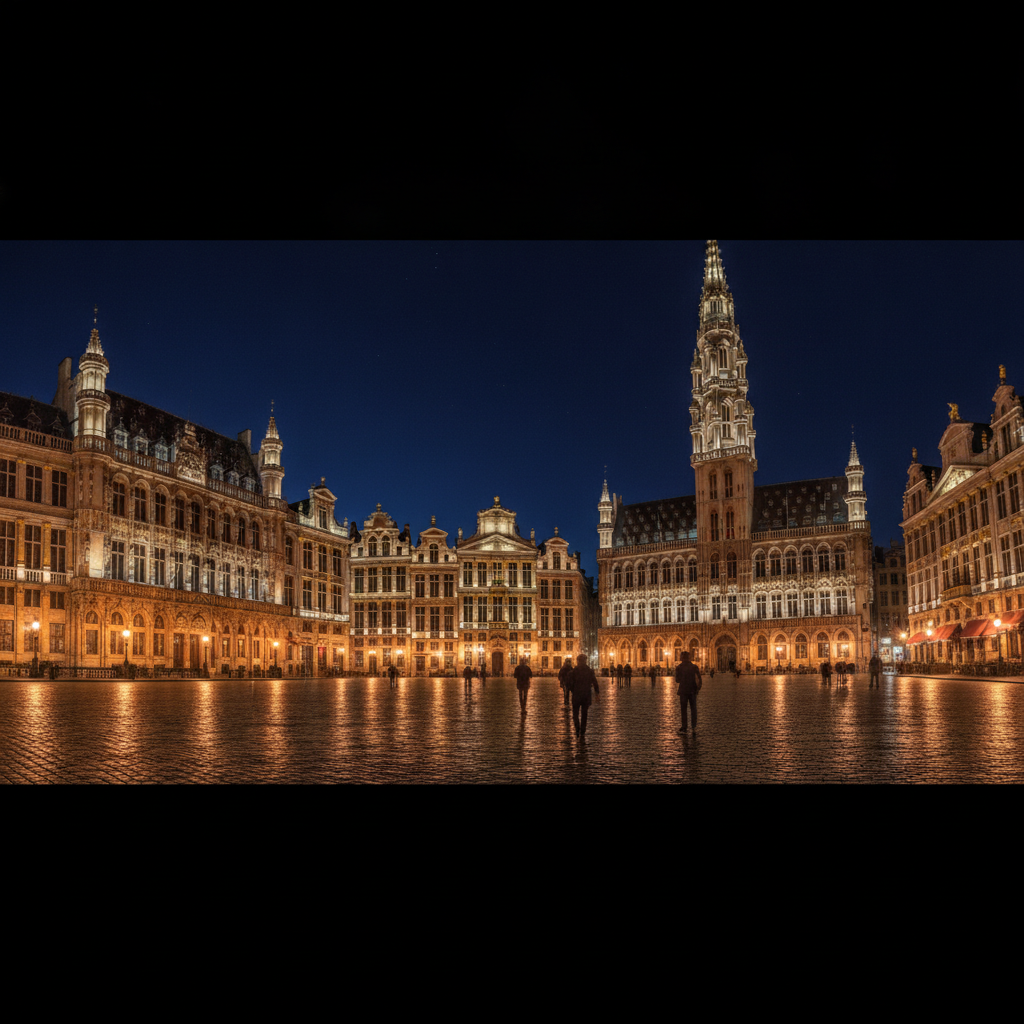
The Grand-Place (Grote Markt — the central square of Brussels, UNESCO World Heritage Site, described by Victor Hugo as 'the most beautiful square in the world,' surrounded by the Gothic Town Hall and the extraordinarily ornate Baroque guild houses of the Brussels merchant guilds, rebuilt after the French bombardment of 1695) is the defining monument of Brussels and the starting point for exploring the Lower Town (the historic commercial centre of the Belgian capital).
- 1
Grand-Place — The Most Beautiful Square in the World
Grand-Place (Grote Markt — the 110-metre x 68-metre central square of Brussels, UNESCO World Heritage Site since 1998): the current ensemble of buildings surrounding the square dates primarily from 1697-1699, when the guild houses were rebuilt after French Marshal de Villeroy's artillery bombardment of Brussels (August 13-15, 1695) destroyed most of the city (the Town Hall survived because French gunners used its spire as an aiming point for their artillery, ensuring that shells fell to either side of it); the rebuilding of the square produced one of the finest concentrations of Baroque architecture in northern Europe — each guild house built in the individual style of its guild but all within a unified Baroque vocabulary of gilded stone, pilasters, and baroque scrollwork; the most celebrated individual buildings are: the Maison du Roi (King's House, the Gothic-revival building housing the Musée de la Ville de Bruxelles, containing among other things the extensive wardrobe of costumes made for Manneken Pis), the Maison des Ducs de Brabant (the single neoclassical palace facade concealing six guild houses), and the golden facade of La Maison du Roi d'Espagne (the Bakers' Guild).
- 2
Hotel de Ville — The Gothic Town Hall
Hôtel de Ville (Town Hall — the south side of the Grand-Place, Brussels — the extraordinary Gothic building built in two phases (the left wing 1402-1444 under alderman Jacob van Thienen, the right wing 1444-1455 by architect Jan van Ruysbroeck), with the famous 96-metre central spire (also 1455, topped by a gilded copper weathervane figure of Saint Michael the Archangel) that survived the 1695 French bombardment): the Hôtel de Ville is the finest example of Brabantine Gothic civic architecture and the oldest surviving large building on the Grand-Place; the Brabantine Gothic style (the regional variant of Gothic architecture developed in the 15th century in what is now Belgium and the Netherlands) is characterized by intricate stone tracery, ornate pinnacles, and the multiplicity of gabled windows that cover the facades; the interior of the Town Hall (accessible by guided tour) contains 15 original tapestries (17th-18th century) depicting historical scenes from the history of Brussels and Belgium.
- 3
Manneken Pis — The Beloved Urinating Boy
Manneken Pis (the small bronze fountain statue of a boy urinating, at the corner of Rue de l'Étuve and Rue du Chêne, 100 metres southwest of the Grand-Place — the most famous statue in Brussels and one of the most famous in the world): the current bronze statue (55 centimetres tall) was cast in 1619 by sculptor Jérôme Duquesnoy the Elder and replaced an earlier stone version; the statue has been stolen and recovered multiple times since 1619 (most famously by British troops in 1745 and by French troops in 1747); the tradition of dressing Manneken Pis in costumes was established when King Maximilian-Emmanuel of Bavaria had the statue dressed in a military uniform in 1698, and the practice has continued ever since — the city of Brussels now has a wardrobe of approximately 1,000 costumes for the statue, which is dressed in themed costumes on approximately 130 occasions per year (national days of various countries, sporting events, cultural festivals); the costumes are displayed in the Musée de la Ville de Bruxelles on the Grand-Place.
- 4
Galeries Royales Saint-Hubert — The World's First Shopping Arcade
Galeries Royales Saint-Hubert (the covered shopping gallery running north from Rue du Marché-aux-Herbes in the Lower Town, opened August 20, 1847, designed by architect Jean-Pierre Cluysenaar in the Italian neoclassical style — the first covered shopping arcade in the world and one of the finest examples of 19th-century arcade architecture): the Galeries Saint-Hubert (comprising three connected sections: the Galerie du Roi, the Galerie de la Reine, and the shorter Galerie des Princes) were the model for all subsequent European shopping arcades — the glass-vaulted covered streets of high-end boutiques, chocolatiers, bookshops, theatres, and cafes that became the principal retail form of mid-19th century European cities; the galeries are particularly famous for their chocolate shops — Brussels being the world capital of fine chocolate (Neuhaus, founded 1857 and the inventor of the praline chocolate in 1912, was originally located in the Galerie de la Reine), and for the Cinéma Arenberg (the art house cinema that has operated in the galeries since 1913 in the Galerie de la Reine).
- 5
Belgian Chocolate, Beer & Waffles — The Holy Trinity
Belgian gastronomy's three greatest contributions to world food culture — chocolate, beer, and waffles: Belgian chocolate (the country produces approximately 220,000 tonnes of chocolate annually and is home to approximately 2,000 chocolate shops — the Belgian praline (the filled chocolate sweet with a hard shell and soft filling, invented by Jean Neuhaus Jr. in 1912) is the defining Belgian confection, and the leading Belgian chocolatiers (Neuhaus, Godiva (founded Brussels 1926), Pierre Marcolini, Mary, Wittamer, and Côte d'Or) are among the finest in the world); Belgian beer (Belgium produces approximately 1,500 different beers from 300 breweries — the most beer varieties per capita of any country in the world, including the extraordinary Trappist beers brewed by Trappist monks (Westvleteren, Chimay, Orval, Rochefort, Westmalle), the sour Lambic and Gueuze beers of the Payottenland region, and the spiced Witbier and Saison styles); Belgian waffles (the Brussels waffle (gaufre de Bruxelles — rectangular, deep-pocketed, light and crispy) versus the Liège waffle (gaufre de Liège — rounder, denser, with pearl sugar caramelized into the dough)).
- 6
Sablon — Antiques, Chocolate & the Fine Arts District
Sablon (Place du Grand Sablon / Place du Petit Sablon — the upmarket district south of the Grand-Place, centred on the Place du Grand Sablon (the square lined with antique dealers, chocolatiers, and restaurants) and the Gothic Church of Notre-Dame du Sablon (built 1304-1450, one of the finest late Gothic churches in Belgium)): the Sablon is the most elegantly attractive neighbourhood in central Brussels, with its tree-lined square (the Saturday and Sunday antique market on the Sablon square is the finest regular antique market in Brussels), high-end chocolate shops (Wittamer, the most famous Brussels chocolatier, has been on the Sablon since 1910), and the adjacent Petit Sablon (the small formal garden with 48 bronze statuettes of the medieval guilds of Brussels surrounding the central fountain); the Musées Royaux des Beaux-Arts de Belgique (the Royal Museums of Fine Arts of Belgium — the finest art museum in Belgium, housing the largest collection of Flemish Primitive and Flemish Baroque painting in the world, including Pieter Bruegel the Elder (the finest collection in the world), Roger van der Weyden, Hans Memling, Rogier de la Pasture, Peter Paul Rubens, and the surrealist collection of René Magritte) is a 10-minute walk from the Sablon.
Walk this route with audio
Stories play automatically as you reach each stop — no tapping needed.
More in brussels
Ghent Day Trip — Gravensteen Castle, the Ghent Altarpiece & Medieval Canals
Molenbeek, Anderlecht & Multicultural Brussels
The European Quarter — EU Institutions & the Capital of Europe
Bruges Day Trip — The Venice of the North & UNESCO Medieval City
The Atomium, Expo 58 & the Royal Domain of Laeken