The Grand Boulevard: Andrássy Avenue from Opera to Heroes' Square
Andrássy Avenue, Budapest's UNESCO-listed grand boulevard stretching 2.5 kilometers from the city center to Heroes' Square, was built in the 1870s as a deliberate statement of Hungarian national confidence after the 1867 Compromise — a Parisian Champs-Élysées for the new Budapest. Its neo-Renaissance palaces house the State Opera, embassies, and the House of Terror museum, one of Europe's most powerful memorials to 20th-century totalitarianism.
- 1
Hungarian State Opera House
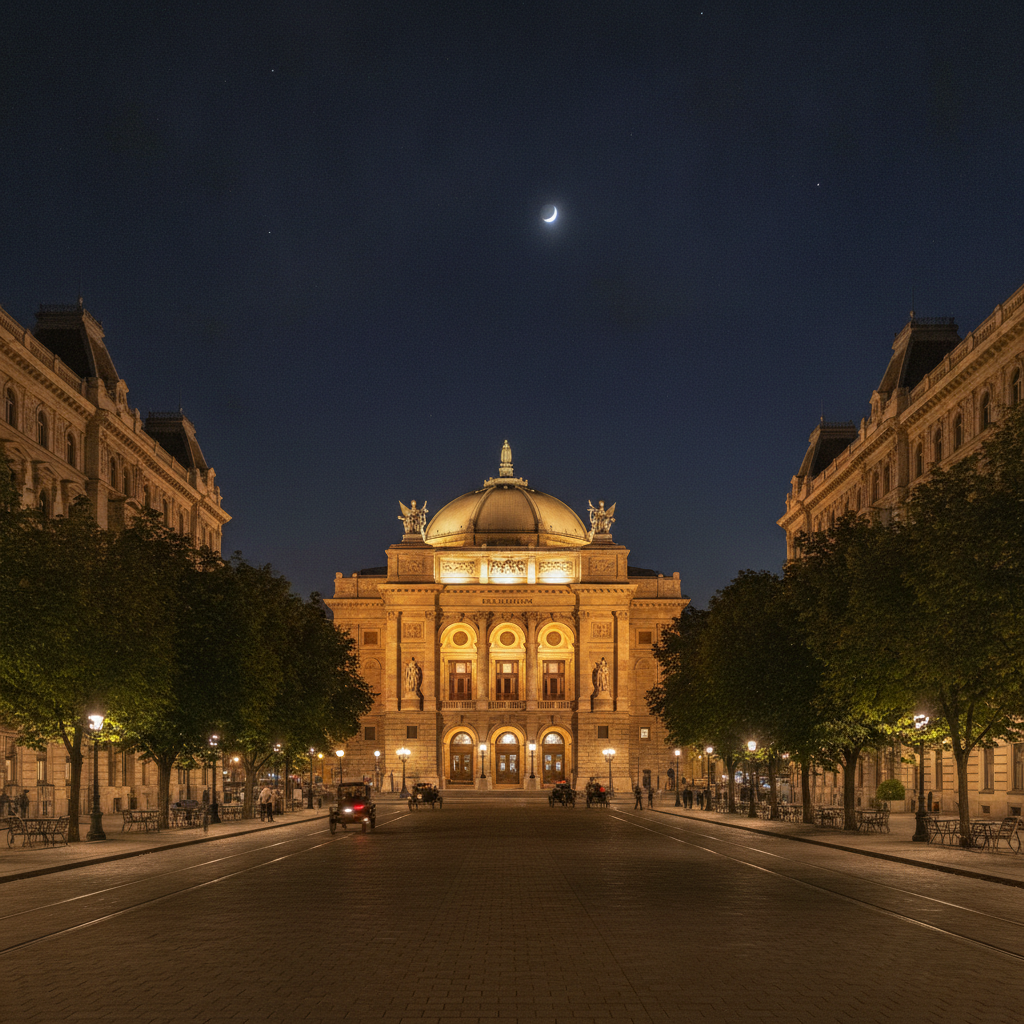
The Hungarian State Opera House (Magyar Állami Operaház), built between 1875 and 1884 by Miklós Ybl — the greatest Hungarian architect of the 19th century — is generally considered the most beautiful opera house in Europe and ranks among the finest acoustically in the world. Its neo-Renaissance facade of limestone and brick is elaborately decorated with allegorical statues; the interior's horseshoe auditorium, gilded stucco, and painted ceiling recall the Vienna Opera but in a smaller, more intimate scale. Gustav Mahler was director here from 1888 to 1891, conducting an exceptionally high-quality season that transformed Hungarian opera performance. Ferenc Liszt, Giacomo Puccini, and Otto Klemperer all conducted here; Richard Strauss's Elektra had its Hungarian premiere at this house.
- 2
Andrássy Avenue (Andrássy út)
Andrássy Avenue, named after Count Gyula Andrássy who championed its construction as prime minister, was built between 1872 and 1884 as a single unified design — apartment palaces in neo-Renaissance style, uniform cornice heights, and tree-lined double carriageways — that is still remarkably intact today. The first section, from Erzsébet körút to Oktogon, contains the densest concentration of late 19th-century bourgeois apartment architecture in Central Europe; every building facade is elaborately ornamented with stucco, carved stone, and ceramic detail. Beneath the avenue's first section runs the Millennium Underground Railway (M1), the first underground railway in continental Europe, opened in 1896, which is itself a UNESCO World Heritage Site.
- 3
House of Terror (Terror Háza)
The House of Terror Museum, in the building at Andrássy út 60 that served successively as the headquarters of the Hungarian Arrow Cross (fascist) secret police and then the ÁVH (Communist secret police), is one of the most emotionally powerful historical museums in Europe. The Arrow Cross used the building's basement as a torture and interrogation center during the 1944-45 occupation; the ÁVH continued its use for the same purposes from 1945 to 1956. The museum documents both regimes with extraordinary visual impact: an entire tank is suspended from the atrium ceiling surrounded by hundreds of photographs of victims; the basement cells have been preserved. The museum opened in 2002 and has been both celebrated for its impact and criticized for emphasizing Communist crimes over the preceding fascist ones.
- 4
Oktogon
Oktogon is the name of the crossing where Andrássy Avenue intersects with the Great Boulevard (Nagykörút), forming an octagonal intersection lined with four-story late-19th-century apartment buildings of unusual uniformity and quality. The Great Boulevard itself, completed in stages between 1872 and 1906, is Budapest's equivalent of the Parisian Grands Boulevards — a 4-kilometer semicircular ring of continuous apartment buildings that became the commercial and entertainment spine of inner Pest, lined with theaters, cafés, and department stores. During the Communist era, Oktogon was renamed November 7 Square (after the date of the Russian Revolution).
- 5
Liszt Ferenc Square (Liszt Ferenc tér)
Liszt Ferenc tér, a pedestrian square running perpendicular to Andrássy Avenue just before the Oktogon, has become the social center of inner Budapest — its terraced restaurants and cafés expanding across the square's entire width in summer, creating one of the most animated outdoor dining scenes in Central Europe. The square is anchored by the Franz Liszt Academy of Music at its head — the finest Art Nouveau concert hall in Hungary, built in 1904-07, with an extraordinary tilework facade by Ödön Lechner's student Flóris Korb. The bronze statue of Liszt himself, seated at a piano, presides over the square that bears his name.
- 6
Heroes' Square (Hősök tere)
Heroes' Square, at the far end of Andrássy Avenue, was created in 1896 for the Millennium celebrations marking the 1000th anniversary of the Magyar conquest of the Carpathian Basin — the same anniversary that produced the Parliament, the Millennium Underground, and many of Budapest's grandest buildings. The square's central monument — the Millennium Memorial — is a 36-meter stone column topped by the Archangel Gabriel, ringed by a semicircular colonnade containing statues of the seven Magyar tribal chieftains and Hungary's greatest rulers from Stephen I to Franz Joseph. The square is flanked by the Museum of Fine Arts (Szépművészeti Múzeum) and the Palace of Arts (Műcsarnok), two massive neo-Classical museum buildings of identical scale.
Walk this route with audio
Stories play automatically as you reach each stop — no tapping needed.
More in budapest
The Jewish Quarter: Dohány Synagogue, Memorial & Ruin Bars
Inner City Markets: Great Market Hall, Váci Street & the Danube Embankment
Green Island in the River: Margaret Island
Roman Budapest: Aquincum, Óbuda & the Ancient City Beneath the Modern
Parliament & the Danube: Lipótváros, Chain Bridge & St. Stephen's Basilica