Thermal Budapest: Széchenyi Baths, City Park & Vajdahunyad Castle
The City Park (Városliget), Budapest's oldest public park immediately behind Heroes' Square, was the site of the 1896 Millennium Exhibition that transformed it with a lake, a replica medieval castle, and the most spectacular neo-Baroque building in the city — the Széchenyi Thermal Bath. The entire complex remains the most concentrated celebration of Budapest's extraordinary thermal culture and 19th-century civic ambition.
- 1
Széchenyi Thermal Bath (Széchenyi gyógyfürdő)
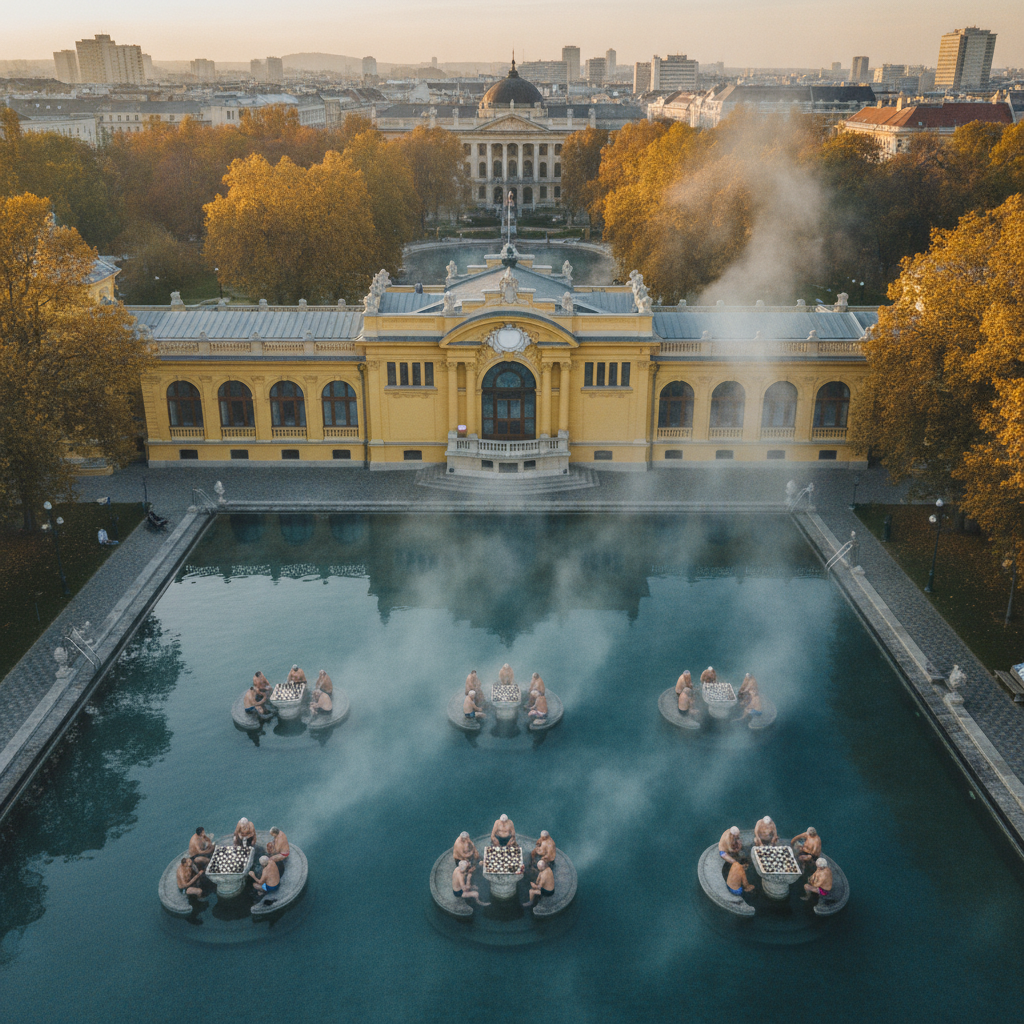
The Széchenyi Thermal Bath (Széchenyi gyógyfürdő), opened in 1913 and expanded in 1927, is the largest medicinal bath complex in Europe and the most famous symbol of Budapest's extraordinary thermal culture. Its neo-Baroque yellow palace — designed by Győző Czigler and Ede Dvorák — contains 18 pools: three outdoor pools (two of which are open year-round) and 15 indoor pools of different temperatures, from pleasantly warm to near-scalding. The thermal water comes from two wells 1,246 meters deep at a temperature of 74-77°C, cooled before entering the pools. The bath is famous for its chess players — older men who play at stone tables in the outdoor pools in all weathers, a Budapest institution for generations — and for the nightly Saturday 'Sparty' (Spa Party) events.
- 2
Vajdahunyad Castle
Vajdahunyad Castle, built for the 1896 Millennium Exhibition on an artificial island in the City Park lake, is a fantastical architectural collage that reproduces, at reduced scale, elements from Romanesque, Gothic, Renaissance, and Baroque buildings from across historical Hungary (including the real Vajdahunyad/Hunedoara Castle in Transylvania, now Romania). The architect Ignác Alpár designed it initially in cardboard and wood for the exhibition; the permanent stone version was built between 1904 and 1908. The castle complex now houses the Museum of Hungarian Agriculture. The lake surrounding it freezes in winter and becomes the largest outdoor ice skating rink in Central Europe, one of Budapest's most beloved seasonal attractions.
- 3
Museum of Fine Arts (Szépművészeti Múzeum)
The Museum of Fine Arts (Szépművészeti Múzeum), on the north side of Heroes' Square, houses Hungary's most important collection of international art in a monumental neo-Classical building (1906) by Albert Schickedanz — the same architect who designed the Millennium Memorial. The collection includes the finest grouping of Spanish paintings outside Spain (with works by El Greco, Goya, and Velázquez), significant Dutch Golden Age paintings, Italian Renaissance works, and Egyptian antiquities. The museum underwent complete renovation between 2012 and 2018 and reopened with expanded facilities.
- 4
Budapest Zoo & Botanical Garden (Fővárosi Állat- és Növénykert)
The Budapest Zoo, founded in 1866 as the first zoo in Hungary, occupies the northern edge of the City Park and is one of the oldest continuously operating zoos in the world. Its most remarkable feature is its architectural heritage: the zoo was substantially rebuilt for the Millennium Exhibition in 1896-1912 with animal houses in Hungarian Secession style designed by Kornél Neuschloss and Dezső Zrumeczky — the Elephant House, Birdhouse, and Palm House are among the finest examples of Secession architecture in Budapest, with Zsolnay ceramic tile facades and iron-and-glass roofs that are as interesting as their inhabitants.
- 5
Városliget Lake & Millennial Monuments
The City Park Lake (Városligeti tó), the artificial lake created for the 1896 Millennium Exhibition, forms the center of the park and surrounds Vajdahunyad Castle's island on three sides. In summer, the lake is used for boating; in winter it becomes the ice skating rink. The park itself — Hungary's oldest, dating to the early 19th century as a formal garden, expanded to English landscape style for the Millennium — contains the 'Anonymous' statue (1903), a bronze medieval chronicler figure sitting on a throne whose face is forever hidden by a hood, regarded as the patron saint of Hungarian writers who come to touch his pen for inspiration.
- 6
Museum of Fine Arts Surroundings & Olof Palme Walk
The area around Heroes' Square extending into the City Park contains several cultural institutions in addition to the museum. The Palace of Arts (Műcsarnok) on the south side of the square is Hungary's largest exhibition hall and hosts major international contemporary art shows. Olof Palme Sétány, the tree-lined walk from Heroes' Square into the park, is named after the Swedish Prime Minister assassinated in 1986; a bust of Palme stands at its entrance. The walk leads past the outdoor chess tables, paddling pools, and cafés that populate the park in summer to the Széchenyi Bath at the far end.
Walk this route with audio
Stories play automatically as you reach each stop — no tapping needed.
More in budapest
The Jewish Quarter: Dohány Synagogue, Memorial & Ruin Bars
Inner City Markets: Great Market Hall, Váci Street & the Danube Embankment
Green Island in the River: Margaret Island
Roman Budapest: Aquincum, Óbuda & the Ancient City Beneath the Modern
The Grand Boulevard: Andrássy Avenue from Opera to Heroes' Square