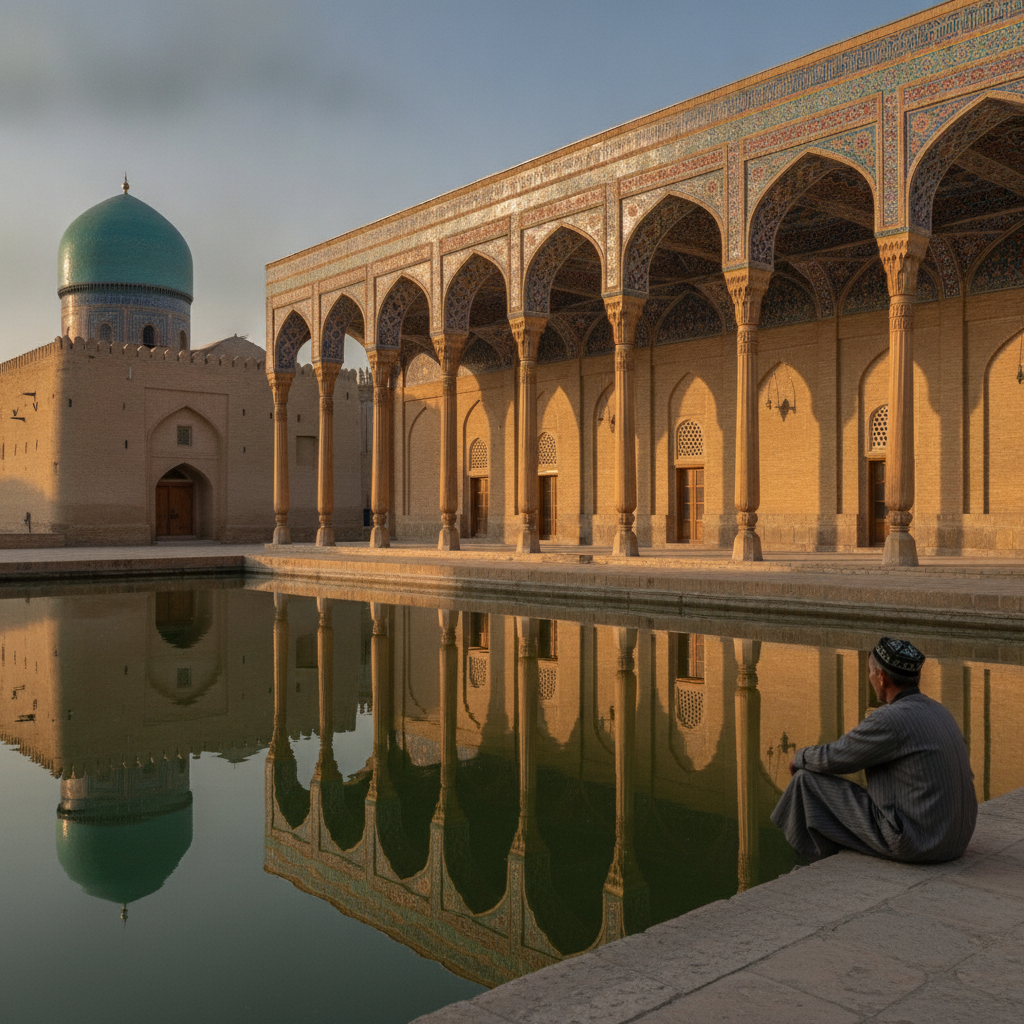
The 1127 Minaret Chinggis Khan Supposedly Spared Out of Admiration While Razing the Rest of Bukhara, the Ismoil Samoniy Mausoleum That Survived the Mongol Sack Because It Was Buried Under 300 Years of Street Sediment & the British Officers Executed in the Ark Fortress Square in 1842
The Kalyan Minaret foundation dried for 3 years before construction to prevent settling; the Ismoil Samoniy Mausoleum buried under 300 years of street-level sediment surviving the 1220 Mongol sack and rediscovered in the 19th century; British officers Stoddart and Conolly executed by Emir Nasrullah Khan in front of the Ark in 1842; the death drop execution of criminals from the 47m minaret top in the Bukharan Emirate period; the Lyabi-Hauz mulberry trees dating to 1620 CE as the oldest trees in Bukhara; and the Toki Zargaron jewellers dome spanning 18m at the primary gold market intersection.
- 1
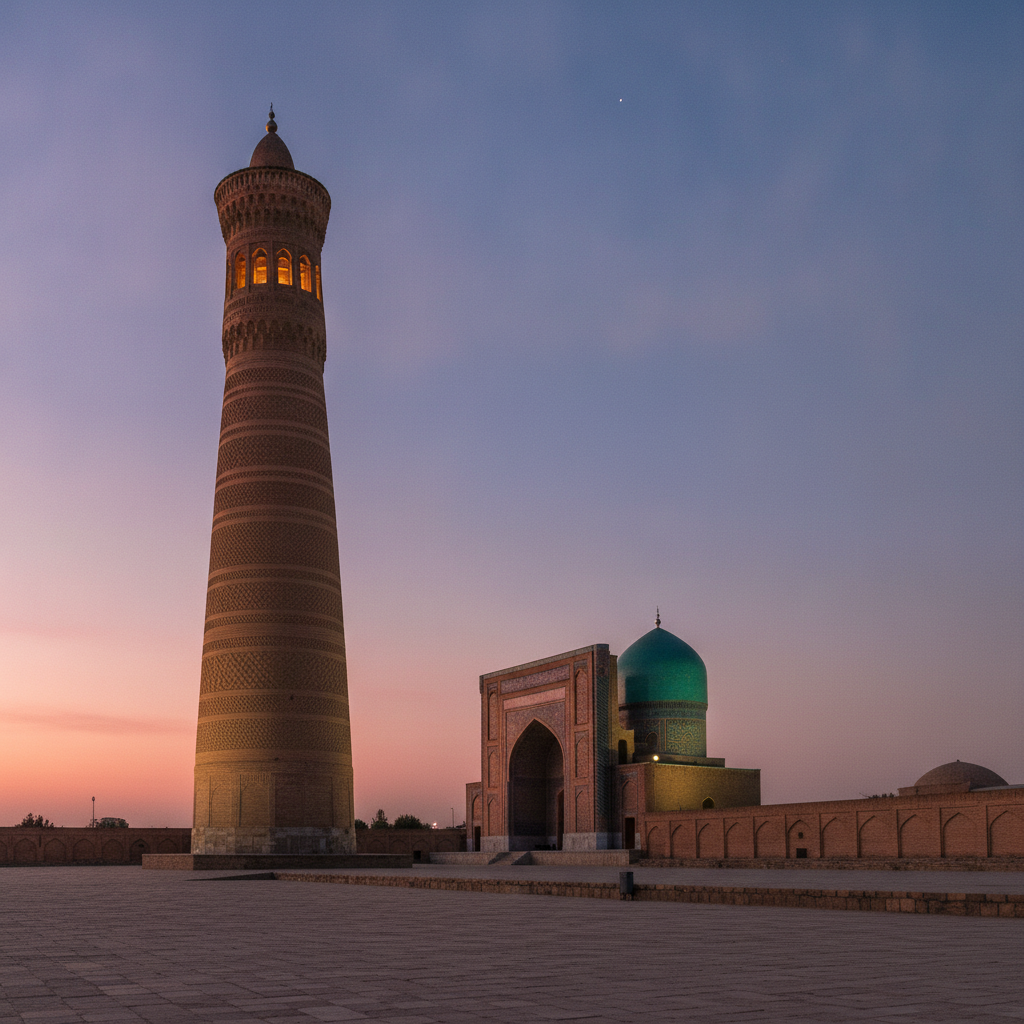
The Kalyan Minaret – The Tower That Survived Chinggis Khan
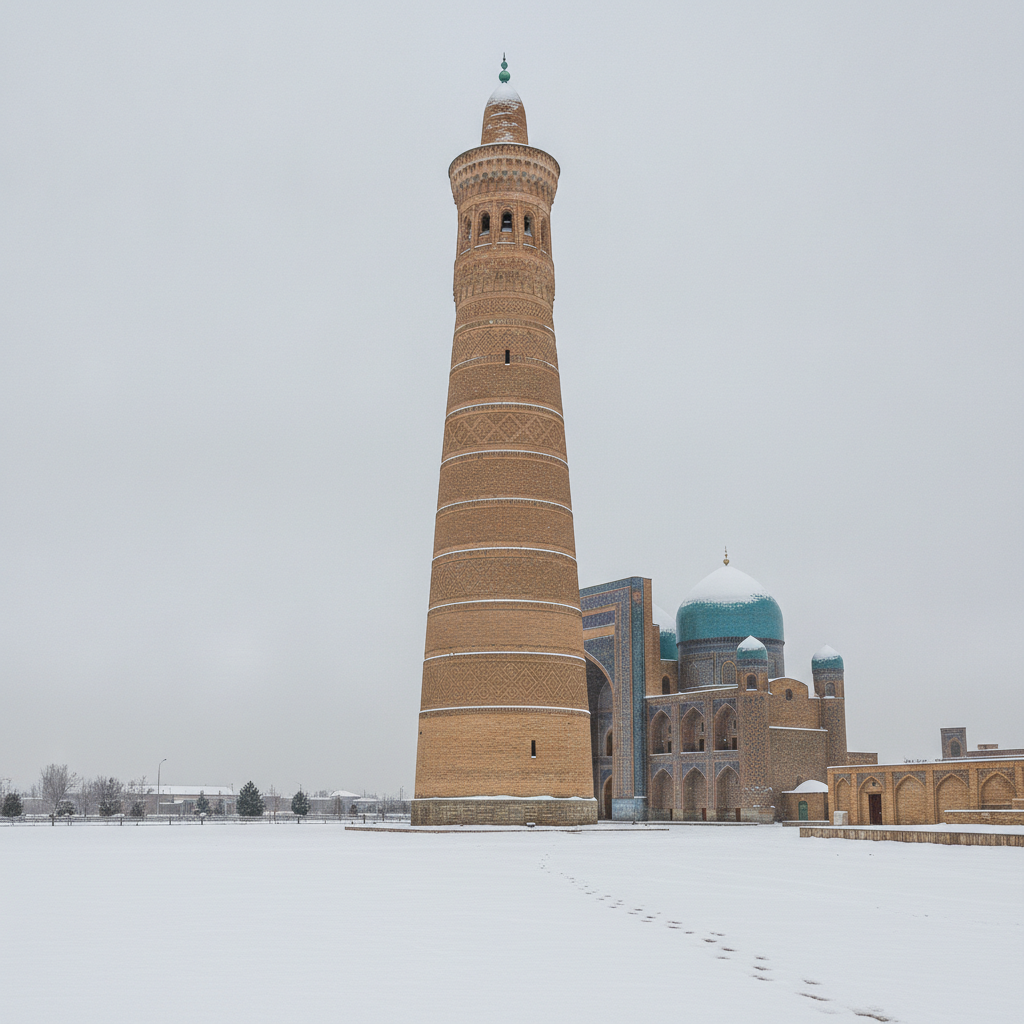
The Kalyan Minaret (Минораи Калон—'Great Minaret' in Tajik—the 47m tower built in 1127 CE by the Qarakhanid ruler Arslan Khan): the most significant surviving monument of pre-Mongol Central Asian architecture. The construction (the Kalyan Minaret was built in 1127 CE as the minaret of the Grand Mosque of Bukhara—the largest pre-Mongol minaret in Central Asia at 47m height and 9m base diameter: the construction technique (the tower is built of baked brick laid in 14 ornamental bands (the exterior brickwork forms 14 distinct decorative registers of geometric patterns, Kufic inscriptions, and interlaced geometric bands—each register unique in its brick-laying pattern): the foundation (the foundation was laid on a wooden frame sunk into the earth and allowed to dry for 3 years before construction of the tower began—the waiting period allowed the clay soil to compress under the foundation weight, preventing differential settlement): the Chinggis Khan story (the story—not historically verified—that Chinggis Khan entered Bukhara in 1220 and was so impressed by the Kalyan Minaret that he ordered it spared while the rest of the city was razed: the story is told in the Uzbek historical tradition and is consistent with the fact that the minaret is the only major pre-Mongol structure in Bukhara to survive the 1220 sack): the death drop (the minaret was used for public executions in the Bukharan Emirate period (18th–19th century)—condemned criminals were thrown from the top (47m) of the minaret onto the packed earth of the mosque courtyard below—a form of execution called the minaret drop recorded by European travelers).
- 2
The Ark Fortress – 1,500 Years of Bukharan Power
The Ark Fortress (Арк—'Fortress' in Uzbek/Tajik—the citadel of Bukhara, first constructed on the same site since the 4th century BCE and continuously inhabited as the seat of Bukharan rulers until 1920): the history of the fortress. The site (the Ark occupies a natural mound 20m above the surrounding city—the mound was the original Sogdian settlement site of ancient Bukhara (Nuparkath/Bumijkath) and has been the center of political power in Bukhara for 2,500 years): the structure (the current visible structure is predominantly the 16th–19th century Shaybanid and Bukharan Emirate reconstruction—the massive sloping brick walls (the battered walls at 3:1 slope—the distinctive Bukharan fortification style that proved resistant to battering ram attack) rise 20m from the surrounding terrain; the total fortress perimeter approximately 800m): the interior (the Ark contains: the throne room (the Kurinish-Khana—the audience hall where the Bukharan Emir received foreign ambassadors); the royal mosque; the mint; the stables; and the prison (zindon—in which Russian officers Charles Stoddart and Arthur Conolly were held before their execution in 1842)): the Great Game (the execution of Stoddart and Conolly in the square before the Ark in June 1842 by order of Emir Nasrullah Khan became one of the defining moments of the Great Game—the execution was a direct rejection of British diplomatic pressure and shocked European public opinion): the 1920 Red Army bombardment (the Red Army artillery bombardment of the Ark on September 2, 1920 ended the Bukharan Emirate and destroyed approximately 30% of the interior of the fortress).
- 3
Lyabi-Hauz – The Heart of Old Bukhara
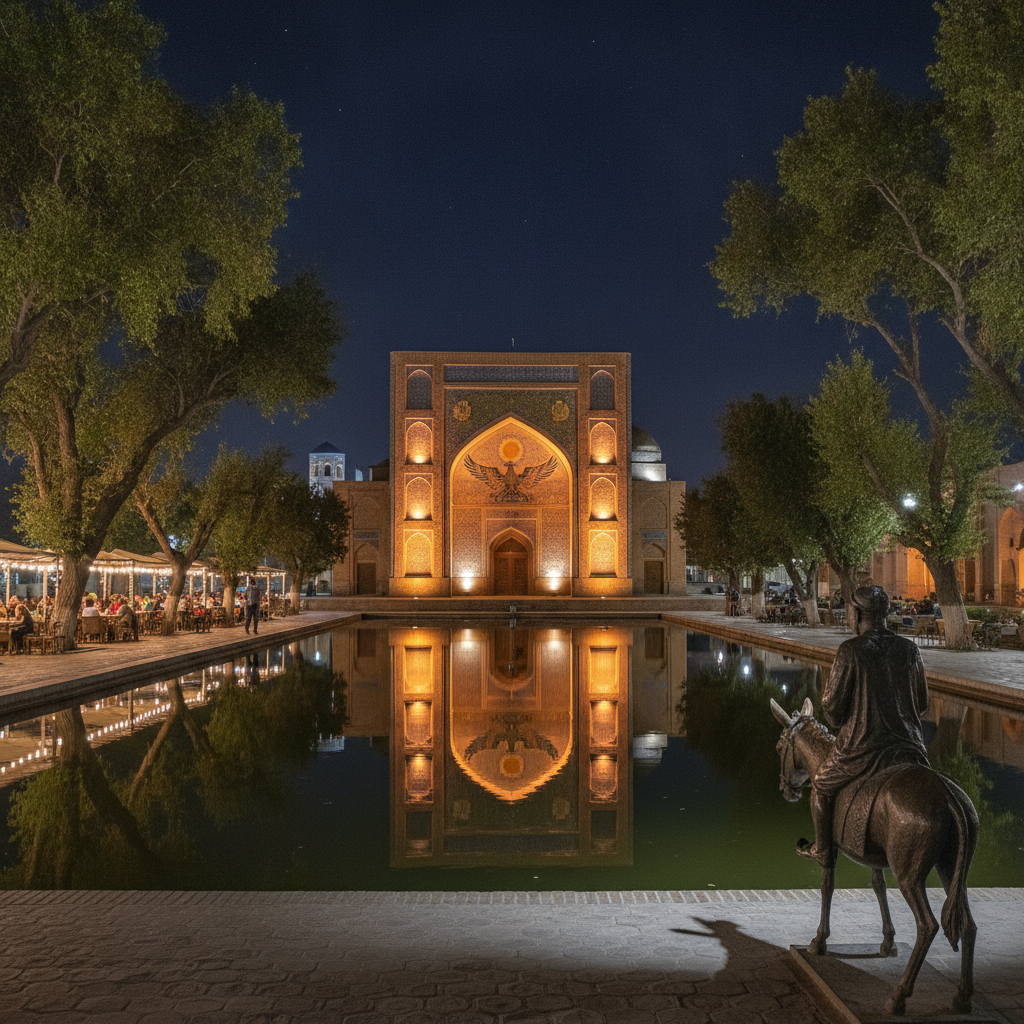
The Lyabi-Hauz ensemble (Лаби Хавз—'Beside the Pool' in Tajik—the central public square of the old city of Bukhara, built around a rectangular pool (hauz) constructed in 1620): the social heart of Bukhara. The ensemble (the Lyabi-Hauz consists of three monuments arranged around the rectangular pool (36m × 45m, 5m deep): the Nadir Divan-Beghi Khanaka (1619—the Sufi lodge built by the court official Nadir Divan-Beghi, with a facade decorated with birds of paradise and a sun (an unusual figural motif for an Islamic building)—the birds are phoenixes (simurgh) in the Persian tradition); the Nadir Divan-Beghi Madrasa (1622—the madrasa facing the pool with the same phoenix-and-sun facade motif); the Kukeldash Madrasa (1568—the largest madrasa in Bukhara, built by the Shaybanid vizier Abdullah Khan II)): the pool culture (the Lyabi-Hauz pool was historically the primary water source for the surrounding neighborhood—the mulberry trees planted around the pool perimeter (the oldest dating to 1620 CE) are the oldest trees in Bukhara): the Nasreddin Hodja statue (the bronze sculpture of Nasreddin Hodja—the folkloric wise fool of Central Asian and Middle Eastern tradition—riding his donkey, installed at the Lyabi-Hauz in 1979 by Soviet sculptor Yakov Shapiro—the statue has become the single most photographed object in Bukhara): the contemporary function (the Lyabi-Hauz is now the primary tourist gathering space in Bukhara—the outdoor restaurants and teahouses around the pool are open 08:00–22:00).
- 4
Ismoil Samoniy Mausoleum – The Oldest Monument in Bukhara
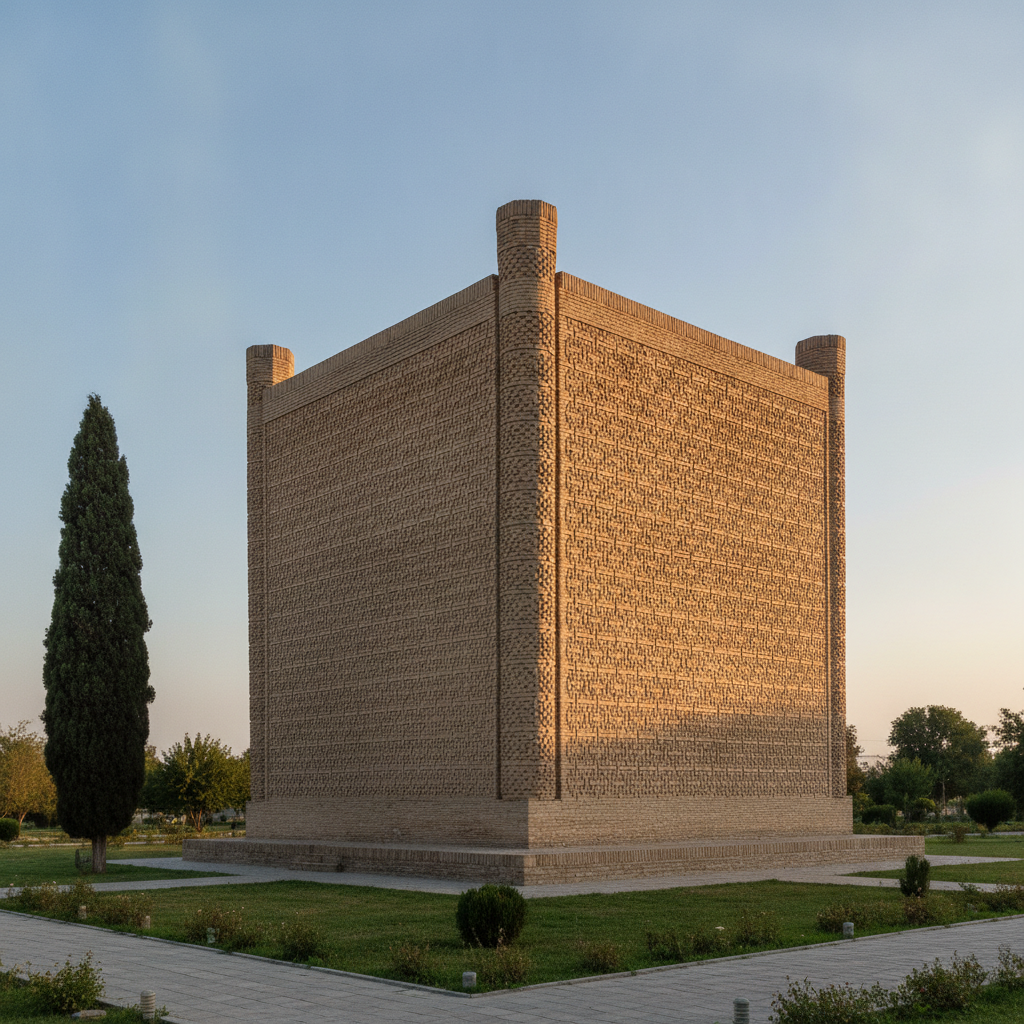
The Ismoil Samoniy Mausoleum (the tomb of Ismoil Samoniy (849–907 CE), founder of the Samanid dynasty—the oldest surviving Islamic monument in Central Asia, built circa 907 CE): the architectural masterpiece. The Samanid dynasty (the Samanids were a Persian-speaking Sunni Muslim dynasty that ruled Bukhara as their capital (819–999 CE) and presided over the first Persian cultural renaissance in the Islamic world—the Samanid court in Bukhara was the patronage environment for the poets Rudaki and Daqiqi and for the early chapters of Ibn Sina's education): the architecture (the mausoleum (10m × 10m square plan, 16m to the dome apex) is the finest example of 10th-century Islamic baked brick architecture—the exterior walls use 8 different brick-laying techniques to create decorative patterns that change appearance with the angle of sunlight throughout the day: at dawn the north wall appears flat; at midday the complex basketweave pattern on the east wall creates deep shadow; at sunset the western facade appears to move as the shadow angle shifts—the structure is an architectural sundial): the conservation (the mausoleum survived the Mongol sack of 1220 because it was buried under the accumulated sediment of 300 years of Bukharan street level rise—it was rediscovered in the 19th century): the symbolic meaning (the dome on squinches construction—the transition from square plan to circular dome via corner squinches is the defining architectural problem of early Islamic architecture; the Ismoil Samoniy mausoleum provides the earliest surviving example of the solution that became standard in all subsequent Central Asian Islamic architecture).
- 5
The Caravanserais of Bukhara – The Merchant Trade Network
The caravanserai heritage of Bukhara (the network of merchant inns and trading domes that formed the commercial infrastructure of the medieval Silk Road city): the trade heritage guide. The trading domes (Bukhara's historic trading domes (Tim-i Sarrafon, Tim-i Abdullah Khan, and Toki Zargaron)—three covered market buildings constructed in the 16th century Shaybanid period at the major intersections of the old city's trading streets: the Toki Zargaron (the Jewellers' Trading Dome, 1569—the largest of the three domes, at the intersection of the main north-south bazaar street; the dome spans 18m and covered the primary goldsmithing market): the Tim-i Sarrafon (the Money-Changers' Trading Dome, 1528—the most intact interior, with muqarnas (stalactite) vaulting in the corner squinches and 14 merchant cell alcoves)): the caravanserai buildings (the Bukhara caravanserai (karavan-saroy) was the standard overnight facility for long-distance merchant caravans—providing stabling for pack animals on the ground floor and sleeping quarters for merchants on the upper floor around a central courtyard (the Tim-i Abdullah Khan once held 40 camel stables and 80 merchant rooms): the contemporary boutique hotels (the most distinctive accommodation in Central Asia—the Silk Road Bukhara, Hotel Amira, and Minzifa Hotel—are housed in restored historic merchant buildings adjacent to the trading domes, with original brick interior walls and courtyard garden restaurants).
- 6
Bukhara Practical Guide – Getting There, Getting Around & Budget
The Bukhara practical guide (the essential logistics for the most remote UNESCO heritage destination in Uzbekistan): the arrival and budget guide. The transport (Bukhara from Tashkent: the Afrosiyob high-speed train from Tashkent Central (5h30m, 2× daily departures, USD 12–18 economy)—the slowest connection in the Uzbekistan high-speed network due to the Bukhara station's distance from the city center (12 km): the Bukhara airport (BHK) receives flights from Tashkent (1h, 4× daily), Moscow (3h, 3× weekly), Istanbul (5h, 2× weekly), and Dubai (3h, 4× weekly)): the city orientation (the Bukhara old city (Ichon-Qala) is compact—the Ark Fortress to the Ismoil Samoniy Mausoleum is 1.5 km; the Ark to Lyabi-Hauz is 600m; the Kalyan Minaret to Lyabi-Hauz is 350m—all principal monuments are walkable in a single 4-hour circuit): the accommodation prices (Bukhara caravanserai boutique hotels: USD 40–80/night—substantially cheaper than equivalent boutique heritage hotels in Istanbul or Prague: the best value (Rumi Hotel, Komil Boutique Hotel, Minzifa Hotel)): the budget (a complete 2-day Bukhara experience—boutique guesthouse, all entry tickets (USD 12 total), all meals—achievable for USD 60–80/person): the timing (Bukhara summer heat is intense—July–August temperatures reach 42°C; April–May and September–October are optimal; winter (December–February) is cold (lows -10°C) but the monuments are crowd-free).
Walk this route with audio
Stories play automatically as you reach each stop — no tapping needed.
More in Bukhara
The Bug Pit Beneath the Ark Where Scorpions and Ticks Were Bred on Human Corpses, Omar Khayyam's Solar Year Calculation More Accurate Than the Gregorian Calendar & the Bukharan Merchant Quarter Built in Jerusalem in 1891
The Zoroastrian Magi From Bukhara as the Most Likely Origin of the Biblical Three Wise Men, the Guinea Worm That Grew 1 Meter Inside Bukharans Who Drank From the Hauz Pools & the Chapan Robe Gift That Encodes Uzbek Social Hierarchy
The Hujum Anti-Veil Campaign That Killed Over 2,000 Uzbek Women Who Unveiled in 1928-1929, the Chapan Quilted Silk Robe at USD 40-120 & the Bukharan Mud-Brick Walls Maintaining 22°C Indoors When It Is 40°C Outside
Al-Bukhari Born in Bukhara Compiled the Second Most Authoritative Text in Sunni Islam After the Quran, the Kalyan Minaret Voice Carrying 1.2km at 47m Height to Reach Every Corner of Medieval Bukhara & the Bukharan Suzani Mirror-Image Reverse Test