Braai Culture, Cape Malay Food & the Taste of Cape Town
Cape Town has the most diverse and interesting food culture in sub-Saharan Africa, combining Cape Malay cuisine (the legacy of enslaved people from the Dutch East Indies), Afrikaner braai culture (the outdoor grilling tradition that is the central social institution of South African outdoor life), and a contemporary food scene centred on the Old Biscuit Mill market and the restaurants of Woodstock and the City Bowl.
- 1
The Braai — South Africa's Great Social Institution
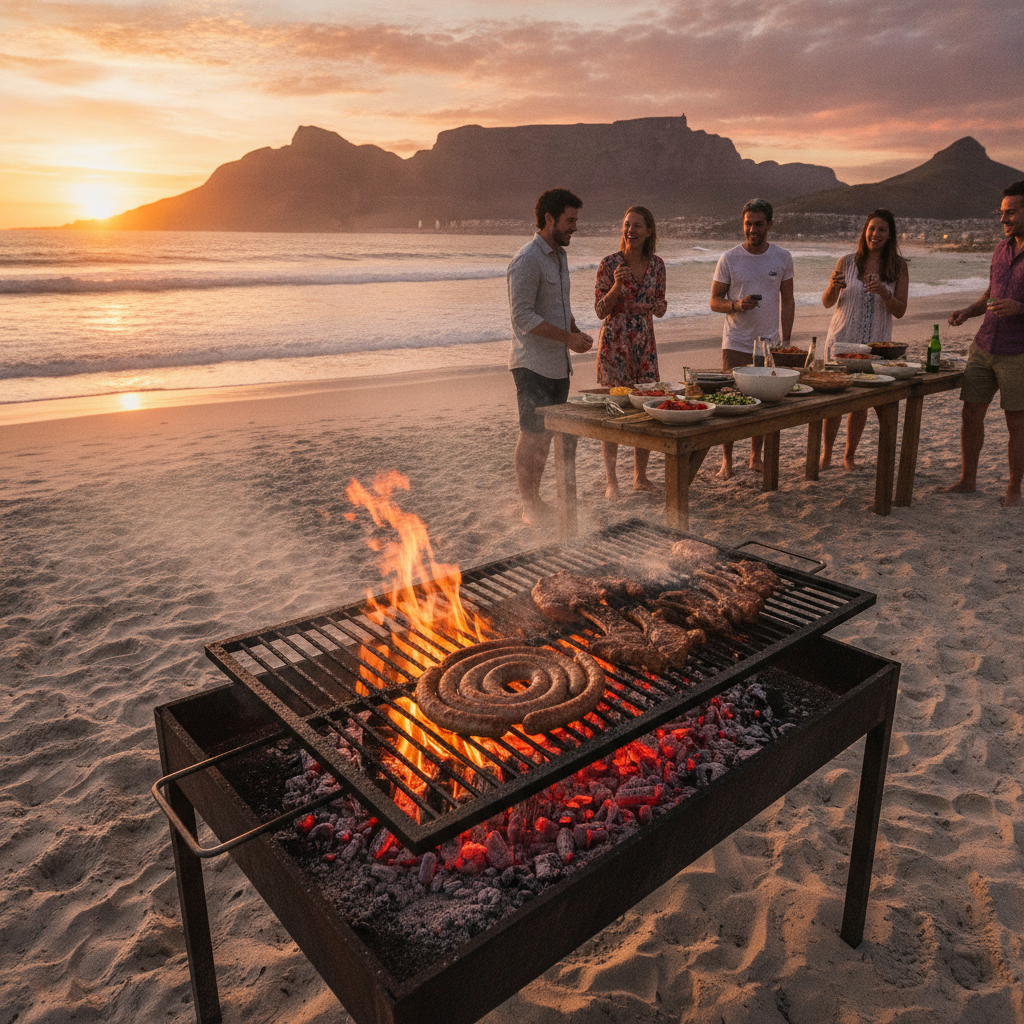
The braai (the South African outdoor grill — from the Afrikaans 'braaivleis' (grilled meat) — the central social institution of South African outdoor life, the cultural practice that unites South Africans across racial and cultural lines more than almost any other activity): the braai is far more than a cooking method — it is a social ritual that requires dedicated wood (never charcoal briquettes in the purist braai tradition), a proper braai stand (the free-standing steel fire grill), and the correct food: boerewors (the spiral-coiled sausage of coarsely minced beef, pork, and lamb seasoned with coriander seed, nutmeg, cloves, and allspice — the most important braai food, served with yellow rice and chakalaka (a spicy relish of onions, tomatoes, and beans)), sosaties (the Cape Malay-derived kebabs of marinated meat on skewers, typically lamb with dried apricot and onion in a curry-spiced marinade), and chops (lamb chops, the prestige braai item); Heritage Day (September 24 — one of South Africa's 12 public holidays) was informally renamed 'National Braai Day' in 2005 by the television personality Jan Scannell ('Jan Braai'), who campaigned to make the braai the national symbol of reconciliation and shared South African identity.
- 2
Old Biscuit Mill & the Woodstock Food Scene
The Old Biscuit Mill (373-375 Albert Road, Woodstock — the converted biscuit factory complex in the inner-city suburb of Woodstock, housing the Neighbourgoods Market (Cape Town's most popular artisan food and craft market, open Saturday mornings (9am-3pm) and, in the warmer months, Thursday evenings) and a permanent complex of shops, studios, and restaurants): the Neighbourgoods Market (established 2006 by Carolyn Unell, modelled on the London Borough Market and the Melbourne farmers' markets) is the finest food market in Cape Town, with approximately 80-100 stalls selling artisan bread (from Knead Bakery and Roodebloem Bakery), specialty coffee (from Truth Coffee, the 'best coffee shop in the world' according to The Guardian), Cape Malay food, West African dishes, and the full spectrum of Cape Town's multicultural food culture; Woodstock itself (the suburb immediately east of the CBD, gentrifying rapidly since the 2010s) has become the most interesting food and arts neighbourhood in Cape Town, with an exceptional density of independent restaurants, roastery cafes, and craft beer taprooms.
- 3
Cape Malay Cuisine — The Most Distinctive Food Heritage in South Africa
Cape Malay cuisine (the cuisine of the Cape Malay community (the descendants of enslaved people brought to the Cape from Batavia, Malacca, Sri Lanka, Madagascar, and Mozambique between 1652 and 1808 by the Dutch East India Company) — the most distinctive and historically significant food tradition in South Africa): the essential Cape Malay dishes are: bobotie (the national dish of South Africa — a spiced minced meat (typically beef or lamb) baked with an egg and milk custard topping, the spicing (bay leaf, turmeric, curry powder, apricot jam, chutney, raisins) reflecting the Cape Malay combination of sweet, sour, and savoury typical of Indonesian-influenced food), bredie (the Cape Malay slow-cooked stew — tomato bredie (with tomatoes and cinnamon), waterblommetjiebredie (with the flowers of the waterblommetjie (Aponogeton distachyos), the Cape water hawthorn — the most distinctively Cape of all the bredie variations, available only in winter when the waterblommetjies flower in the dams and pans of the Western Cape)), and the Cape spices (the characteristic Cape Malay spice blend: koraander (coriander seed), borrie (turmeric), jeera (cumin), and kardemom (cardamom) — the essential flavour profile of Cape Malay cooking).
- 4
Truth Coffee & Cape Town's World-Class Coffee Culture
Truth Coffee (36 Buitenkant Street, Cape Town CBD — the steampunk-themed specialty coffee roastery and café that The Guardian named 'the best coffee shop in the world' in 2015 — the most internationally celebrated café in Africa): Truth Coffee (founded 2006 by David Donde) is a coffee roastery and café in a converted Victorian warehouse, with an elaborate steampunk-themed interior (copper pipes, brass fittings, leather and wood, a massive exposed espresso machine as the visual centrepiece) and a sourcing philosophy focused on single-origin African coffees (Ethiopia, Kenya, Rwanda, Uganda, Burundi — the great coffee-growing nations of East Africa); Cape Town has one of the most vibrant specialty coffee cultures in the world, with a density of independent specialty coffee roasters (Origin Coffee Roasting (the first specialty coffee roaster in Cape Town, established 2006), Rosetta Roastery, Deluxe Coffeeworks, Honest Chocolate) comparable to Melbourne or Oslo — the two other cities most celebrated for coffee culture.
- 5
Constantia Valley — The Oldest Wine Estate in South Africa
Constantia (the residential and wine-producing valley on the southern slopes of Table Mountain, 15 km from the Cape Town CBD — the location of the oldest wine estate in South Africa (Groot Constantia, established 1685) and the most prestigious residential address in Cape Town): Groot Constantia (the manor house, wine cellars, and museum on the estate granted by Governor Simon van der Stel in 1685 as his private farm, the original source of the Constantia wine that was the most celebrated dessert wine in 18th-century Europe — Napoleon had Constantia wine shipped to St Helena during his exile; Jane Austen mentions it in Sense and Sensibility as a cure for sorrow; Baudelaire celebrated it in his poetry) now produces a full range of wines and is the most historically significant wine estate in the southern hemisphere; the Constantia valley (with the other wine estates — Buitenverwachting, Klein Constantia, Steenberg, and Constantia Glen — within a 5 km radius) is the closest wine-tasting destination to the Cape Town CBD.
- 6
Woodstock & Salt River — Cape Town's Creative District
Woodstock (the inner-city suburb immediately east of the Cape Town CBD, and its neighbour Salt River — the most rapidly evolving neighbourhood in Cape Town, transforming from an industrial and working-class residential area to one of the most creative urban districts in Africa): the Woodstock Exchange (66 Albert Road, Woodstock — the creative industry hub in a converted factory, housing graphic designers, architects, advertising agencies, and tech startups) and the Old Biscuit Mill (373 Albert Road) are the twin anchors of Woodstock's creative economy; the street art of Woodstock (the large-scale murals by local and international artists commissioned by the Latitudes Art Fair and various city initiatives — including works by South African artists such as Faith47, the most internationally successful street artist to emerge from South Africa) have made Woodstock one of the most significant street art destinations in Africa; the Woodstock craft beer scene (including the Beerhouse (the craft beer bar with the largest selection of South African craft beer in Cape Town), the Woodstock Brewery, and the Jack Black Brewing Company taproom) has established Woodstock as the centre of Cape Town's growing craft beer culture.
Walk this route with audio
Stories play automatically as you reach each stop — no tapping needed.
More in cape-town
District Six, the Apartheid Museum & Cape Town's History
Stellenbosch, Franschhoek & the Cape Winelands — South Africa's Wine Heartland
Kirstenbosch & the Cape Floral Kingdom — World's Most Biodiverse Garden

Shark Cage Diving & Whale Watching — The Cape's Ocean Wildlife
Table Mountain, the Cable Car & the City Bowl — Cape Town's Natural Icon