Charleston R2: Ashley River plantations (Middleton Place oldest US landscaped gardens 1741, Drayton Hall 1738 unaltered Palladian most significant US plantation house, Magnolia 1676 oldest US gardens Audubon Swamp Garden, Boone Hall Avenue of Oaks 1743), Plantation tourism ethics and Gullah tours (Slave Street brick cabins Gullah Theater, Sea Islands Johns Wadmalaw Edisto tours), Charleston Earthquake 1886 (magnitude 7.0-7.3 most powerful East Coast historical, 100 dead 2,000 buildings destroyed, Hurricane Hugo 1989 Category 4 USD 7B 27 dead, seawall flood infrastructure), Holy City churches (St. Michael's 1752 oldest SC building, Circular Congregational 1681 oldest congregation graves to 1695, Kahal Kadosh Beth Elohim 1749 oldest active Reform Jewish US, Mother Emanuel 1816 AME shooting June 17 2015 9 killed Confederate flag removed), Outdoor kayaking ACE Basin (350,000 acres largest undeveloped East Coast estuary, Hunting Island Lighthouse 1875 climbable, Congaree National Park old-growth bottomland), Day trips (Columbia USC Gamecocks Dawn Staley, Beaufort Big Chill Prince of Tides Forrest Gump filming, Port Royal Sound Civil War 1861, Hilton Head 24 golf courses)
Charleston R2: Ashley River plantations (Middleton Place oldest US landscaped gardens 1741 Continental Congress signer, Drayton Hall 1738 unaltered Palladian NTH most significant US plantation house, Magnolia 1676 oldest US gardens Audubon Swamp alligators, Boone Hall Avenue Oaks 1743 Slave Street brick cabins Gullah Theater), plantation tourism ethics and Gullah tours (Sea Islands Johns Wadmalaw Edisto), earthquake 1886 (7.0-7.3 most powerful East Coast historical 100 dead 2,000 buildings, Hugo 1989 Category 4 220kmh USD 7B, seawall flood USD 100M investment), churches (St. Michael's 1752 56m steeple navigational landmark 260 years, Circular Congregational 1681 oldest congregation oldest burial ground 1695, Kahal Kadosh Beth Elohim 1749 oldest active Reform Jewish US largest Jewish community early America, Mother Emanuel 1816 oldest AME South shooting June 17 2015 9 killed including Pinckney Confederate flag removed State House), kayaking ACE Basin (350,000 acres largest undeveloped East Coast estuary, Hunting Island Lighthouse 1875 climbable, Congaree old-growth bottomland champion trees), day trips (Columbia USC Dawn Staley 2022 2024 titles, Beaufort Big Chill Prince of Tides Forrest Gump filming, Port Royal Civil War 1861 Union naval victory, Hilton Head 24 golf courses Harbour Town).
- 1
Middleton Place and the Lowcountry Plantation Landscape
Middleton Place (at 4300 Ashley River Road, 22 km northwest of downtown Charleston): the oldest landscaped gardens in the United States (begun 1741 by Henry Middleton, president of the First Continental Congress), with the formal terraced garden descending to the Ashley River through a series of butterfly lakes and geometric parterres. Middleton Place history: the plantation was home to four generations of the Middleton family, including Arthur Middleton (a signer of the Declaration of Independence) and Williams Middleton (a signer of the Ordinance of Secession). The plantation house was burned by Union troops in February 1865, with only the gentlemen's guest wing surviving; the ruins of the main house are preserved as a museum. The Middleton Place Stableyard: the living history interpretation of plantation craftsmanship, with blacksmiths, potters, carpenters, and weavers demonstrating the enslaved artisans' skills that maintained plantation economy. Magnolia Plantation and Gardens (at 3550 Ashley River Road): the plantation whose gardens (begun circa 1676, the oldest surviving gardens of any kind in the United States) are famous for the Audubon Swamp Garden (the blackwater swamp with wood storks, egrets, alligators, and river otters accessible by boat and boardwalk). Drayton Hall (at 3380 Ashley River Road, circa 1738): the most architecturally significant surviving plantation house in the United States, an unaltered Palladian Georgian mansion that has never been restored or modernized, preserved as an authentic relic of the 18th century by the National Trust for Historic Preservation. The Ashley River Road National Scenic Byway (SC-61, the 24-km road connecting Charleston to Middleton Place): the most concentrated collection of antebellum plantation sites in the American South.
- 2
Boone Hall Plantation and Gullah Heritage Tours
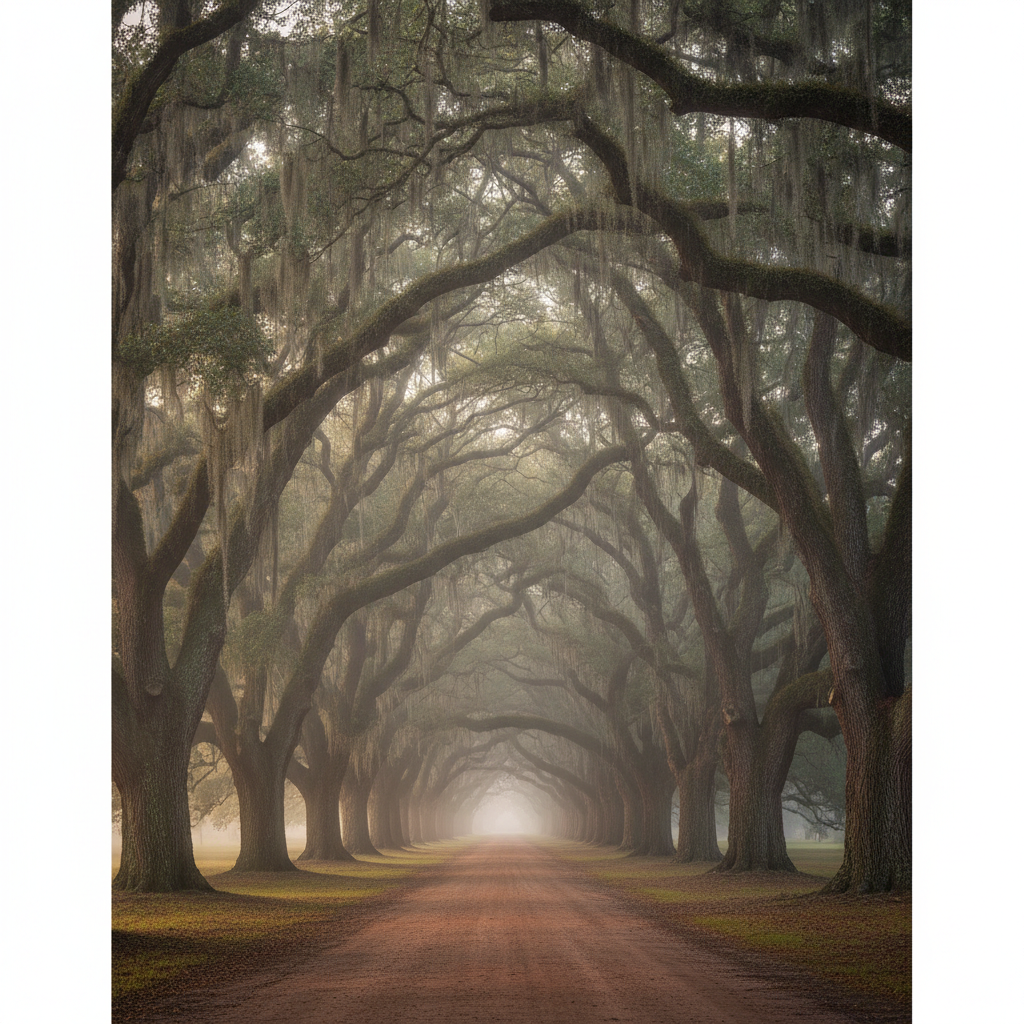
Boone Hall Plantation (at 1235 Long Point Road, Mount Pleasant, 12 km north of Charleston): one of the most visited plantations in the American South, famous for its Avenue of Oaks (the 0.75-km entrance drive lined with live oak trees draped in Spanish moss, planted in 1743 — one of the most photographed natural landscapes in South Carolina). Boone Hall authenticity: the main plantation house was rebuilt in 1935 (after the original burned), making it less architecturally significant than Drayton Hall, but the Slave Street (the row of 9 original brick slave cabins built in the 1790s and 1800s, with exhibits on the lives of enslaved people) and the Gullah Theater (the living history performances about Gullah Geechee culture by descendants of enslaved people who lived on the plantation) are among the most genuine slavery interpretation programs in the American South. Plantation tourism ethics: the interpretation of plantation sites in the American South is one of the most contested areas of American public history, with ongoing debates about how to present the lives of enslaved people alongside the architectural and landscape heritage of the planter class. Many scholars and activists argue that too much plantation tourism focuses on the architecture and gardens while marginalizing the enslaved people whose labor created the wealth. Gullah cultural tours of Charleston: multiple operators offer walking, van, and boat tours of the Gullah Geechee cultural landscape of Charleston and the Sea Islands, including the historic African American neighborhoods of Charleston's east side (the Eastside community), the old slave neighborhoods of the French Quarter, and the Gullah communities of the Sea Islands of Johns Island, Wadmalaw Island, and Edisto Island.
- 3
Charleston Earthquake History and Natural Disasters
Charleston earthquake history: Charleston lies on one of the most seismically active areas on the East Coast of the United States, above the poorly understood fault system of the Atlantic Coastal Plain. The Charleston Earthquake of 1886 (August 31, 1886, estimated magnitude 7.0-7.3): the most powerful earthquake to strike the eastern United States in historical times, killing approximately 100 people, destroying over 2,000 buildings, and causing USD 5-6 million in damage (equivalent to approximately USD 150-175 million in current dollars) — virtually every building in Charleston was damaged. The earthquake was felt from Cuba to New York, caused liquefaction across the entire Charleston Peninsula, and triggered seismic activity as far away as the Mississippi Valley. Charleston hurricane history: Charleston's location on a peninsula exposed to the Atlantic Ocean, the Gulf Stream, and the unique atmospheric dynamics of the South Carolina coast makes it one of the most hurricane-vulnerable cities in the United States. Major hurricanes affecting Charleston: Hurricane Hugo (September 21-22, 1989, Category 4 at landfall, making direct landfall at McClellanville 48 km north of Charleston): the most damaging hurricane to affect South Carolina in the 20th century, with winds of 220 km/h, a storm surge of 6 meters, USD 7 billion in damage, and 27 deaths in South Carolina. Hurricane Dorian (September 2019) caused significant flooding and damage. The Charleston seawall and flood infrastructure: Charleston has invested hundreds of millions of dollars in flood protection infrastructure in response to increasingly severe flooding from hurricanes and sea level rise.
- 4
Spoleto, Historic Churches, and Charleston Architecture
Charleston's historic churches: the Holy City's 400+ churches represent every major Christian denomination and several minor ones, making Charleston one of the most architecturally diverse religious landscapes in the American South. St. Michael's Episcopal Church (at 14 Broad Street, downtown Charleston, built 1752-1761): the oldest church building in South Carolina, with the original 185-foot (56m) steeple that has served as a navigational landmark for Charleston Harbor for over 260 years. The Circular Congregational Church (at 150 Meeting Street): the oldest congregation in Charleston (organized 1681), now in its third building (the current Romanesque Revival structure built in 1892 after the original was destroyed in the 1886 earthquake), with the oldest burial ground in Charleston (graves dating to 1695). Kahal Kadosh Beth Elohim Synagogue (at 90 Hasell Street): the oldest continuously active Reform Jewish congregation in the United States (founded 1749), with the second oldest synagogue building in the United States (built 1840 in the Greek Revival style), and the oldest synagogue in continuous use in the country — Charleston had the largest Jewish community in North America through the early 19th century. Charleston's Emanuel African Methodist Episcopal Church (Mother Emanuel, at 110 Calhoun Street): the oldest African Methodist Episcopal church in the South (founded 1816), and the site of the Charleston church shooting (June 17, 2015): a white supremacist killed 9 African American worshippers, including the senior pastor and South Carolina state senator Clementa Pinckney, during a Bible study session — one of the most traumatic events in modern South Carolina history, triggering the removal of the Confederate battle flag from the South Carolina State House grounds.
- 5
Charleston Outdoor Life - Kayaking and the ACE Basin
Charleston outdoor recreation: Charleston's location at the intersection of rivers, estuaries, barrier islands, and the Atlantic Ocean makes it one of the most diverse outdoor recreation destinations in the American Southeast. Sea kayaking in Charleston Harbor: guided kayak tours through the salt marshes, tidal creeks, and barrier islands surrounding Charleston Harbor, with wildlife including bottlenose dolphins, loggerhead sea turtles, white ibis, roseate spoonbills, and hundreds of migratory shorebird species. The ACE Basin National Estuarine Research Reserve (the 350,000-acre protected estuary formed by the Ashepoo, Combahee, and Edisto Rivers, 50-80 km southwest of Charleston): the largest undeveloped estuary on the East Coast north of the Everglades, with vast tidal marshes, maritime forests, and barrier islands that support one of the most diverse bird populations in the Southeast. Hunting Island State Park (at 2555 Sea Island Pkwy, St. Helena Island, 100 km south of Charleston): one of the most spectacular natural beaches in South Carolina, with the Hunting Island Lighthouse (built 1875, the only climbable lighthouse in South Carolina, with views across St. Helena Sound) and maritime forest of live oak, cabbage palm, and slash pine. Edisto Beach State Park (at 8377 State Cabin Road, Edisto Island, 70 km south of Charleston): the most pristine and least developed barrier island beach in South Carolina, with Spanish moss-draped maritime forest and the Edisto Museum documenting Gullah Geechee heritage. The Congaree National Park (100 km north of Charleston, near Columbia): the largest intact expanse of old-growth bottomland hardwood forest in the United States, with champion trees and the most diverse forest in the temperate zone of North America.
- 6
Charleston Day Trips - Columbia, Beaufort, and the Lowcountry
Charleston day trips and regional exploration: Columbia (the state capital of South Carolina, 200 km northwest of Charleston on I-26): the home of the University of South Carolina (the flagship state university, founded 1801, with Darla Moore School of Business ranked among the top international business schools and the Gamecocks women's basketball dynasty under coach Dawn Staley with national championships in 2022 and 2024). The South Carolina State Museum in Columbia (at 301 Gervais Street, in the former Columbia Mills building — the first all-electric textile mill in the United States, built 1894): the comprehensive museum of South Carolina history, natural history, art, and science. Beaufort (50 km southwest of Charleston, the second oldest city in South Carolina, founded 1711): one of the most beautifully preserved antebellum towns in the American South, with the Historic District (one of the oldest National Historic Landmark Districts in the United States) and the Henry C. Chambers Waterfront Park (the waterfront park on the Beaufort River with views of the Sea Islands). The filming location for The Big Chill (1983), The Prince of Tides (1991, with the distinctive Beaufort water tower visible in many scenes), and Forrest Gump (1994 — the scenes set in Greenbow, Alabama, were filmed in Beaufort and the surrounding Lowcountry). Port Royal Sound (the deep-water port and Civil War-era Union beachhead): one of the deepest natural harbors on the East Coast, where Union forces captured Port Royal in November 1861 in one of the first major Union naval victories of the Civil War. Hilton Head Island (50 km south of Beaufort): the major resort island of the South Carolina coast, with 24 golf courses, the Sea Pines Forest Preserve, and Harbour Town.
Walk this route with audio
Stories play automatically as you reach each stop — no tapping needed.
More in charleston
Charleston R4: Angel Oak Johns Island (400-500 years old 8.5m trunk live oak, Spanish moss bromeliad absorbs nutrients from air, Francis Beidler Forest 1000-year-old virgin bald cypress), Sea Islands Gullah heritage (Penn Center St. Helena Island 1862 first school for freed people, MLK SCLC meeting place 1960s, Port Royal Experiment 1861 first test of African American freedom, Hunting Island pristine dark sand beach), Columbia and SC interior (Congaree National Park old-growth bottomland firefly synchronization May-June, SC Aquarium sea turtle rehabilitation, Cowpens Battlefield 1781 Revolutionary War turning point), Francis Marion National Forest (longleaf pine ecosystem 3% remaining, red-cockaded woodpecker, Sewee Visitor Center Cape Romain, Wambaw Creek wilderness canoe trail), New Charleston food (Rodney Scott BBQ 2018 James Beard first Black pitmaster Outstanding SE, whole-hog live oak pits, Leon's Oyster Shop Upper King fried chicken oyster bar, craft cocktail Husk Bar Gin Joint), Ghost tours (most haunted US city top 3, Unitarian churchyard Annabel Lee grave, Old City Jail 1802 Lavinia Fisher first US female serial killer Denmark Vesey 1822 rebellion, Dock Street Theatre ghost Juanita)
Charleston: America Oldest Museum, Self-Supporting Spiral Staircase and the Swamp Canal Older Than the Nation
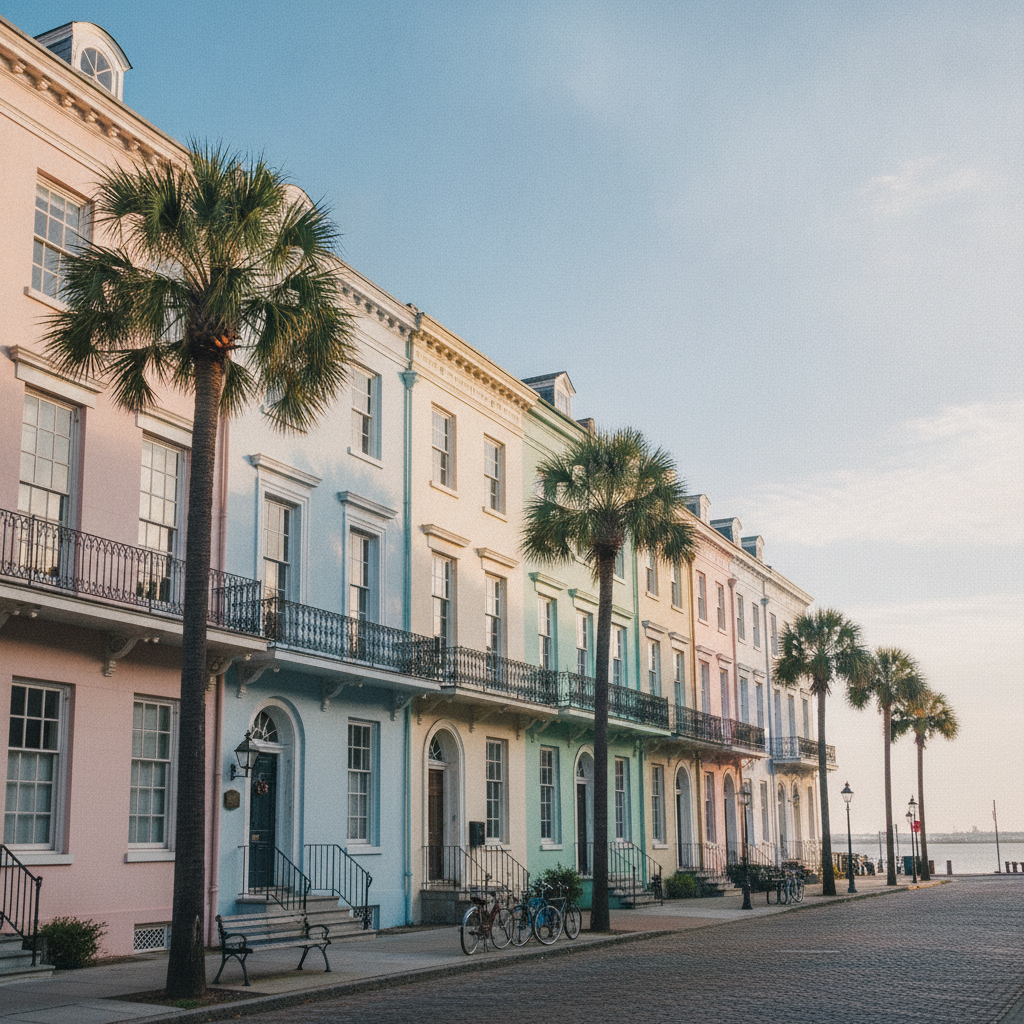
Charleston: First Submarine to Sink a Warship, Gullah Creole Language and the Pastel Row That Started a Design Trend
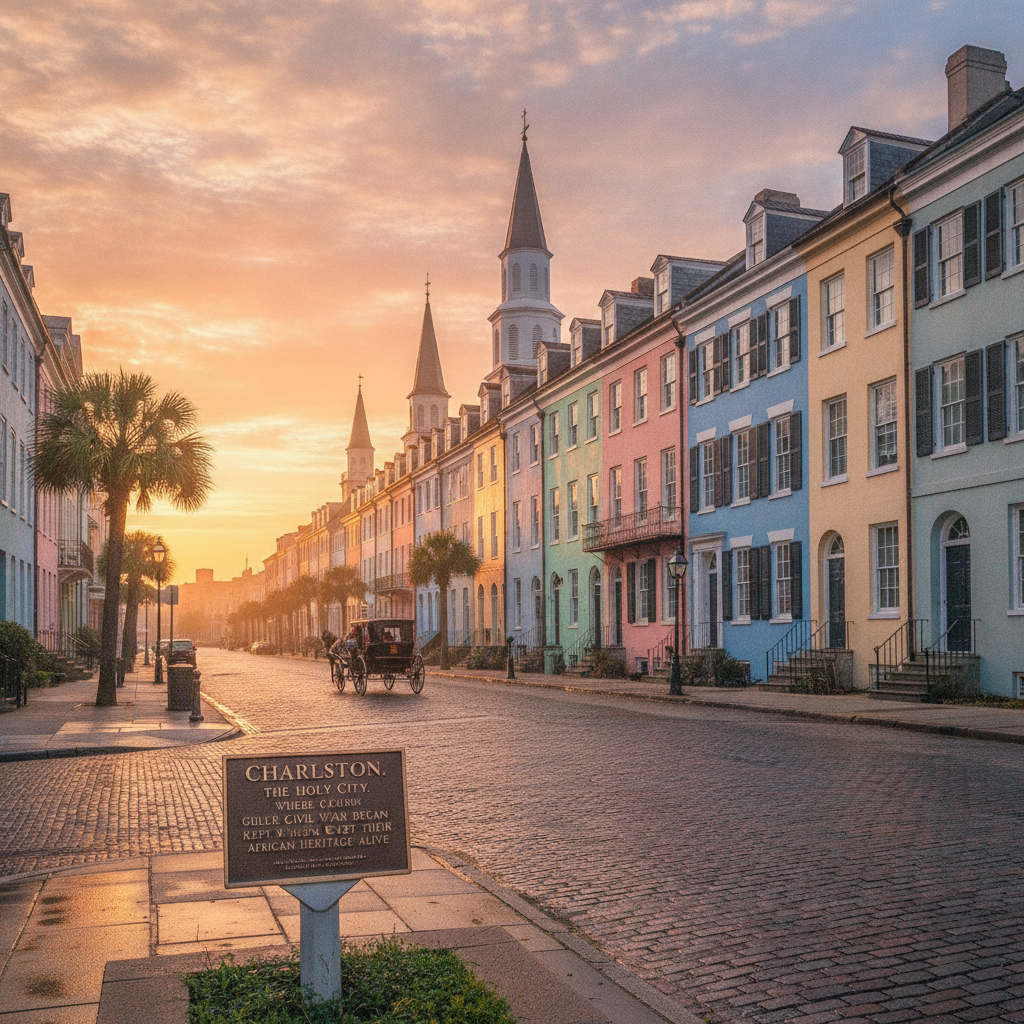
Charleston: Antebellum architecture (Holy City 400 churches, Charleston single house 300 surviving, Rainbow Row 1740s 13 pastel houses, Battery and White Point Garden Fort Sumter views), Fort Sumter (Civil War opened April 12 1861, 34-hour bombardment, 54th Massachusetts Infantry Glory film, H.L. Hunley first combat submarine sank USS Housatonic 1864 recovered 2000), Gullah Geechee culture (creole language rice cultivation sweetgrass baskets, International African American Museum January 2023 Gadsden's Wharf 40% all enslaved Africans imported, Lowcountry rice made Charleston wealthiest colonial city), Lowcountry food (FIG 2003 Lata James Beard 2009, Husk Sean Brock all-Southern-sourced menu, shrimp grits she-crab soup Lowcountry boil, Charleston City Market 1804 sweetgrass weavers), Spoleto Festival USA (largest US performing arts festival 17 days 150 performances 80,000 attendees, first US historic preservation ordinance 1931), Practical (Sullivan's Island Folly Beach Isle of Palms Kiawah Ocean Course 1991 Ryder Cup, ACE Basin largest undeveloped estuary East Coast, spring and fall best seasons CHS airport)
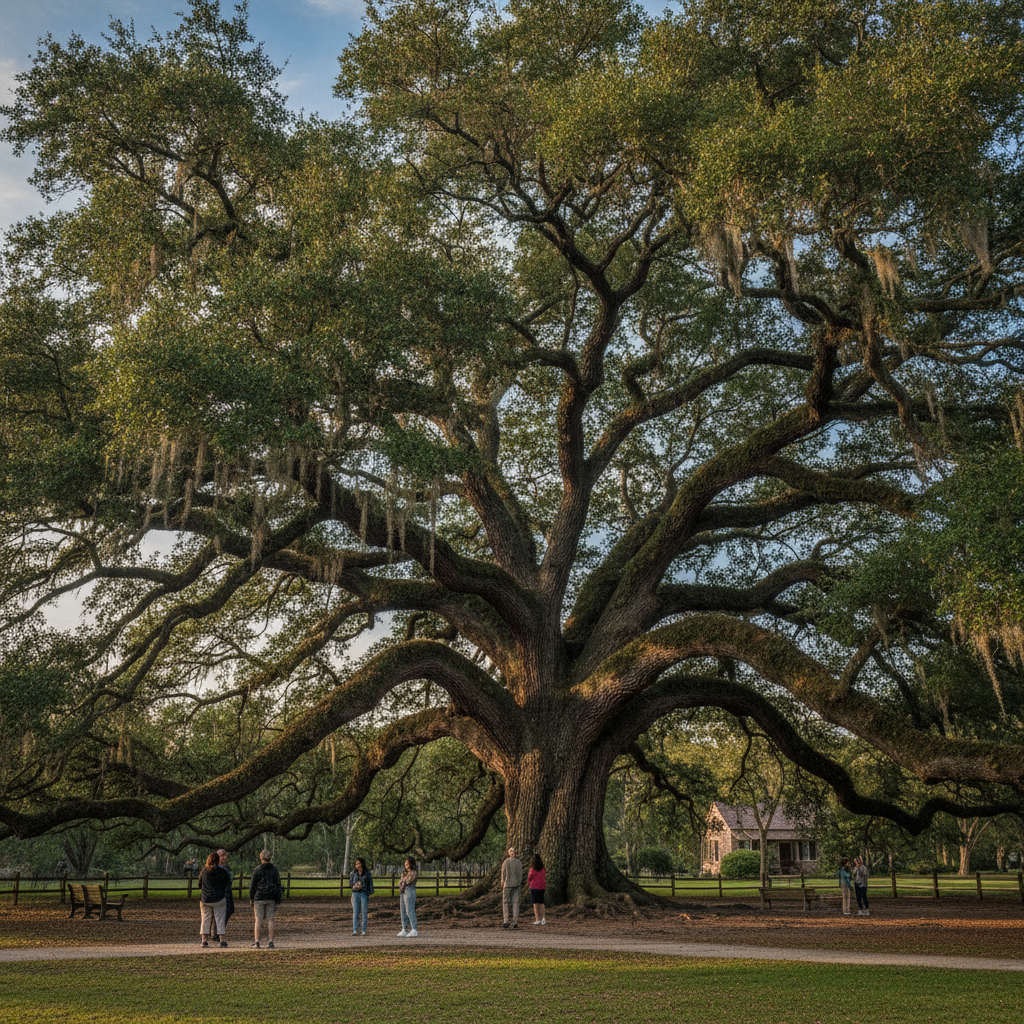
Charleston: 400-Year-Old Tree, Spoleto World Premieres and Sea Island Cotton Grown from West African Knowledge