Tivoli Gardens — The Enchanted Amusement Park That Inspired Walt Disney
Tivoli Gardens (Tivoli — Vesterbrogade 3, adjacent to Copenhagen Central Station, opened August 15, 1843, by Georg Carstensen — the second oldest amusement park in the world (after Dyrehavsbakken, 1583, also in Denmark) and the most visited paid attraction in Scandinavia, with approximately 4 million visitors per year): Tivoli is simultaneously an amusement park, concert venue, restaurant complex, and garden, set in 8.3 hectares in the centre of Copenhagen, and was reportedly the inspiration for Walt Disney when he created Disneyland.
- 1
Tivoli's History — Walt Disney, Hans Christian Andersen & the Gardens
Tivoli Gardens (opened 1843 by Georg Carstensen, who convinced King Christian VIII that 'when the people are amusing themselves, they do not think about politics' — Carstensen's argument for why the king should grant him a licence for an amusement park immediately outside the city walls): Tivoli's 8.3-hectare site was originally outside the Copenhagen city walls (the ramparts were demolished in the 1850s-1870s, but Tivoli retained its original site, which today is surrounded by the modern city); Walt Disney visited Tivoli in 1951 (with his daughters) while on a European research trip, and described it as the inspiration for Disneyland (which opened in Anaheim, California, in 1955) — specifically, Tivoli's combination of gardens, rides, restaurants, and live entertainment in a single destination was the template for the Disney theme park concept; Hans Christian Andersen was a frequent visitor and lived nearby; the Gardens are famous for their elaborate seasonal decorations: the summer season (mid-April to late September), Halloween (October), and Christmas (mid-November to late December, the most atmospheric, with traditional Danish Christmas market).
- 2
The Rides — Roller Coasters & Historic Attractions
Tivoli's rides (approximately 30 attractions ranging from the historic to the ultra-modern): the most important historic rides are: Bjergbanen (the Wooden Roller Coaster — built 1914, currently the oldest operating roller coaster in the world (the Leap-the-Dips at Lakemont Park, USA, built 1902, claims the title but has had extended periods of non-operation), the brakeman who operates the manual brakes is one of the most traditional jobs in Copenhagen tourism), the Rutschebanen (another historic coaster, 1914), and the vintage carousels; the most spectacular modern attraction is Daemonen (The Demon — the triple-loop steel coaster added 2008) and the Aquila (the ride that swings riders 80 metres above the Gardens, providing views over central Copenhagen); the Pantomime Theatre (the original open-air theatre building from 1874, the oldest surviving structure in Tivoli, hosting the traditional Commedia dell'arte performances that have been performed here almost continuously since 1843).
- 3
Tivoli's Food Culture — From Smørrebrød to Michelin Stars
Tivoli's restaurant and food culture (approximately 40 restaurants and food stands within the Gardens, ranging from fast food to Michelin-starred fine dining): the defining food experiences of Tivoli include: Nimb Hotel (the magnificent Moorish-style building at the entrance to Tivoli, built 1909, now a luxury hotel with five restaurants including the Michelin-starred Nimb Brasserie and the Nimb Bar — the most elegant address inside Tivoli), the Grøften (the traditional Danish restaurant opened in 1874, the oldest continuously operating restaurant in Tivoli, serving traditional Danish smørrebrød (open-face sandwiches), frikadeller (Danish meatballs), and æbleskiver (traditional Danish pastry balls)), and the outdoor food stalls serving aebleskiver with jam and powdered sugar, æblegrød (apple porridge), and the famous Tivoli cotton candy; the Faergekroen (the lakeside restaurant, opened 1850s) is the most scenic dining spot in the Gardens.
- 4
Tivoli Concert Hall — Copenhagen's Music Centre
Tivoli Concert Hall (Tivoli Koncertsal — the concert hall within Tivoli, the most important music venue in Copenhagen and the primary home of the Danish National Symphony Orchestra (Danmarks Radio Symfoniorkester)): the current Concert Hall (capacity 1,660) is housed in the 1956 building designed by Vilhelm Lauritzen (one of the leading Danish modernist architects) replacing the original 1843 concert hall; Tivoli has a continuous musical tradition stretching from its founding (the Tivoli Boys Guard (Tivoli Vagtparaden), the boys' military band in historic uniforms that has marched through the Gardens on summer evenings since 1844, is the oldest continuously performing youth ensemble in the world); in summer, the outdoor Plænen stage (capacity 15,000) hosts free concerts most evenings, making Tivoli one of the most accessible and democratic concert venues in Europe — admission to Tivoli (approximately 150 DKK) includes access to all concerts.
- 5
The Chinese Tower & Lake — Tivoli's Iconic Centre
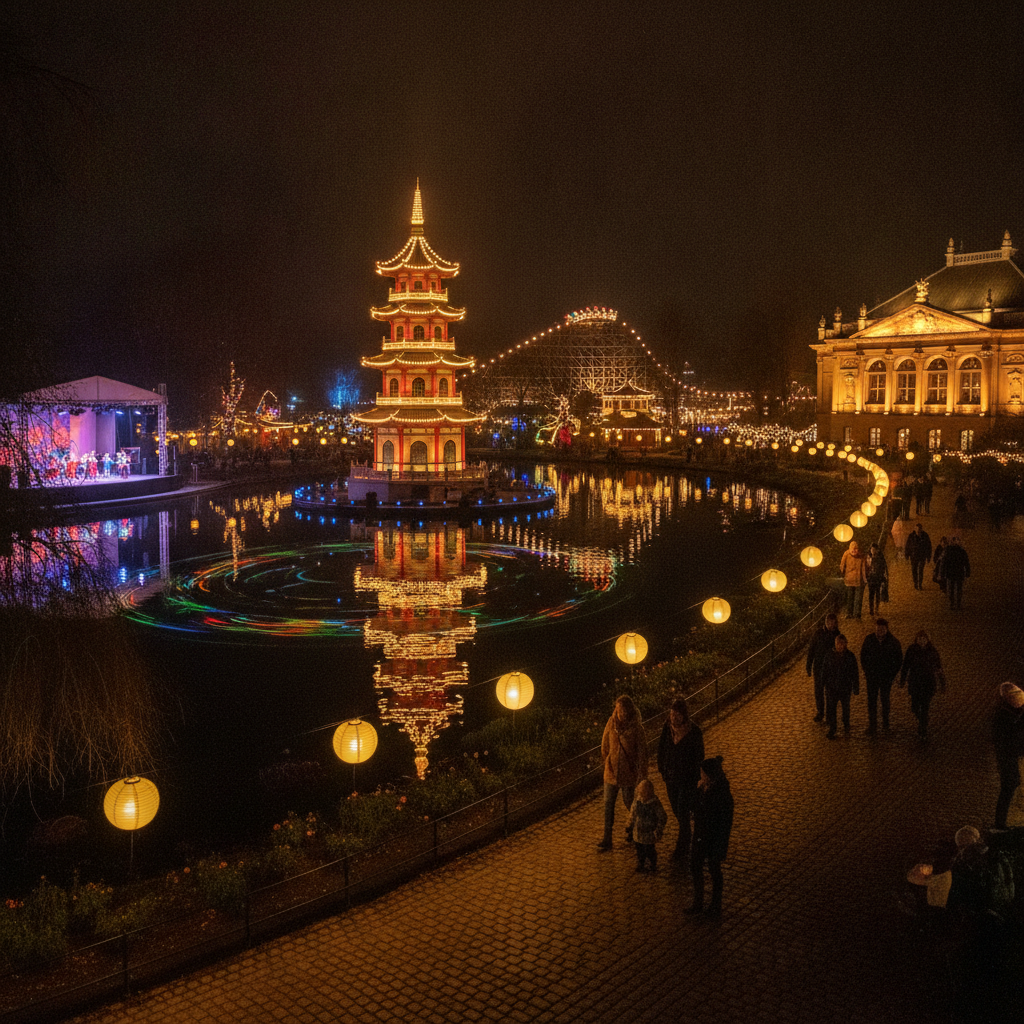
The Chinese Pagoda Tower (the iconic multi-tiered pagoda at the heart of Tivoli, the most recognizable single structure in the Gardens, built 1900 in the Chinoiserie style that was fashionable in European garden design from the 18th century): Tivoli's fascination with Chinoiserie is a fundamental element of its design identity — the Chinese Tower, the Chinese restaurant at the base, and the Chinese-style lanterns throughout the Gardens reflect the 19th-century European Romantic taste for exotic Asian aesthetics (a taste that Tivoli helped popularize and that Walt Disney also borrowed in the design of Fantasyland); the Tivoli Lake (Søen — the ornamental lake at the centre of the Gardens) is surrounded by the most photographed garden paths in Copenhagen, with the lake reflections of the surrounding lanterns and the Chinese Tower creating the most atmospheric night-time scene in the city; the lake hosts Tivoli's nightly fountain shows in summer (free, a tradition since the 1870s).
- 6
Tivoli at Christmas — The Most Magical Winter Market in Scandinavia
Tivoli Christmas (Tivoli Jul — the Christmas season at Tivoli, running from mid-November to late December (approximately 6-7 weeks), the most popular seasonal event in Copenhagen and consistently ranked as one of the finest Christmas markets in Europe): the Tivoli Christmas market is fundamentally different from the standard European outdoor Christmas market — it takes place within the permanent infrastructure of Tivoli's 8.3-hectare garden, so the market stalls are set among the garden's structures, food pavilions, and rides, all decorated with approximately 100,000 fairy lights and in accordance with the traditional Danish Christmas aesthetic (the nisser (Danish Christmas elves), the julehjerter (the woven paper Christmas hearts that are a uniquely Danish Christmas decoration), and the traditional foods (æbleskiver, gløgg (mulled wine), and the traditional Danish Christmas dinner of roast duck or pork with red cabbage and caramelized potatoes)); several of the park's rides (including the Bjergbanen wooden roller coaster) operate through the Christmas season.
Walk this route with audio
Stories play automatically as you reach each stop — no tapping needed.
More in copenhagen
Nyhavn, Old Town & Christiansborg — Copenhagen's Historic Heart
New Nordic Cuisine & Copenhagen's Food Revolution
The Little Mermaid, Amalienborg & Kastellet — Royal Copenhagen
Smørrebrød, Danish Pastry & Copenhagen's Food Markets
Kronborg Castle & Helsingør — Hamlet's Elsinore