Al Fahidi, Dubai Creek & the Gold Souk: Dubai Before Oil
The Dubai Creek — a natural inlet of the Persian Gulf that divides Dubai into its two historic halves, Bur Dubai (the western bank) and Deira (the eastern bank) — was the reason Dubai existed at all: a natural harbor that attracted pearl divers, fishermen, and traders from the Persian coast, the Musandam Peninsula, and Balochistan in the 18th century. The area around the Creek, and particularly the Al Fahidi Historical Neighbourhood on the Bur Dubai bank, is the only part of Dubai that preserves the architectural character of the city before the oil boom — a dense collection of coral-stone and gypsum buildings with wind towers (barjeel), courtyard houses, and merchant storage rooms that date from the late 19th and early 20th centuries. On the Deira side: the Gold Souk (the world's largest single gold retail market), the Spice Souk (cardamom, saffron, frankincense), and the dhow wharfage where traditional wooden cargo ships continue to operate the same re-export trade routes that made Dubai prosperous long before petroleum.
- 1
Al Fahidi Historical Neighbourhood — Dubai's Old City
The Al Fahidi Historical Neighbourhood (formerly Bastakiya), on the Bur Dubai bank of the Dubai Creek between the Grand Mosque and the Creek promenade, is the largest surviving ensemble of traditional Dubai architecture: approximately 50 buildings with wind towers (barjeel — passive ventilation systems that capture prevailing breezes and channel them down into rooms below, reducing interior temperatures by up to 15°C without mechanical cooling), courtyard layouts, and thick coral-stone walls, most dating from the period 1890–1930. The neighborhood was settled primarily by merchants from Bastak in the Fars province of Iran (hence the original name 'Bastakiya'), who were attracted by Dubai's zero-tax trading environment under Sheikh Maktoum bin Hasher Al Maktoum. The area was threatened with demolition in the 1980s and saved by the intervention of the Dubai Municipality and a coalition of conservationists; it was subsequently converted into a cultural quarter containing the Dubai Museum (in the Al Fahidi Fort, 1787, the oldest existing building in Dubai), several small museums, art galleries (the XVA Gallery is one of the best in the city), and numerous cafés.
- 2
Dubai Creek Abra — The World's Oldest Urban Ferry Service
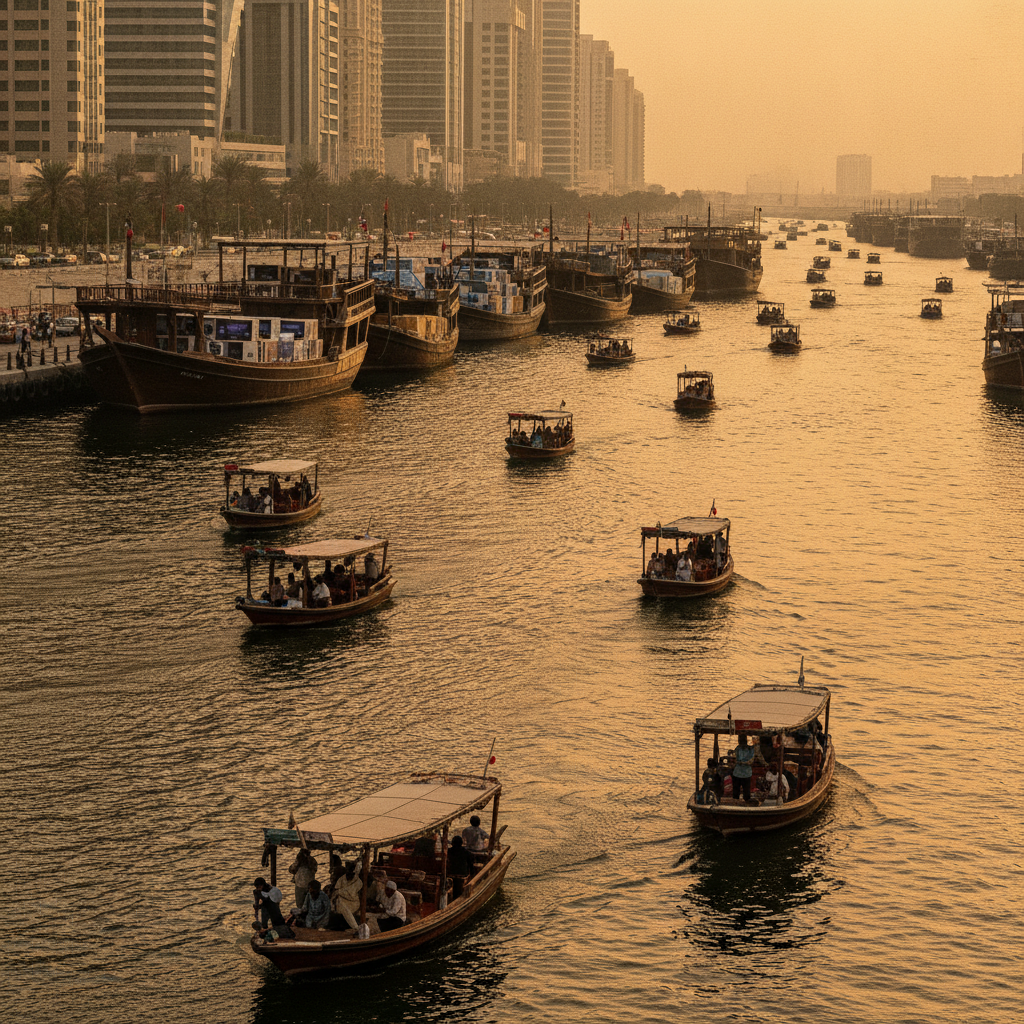
The abra (a flat-bottomed wooden water taxi, typically 8 meters long and seating 20 passengers) has been crossing the Dubai Creek since the city's founding in the early 19th century, making it one of the world's oldest continuously operating urban ferry services. Today approximately 15 abra operators, using diesel-powered fiberglass reproductions of the traditional wooden boats, carry an estimated 15–20 million passengers per year between the Bur Dubai Abra Station (near the Textile Souk) and the Deira Old Souk Abra Station (near the Gold Souk), at a fare of 1 dirham (approximately $0.27). The crossing takes approximately 5 minutes and provides the best single perspective on the Creek, the dhow wharfage, and the contrast between old and new Dubai (the wind-tower silhouettes of Al Fahidi visible on one bank; the glass towers of Deira and Baniyas Road on the other). A longer 'Al Shindagha' crossing connects the western end of the Creek to the Al Shindagha district.
- 3
Gold Souk — The World's Largest Gold Market
The Deira Gold Souk, a covered market in a 19th-century arcade building on the Sikkat Al Khail Road in the Al Sabkha district of Deira, is the world's largest single gold retail market: approximately 380 shops selling gold, diamond, and precious stone jewelry in a covered alley approximately 300 meters long. The souk operates under Dubai's 0% import duty and 0% sales tax on gold, making Dubai gold prices among the lowest in the world; the gold displayed in shop windows — estimated at 10–12 tonnes of gold across the entire souk — is typically 18, 21, or 24 carat, with the 24-carat 'investment gold' particularly popular with South Asian and Iranian customers who regard it as a savings vehicle. The souk is open daily from approximately 10am to 10pm, with a midday break (1pm–4pm), and is particularly vibrant in the evening when workers from the Deira district come to shop. Bargaining is expected; prices are quoted by weight plus a 'making charge' for workmanship.
- 4
Spice Souk & Perfume Souk — The Sensory Market
The Deira Spice Souk (also called the Old Souk), a few hundred meters from the Gold Souk in a covered market along the Creek bank, is one of the most photogenic and olfactorily overwhelming markets in the Middle East: sacks of cardamom, cinnamon, turmeric, dried limes, star anise, rose petals, frankincense, myrrh, and saffron ($12 per gram, one of the cheapest prices outside Iran and Spain) spilling onto the walkway in front of shops whose owners are almost exclusively from South Asia and the Horn of Africa. The Perfume Souk, adjacent to the Spice Souk along the Deira waterfront, sells oud (agarwood oil, the basis of most Arabic perfumery, produced from infected Aquilaria trees and valued at up to $100,000 per kilogram for the finest grades), attar (Indian floral perfume), and various hybrid western-Arabic fragrance blends, as well as burning oud chips and incense burners.
- 5
Dhow Wharfage — The Surviving Trade Routes
The Dhow Wharfage on the Deira bank of the Creek, between the Gold Souk and the Al Shindagha bridge, is where traditional wooden cargo ships (dhows) moored to the Creek embankment continue a centuries-old trade: loading refrigerators, televisions, air conditioners, automobile spare parts, and textiles in Dubai for re-export to Iran (evading sanctions through Dubai's entrepôt system), East Africa (Kenya, Tanzania, Somalia, Zanzibar), India, Pakistan, and the Yemeni coast. The dhows — most are 20–30 meter ocean-going vessels with diesel engines replacing the original lateen sails — are loaded and unloaded by crews of 5–20 workers (typically Bangladeshi or Pakistani) working at all hours. The wharfage provides perhaps the most vivid demonstration of Dubai's role as the world's most important re-export hub: the Emirates flag at the stern, the crates of Samsung TVs and Carrier air conditioners on the quay, and the wooden dhow hull beneath both.
- 6
Al Shindagha Museum & Heritage Village
The Al Shindagha district, at the western mouth of the Creek where it meets the Persian Gulf, was the site of the original Al Maktoum family settlement and the location of the Sheikh's palace complex from the late 19th century until the 1950s when the ruling family moved to a new palace in Zabeel. The area has been converted to a heritage museum complex — the Al Shindagha Museum — with reconstructed merchant houses, a perfume museum (covering the history of Arabian fragrance from frankincense trade routes to modern oud production), a maritime museum, and a falconry museum, all in a setting of palm-fringed Creek frontage that gives the best sense in Dubai of what the city looked like before concrete and glass replaced coral stone and gypsum. The Sheikh Obaid bin Thani House and the Sheikh Saeed Al Maktoum House (now a museum of photographs and documents) are the most architecturally significant surviving buildings.
Walk this route with audio
Stories play automatically as you reach each stop — no tapping needed.
More in dubai
Deira: Heritage Markets, Naif Square & the Multicultural Old Quarter
Palm Jumeirah: The World's Largest Artificial Island
Expo City Dubai: The World's Fair Becomes a Permanent City
Business Bay, Dubai Canal & Design District: The Creative and Commercial New Center
Jumeirah Beach Road, Kite Beach & Burj Al Arab: Old Dubai Meets the Sea