The New Town — Georgian Edinburgh & the Scottish Enlightenment
Edinburgh's New Town (the planned Georgian district built from 1767 to the north of the Old Town, the finest and most complete example of Georgian urban planning in the world — UNESCO World Heritage alongside the Old Town) was the physical manifestation of the Scottish Enlightenment (the intellectual movement 1740-1800 that made Edinburgh one of the greatest centres of learning in the world), producing philosophers (David Hume), economists (Adam Smith), engineers (James Watt), geologists (James Hutton), and architects (Robert Adam).
- 1
Princes Street & the Scott Monument
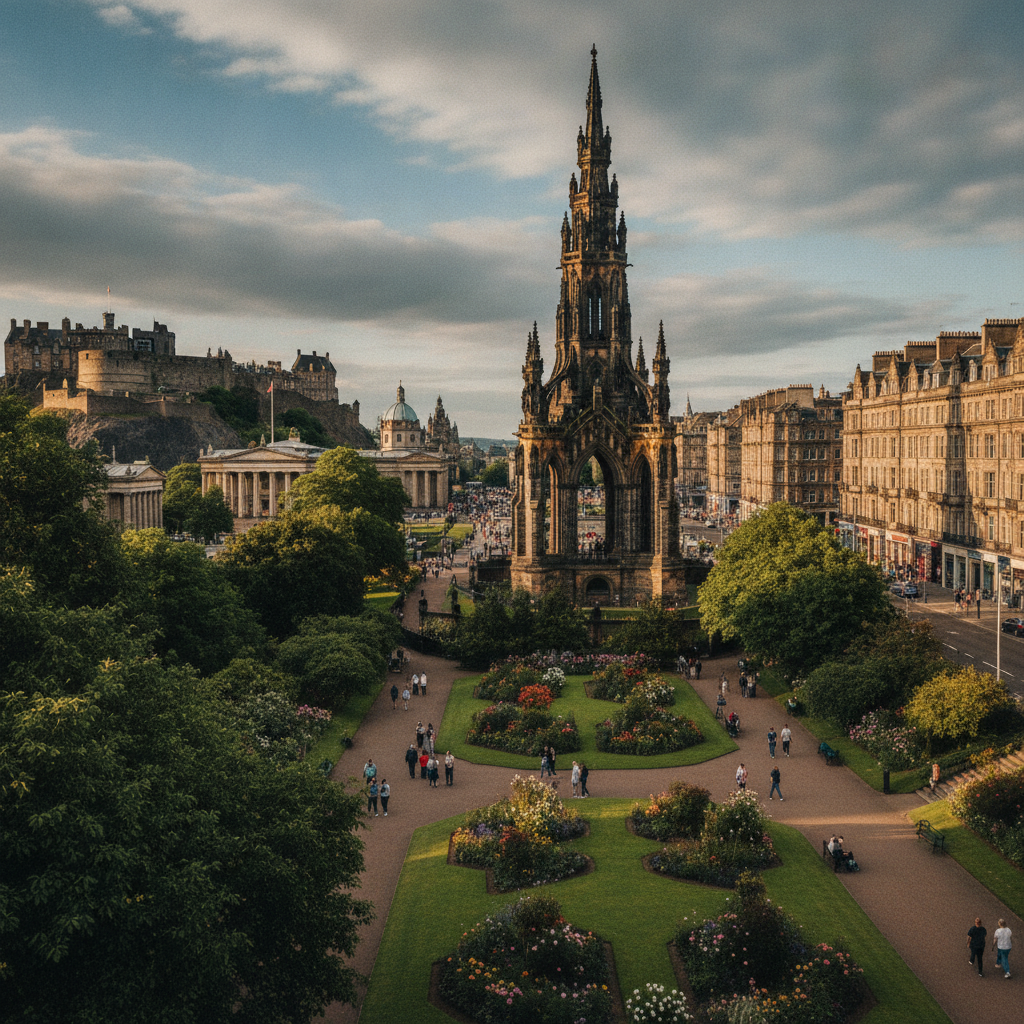
Princes Street (the main commercial street of Edinburgh, running east-west along the southern edge of the New Town, with shops on the north side only and the Princes Street Gardens (the formal gardens in the valley between the New Town and the Old Town ridge) on the south side — giving unobstructed views of Edinburgh Castle from the entirety of the street): the Walter Scott Monument (the Gothic Revival spire (61 metres tall) built 1840-1846 to commemorate the Scottish novelist Sir Walter Scott (1771-1832, the most internationally famous Scottish writer of the 19th century, author of Waverley (1814, the first historical novel in the English language), Rob Roy (1817), Ivanhoe (1820), and the series of Waverley Novels that virtually created the international image of Scotland — the tartan, the Highlands, the Highland clan culture — through their worldwide readership) is the largest monument to a writer in the world and the second largest monument to a fictional character (after the Christopher Columbus Monument in Barcelona)); the monument (with 287 spiral stairs to four viewing platforms) is open to visitors; the statue of Scott with his deerhound Maida at the base is by Sir John Steell (1846).
- 2
Charlotte Square — The Masterpiece of Robert Adam
Charlotte Square (the square at the western end of George Street in Edinburgh's New Town — the finest example of Georgian town planning in Scotland and the masterpiece of the Scottish Neoclassical architect Robert Adam (1728-1792)): Charlotte Square was designed by Robert Adam in 1791 (the year before his death) as the western terminus of the New Town's central axis (George Street, connecting St. Andrew Square in the east to Charlotte Square in the west), with identical palace-fronted terraces on the north and south sides (the north side being the finest and most completely intact); the Georgian House (7 Charlotte Square — the National Trust for Scotland's reconstruction of a late 18th-century Edinburgh New Town interior (the house of John Lamont of Lamont, c.1796), with rooms dressed in the furnishing and household equipment of the period — the most complete recreation of a Georgian Edinburgh New Town interior accessible to the public); Bute House (6 Charlotte Square — the official residence of the First Minister of Scotland, the head of the Scottish Government) is on the north side.
- 3
Scottish National Gallery & the Royal Scottish Academy
Scottish National Gallery (The Mound, between the Old and New Towns — the national art gallery of Scotland, in the neoclassical building (completed 1859, designed by William Henry Playfair) on the Mound (the artificial hill built from the rubble of the New Town excavations in the late 18th century)): the National Gallery has an outstanding collection of European Old Master paintings (Velázquez, Rembrandt, Vermeer, Titian, El Greco, Raphael, and the finest collection of Poussin outside France) and the most important collection of Scottish painting in the world (from the 16th century to the present), including the complete set of the Seven Sacraments by Nicolas Poussin (on permanent loan from the Duke of Sutherland — the most important Poussin group outside France), the Bridgewater Raphael (The Bridgewater Madonna, c.1507), and Allan Ramsay and Henry Raeburn portraits of Edinburgh Enlightenment figures; the adjacent Royal Scottish Academy building (also by Playfair) hosts temporary exhibitions.
- 4
Scottish National Portrait Gallery — Edinburgh's Human History
Scottish National Portrait Gallery (1 Queen Street — the national portrait gallery of Scotland, in the red sandstone Gothic Revival building (completed 1889, designed by Robert Rowand Anderson — the most elaborately decorated public building in Edinburgh, with a frieze of 155 notable Scots running around the exterior, a processional frieze of Scottish historical figures in the entrance hall, and the zodiac ceiling of the upper galleries)): the Portrait Gallery tells the history of Scotland through the faces of its people — from Mary, Queen of Scots (the most frequently painted subject in the collection) through Robert Burns (the national poet of Scotland, 1759-1796, whose portrait by Alexander Nasmyth (1787) is the most universally reproduced image of Burns and the primary visual impression of him) and David Hume (the philosopher, economist, and historian (1711-1776) whose Treatise of Human Nature (1739-1740) and An Enquiry Concerning Human Understanding (1748) are among the most important works in the history of Western philosophy) to contemporary Scottish figures.
- 5
Dean Village & the Water of Leith Walkway
Dean Village (the former mill village on the Water of Leith, 10 minutes walk northwest from Charlotte Square — the most picturesque and unexpected urban landscape in Edinburgh, a 19th-century mill village preserved in a steep river gorge within walking distance of the city centre): Dean Village was a mill community from the 12th century (when the mills ground grain for the city) to the 19th century, and the surviving mill buildings (Well Court (1884) and the Miller Row cottages) give it a uniquely preserved Victorian industrial character; the Water of Leith Walkway (the 12-mile walking and cycling path following the Water of Leith river from Balerno in the Pentland Hills to Leith harbour on the Firth of Forth, passing through Dean Village, Stockbridge, and Canonmills — the finest urban walking route in Edinburgh) passes through Dean Village; the Scottish National Gallery of Modern Art (Belford Road — the two buildings (Modern One and Modern Two) housing Scotland's national collection of modern and contemporary art, including works by Picasso, Giacometti, Matisse, Dali, and the Scottish Colourists (Peploe, Cadell, Hunter, Ferguson)) is a 10-minute walk from Dean Village.
- 6
Stockbridge & Edinburgh's Independent Village Character
Stockbridge (the former village and now neighbourhood on the Water of Leith, between the New Town and Dean Village — the most desirable residential neighbourhood in Edinburgh, known for its independent shops, farmers market, and the distinctive Stockbridge character that makes it feel like a village within the city): the Stockbridge Market (the Sunday farmers market under the Arboretum Road arches, one of the finest in Scotland) and the independent shops of St. Stephen Street (the most bohemian shopping street in Edinburgh, with vintage clothes, independent bookshops, and the most concentrated collection of antique shops in the city) are the commercial heart of Stockbridge; the neighbourhood also contains the Ann Street (the residential street designed by James Milne in 1814 that John Betjeman described as 'the most attractive street in Britain,' with its unusually large front gardens — unique among Edinburgh New Town streets — and its small, beautifully proportioned Georgian terraced houses).
Walk this route with audio
Stories play automatically as you reach each stop — no tapping needed.
More in edinburgh
Edinburgh Castle, the Royal Mile & Holyrood — The Old Town
Edinburgh Festival, Fringe & Hogmanay — The World's Greatest Arts Festival City
Mary Queen of Scots & Scottish History
St Andrews, Golf & the Fife Coastal Path
Scotch Whisky Distillery Tours & the Whisky Trail