The Essaouira Gnawa and World Music Festival With 450,000-500,000 Free-Entry Visitors Over 4 Days Is the Largest Single Annual Event in Morocco by Attendance; The Bald Ibis (Geronticus eremita) in the Souss Massa National Park Is One of the World's Most Critically Endangered Birds With Morocco Holding One of the Last Wild Populations; The Imessouane Point Break 75 km Northeast of Essaouira Produces Rides of Up to 800m Making It the Longest Point Break in Africa
The Gnawa Festival attracting 450,000-500,000 free-entry visitors annually as Morocco's largest event; Morocco holding one of the last wild bald ibis populations in the Souss Massa National Park; the Imessouane point break producing 800m rides as the longest in Africa; the Sidi Kaouki marabout shrine of the 16th century saint attracting Moroccan pilgrims for healing of blindness and deafness; thuya small boxes priced at 50-150 MAD in the cooperative workshops; and Essaouira's 3,000-year Atlantic heritage from Tyrian purple to the Gnawa World Music Festival.
- 1
Essaouira at the Gnawa Festival - 450,000 Visitors and World Music in the Ancient Port
The Essaouira Gnawa and World Music Festival in detail: the largest music festival in Morocco and one of the most significant world music festivals in Africa. The festival (the Gnawa and World Music Festival (Festival Gnaoua et Musiques du Monde d'Essaouira): established 1998: held annually in late June (4 days): the organizers (the Festival is organized by the Essaouira-Mogador association founded by Neila Tazi and supported by the Moroccan Ministry of Culture and international sponsors): the attendance (450,000-500,000 visitors over 4 festival days: the largest single annual event in Morocco by attendance): the primary venues (the Mogador Stage (the open-air main stage in the Place Moulay Hassan and the adjacent seafront area): the Bab Marrakech stage: the Bab Doukkala stage: the Kechich stage: multiple free outdoor stages throughout the medina: the programming (the Gnawa Festival programming balances traditional Gnawa lila ceremony performances with collaborative fusion concerts: the traditional performances (certified Maalem Gnawa masters performing the full lila ceremony with guembri, qraqeb, and the sequence of mluk color-coded spirit invocations): the fusion concerts (collaborations between Gnawa masters and international jazz, blues, reggae, and electronic musicians): notable collaborators over the years (Peter Gabriel, Carlos Santana, Bobby McFerrin, Youssou N'Dour, and dozens of jazz and blues musicians): the free access (all outdoor main stage concerts are free of charge: no admission ticket for the primary festival events: the crowd management (the massive free concerts require significant crowd management: the best positions at the seafront stage should be taken 1-2 hours before the headliner performance).
- 2
The Anti-Atlas and the Draa Valley - Day Trips South of Essaouira into the Pre-Sahara
The landscape south of Essaouira: the transition from the Atlantic argan forest to the Pre-Saharan valleys of the Anti-Atlas: the southern excursion guide. The N1 coastal road south from Essaouira (the N1 national road runs south from Essaouira to Agadir (170 km) along the Atlantic coast: the road passes through the argan forest (with the goat-climbing trees): the coastal fishing villages: Sidi Kaouki (25 km south: the remote beach with the whitewashed marabout shrine: one of the finest surf beaches in Morocco): the N1 south of Agadir (continuing south of Agadir on the N1 the landscape transitions to a drier Pre-Saharan environment: the Souss Massa National Park (south of Agadir: a coastal park protecting the endangered bald ibis (Geronticus eremita - a critically endangered ibis that nests on the coastal cliffs: Morocco has one of the last wild populations of this species)): Tiznit (90 km south of Agadir: a small walled town famous for Berber silver jewelry production - the primary center for the traditional Amazigh silversmithing of the Sous region): the Draa Valley (the Draa Valley beginning south of Ouarzazate: the longest river valley in Morocco: the primary date palm oasis valley of Morocco: the Draa dates (the Medjool dates of the Draa Valley are Morocco's finest dates): the Ait Benhaddou kasbah (UNESCO World Heritage - the most famous Moroccan kasbah: used as a filming location for Game of Thrones, Gladiator, and many other major productions).
- 3
Sufism and the Sacred Geography of Essaouira - The Marabout Tradition
The Sufi and sacred geography of the Essaouira region: the marabout shrine tradition and the spiritual landscape of the Atlantic coast. The marabout (the marabout (from the Arabic murabit - one who is bound to God): the North African term for a Muslim saint (wali - friend of God) and the shrine built over the saint tomb: Morocco has thousands of marabout shrines throughout the country: the pilgrimage to a local marabout shrine (the ziyara) is a central practice of Moroccan popular Islam: the marabout of Sidi Kaouki (the most famous marabout near Essaouira: the whitewashed domed shrine of Sidi Kaouki on a headland 25 km south of Essaouira: the shrine overlooks the Atlantic: Sidi Kaouki was a 16th century saint associated with healing the blind and the deaf: Moroccan pilgrims still visit the shrine for blessing and healing: the annual moussem (festival) at Sidi Kaouki attracts Moroccan pilgrims from across the region: the marabout architecture (the typical Moroccan marabout architecture: a simple domed whitewashed cube (koubba): the dome is a symbolic representation of the celestial dome: the interior has a cedarwood catafalque (sarcophagus) draped with green cloth: the women of the surrounding community maintain the shrine and manage the votive offerings (candles, incense, henna, and food): the Sufism in Essaouira (the Qadiriyya and Tijaniyya Sufi orders both have zawiyas in Essaouira: the Gnawa lila ceremony operates in parallel with the Sufi dhikr tradition: both involve trance states, rhythmic recitation, and the invocation of spiritual presences).
- 4
Essaouira for Surfers - Atlantic Waves, Point Breaks, and Surf Camps
Essaouira as a surfing destination: the Atlantic coast waves and the growing surf scene around Morocco's Wind City. The surf context (Morocco is one of the primary surfing destinations in Africa and increasingly in the world: the Atlantic coast of Morocco (from Tangier to Dakhla) receives consistent North Atlantic swells throughout the year: the primary swell direction is northwest (generated by North Atlantic depressions): the surf spots (the primary Essaouira area surf spots: Sidi Kaouki beach (25 km south): the most reliable surf beach near Essaouira: a beach break that works on northwesterly swell: 1-2.5m waves in autumn and winter: the wind (the consistent Essaouira trade wind creates offshore conditions for the surf at Sidi Kaouki in the morning before the wind increases in the afternoon: the Moulay Bouzerktoun break (50 km north of Essaouira): considered one of the best wave breaks in Africa: a powerful right-hand point break that produces long rides in large north swell: best for experienced surfers only: the Imessouane point break (75 km northeast of Essaouira near Agadir): the longest point break in Africa (rides of up to 800m reported in large swell): a world-class wave destination: the surf camps (several surf camps operate around Sidi Kaouki and the Essaouira area: the camps offer accommodation, surfboard and wetsuit rental, and surf coaching: the season (surfing is possible year-round but the best surf season is September-April when the North Atlantic swell is most consistent and the wind is less overpowering than in summer).
- 5
The Thuya Craft Workshops of Essaouira - Inside the Artisan Cooperatives
An inside look at the Essaouira thuya wood craft tradition: the cooperative workshops and the craft production process. The cooperative (the primary Essaouira thuya craft cooperatives are located near the Skala de la Kasbah and in the artisan quarter of the medina: the cooperatives organize the traditional craftsmen (the thuya craftsmen are called marquetiers (marquetry workers) in French and najjar (carpenter) in Arabic): the workshop (the typical thuya workshop: a long narrow room with workbenches along the walls: the floor is covered in thuya wood shavings and dust with a distinctive aromatic resinous scent: the artisans sit cross-legged or on low stools at the workbenches: the tools: the narrow-bladed fretsaw for cutting thuya veneer into geometric shapes: the mallet and chisels for rough shaping: the files and sandpaper for finishing: the production process (the thuya root burl is first split into slabs: the slabs are dried: then sliced into thin veneer (1-2mm): the veneer is cut into the geometric shapes needed for the design: the pieces (thuya veneer, mother-of-pearl, camel bone, ebony, lemon wood) are arranged face-down in the designed geometric pattern on a flat surface: the backing substrate (typically medium-density fiberboard or solid wood) is spread with woodworking adhesive: the arranged veneer pattern is pressed onto the adhesive: the panel is then trimmed, sanded, and finished with natural wax or lacquer: the products (the primary products: small lidded boxes (the most popular souvenir item): picture frames: mirror frames: chess sets: backgammon boards: the price (a small thuya box: approximately 50-150 MAD: a large marquetry panel: 500-2,000 MAD).
- 6
Essaouira Final Legacy - Three Thousand Years on the Atlantic
Essaouira final legacy: 3,000 years of civilization on the Atlantic headland. The long view (the Essaouira bay has been inhabited continuously from the Phoenician period (7th century BCE) through the Ptolemaic, Roman, and Moorish periods to the present: 3,000 years of maritime culture): the Tyrian purple heritage (the Iles Purpuraires as the western terminus of the Phoenician-Roman luxury goods trade: the most valuable dye in the ancient world produced just offshore): the Portuguese-Moroccan encounter (the Portuguese fort of the 16th century: the first direct European encounter with the Essaouira bay in the age of Atlantic exploration): the Enlightenment city (Cornut and Sultan Mohammed III creating the model 18th century port city on the Atlantic coast of Africa in 1764-1765: the rational urban plan, the sea ramparts, the Tujjar al-Sultan merchant community): the trans-Saharan terminus (Essaouira as the Atlantic terminus of the West African gold and trade route until the late 19th century): the artistic legacy (the Gnawa tradition: the naive painting school: the Orson Welles film connection: the Jimi Hendrix legend): the music legacy (the Gnawa and World Music Festival as the largest music event in Morocco: 450,000-500,000 visitors annually: a model of heritage-led cultural tourism: the Atlantic future (Essaouira is well positioned for the 21st century: the wind energy potential of the Essaouira Atlantic coast is among the highest in Morocco: the city is a model of balanced heritage tourism: the Gnawa Festival is a model of cultural tourism that enriches both host and visitor).
Walk this route with audio
Stories play automatically as you reach each stop — no tapping needed.
More in Essaouira
The Guanche Indigenous Population of the Canary Islands Were Amazigh (Berber) Speakers Linguistically Related to the Tamazight Populations of the Moroccan Atlantic Coast Who Were Progressively Conquered by Spanish Settlers in the 15th Century; The Battle of Alcacer Quibir in 1578 Where the Moroccan Saadians Killed Portuguese King Sebastian I Triggered the Portuguese Succession Crisis Leading to the 60-Year Iberian Union of Portugal and Spain Under Philip II; The Essaouira Pastilla au Fruits de Mer (Shrimp, Crab, and White Fish in Warqa Pastry With Saffron Cream) Was Invented in Essaouira as a Seafood Adaptation of the Classic Fassi Bastilla
Essaouira Practical: Transport from Marrakech and Agadir, the Best Riad Accommodation, the Optimal Visit Timing, the Wind Season Implications, and the Departure Summary
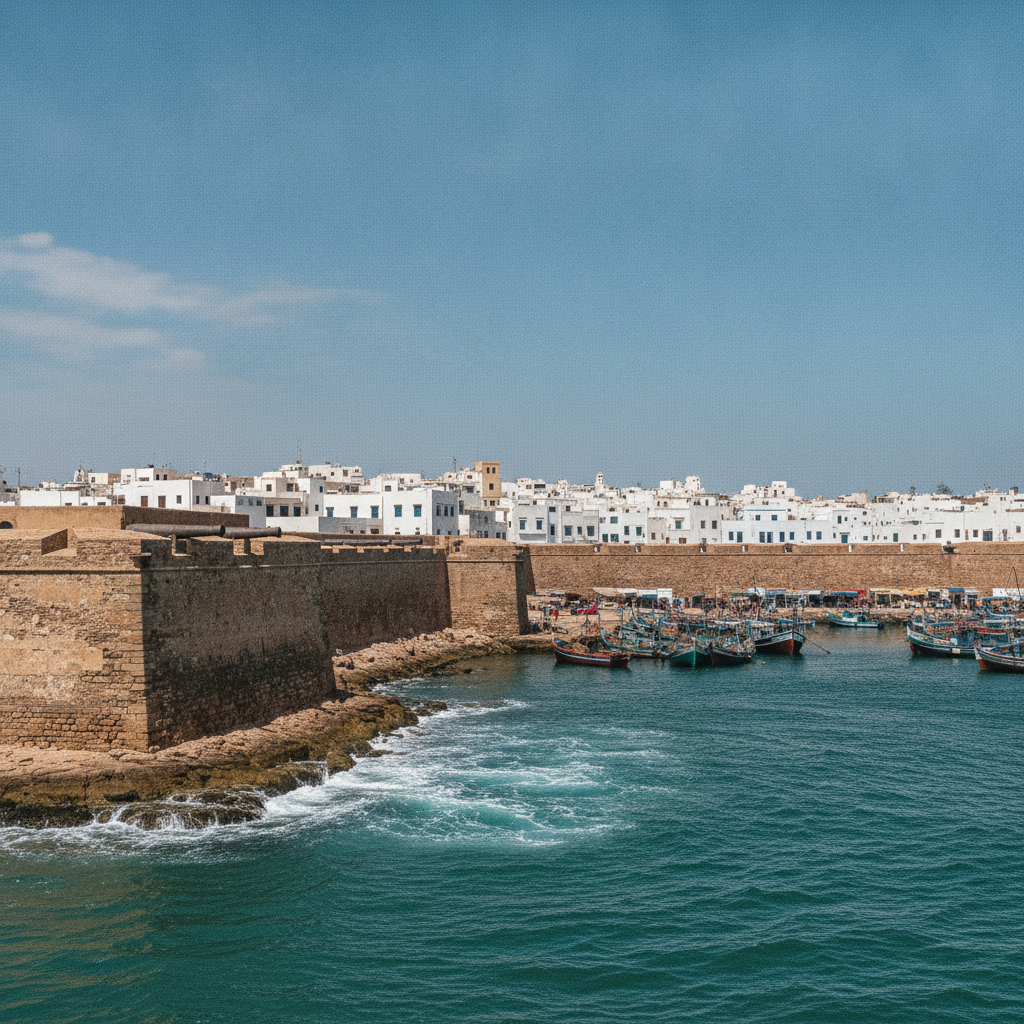
Essaouira Essential: The Atlantic Ramparts, the UNESCO Medina, Gnawa Music, the Mogador Portuguese Heritage, the Orson Welles and Jimi Hendrix Connections, and the Wind City Character
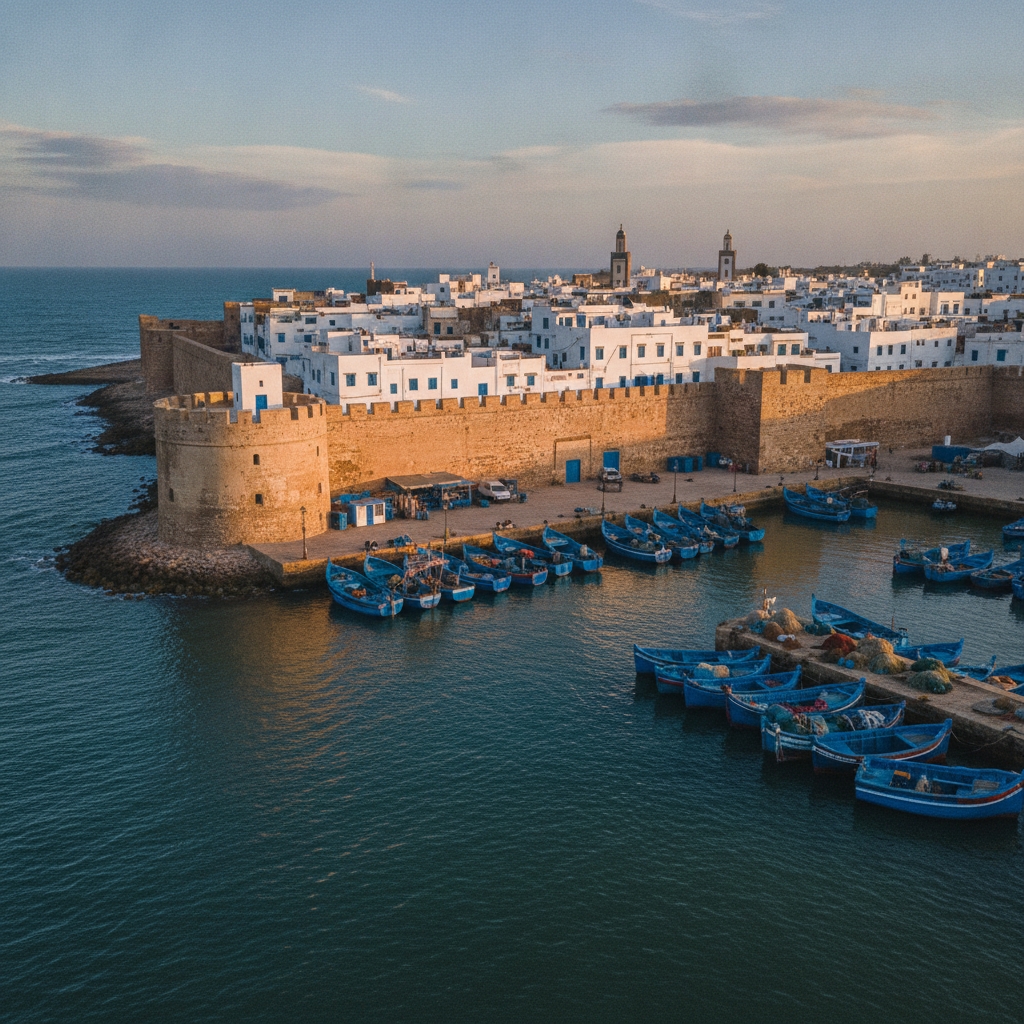
Essaouira History: The Mogador Portuguese Trading Post, the Phoenician Foundation, the Jewish Merchant Community, the Gnawa Slave Trade Origins, the 18th Century Sultan Rebuilding, and the UNESCO Recognition
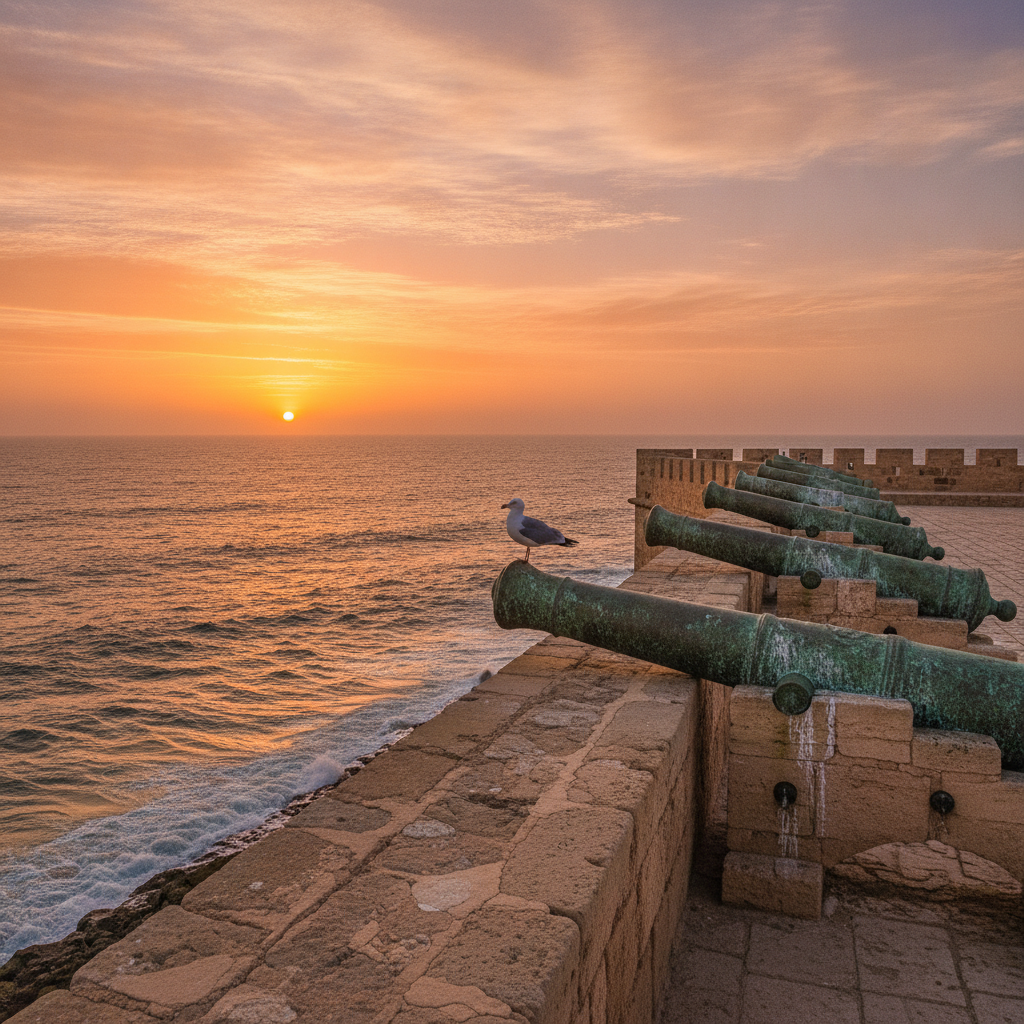
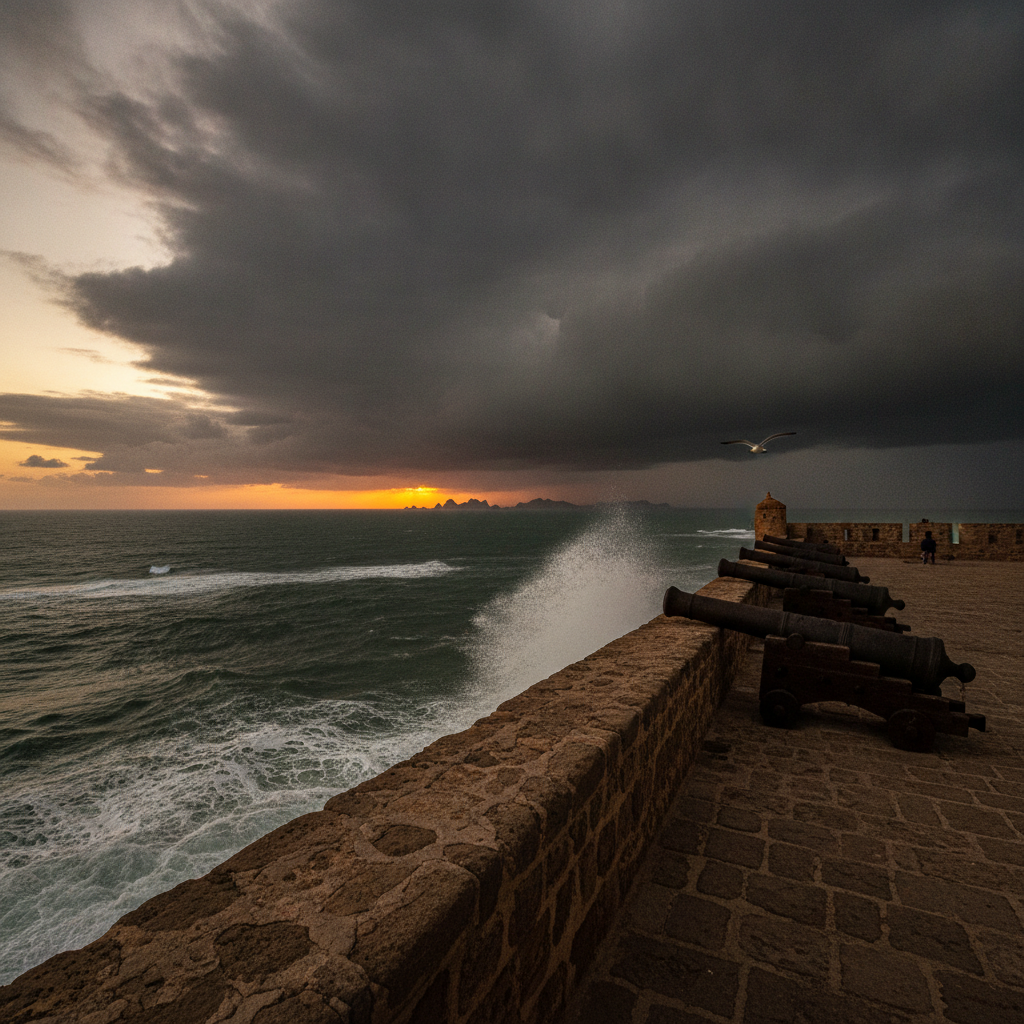
Essaouira's UNESCO-Listed Ramparts Were Designed by French Engineer Theodore Cornut in 1764-1765 Under Sultan Mohammed III and Line the Atlantic With 17th-18th Century Bronze Cannons Seized From European Ships; The Gnawa and World Music Festival of Essaouira Attracts 450,000-500,000 Visitors Over 4 Days in June and Is the World's Largest Gnawa Festival; The Thuya Arborvitae Root Burl Exploitation for the Essaouira Marquetry Craft Is Not Sustainable as Burl Harvesting Kills the Root System Preventing Tree Regeneration