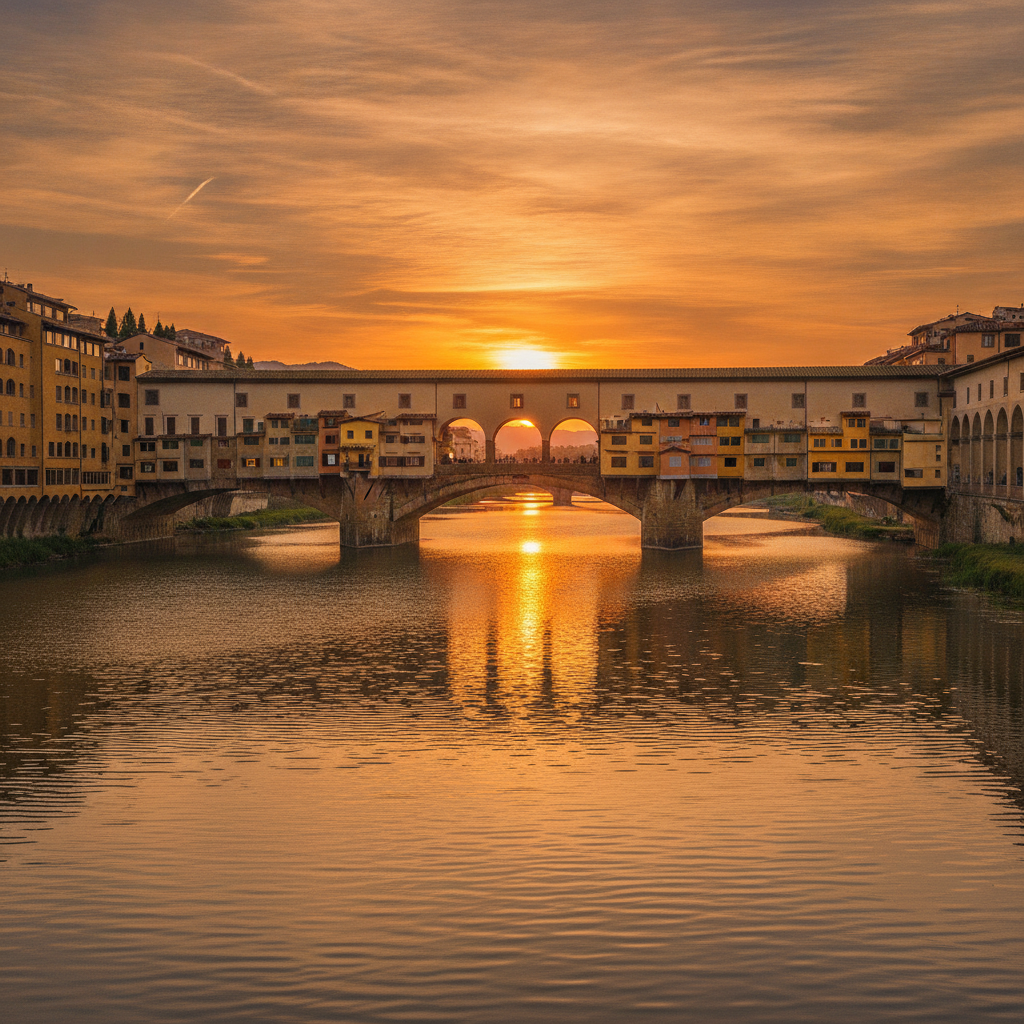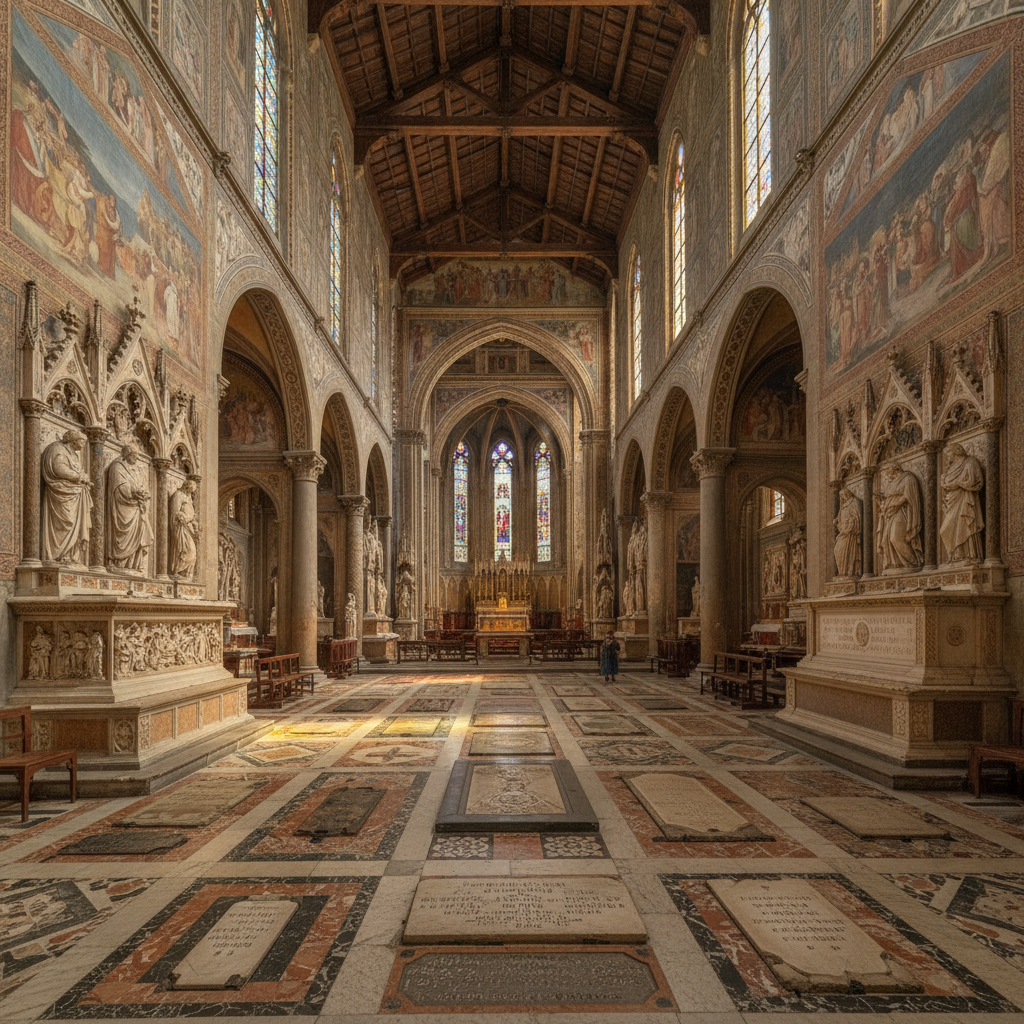
Santa Croce, the Medici Chapels & San Miniato al Monte
The eastern quarter of Florence's historic centre is anchored by Santa Croce — the Franciscan basilica that serves as Florence's principal monument to its own cultural legacy, containing the tombs of Michelangelo, Galileo, Machiavelli, Ghiberti and Rossini, and frescoes by Giotto — while the northern quarter contains the Medici Chapels (the funerary complex of the ruling dynasty, including Michelangelo's New Sacristy) and the southern hilltop contains the Romanesque gem of San Miniato al Monte.
- 1
Basilica di Santa Croce — Florence's Pantheon
The Basilica di Santa Croce (the Franciscan basilica of the Holy Cross, Piazza Santa Croce, one of the largest Franciscan churches in the world, begun in 1294 by Arnolfo di Cambio on the site of an earlier Franciscan oratory — the current building was largely complete by 1385 and the Gothic marble facade was added in 1853-1863 by Niccolo Matas at the expense of the English merchant Francis Joseph Sloane): Santa Croce contains the tombs or cenotaphs of the most important figures of Florentine and Italian intellectual and cultural history — including Michelangelo (died 1564, tomb designed by Vasari with allegorical figures of Painting, Sculpture and Architecture), Galileo Galilei (died 1642, tomb designed by Giovanni Battista Foggini, erected 1737 when the Church finally permitted his burial in consecrated ground), Niccolò Machiavelli (died 1527, cenotaph with Latin inscription 'Tanto nomini nullum par elogium' — 'No praise is adequate to so great a name'), Lorenzo Ghiberti (died 1455), Gioachino Rossini (died 1868), and many others; the basilica is also famous for the fresco cycles by Giotto in the Bardi Chapel (c.1320s, scenes from the life of St Francis) and the Peruzzi Chapel (c.1320s, scenes from the lives of St John the Baptist and St John the Evangelist) — the most important surviving works by Giotto and the foundation of the Western pictorial tradition.
- 2
Cappelle Medicee — Michelangelo's New Sacristy
The Cappelle Medicee (the Medici Chapels, Piazza Madonna degli Aldobrandini, the funerary complex of the Medici dynasty attached to the church of San Lorenzo): the complex comprises two distinct spaces — the Cappella dei Principi (Chapel of the Princes, the enormous octagonal mausoleum begun in 1604 for Cosimo I and his descendants, faced in pietra dura and coloured marble panels of extraordinary craftsmanship, one of the most expensive building projects in Florentine history, still unfinished at the top when construction stopped in the 18th century — and today housing the sarcophagi of six Medici Grand Dukes) and the Sagrestia Nuova (New Sacristy, designed and decorated by Michelangelo 1520-1534 for Cardinal Giulio de' Medici as a counterpart to Brunelleschi's Old Sacristy in San Lorenzo, and containing the most important cycle of funerary sculpture Michelangelo created): the New Sacristy contains the tombs of Lorenzo de' Medici Duke of Urbino (with the allegorical figures of 'Dawn' and 'Dusk') and Giuliano de' Medici Duke of Nemours (with the allegorical figures of 'Day' and 'Night') — six marble figures of overpowering sculptural intensity that represent the culmination of Michelangelo's exploration of the human body as an expressive vehicle.
- 3
Basilica di San Lorenzo — The Medici Parish Church
The Basilica di San Lorenzo (one of the largest churches in Florence, the parish church of the Medici family and the site of their patronage from the 15th century onwards, begun by Brunelleschi in 1419 and completed after his death with modifications by his successors): the interior, by Brunelleschi (completed 1470), is the purest surviving example of his mature architectural style — a three-nave basilica with grey pietra serena columns and arches against white plaster, the proportion of 1:2:4 (column : nave width : nave height) governing the entire space; the Sagrestia Vecchia (Old Sacristy, 1421-1428, Brunelleschi's first significant architectural work and the model for his subsequent work on the Duomo and Santo Spirito) contains bronze doors by Donatello and marble reliefs by Donatello; the attached cloister and the Biblioteca Medicea Laurenziana (the Medici library, the reading room and staircase designed by Michelangelo 1524-1534 and housing the Medici collection of manuscripts) are also accessible.
- 4
Piazza Santa Croce & the Leather Market
The Piazza Santa Croce (the large square in front of Santa Croce basilica, one of the most important public spaces in Florence — the site of jousting tournaments, religious processions, theatrical performances and executions in the medieval period, and today the venue for the annual Calcio Storico Fiorentino — the 16th-century historic football game played in period costume between the four historic quarters of the city): the piazza is surrounded by the finest concentration of medieval and Renaissance palazzo facades in Florence, and the area around it (particularly the Via dei Benci and Via Ghibellina) contains some of the best examples of 14th-16th century residential architecture in the city; the leather school and shops in and around Santa Croce (the Scuola del Cuoio, founded in 1950 in the convent behind the basilica by friars to provide a livelihood for WWII orphans) continue a leather-working tradition in this quarter of the city that dates to the medieval period.
- 5
San Miniato al Monte — The Romanesque Hilltop Basilica
The Basilica di San Miniato al Monte (Via delle Porte Sante, on the south bank of the Arno approximately 110 metres above the city, accessible on foot via the Piazzale Michelangelo or by bus from Piazza Ferrucci): San Miniato al Monte is the finest example of Florentine Romanesque architecture in existence and one of the most beautiful churches in Italy — the facade (begun c.1090) consists of alternating bands of white Carrara marble and green Prato serpentine in a geometric pattern that prefigures the polychrome marble aesthetic of the Florentine Gothic style; the interior contains the most complete Romanesque floor pavement in Tuscany (the inlaid marble floor of 1207, with signs of the zodiac and the emblems of the guilds), a freestanding tabernacle by Michelozzo (1447) commissioned by Piero de' Medici as ex-voto for a miraculous image of the Virgin, and the Cappella del Cardinale del Portogallo (Chapel of the Cardinal of Portugal, 1461-1473, commissioned by King Afonso V of Portugal for his nephew Giacomo di Lusitania, Cardinal of Portugal — one of the most complete and lavishly decorated small chapel interiors of the 15th century, with ceiling medallions by Luca della Robbia, wall paintings by Antonio and Piero Pollaiuolo, and a marble tomb by Antonio Rossellino).
- 6
Oltrarno Hidden Gems — Santo Spirito & Palazzo Pitti
Santo Spirito (the Augustinian basilica in the Oltrarno quarter of Florence, Piazza Santo Spirito, designed by Brunelleschi in 1434-1446 though built largely after his death — the interior, with its 40 semicircular chapels running around the entire perimeter of the nave and transepts behind a continuous colonnade of grey pietra serena columns, is considered by many architectural historians to be Brunelleschi's most mature and technically complete design): the Piazza Santo Spirito is the most characteristic square in the Oltrarno quarter, lined with local bars and restaurants and the site of the daily market, a Sunday antiques market, and the summer aperitivo culture that makes it the social heart of the working-class/bohemian Oltrarno neighbourhood that has been increasingly gentrified over the past two decades but still retains a more authentically Florentine character than the heavily tourist areas north of the Arno.
Walk this route with audio
Stories play automatically as you reach each stop — no tapping needed.
More in florence
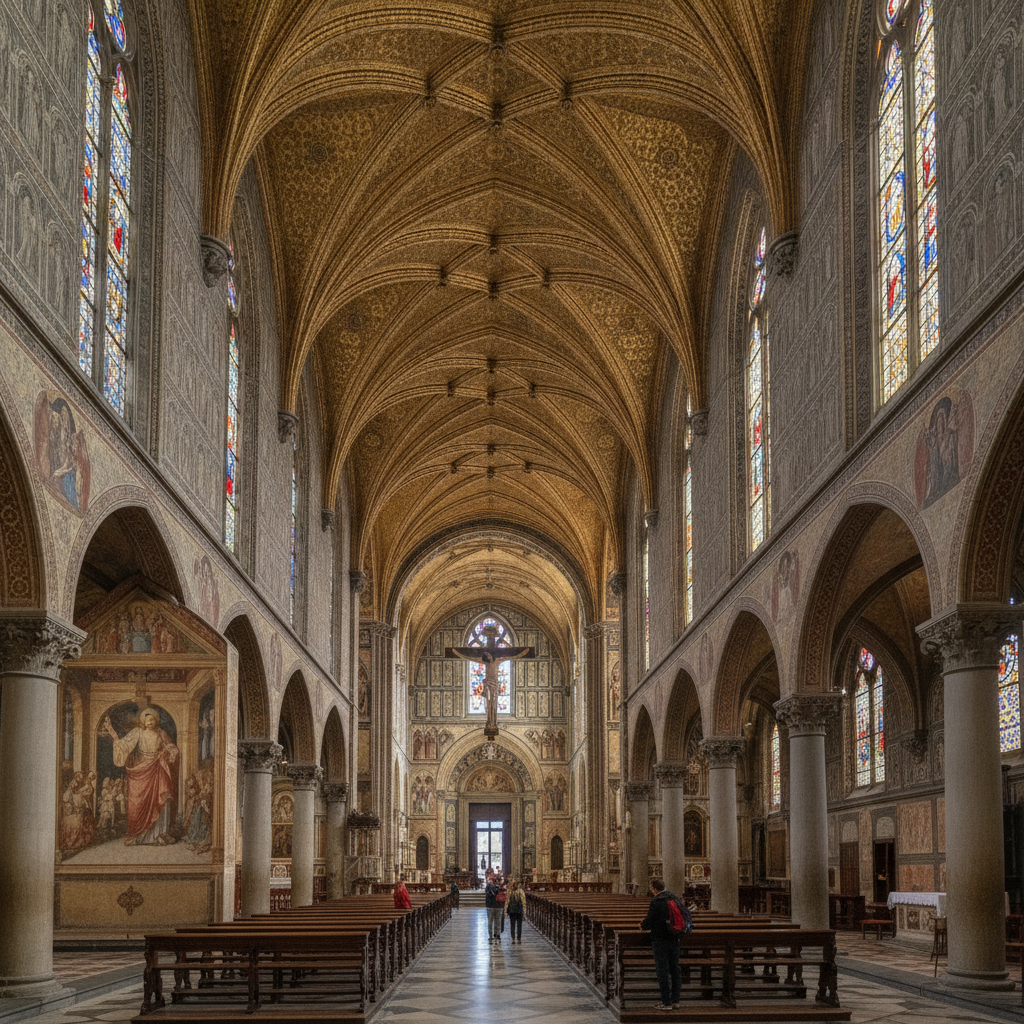
Santa Maria Novella, Via Tornabuoni & Ghirlandaio's Florence
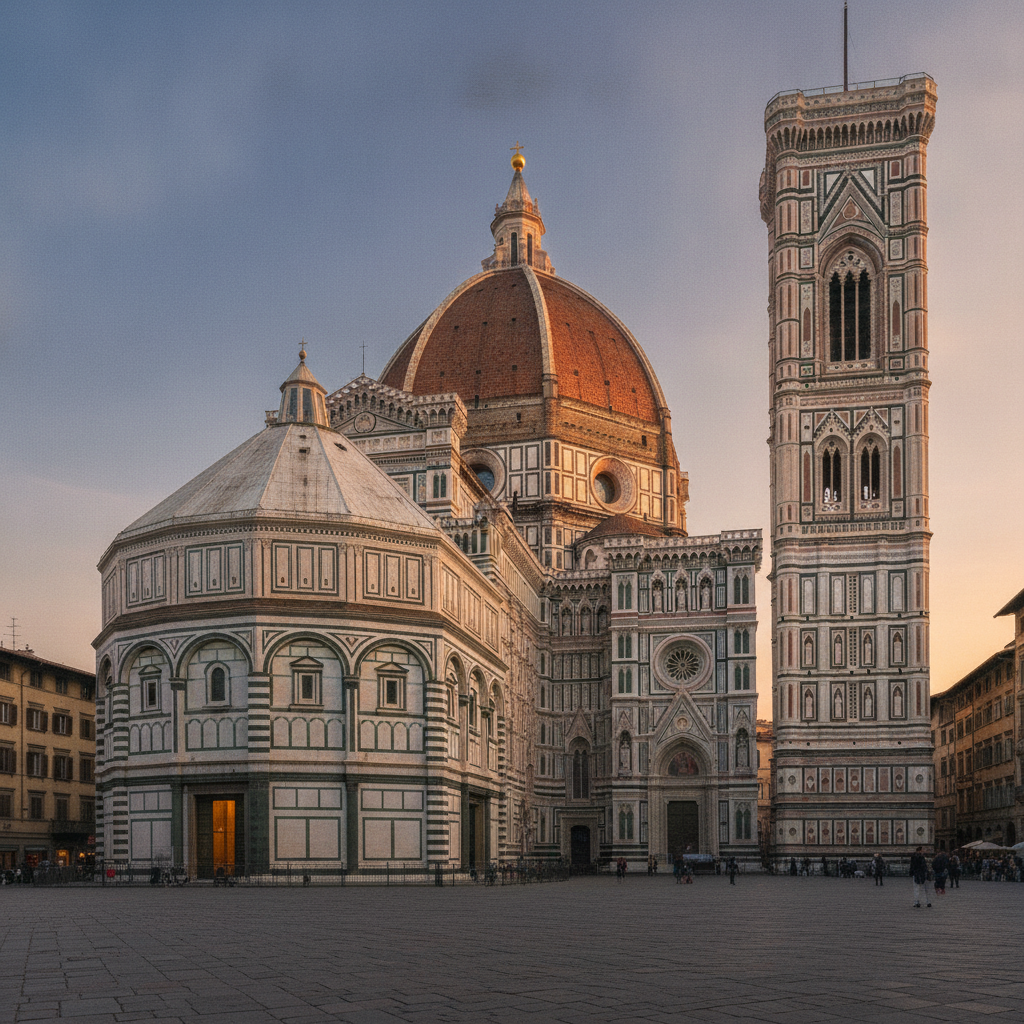
The Duomo, Baptistery & Giotto's Campanile — Piazza del Duomo
Fiesole, the Chianti Hills & the Tuscan Countryside above Florence
Galleria dell'Accademia, Michelangelo's David & the Convent of San Marco
Museo Galileo, the Florentine Jewish Ghetto & the Via dei Benci