Santa Maria Novella, Via Tornabuoni & Ghirlandaio's Florence
The western quarter of Florence's historic centre, focused on the Dominican basilica of Santa Maria Novella and the luxury shopping street of Via Tornabuoni, represents a distinct layer of Florentine culture — the Church that contains Masaccio's 'Trinity' (the first painting using true linear perspective), Ghirlandaio's cycle of Florentine society portraits in the Tornabuoni Chapel, and the aristocratic urban fabric of the Palazzo Strozzi and the Via de' Tornabuoni banking district.
- 1
Basilica di Santa Maria Novella — Dominican Gothic & Masaccio's Trinity
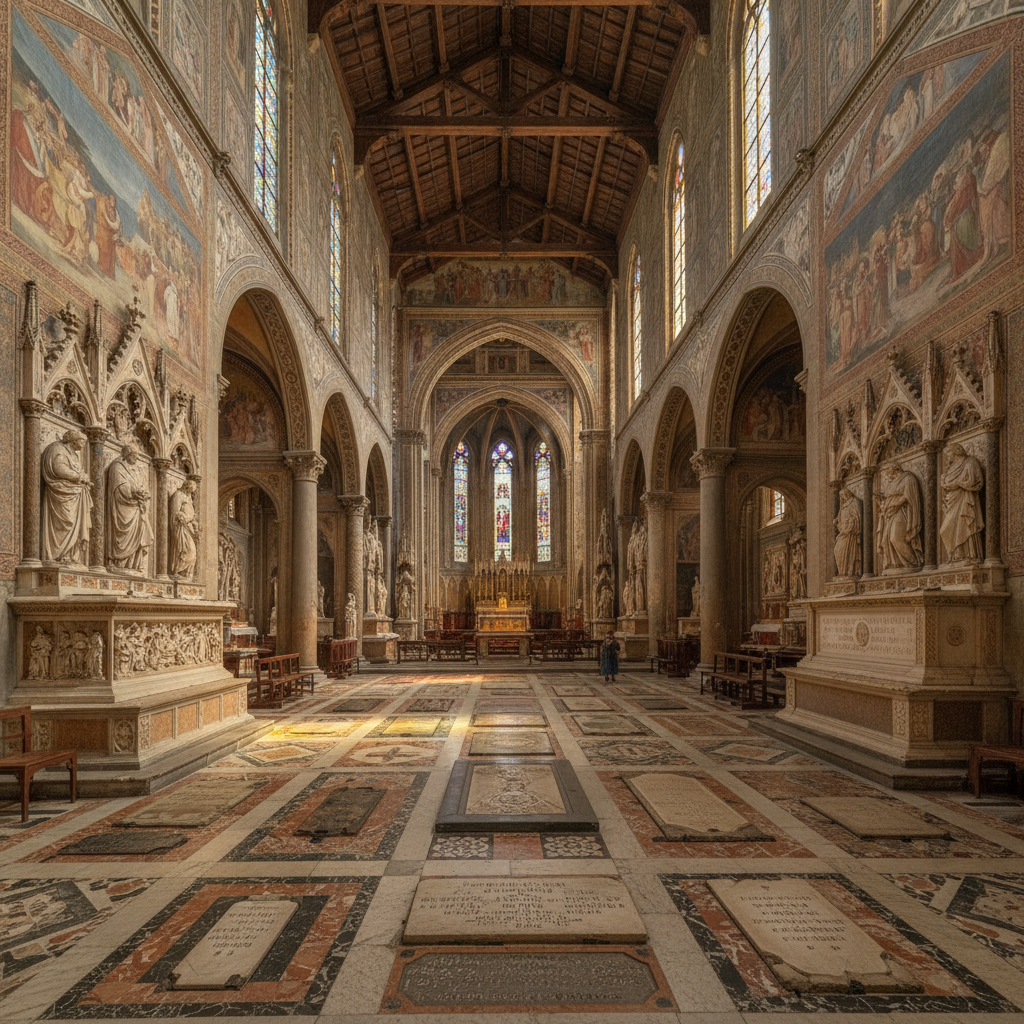
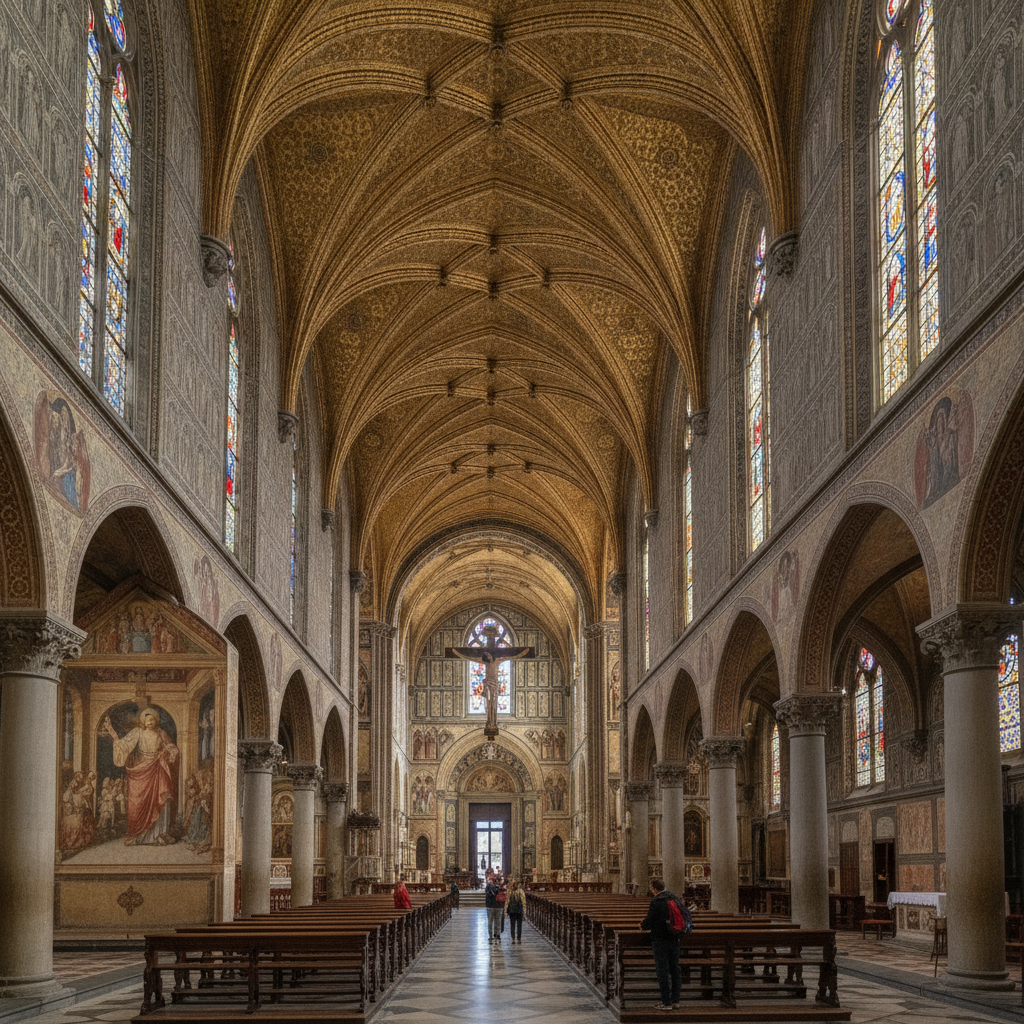
The Basilica di Santa Maria Novella (Piazza Santa Maria Novella, the principal Dominican church of Florence, begun in 1246 and largely complete by 1360, with the facade completed in 1470 by Leon Battista Alberti — Alberti's facade, combining the green and white marble inlay tradition of Florentine Romanesque with Renaissance classical elements, was the first Renaissance church facade and established the template for most subsequent Italian church architecture): the interior contains one of the most important concentrations of Renaissance art in any single church in Italy: Masaccio's 'Trinity' (c.1427, the fresco on the left wall of the nave that represents the first painting in the history of Western art to use true mathematical linear perspective — the illusionistic barrel vault above the figures of the Trinity, painted as if it were a real architectural space receding into the wall, was a revolutionary demonstration of the new Renaissance approach to pictorial space that Brunelleschi had theorized and Alberti had codified); the Tornabuoni Chapel frescoes by Ghirlandaio (1485-1490, covering all four walls of the main chapel behind the altar with scenes from the lives of the Virgin and St John the Baptist but incorporating the portraits of the entire Tornabuoni family and their circle, effectively turning a religious commission into the most ambitious portrait cycle of the 15th century — the young Michelangelo was apprenticed to Ghirlandaio during the execution of this cycle); Brunelleschi's carved wooden Crucifix (c.1410-1415); and the Gondi Chapel (Filippino Lippi, 1502).
- 2
Piazza Santa Maria Novella & the Obelisks
The Piazza Santa Maria Novella (the triangular square in front of the basilica, between the railway station area and the historic centre): the piazza is notable for the two marble obelisks resting on bronze tortoises at either end (erected in 1608 to mark the turning posts for the Palio dei Cocchi — the chariot races that were held in the piazza on the feast of St John the Baptist); the arcade of the Loggia di San Paolo on the west side of the piazza (15th century, with ceramic roundels attributed to Andrea della Robbia) mirrors the appearance of Brunelleschi's Ospedale degli Innocenti in the Piazza Santissima Annunziata; the Cappella degli Ubriachi (Chapel of the Drunkards, accessible from the convent), the Spanish Chapel (Cappellone degli Spagnuoli, the chapter house decorated with Andrea di Bonaiuto's extraordinary fresco cycle of Dominican doctrine c.1365-1368), and the Green Cloister (Chiostro Verde, with 15th-century frescoes by Paolo Uccello including the four scenes of the 'Flood') are accessible through the museum entrance.
- 3
Via Tornabuoni & the Palazzo Strozzi
Via Tornabuoni (the principal luxury shopping street of Florence, running north-south between the Piazza Santa Trinita (south) and the Via de' Cerretani (north), approximately 500 metres long): the Via Tornabuoni has been the central axis of aristocratic and upper-class Florentine urban life since the 15th century, when the Tornabuoni family (the family of Lorenzo de' Medici's mother Lucrezia Tornabuoni) developed their palazzo and banking operations here; today the street houses the major Italian and international luxury brands (Gucci, Ferragamo, Versace, Bulgari, Cavalli, Emilio Pucci — many with their original or historic connections to Florence); the Palazzo Strozzi (Piazza degli Strozzi, begun 1489 by Benedetto da Maiano for the wealthy banker Filippo Strozzi the Elder in conscious emulation and rivalry of the Medici palace on Via Cavour — the largest private palace in Renaissance Florence, with identical rusticated stone facades on all four sides and a continuous projecting cornice running around the building at the top) is today the principal venue for major art exhibitions in Florence.
- 4
Officina Profumo-Farmaceutica di Santa Maria Novella
The Officina Profumo-Farmaceutica di Santa Maria Novella (Via della Scala 16, accessible from the north side of Piazza Santa Maria Novella — the pharmacy and perfumery established by the Dominican friars of Santa Maria Novella in the early 17th century, drawing on the tradition of monastic herbal medicine and the production of distilled waters, unguents, and herbal remedies that the friars had practiced since at least the 13th century): the pharmacy is the oldest in the world in continuous operation — it has been open to the public since 1612 and its products (acqua di colonia, rose water, pomades, herbal liqueurs, soaps, and beauty preparations) are still made using methods and formulas derived from the original monastic recipes; the interior of the shop occupies the former chapel of the Rucellai family and is one of the most beautiful retail spaces in Florence — Neo-Gothic walls and vaulted ceilings, antique pharmacy furniture, and the extraordinary fragrance of hundreds of botanical preparations accumulated over four centuries.
- 5
Palazzo Rucellai & Alberti's Architecture
The Palazzo Rucellai (Via della Vigna Nuova 18, approximately 200 metres west of Via Tornabuoni — the palazzo built c.1446-1451 by Leon Battista Alberti for the merchant Giovanni Rucellai, the first palazzo facade in Florence to use the classical orders of architecture in a systematic way, superimposing pilasters of Doric, Ionic and Corinthian character on successive storeys after the manner of the Colosseum in Rome): the Palazzo Rucellai represents the theoretical counterpart to Brunelleschi's practical architectural revolution — where Brunelleschi used classical forms intuitively and pragmatically in his church interiors, Alberti (1404-1472) — architect, humanist, theorist and the author of 'De re aedificatoria' (On the Art of Building, c.1443-1452, the first complete architectural treatise of the Renaissance) — applied classical orders with scholarly consistency according to the rules he derived from Vitruvius and his observation of ancient Roman buildings; the Loggia dei Rucellai opposite (Via della Vigna Nuova, c.1464, also designed by Alberti) was built as a family loggia for wedding ceremonies.
- 6
San Lorenzo Market & the Leather Quarter
The Mercato di San Lorenzo (the large covered market hall on the Piazza del Mercato Centrale, between the Basilica di San Lorenzo and the railway station, built in 1874 by Giuseppe Mengoni — the architect of the Galleria Vittorio Emanuele II in Milan — as a cast-iron and glass market hall of the type being built throughout Europe in the second half of the 19th century as part of urban hygiene reform): the ground floor of the market hall (Mercato Centrale) is Florence's principal food market, selling fresh produce, meat, fish, cheese and prepared foods; the upper floor was renovated in 2014 as a gastronomic hall with individual food stalls and a restaurant; the surrounding streets (particularly the Via dell'Ariento and Piazza San Lorenzo) are lined with leather goods stalls and souvenir vendors — the heart of the touristy but authentic Florentine leather market quarter, where the leather goods sold range from mass-produced items of uncertain origin to high-quality handmade products by local craftspeople.
Walk this route with audio
Stories play automatically as you reach each stop — no tapping needed.
More in florence
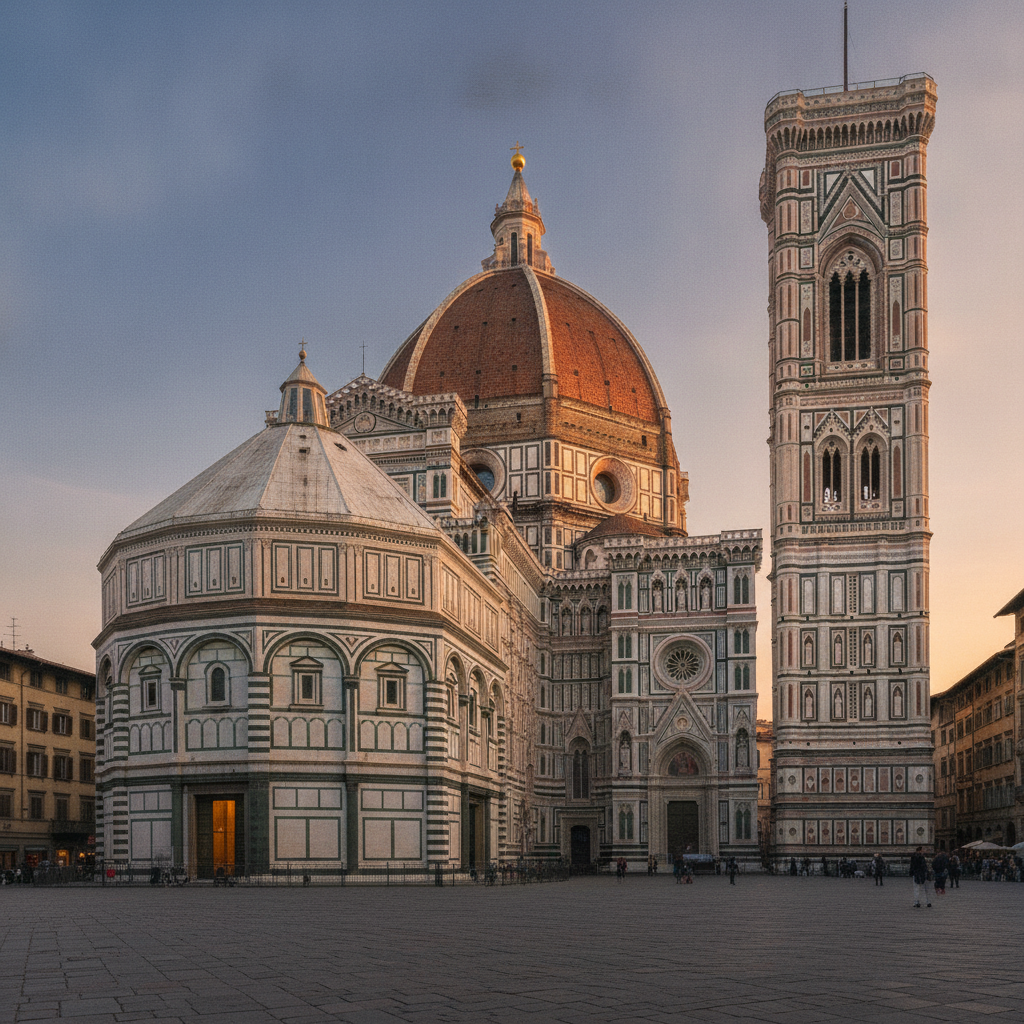
The Duomo, Baptistery & Giotto's Campanile — Piazza del Duomo
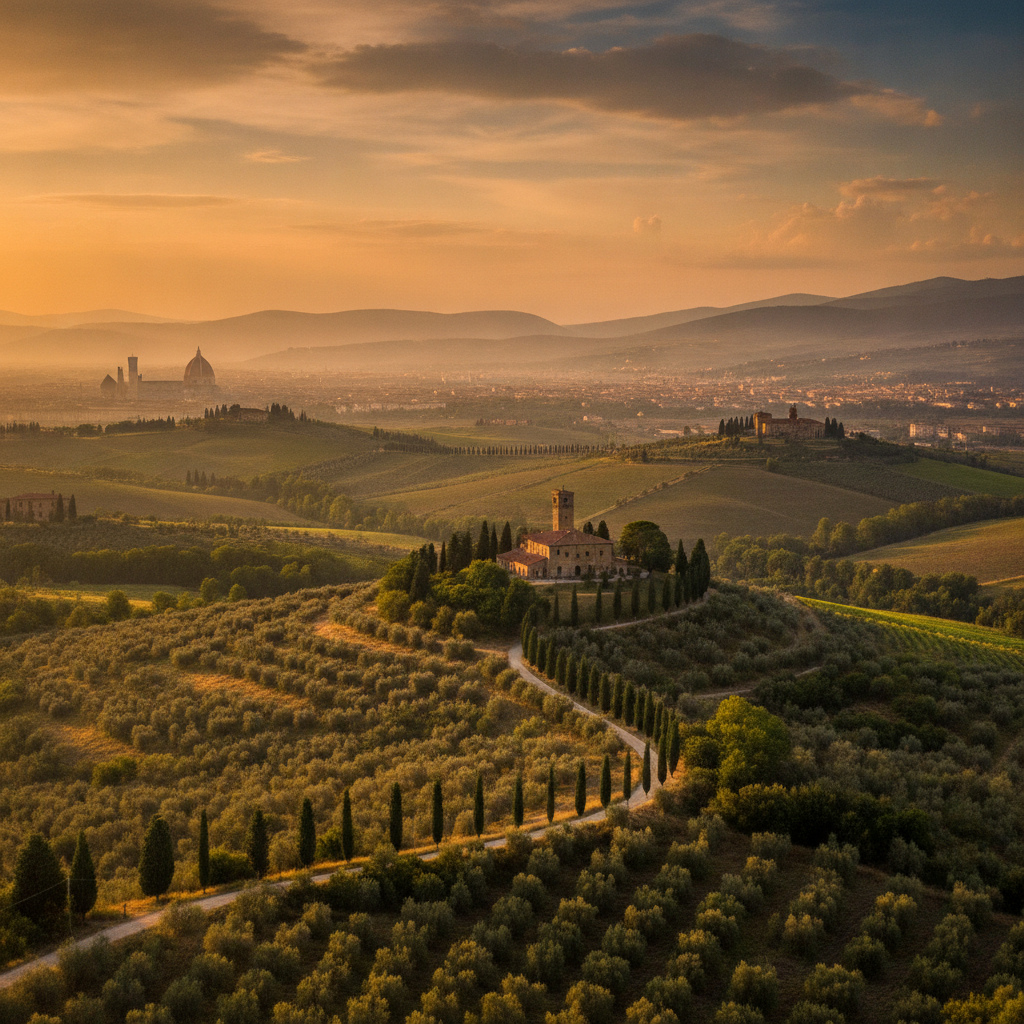
Fiesole, the Chianti Hills & the Tuscan Countryside above Florence
Galleria dell'Accademia, Michelangelo's David & the Convent of San Marco
Museo Galileo, the Florentine Jewish Ghetto & the Via dei Benci
The Uffizi Gallery, Ponte Vecchio & Piazzale Michelangelo