Galapagos Birds: Boobies, Finches, Frigatebirds, and the Flightless Cormorant
The bird life of the Galapagos is the most accessible and scientifically significant in the world. Of the approximately 60 resident bird species, 27 are endemic, found nowhere else on earth. The famous Darwin finches, 13 species that radiated from a single founding ancestor, remain the textbook example of adaptive radiation. The tame behavior of all Galapagos birds, which evolved in the absence of terrestrial predators, allows observation at distances measured in centimeters. Nesting colonies of blue-footed boobies, magnificent frigatebirds, waved albatrosses, and red-footed boobies are accessible from marked trails where birds sit beside the path ignoring human observers. This route covers the key bird species and the islands where each is most reliably encountered.
- 1
Darwin Finches: 13 Species from One Ancestor
The 13 species of Darwin finches represent one of the most celebrated examples of adaptive radiation in biology, the process by which a single founding species diverges into multiple species filling different ecological niches. A single founding finch species arrived in the Galapagos from South America millions of years ago; its descendants diversified to occupy niches that on the mainland are filled by other bird families: large seed-crackers, small seed-crackers, insect-gleaners, cactus specialists, and even a woodpecker finch that uses a cactus spine as a tool to probe for insects in bark crevices. Beak shape varies dramatically between species in direct correlation with food type. The medium ground finch on Santa Cruz and Isabela, the most common and easily observed species, is a good starting point; specialist birders systematically check all 13 species as a challenging Galapagos completionist goal.
- 2
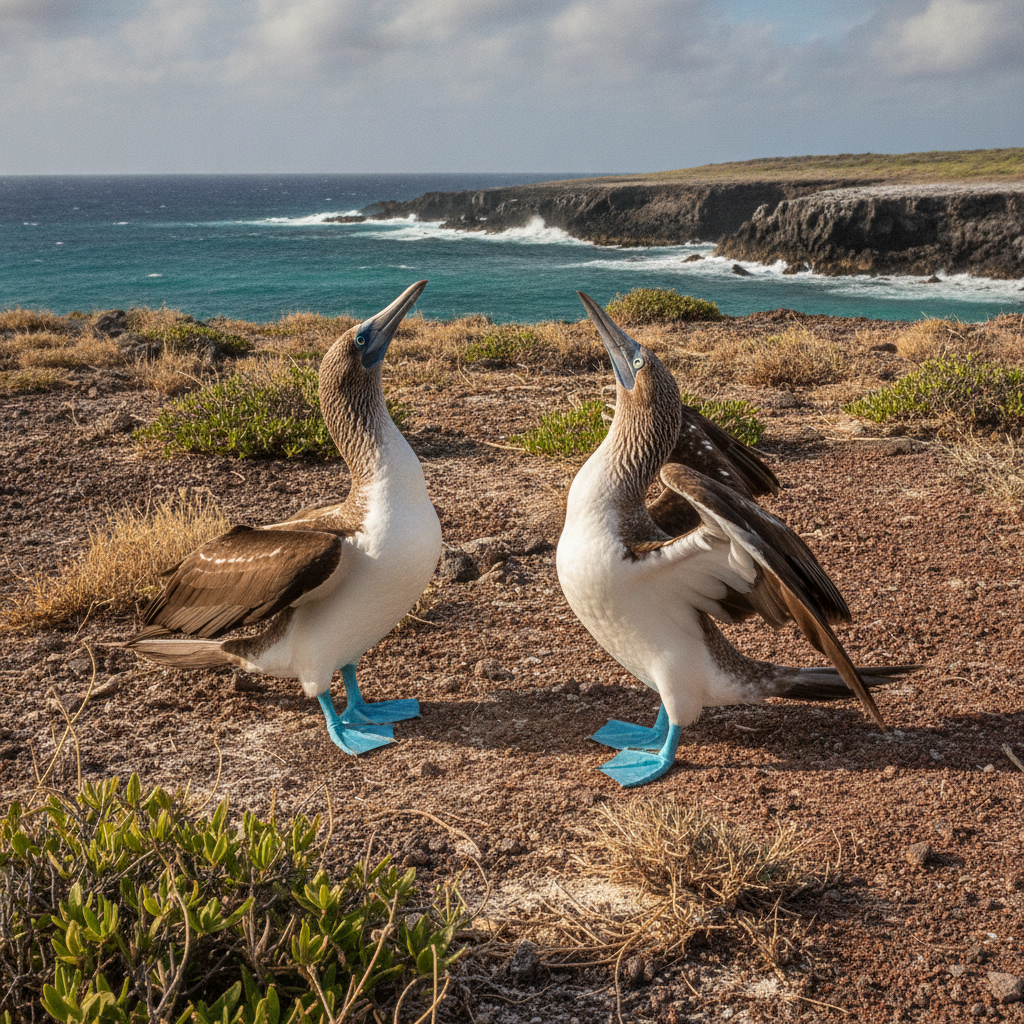
Blue-Footed Boobies: The Foot Display and Espanola Colonies
The blue-footed booby is the most photographed bird in the Galapagos, its intense turquoise-blue feet the result of carotenoid pigments derived from the fresh fish it eats; healthier, better-fed birds have brighter feet, and female boobies prefer males with the brightest feet as indicators of fitness. The courtship display involves the male lifting each blue foot in a deliberate high-stepping walk in front of the female, accompanied by sky-pointing and whistling. Nests are depressions on the ground, and chicks are brooded between the parents feet. Espanola Island has the largest accessible colony, with birds nesting beside the visitor trail. Colonies are also found at North Seymour, Daphne Major, Punta Vicente Roca on Isabela, and at Gardner Bay. The booby dives from heights of up to 25 meters, entering the water at up to 100 kilometers per hour, and schools of boobies dive-bombing a fish concentration are one of the great Galapagos spectacles.
- 3
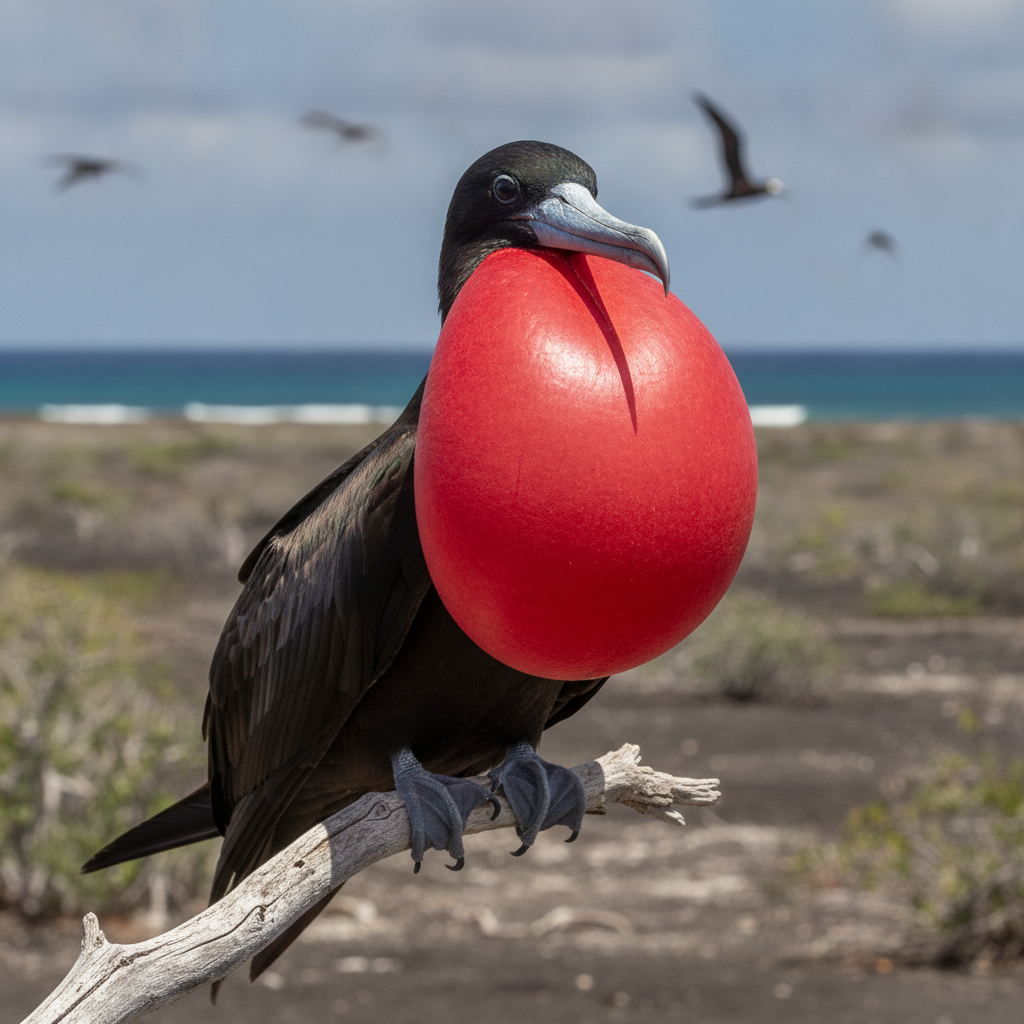
Magnificent Frigatebirds: The Red Balloon Display at North Seymour
The magnificent frigatebird is one of the most theatrical birds in the world, the male displaying to females with an inflated red throat pouch that expands to the size of a volleyball, held for up to 20 minutes while the male shakes his wings and bill-chatters at females flying overhead. Frigatebirds are kleptoparasites, stealing food from other birds in aerial chases rather than fishing themselves; their feathers lack the waterproofing of other seabirds and they cannot land on water. North Seymour Island near Baltra is the best site for frigatebird display observation, with both magnificent and great frigatebirds nesting in the palo santo shrubs alongside blue-footed boobies. The males with inflated red pouches line the trail in spectacle rivaling anything in the natural world. The nesting season runs approximately from April through August when inflated displays are most common, though some birds are present year-round.
- 4
Flightless Cormorant: Evolution of Flightlessness on Fernandina
The flightless cormorant, found only on Fernandina and the western coast of Isabela, is the largest cormorant in the world and the only cormorant that cannot fly. Its wings are roughly one-third the size required for sustained flight; they are used to balance while running on land and as rudders while diving. The birds are superb underwater swimmers, pursuing fish and octopus into deep crevices in the rocky seafloor. The evolutionary logic is straightforward: having no terrestrial predators, the energetic cost of maintaining flight-capable wings was not offset by any survival benefit, so smaller wings became advantageous by freeing energy for other uses. The total population is estimated at approximately 1,000 pairs, making it one of the rarest birds in the world. Visitor sites at Punta Espinosa on Fernandina and Punta Moreno and Elizabeth Bay on Isabela provide reliable sightings.
- 5
Waved Albatross: The Ocean Wanderers of Espanola
The waved albatross, with its 2.5-meter wingspan and elaborate head-waving, bill-clapping, and sky-pointing courtship ritual, nests exclusively on Espanola Island from April through December. The population of approximately 35,000 birds makes this the only breeding site in the world for the species. Outside the nesting season, waved albatrosses spend their lives over the open Pacific, returning to the same partner and often the same nest site year after year. The courtship display, performed by reuniting pairs after months at sea, involves an elaborate sequence of mutual preening, beak-rubbing, and the iconic head-waving that gives the species its common name. The visitor trail at Punta Suarez on Espanola passes through the nesting colony at close range; the birds ignore observers and continue their displays at distances of one to two meters. Espanola is a four to five hour sail from Santa Cruz and is reached only by cruise.
- 6
Seabirds and Shorebirds: Gulls, Pelicans, and Tropicbirds
In addition to the iconic species, the Galapagos supports a rich community of seabirds and shorebirds. The swallow-tailed gull is the only nocturnal gull in the world, fishing at night using large red-rimmed eyes adapted for low light; it nests in large colonies on Genovesa, Wolf, Darwin, and the rim of Espanola. The lava gull, the rarest gull on earth with a total population of approximately 600 pairs, forages along every shoreline and is easily confused with a common bird despite its rarity. The red-billed tropicbird, with long white tail streamers, nests in cliff crevices and is regularly seen soaring overhead at several visitor sites. Brown pelicans are omnipresent in the harbors and fishing docks, and the endemic Galapagos penguin waddles along the Isabela and Fernandina shorelines. The American flamingo flock at Punta Cormorant on Floreana feeds in the brackish lagoon visible from the visitor trail.
Walk this route with audio
Stories play automatically as you reach each stop — no tapping needed.
More in Galapagos

Galapagos Geology: Hotspot Volcanism and the Making of the Islands
Galapagos Giant Tortoises: Natural History, Near Extinction, and Recovery
Galapagos Diving and Snorkeling: Shark Aggregations and Underwater Wildlife
Galapagos Reptiles: Marine Iguanas, Land Iguanas, and Lava Lizards
Galapagos Conservation: The Human Presence, Tourism Management, and Future Threats