Gdańsk Churches & Art — St. Mary's Basilica, the Teutonic Legacy & the Memling Altarpiece
Gdańsk's ecclesiastical and artistic heritage reflects the city's position at the intersection of the Teutonic Order's Baltic state, the Polish-Lithuanian Commonwealth, and the Hanseatic trading network — three distinct political and cultural systems that each left their mark on the city's churches, civic buildings, and art collections.
- 1
The Teutonic Knights and the Foundation of Gdańsk
The Teutonic Order (the German crusading military order that conquered the Baltic lands in the 13th century, establishing a monastic state covering modern-day Poland, Lithuania, Latvia, and Estonia, the Order's Grand Masters ruling from Marienburg — Malbork Castle, 60km southeast of Gdańsk — until the Polish-Lithuanian defeat of the Order at the Battle of Grunwald in 1410, the Order's influence on Gdańsk most visible in the original Gothic city plan and the Great Mill of 1350 — both Order constructions): Malbork Castle (the most important Teutonic Knights monument, 60km from Gdańsk by train in 40 minutes at €5, the largest medieval brick castle in the world, UNESCO World Heritage Site, €22 adults, the Grand Masters' palace, the Great Refectory, and the amber collection the three essential elements of the 3-hour visit) and the Church of St. Catherine (Kościół Świętej Katarzyny, Katarzynki 1, the oldest parish church in Gdańsk, the first church built in the city in 1227 by the Teutonic Order, the Gothic brick structure rebuilt after 1945, the carillon of 49 bells — the largest carillon in Poland, the bells audible across the Old Town on the hour — free, open daily 9am-6pm).
- 2
St. Mary's Basilica — the Largest Brick Church in the World
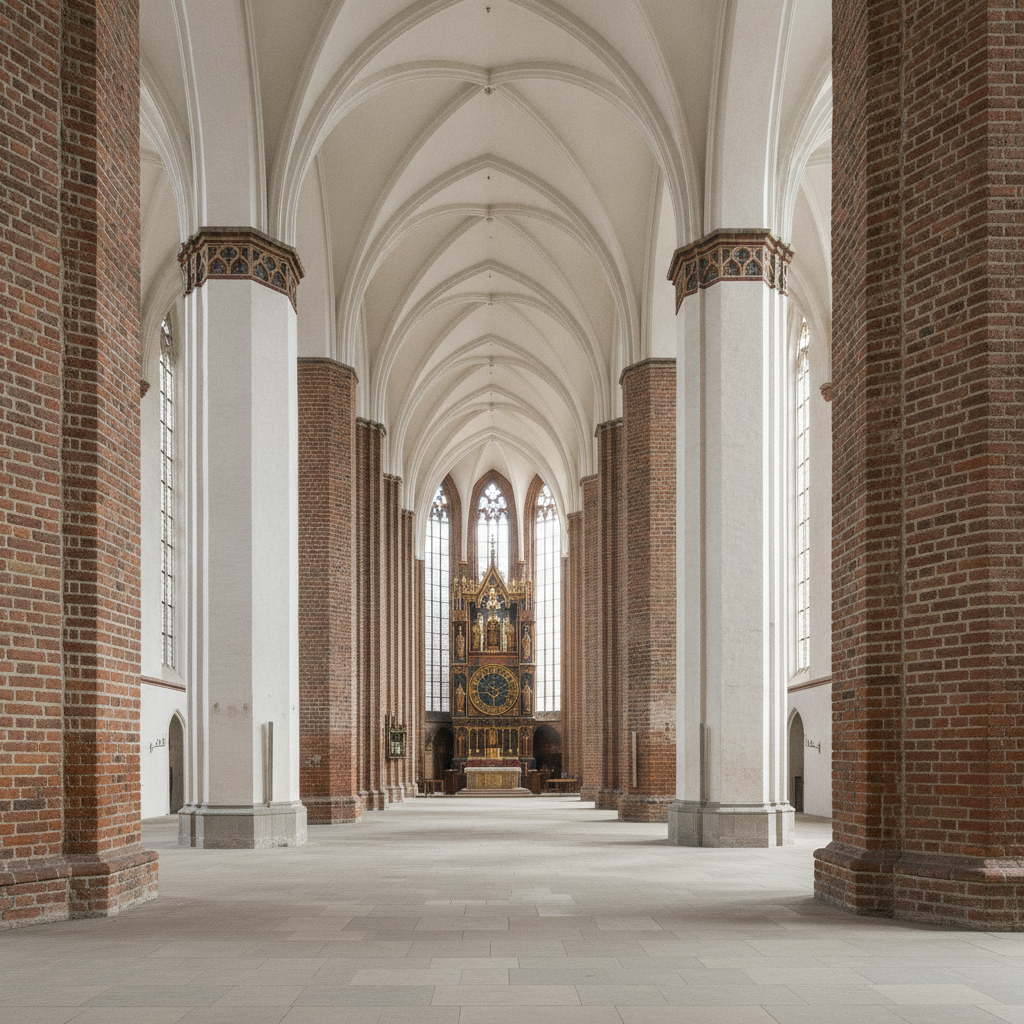
The Basilica of the Assumption of the Virgin Mary (Bazylika Mariacka, Podkramarska 5, the Gothic brick church built 1343-1502, the construction taking 159 years and involving the work of 5 generations of Gdańsk master builders, the dimensions: 105m long, 66m wide at the transept, the central vault rising to 29m, the church accommodating 25,000 worshippers — the largest gathering space in medieval Northern Europe, free during visiting hours, open daily 8am-7pm in summer) is the most important single building in Gdańsk. The astronomical clock of 1470 (the mechanical clock 14m tall in the north transept, the daily procession of 12 apostle figures at noon, the skeleton figure of Death striking the bell on the hour, the lunar calendar, the perpetual calendar showing the feast days of all saints — the most complex Gothic mechanical clock in the world at the time of its construction, the mechanism still working in its original form); the tower (405 steps to the observation gallery, €5 adults, the view over the Old Town roofline, the Motława River, and the Baltic coast the best elevated perspective in Gdańsk); and the interior as a whole (the white-painted brick vault, the absence of wooden pews creating an extraordinary sense of volume, the 37 chapels with their private family altarpieces, the monument to the families of the Gdańsk Patriciate).
- 3
The Hans Memling Last Judgement — Gdańsk's Greatest Art Treasure
The Last Judgement triptych by Hans Memling (painted Bruges 1467-1473, the central panel 223cm × 161cm, the wings 223cm × 72cm each, the work commissioned by the Florentine banker Angelo di Jacopo Tani as the altarpiece for the Medici chapel in Florence — the Medici had specifically requested a Memling from their Bruges agents, the most expensive Flemish painting commission of the decade): the capture (the Italian galley carrying the altarpiece from Bruges to Florence intercepted by the Gdańsk privateer Paul Beneke in the English Channel in 1473, Beneke unaware of the cultural value of the cargo but aware of its monetary worth, the altarpiece taken to Gdańsk as legitimate war booty in the ongoing conflict between the Hanseatic League and the English, the Medici protesting the theft for decades but unable to recover the painting) and the work itself (the central panel's extraordinary detail — the 100+ individual figures in the Last Judgement scene, each face individually characterized, the architectural throne of Christ the most complex compositional problem in Northern Renaissance painting, the weighing of souls in the scales held by the Archangel Michael the most psychologically precise representation of divine judgment in any painting before Michelangelo). Now at the National Museum, Toruńska 1, €10 adults.
- 4
Oliwa Cathedral and the Baroque Organ
The Oliwa Cathedral (Archikatedra Oliwska, Biskupa Edmunda Nowickiego 5, Gdańsk-Oliwa, accessible by SKM commuter train in 12 minutes from Gdańsk Główny, the Cistercian abbey church founded 1186 by the Polish Duke Sambor I, the Gothic cathedral extensively rebuilt in the Baroque period, the longest church nave in Poland at 107m, free during visiting hours daily 9am-5pm) is the most atmospheric church in the Tri-City. The Baroque organ (the instrument built 1763-1788 by the Cistercian brother Franz Rudolf Dalitz and Johann Wilhelm Wulff, 110 stops and 7,876 pipes organized in two halves of the west gallery, the mechanical angels and solar-system models activating when the organ plays the top register — the angels moving their trumpets to their lips, the gilded stars rotating above the keyboard, the sun and moon models moving on their tracks — the demonstration concert twice daily in summer at noon and 1pm, €5 per concert, 30 minutes of Bach and Polish Baroque, the concert the most popular cultural event in the Tri-City) and the Oliwa Park (the formal Baroque garden behind the cathedral, the French garden design with the water channel, the yew topiary, and the 300-year-old lime trees lining the central axis, free and open daily, the garden at its most atmospheric in the early morning when the mist rises from the fishpond).
- 5
The Arthur's Court — the Patrician Guildhall
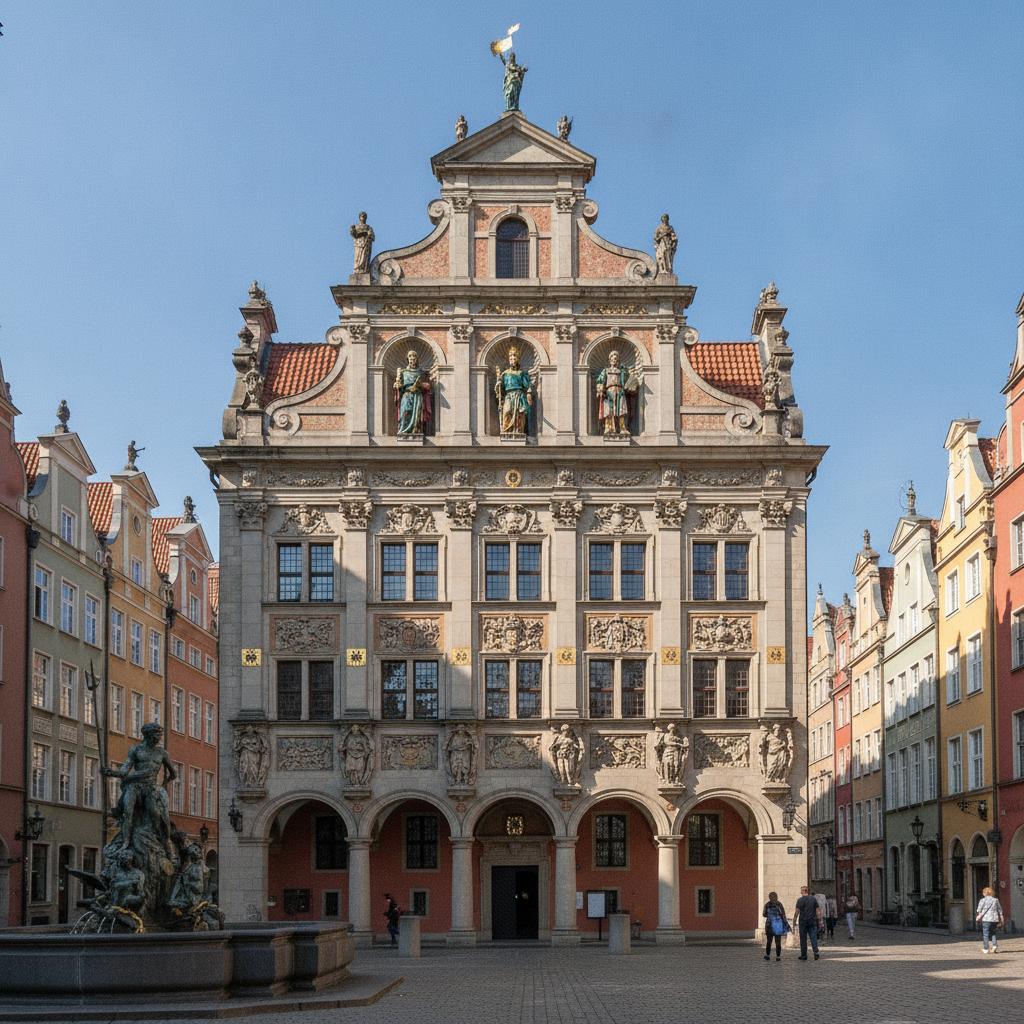
The Arthur's Court (Dwór Artusa, Długi Targ 43-44, the most important civic building on the Long Market, the Gothic-Renaissance guildhall built in the 14th century and redesigned in the 16th century as the meeting place of the Gdańsk merchant patriciate — the court named for the legendary King Arthur whose Round Table concept of equal nobility regardless of birth status appealed to the merchant elite who were noble by wealth rather than lineage, the building housing the Museum of the History of Gdańsk, €8 adults, Tuesday-Sunday 10am-6pm, the reconstruction of the 17th-century guildhall interior the primary exhibit — the reconstructed oven of 1545, the largest Renaissance tiled stove in the world, its 520 ceramic tiles depicting biblical and mythological scenes, the stove built by Georg Stelzener to heat the merchant meetings in the unheated Gothic hall): the Bench of the Three Brothers (the oak merchant bench where the leaders of the city's three main trading guilds sat during meetings, the original bench the most important piece of civic furniture in Gdańsk, destroyed in 1945 and reconstructed from the pre-war photographs), and the collection of guild standards (the silk and painted standards of the Gdańsk merchant guilds, the most complete collection of Hanseatic civic heraldry in Poland).
- 6
The Dominican Church — Amber Votive Offerings
The Church of St. Nicholas (Kościół Świętego Mikołaja — the Dominican church at Świętego Ducha 72, the only church in Gdańsk Old Town to survive the 1945 destruction almost completely intact — the Dominicans negotiated the church's protection by offering their cultural treasures to the Soviet commanders in exchange for the building being spared, the church thus the single building in the Old Town that is a genuine survivor rather than a reconstruction, free, open daily 9am-6pm, the Baroque interior in the rich Dominican tradition — the gilt altarpieces, the carved wooden choir stalls, the amber votive offerings): the amber votives (the tradition of leaving amber objects as ex-voto offerings at the Dominican church dating from the 16th century, when the amber trade guilds maintained their chapel in the church — the collection of amber crucifixes, amber monstrances, and amber-inlaid devotional objects the most significant collection of votive amber in Poland, the objects displayed in the side chapels) and the St. Dominic's Fair connection (the Dominican church as the origin of the St. Dominic's Fair — the oldest market in Europe, the fair established on the feast day of St. Dominic 4 August 1260 by papal privilege, the fair still named for the church 760 years later despite no longer being centered on it).
Walk this route with audio
Stories play automatically as you reach each stop — no tapping needed.
More in gdansk
Gdańsk Amber, Food & the St. Dominic's Fair — the Baltic Amber Capital
Gdańsk Solidarity Heritage — the European Solidarity Centre, the Shipyard & the End of Communism
Gdańsk Practical Guide — Reconstruction, Flemish Architecture & the National Museum
Gdańsk Long Lane & the Old Town — Neptune's Fountain, the Crane & Hanseatic Heritage