Gdańsk Solidarity Heritage — the European Solidarity Centre, the Shipyard & the End of Communism
Gdańsk's Lenin Shipyard was the birthplace of the Solidarity trade union movement — the mass trade union that challenged communist rule in Poland and whose success in 1989 triggered the democratic revolutions across Eastern Europe. The European Solidarity Centre (ECS), opened 2014, is the world's most important museum of non-violent resistance.
- 1
The August 1980 Strike — the Birth of Solidarity
The August 1980 strike at the Gdańsk Lenin Shipyard (the strike beginning 14 August 1980 when the shipyard director dismissed Anna Walentynowicz — the crane operator and union activist — 5 months before her retirement, the workers occupying the shipyard in response, the Strike Committee headed by the electrician Lech Wałęsa who climbed over the shipyard gate to join the strikers, the Inter-Enterprise Strike Committee coordinating strikes across 350 enterprises in the Gdańsk region within 2 weeks, the government forced to negotiate the August Agreements on 31 August 1980 — the 21 Demands of the Gdańsk strikers becoming the foundation of the Solidarity union, the right to form independent trade unions the first demand, the strike the most successful non-violent labour action in European history): the agreement (the document signed at the shipyard gate, the original agreement preserved in the ECS, the handwriting of Lech Wałęsa's signature with the souvenir pen decorated with a picture of Pope John Paul II the defining image of 20th-century Polish history).
- 2
The European Solidarity Centre — the Museum of Freedom
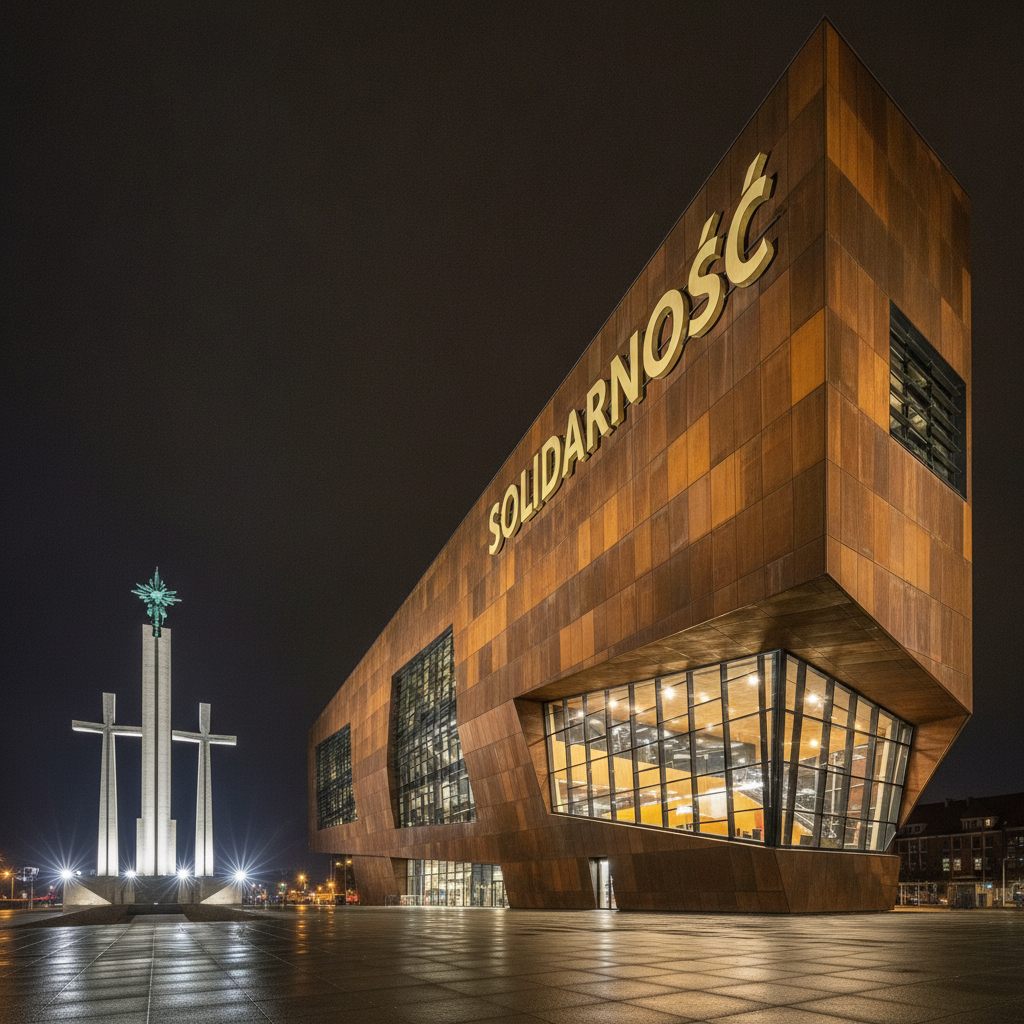
The European Solidarity Centre (ECS, Plac Solidarności 1, the museum opened 31 August 2014 on the 34th anniversary of the August Agreements, the building designed in Corten steel to resemble the hull of a ship — the material of the shipyard workers — the rust-orange facade the most distinctive contemporary building in Gdańsk, €15 adults, Tuesday-Sunday 10am-8pm) is the most important museum of peaceful resistance and democratic transition in the world. The 8 permanent galleries (the Strike, the Solidarity, the Martial Law, the Underground, the Collapse of Communism, the Solidarity Today, the Gallery of Testimonies, and the Solidarity Worldwide — the gallery covering the global impact of the Solidarity movement on democratic transitions from South Korea to South Africa to Latin America) use the original objects from the August 1980 strike (the original 21 Demands of the Gdańsk workers written on plywood boards and displayed in the museum, the strike bus, the photographs by Chris Niedenthal and Erazm Ciołek who documented the strike, the Wałęsa papers) with documentary film, audio testimonies, and interactive elements. The view from the ECS rooftop (the panorama of the Shipyard Square, the Monument of the Three Crosses, and the Baltic coast from the museum terrace, free with museum entry).
- 3
The Monument of the Three Crosses — the Workers' Memorial
The Monument of the Three Crosses (Pomnik Poległych Stoczniowców, at Plac Solidarności outside the ECS and the Shipyard Gate 2, the 42m stainless steel monument erected December 1980 — the monument built by the shipyard workers themselves after the August Agreements permitted it, designed by Bogdan Pietruszka and Wiesław Szyślak, the three crosses representing the 42 workers killed in the shipyard strikes of December 1970 when the communist government ordered the military to fire on striking workers, the memorial the first public monument in the communist bloc commemorating workers killed by their own government) is the most politically powerful public sculpture in Poland. The anchor reliefs at the base of each cross (the anchors symbolizing the maritime trade of Gdańsk and the hope of the resistance movement — the anchor being the symbol of Solidarity from 1980), the names of the 42 victims carved in the granite base, and the location directly in front of the Shipyard Gate 2 (the gate through which the strikers entered and exited the August 1980 occupation, the gate preserved with its original lettering as a monument site) make the Three Crosses Monument the physical centre of the Solidarity memorial landscape.
- 4
Lenin Shipyard — the Birthplace of Freedom
The Lenin Shipyard (Stocznia Gdańska, the shipyard founded 1844 by the German iron-master Johann Wilhelm Klawitter, the yard producing 30+ vessels annually at its 1970s peak, the yard renamed the Lenin Shipyard in 1967 as a communist ideological gesture and reverting to the Gdańsk Shipyard name after 1989, the yard currently operating as the SECDA shipyard for vessel repair on a fraction of its former area, the former shipyard territory being converted to the Young City — Młode Miasto — residential and commercial development, the ECS and the Gate 2 monument preserved as a UNESCO-nominated heritage site): the Shipyard Gate 2 (Brama nr 2, the main workers' entrance where Lech Wałęsa climbed the fence on 14 August 1980 to join the strikers, the gate preserved with the original lettering Stocznia Gdańska im. Lenina, the most important single object in the Solidarity heritage landscape, accessible at any time from Plac Solidarności), the BHP Hall (the Health and Safety meeting room where the August Agreements were signed, preserved within the ECS building, visible on the museum tour, the original wooden signing table and chairs in situ).
- 5
Lech Wałęsa — From Shipyard Electrician to President
Lech Wałęsa (born 1943 in Popowo, trained as an electrician, employed at the Gdańsk Shipyard from 1967, dismissed from the shipyard in 1976 for union activity, co-founder of the Free Trade Unions of the Baltic Coast in 1978, leader of the August 1980 strike committee, elected chairman of Solidarity in 1981, interned during the martial law period December 1981 to November 1982, awarded the Nobel Peace Prize in 1983 — Wałęsa unable to collect the prize in person fearing he would not be allowed to return to Poland, his wife Danuta collecting on his behalf, the Nobel diploma and medal displayed at the ECS — the Solidarity underground leader throughout the 1980s, the Round Table Agreement negotiator in 1989, elected President of Poland 1990-1995, the most important individual in the peaceful dissolution of communist rule in Central Europe): the Wałęsa collection at the ECS (the Nobel Prize, the photographs, the handwritten notes, the personal testimony in the video gallery) and the Lech Wałęsa Institute (the foundation promoting democratic values, the former president's personal archive accessible by appointment, Pilotów 30 in Gdańsk).
- 6
The Roads to Freedom Exhibition
The Roads to Freedom Exhibition (Drogi do Wolności, at Wały Piastowskie 24, adjacent to the ECS, the smaller museum focused specifically on the 1980-81 period and the martial law period, €6 adults, Tuesday-Sunday 10am-5pm, the exhibition using documents, photographs, and audio-visual materials to reconstruct the atmosphere of the August 1980 strike and the subsequent 9 months before martial law — the most immediate and personal of the Solidarity museums, the focus on the street-level experience of the striking workers rather than the political and diplomatic dimensions covered at the ECS): the reconstruction of the clandestine Solidarity printing press (the underground press that printed Solidarity's newspaper Tygodnik Solidarność — Solidarity Weekly — with 500,000 copies distributed weekly at the peak, the press operators trained by the KOR intellectual opposition, the press technology reverse-engineered from the Polish People's Republic's own printing industry, the specific machines used in Gdańsk displayed at the Roads to Freedom museum). The walk from the Roads to Freedom to the ECS and then to Westerplatte (the full Solidarity and WWII historical day trip from central Gdańsk, 6-8 hours including the boat to Westerplatte).
Walk this route with audio
Stories play automatically as you reach each stop — no tapping needed.
More in gdansk
Gdańsk Amber, Food & the St. Dominic's Fair — the Baltic Amber Capital
Gdańsk Practical Guide — Reconstruction, Flemish Architecture & the National Museum
Gdańsk Long Lane & the Old Town — Neptune's Fountain, the Crane & Hanseatic Heritage
Gdańsk Churches & Art — St. Mary's Basilica, the Teutonic Legacy & the Memling Altarpiece