Geneva Culture — CERN, the MAH, the Ariana Museum & French-Swiss Cuisine
Geneva's cultural institutions range from the world's largest physics laboratory at CERN to the Musée d'Art et d'Histoire and the Ariana ceramics collection — all within the most international city in the world.
- 1
CERN — the World's Largest Physics Laboratory
CERN (the Conseil Européen pour la Recherche Nucléaire — the European Organization for Nuclear Research, Route de Meyrin 385, 5km northwest of Geneva, accessible by tram 18 in 30 minutes from the Cornavin station, the most important scientific research facility in the world): the Large Hadron Collider (the LHC — the 27km circumference particle accelerator 100m underground at the Swiss-French border, the machine that discovered the Higgs boson on July 4 2012 — the particle theorized by Peter Higgs and François Englert in 1964 as the mechanism giving mass to elementary particles, the most important single physics discovery of the 21st century, the discovery requiring the collaboration of 10,000 scientists from 100 countries working for 25 years at a cost of CHF 6 billion — the LHC tunnel tours available by advance booking 4 months ahead at outreach.web.cern.ch, the tours free but oversubscribed, the surface visit accessible without pre-booking at the visitor centre), the Microcosm exhibition (the permanent free exhibition at the CERN visitor centre Reception Building 33, Monday-Saturday 8am-6pm, the exhibition explaining the history and the current research of CERN for the non-specialist — the original bubble chamber photographs showing the particle tracks the most visually accessible physics objects in the exhibition, the full-scale model of the LHC dipole magnet the most physically impressive), the World Wide Web birthplace (the plaque at Building 3 on the CERN campus marking the desk of Tim Berners-Lee where the World Wide Web was conceived in 1989 as a document-sharing system for physicists — the first website at info.cern.ch published on a NeXT workstation August 6 1991, the most consequential single computing contribution in the history of technology made at a physics laboratory), and the CERN Globe (the 27m diameter wooden Globe of Science and Innovation at the CERN entrance, the exhibition hall designed by Hervé Dessimoz and Thomas Büchi for the Swiss National Exhibition 2002, now a permanent CERN exhibition space for the travelling science exhibitions and the public lectures).
- 2
The Musée d'Art et d'Histoire — the Geneva Art Collection
Musée d'Art et d'Histoire (Rue Charles-Galland 2, the primary art and history museum of Geneva, the largest art museum in Switzerland, free permanent collection, Tuesday-Sunday 11am-6pm): the archaeological collections (the Egyptian and the Mediterranean antiquities — the mummy collection including a complete ancient Egyptian mummy in its original coffin, the most complete Egyptian collection in French-speaking Switzerland, and the Greek and Roman ceramics, coins, and sculptures from the Geneva patrician collections of the 18th and 19th centuries), the medieval art (the Conrad Witz altarpiece 'The Miraculous Draught of Fish' 1444 — the most important single painting in the Geneva collection, the first painting in Western art to depict a specific identifiable landscape — Lake Geneva with the Dent du Midi and the Savoy Alps visible behind the Biblical scene — the painting the beginning of landscape realism in European painting, the original on permanent display in the museum), the applied arts (the Swiss clock and the watch collection the most comprehensive of any Swiss museum — the Geneva watch-making tradition from the 16th century including the movement designed for Marie Antoinette by Abraham-Louis Breguet, and the decorative arts from the Geneva bourgeois tradition of the 17th-18th centuries) and the European paintings (the 15th-19th century European painting collection with the particular strength in the Swiss and the French tradition — the Hodler, the Vallotton, and the Cuno Amiet representing the Swiss national tradition, the Camille Corot and the Gustave Courbet representing the French Realist connection to the Swiss landscape painting).
- 3
Paquis Beach and the Lake Geneva Summer
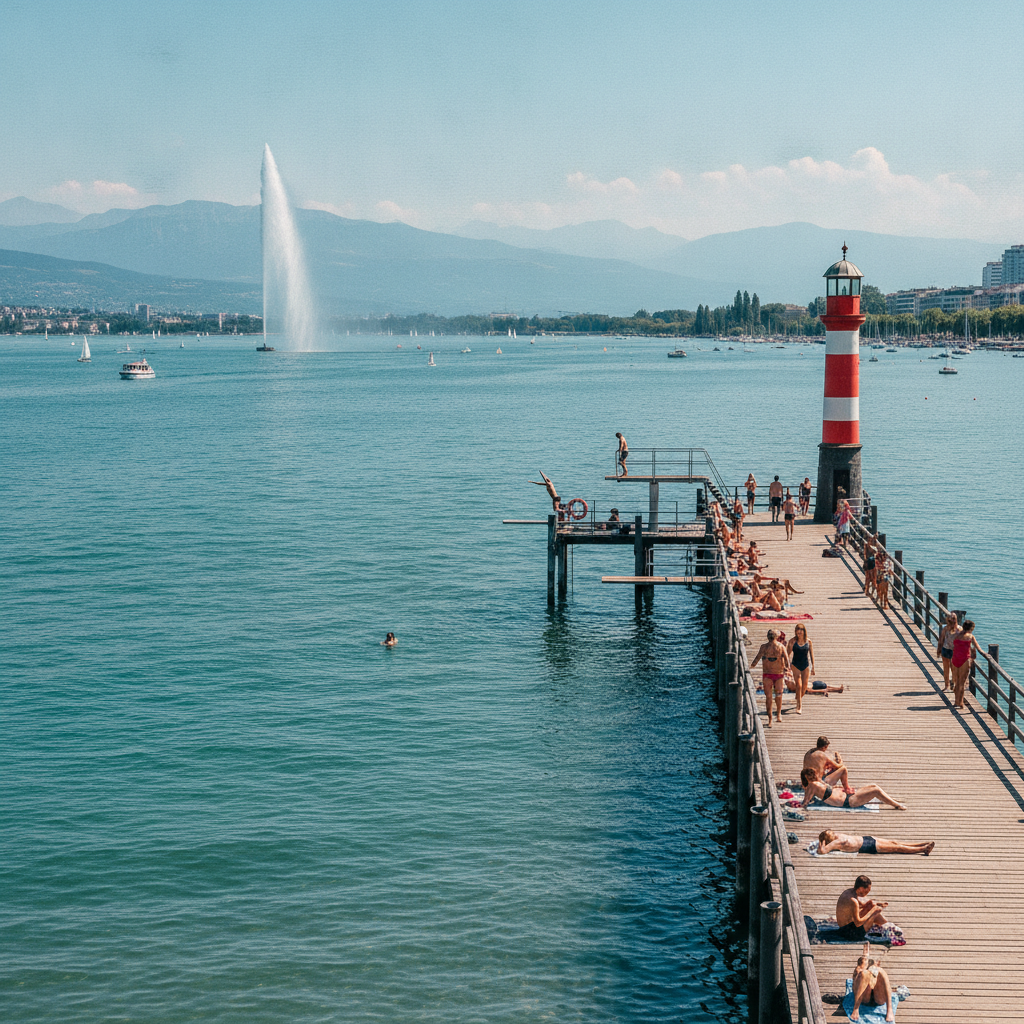
Les Pâquis (the most beloved local neighbourhood in Geneva — the Pâquis district on the right bank of the Rhône at the lake outlet, the most ethnically diverse and the most socially mixed quarter of Geneva, the neighbourhood with the most cafés, the most North African and Middle Eastern restaurants, and the oldest working-class housing stock in the city): the Bains des Pâquis (the Jetée des Pâquis, the public lake bathing facility on the right bank at Quai du Mont-Blanc, open May-September daily 9am-8pm, CHF 2 adults for the lake access, the most democratic institution in Geneva — the outdoor baths where the Geneva banker and the Geneva construction worker sit on the same wooden pier and swim in the same Lake Geneva water, the sauna pavilion on the pier open year-round for the most social sauna experience in Switzerland at CHF 7 per session), the Pâquis Saturday market (the Marché de la Rive on the Rive Droite — the right bank market at Rue de Berne Saturday mornings 7am-1:30pm, the most internationally diverse market in Geneva — the North African produce, the Middle Eastern spices, the Swiss cheese and the Savoie charcuterie all available within 200m, the most anthropologically interesting Geneva market for the visitor observing the real population of the most international city in the world), Rue de Berne and the Pâquis food scene (the street food strip of the Geneva right bank — the Lebanese, the Moroccan, the Ethiopian, and the Eritrean restaurants on the Rue de Berne and the side streets, the most affordable restaurant dinners in Geneva at CHF 15-25 per person, the Carnets de Route at Rue de Berne 23 the most respected Ethiopian restaurant in the city) and the Pont du Mont-Blanc (the main bridge connecting the left and the right bank of Geneva above the lake outlet, the Jet d'Eau visible from the bridge to the east, the Mont Blanc massif visible on a clear day to the southeast — the most geographically dramatic urban bridge view in Switzerland).
- 4
Geneva's French-Swiss Cuisine and the Brasserie Tradition
Geneva food culture (the French-Swiss culinary tradition — the most French-influenced of the Swiss regional cuisines, the cuisine reflecting the historical connection to Savoy, the Burgundian wine tradition, and the Protestant Geneva bourgeois table): the fondue and raclette (Geneva's version of the Swiss cheese tradition: the fondue Genevoise using the Gruyère and the Vacherin with the Geneva AOC white wine — the Chasselas rather than the Fendant as in the Valais — the distinction marking the boundary between the French and German Swiss culinary identities, the most correct address for the fondue in Geneva: Le Fournil at Rue de la Fontaine 9, the most historically resonant fondue in the Geneva Old Town at CHF 32 per person; Le Chalet Suisse at Chemin de la Chale 23, the most authentically Alpine ambiance at CHF 28), the brasserie tradition (the French brasserie tradition imported from Lyon and Strasbourg giving Geneva the most complete brasserie dining culture in Switzerland — the Café de Paris at Rue du Mont-Blanc 26 the most famous single-dish restaurant in Geneva: the entrecôte with the café de Paris butter sauce — the secret recipe herb butter from the 1930s, the only dish served, the queue forming outside the restaurant from 5pm — CHF 48 per person including the salad, the bread, and the frites, the most celebrated single restaurant experience in Geneva), the Marché de Plainpalais (the famous Geneva flea market and the general market on the Plaine de Plainpalais, Tuesday and Friday 8am-6pm for the food market, Saturday and Sunday for the flea market, the most attended outdoor public space in Geneva for the local population, the food market the most representative cross-section of the Geneva population and the most affordable food shopping in the city) and the chocolate (the Geneva chocolate tradition the oldest in Switzerland — the Confiserie du Rhône at Rue de la Confédération 3, the most historical chocolatier in Geneva since 1875, the handmade pralines and the bitter-chocolate ganaches at CHF 6-10 per 100g, the Swiss chocolate lesson for the visitor: the Swiss milk chocolate invented by Daniel Peter in Vevey in 1875 using Henri Nestlé's condensed milk — the most commercially significant Swiss food innovation in history).
- 5
Geneva's Calvin Legacy — the Reformation and the Protestant Tradition
John Calvin and the Geneva Reformation (the most consequential single individual in Geneva history: Jean Calvin 1509-1564, the French-born theologian who made Geneva the 'Protestant Rome' — the international centre of the Reformation from 1541 to the present): Calvin in Geneva (Calvin arriving in Geneva 1536 at age 27 at the invitation of the Protestant leader Guillaume Farel, the initial period expelled 1538, recalled 1541, ruling Geneva as the theocratic city-state under the Ecclesiastical Ordinances — the laws regulating the Geneva church, the schools, the morality, and the social order — until his death 1564, the Geneva under Calvin the most rigorously organised Protestant city in Europe, the theatre prohibited, the gambling prohibited, the religious images removed from the churches, and the blue laws governing the sabbath, the dress, and the social behaviour creating the most regulated urban environment in Reformation Europe), the Calvin legacy (the Calvinist theological tradition the most globally influential branch of Protestant Christianity — the Presbyterian churches of Scotland and the United States, the Reformed churches of the Netherlands and Hungary, the Huguenot diaspora in France, South Africa, and North America, and the Puritan tradition of colonial America all deriving directly from the Geneva Calvinist model, the most geographically widespread single theological export in Christian history after the Roman Catholic church), the Reformation Wall (the Mur des Réformateurs at the Parc des Bastions, the 5m relief portraits of Farel, Calvin, Beza, and Knox, the most symbolically concentrated Reformation monument in the world — the 4 figures representing the 4 primary geographical extensions of Calvinist influence: France/Geneva, Geneva, France/Germany, Scotland — free, always accessible, the most visited public monument in the Geneva Old Town after the Jet d'Eau) and the Bibliothèque de Genève (the Geneva University Library at Promenade des Bastions 1, the library holding the original Calvin manuscripts and the 16th-century Geneva Consistory records — the court records of the moral governance of Geneva 1542-1564, the most historically specific primary source for the Calvin period in the city, accessible to researchers by appointment, the display cases in the library reading room showing the Calvin manuscripts for the general public).
- 6
Geneva Day Trips — Lausanne, Montreux and the French Border
Geneva day trips: Lausanne (the Olympic Capital, 60km east of Geneva by SBB train in 38 minutes at CHF 24 return — the home of the International Olympic Committee headquarters at the Château de Vidy, the Olympic Museum at Quai d'Ouchy 1 the most comprehensive Olympic history institution in the world at CHF 20 adults — and the most impressive Gothic cathedral in Switzerland, the Cathédrale de Lausanne 1275 with the medieval tympanum and the rose window, free daily 9am-7pm), Montreux (90km east of Geneva, train 65 minutes at CHF 34 return — the Swiss Riviera town with the palm trees along the Quai de la Reine, the Freddie Mercury statue at the lakefront — Mercury died in Montreux 1991, Queen recording at the Mountain Studio from 1978 — and the Château de Chillon the most visited monument in Switzerland at 400,000 visitors per year), Annecy (45km southwest of Geneva in France, accessible by bus in 90 minutes or by regional train in 70 minutes, the most beautiful small city in the French Alps — the Old Town with the painted houses over the canal, the Palais de l'Île on the island in the Thiou canal, and Lake Annecy the cleanest lake in Europe — the Annecy day trip the most recommended French-side excursion from Geneva, the franc-to-euro exchange providing the first price relief from the Swiss Franc level), Gruyères (90km east of Geneva, train and PostBus in 90 minutes at CHF 28 return — the medieval village on the hilltop producing the Gruyère cheese DOP, the Gruyère cheese dairy at the village entrance with the daily 15-minute cheese-making film, CHF 7 adults, the HR Giger Museum in the Gruyères castle with the Alien film artwork, CHF 12 adults, the most unexpected cultural-cheese combination in a single Swiss village) and Chamonix (80km southeast of Geneva in France, the bus from Geneva coach station in 90 minutes at €20 return — the town at the foot of Mont Blanc, the highest peak in the Alps at 4,808m, the Aiguille du Midi cable car to 3,842m at €69 adults return the most dramatic single mountain ascent in the European Alps).
Walk this route with audio
Stories play automatically as you reach each stop — no tapping needed.
More in geneva
Geneva Watches, the Rue du Rhône & Jean-Jacques Rousseau's City
Geneva Old Town Walk — the Cathedral, the Bourg-de-Four & the Reformation Heritage
Geneva Outdoors — the Bains des Pâquis, the Rhône Parks & the City's Green Spaces
Geneva Annual Calendar — the Escalade, the Fêtes de Genève & Seasonal Guide