Geneva Old Town Walk — the Cathedral, the Bourg-de-Four & the Reformation Heritage
The Geneva Old Town contains the densest concentration of Reformation history in the world — Calvin's cathedral, the oldest house in Geneva, the Reformation Wall, and the Renaissance patrician houses within a 500m radius.
- 1
The Cathédrale Saint-Pierre — Calvin's Cathedral
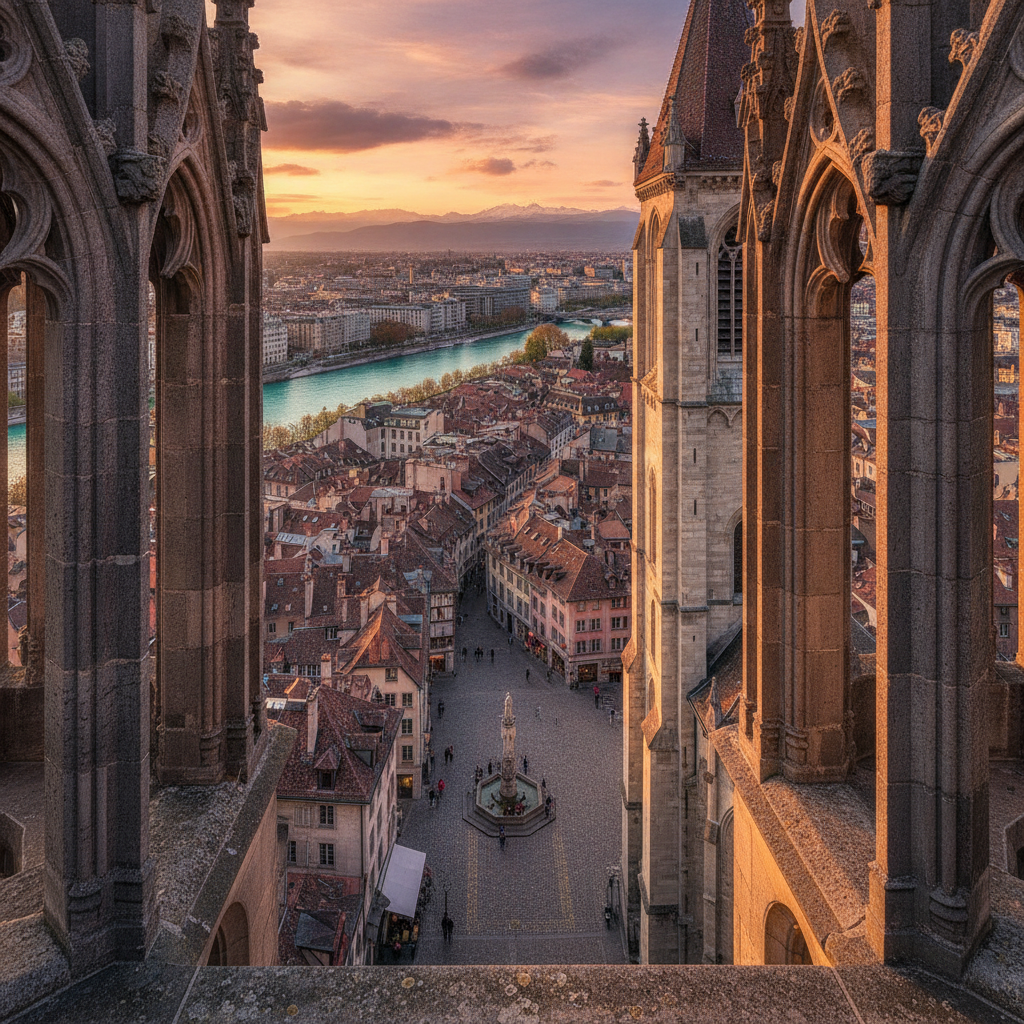
Cathédrale Saint-Pierre (the Cathedral of Geneva, at the top of the Old Town hill, the 12th-century Romanesque-Gothic cathedral where John Calvin preached and governed from 1536 to his death in 1564, free, Monday-Saturday 9:30am-6:30pm, Sunday noon-6:30pm): the exterior (the facade the most architecturally complex in Geneva — the Corinthian portico of 1752 by Benedetto Alfieri attached to the Romanesque-Gothic towers of 1160, the most incongruous architectural combination in Swiss religious architecture, the north tower 1387 and the south tower 1160 surviving the Reformation iconoclasm of 1535 that stripped the interior), the interior (the most austere major European cathedral interior — the Calvinist Reformation of 1535 removed every statue, every painting, every altar decoration, every stained glass window, and every carved relief from the interior, leaving the bare whitewashed Gothic stone and the plain wooden pews, the Calvin's Chair the most historically charged object in the cathedral — the simple wooden armchair in which Calvin preached from 1536 to 1564, displayed in the north aisle with the descriptive panel), the tower (the north tower climb at CHF 5, the 157 steps to the platform with the panoramic view of Geneva, the lake, and the Alps, open daily during cathedral hours, the most vertically dramatic Old Town view in Geneva), the Archaeological Site (the Cathédrale excavation site in the basement, CHF 5 adults, the most complete urban archaeology of a single site in Switzerland — the excavations revealing the 5 successive construction phases from the 4th-century early Christian cemetery to the current 12th-century cathedral, the best-preserved pre-Romanesque church foundations in Switzerland) and the summer organ concerts (the free Saturday noon recitals June-September at the cathedral organ — the 6,000-pipe 1965 organ, the most accessible free classical music experience in the Geneva Old Town).
- 2
The Bourg-de-Four — the Ancient Roman Forum
Place du Bourg-de-Four (the oldest square in Geneva on the south side of the Old Town hill, the site of the Roman forum of the 1st-century Roman settlement of Genua, the square where the Old Town market was held from medieval times to 1900, the most historically embedded outdoor space in Geneva): the square (the irregular square with the central fountain of 1877 — the cast-iron fountain the primary visual centre of the square, the water running year-round, the most photographed single element of the Bourg-de-Four — surrounded by the 16th-19th century houses with the ground-floor terrace cafés and restaurants, the most pleasantly inhabited historic square in Geneva), the restaurants (the Bourg-de-Four the most relaxed outdoor dining area in the Geneva Old Town — the Restaurant de l'Hôtel de Ville at Bourg-de-Four 1 the most historically embedded, the Café du Bourg-de-Four the most locally attended for the afternoon wine — the Chasselas by the glass at CHF 5-7 the correct order in the Geneva Old Town, the Fendant the Valais version, the Chasselas the Geneva AOC version), the Palais de Justice (the former convent of the Poor Clares on the south side of the square, converted to the Palais de Justice 1860, the primary court building of the Canton of Geneva, the most architecturally distinguished civic building on the Bourg-de-Four), the Collège Calvin (the secondary school on the Promenade des Bastions founded by Calvin in 1559 — the school is the oldest educational institution in Geneva still in continuous operation, the Parc des Bastions the park surrounding the school where the famous Reformation Wall stands) and the evening atmosphere (the Bourg-de-Four at evening the most animated outdoor square in the Geneva Old Town from May to September — the terraces filling with the Geneva professional class after 6pm, the multilingual conversations reflecting the international composition of the city's residents, the most convivial single outdoor space in Geneva in summer).
- 3
The Maison Tavel and the Geneva History Museum
Maison Tavel (Rue du Puits-Saint-Pierre 6, the oldest surviving house in Geneva built in 1334 by the Tavel family, now the Museum of Old Geneva, free, Tuesday-Sunday 11am-6pm): the building (the 3-storey medieval townhouse the most complete surviving medieval domestic interior in Geneva — the facade with the carved stone lions' heads representing the Tavel family symbol at the corners of each floor, the building rebuilt after the great fire of 1334 on the existing foundations of a 12th-century house — the 1334 rebuild the origin date of the current structure, the building privately owned until 1963 when the City of Geneva purchased it and converted to the museum), the Model of Geneva 1850 (the primary object in the museum: the large-scale 3D model of the entire Geneva city as it appeared in 1850, created 1896-1900 by Auguste Magnin with the obsessive accuracy of every house, every garden wall, and every street of pre-modern Geneva — the model the most precise urban topographic document of a 19th-century Swiss city, the model updated from 1850 drawings and the early photographs, the museum commentary explaining what has been demolished and what survives from 1850 to the present — the most spatially informative single object for the visitor trying to understand the historical Geneva city structure), the doorbell collection (the collection of historical Geneva doorbells — the most unusual single collection in the Geneva museum network, the 18th and 19th century cast-iron and bronze door knockers and pull-bells from the Geneva patrician houses, the most overlooked collection in the city), and the temporary exhibitions (the rotating exhibitions of the Geneva urban history — the past exhibitions covering the Revolution of 1846, the Belle Époque tourism, and the 1930s working-class Geneva, the most locally specific exhibition programme in the Geneva museum circuit).
- 4
The Reformation Wall — the Monument to Protestant Geneva
Mur des Réformateurs (the Reformation Wall at the Promenade des Bastions, the 100m granite wall erected 1909-1917 commemorating the 400th anniversary of Calvin's birth, the most symbolically concentrated monument in Protestant Christianity): the figures (the 4 central 5-metre relief portraits: Guillaume Farel — the preacher who persuaded Calvin to come to Geneva, the most aggressive of the Genevan Reformers, the beard and the raised pointing finger the most characteristic portrait element; John Calvin — the central and largest figure, the profile in the sharp-featured portrait derived from the few authenticated Calvin portraits, the most historically important single relief figure in Geneva; Theodore Beza — Calvin's successor as the Geneva church leader, the only figure in the 4 to be represented in his older age; and John Knox — the Scottish Reformer who studied in Geneva and exported the Calvinist model to Scotland, the founder of the Presbyterian church and the most geographically distant of the four from Geneva), the inscription (the Latin motto carved in the base of the wall: 'Post Tenebras Lux' — 'After Darkness, Light', the motto of the Geneva Reformation adopted 1536 still used by the Canton of Geneva on the official seal — the most historically resonant single phrase in Geneva public space), the flanking figures (the smaller relief figures flanking the 4 central Reformers: Roger Williams — the founder of Rhode Island and the principle of religious freedom in America; Oliver Cromwell; Frederick William of Brandenburg; and Admiral Coligny — the French Protestant leader assassinated in the St. Bartholomew's Day Massacre 1572, the most internationally connected monument in Geneva) and the Promenade des Bastions (the park surrounding the Reformation Wall — the Bastions the former fortification ramparts converted to a public park in 1870, the chess tables in the park the most distinctively Genevan public amenity — the permanent outdoor chess tables with the 30cm pieces where the Genevans play chess daily in good weather, the most intellectual public park pastime in Switzerland).
- 5
The Île Rousseau and the Rhône Islands
The Rhône through Geneva (the Rhône River flowing through the centre of Geneva from the lake outlet west toward France — the Rhône the defining linear element of the Geneva city, the river dividing the city into the left bank Rive Gauche and the right bank Rive Droite): the Pont du Mont-Blanc (the primary bridge connecting the two banks directly at the lake outlet, the 6-lane bridge with the sidewalk giving the widest panorama of the Geneva city — the Jet d'Eau to the east, the Old Town hill to the southeast, and the Jura mountains to the northwest all visible from the bridge centre, the most geographically comprehensive single standing viewpoint in Geneva), the Île Rousseau (the small island in the Rhône at the foot of the Pont des Bergues, the bronze statue of Rousseau by James Pradier 1835, the most romantically isolated public monument in Geneva — the island accessible by foot via the bridges, the poplar trees surrounding the statue creating the most sheltered outdoor sitting area in the central city, free, always accessible), the Pont de la Machine (the footbridge at the mouth of the Rhône 200m below the Pont du Mont-Blanc, the former location of the Geneva hydraulic power plant that originally powered the Jet d'Eau — the current footbridge the public access point to the island and the most photographed bridge in Geneva after the Pont du Mont-Blanc), the Rhône weirs (the 3 concrete weirs stepping down the Geneva Rhône managing the lake level — the most visible infrastructure of the Geneva lake management system, the weirs creating the most turbulent white water in the Geneva city centre, visible from the Pont de la Machine) and the Seujet park (the Parc Seujet on the left bank below the Old Town, the most recently created riverside park in central Geneva, the lawn extending to the Rhône edge and the steps descending to the water level in the first urban riverfront park in Geneva accessible directly to the river — the most genuinely urban riverside experience in the city, the Rhône water at 14 degrees year-round from the lake source the coldest urban river access in the Swiss Plateau cities).
- 6
The Grand Théâtre and the Geneva Performing Arts Scene
Geneva performing arts (the most complete performing arts offering in French-speaking Switzerland, the city supporting both the Grand Théâtre opera house and the Orchestre de la Suisse Romande — OSR): the Grand Théâtre de Genève (Place Neuve 5, the primary opera house of Geneva, the building of 1879 in the style of the Paris Opéra Garnier rebuilt after the 1951 fire, the 1,488-seat opera house the most important French-language opera stage in Switzerland, the annual programme of 6-8 opera productions September-July at gt-geneve.ch, the tickets at CHF 25-180 per performance, the SRO — the Standing Room Only — tickets at CHF 25 available from 1 hour before the performance the most affordable opera access), the Orchestre de la Suisse Romande (the OSR, the professional symphony orchestra of French-speaking Switzerland founded by Ernest Ansermet 1918 — the most important orchestral institution in French-speaking Switzerland, the OSR performing at the Victoria Hall at Rue Général-Dufour 14, the Victoria Hall the most acoustically correct concert hall in Geneva for the orchestral repertoire, the season September-June, the tickets at CHF 35-120 at osr.ch), the Bâtiment des Forces Motrices (the converted 1886 hydraulic power station at Place des Volontaires 2, the most unusual concert and performance venue in Geneva — the former pump house with the ornate cast-iron machinery still in place serving as the backdrop for the chamber concerts, the theatre performances, and the contemporary dance, the most architecturally dramatic performance space in the city), the Victoria Hall (Rue Général-Dufour 14, the 1591-seat concert hall of 1894 designed by the Genevan architect John Camoletti, the home of the OSR — the neoclassical interior with the original late-Victorian decoration the most elaborately preserved concert hall interior in Switzerland) and the cinema (the Cinéma Bio at Rue des Battoirs 7 the most historically specific cinema in Geneva, the independent art-house cinema with the Swiss and French film programme in the original French, the most consistent programme of French-language cinema in Geneva, tickets CHF 15, the programme at cinema-bio.ch).
Walk this route with audio
Stories play automatically as you reach each stop — no tapping needed.
More in geneva
Geneva Watches, the Rue du Rhône & Jean-Jacques Rousseau's City
Geneva Outdoors — the Bains des Pâquis, the Rhône Parks & the City's Green Spaces
Geneva Culture — CERN, the MAH, the Ariana Museum & French-Swiss Cuisine
Geneva Annual Calendar — the Escalade, the Fêtes de Genève & Seasonal Guide