Guanajuato Alhondiga de Granaditas Silver Mines El Pipila Callejon del Beso Teatro Juarez and the Underground Tunnels of a City Built Inside a Silver Canyon That Funded the Spanish Empire for Three Centuries
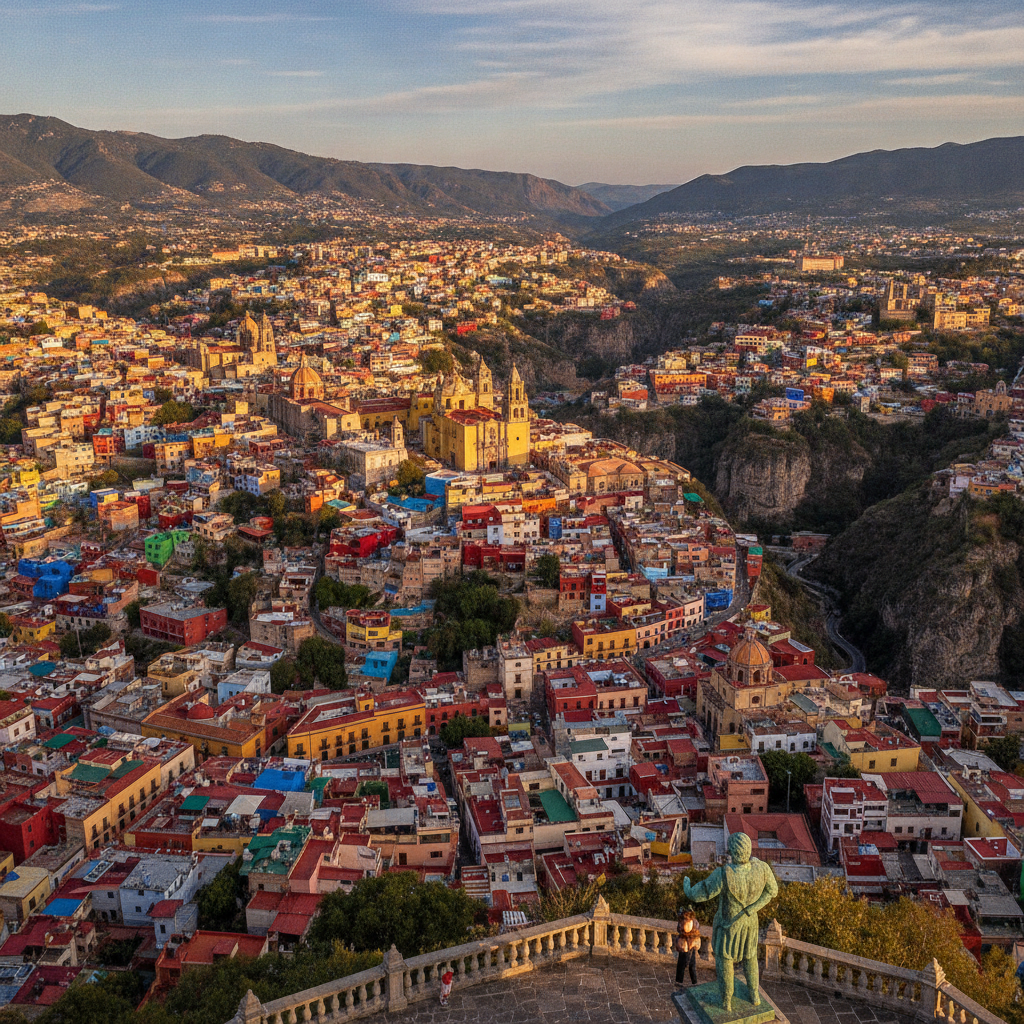
Guanajuato is the most dramatically situated colonial city in Mexico, built inside the narrow gorge of a silver-bearing canyon whose walls rise steeply on both sides of the main street, forcing the city to grow vertically up the canyon slopes in a dense medieval-like accumulation of colored houses, church towers, and plazas linked by narrow alleys called callejones. The silver mines of Guanajuato, discovered in 1548 by Juan de Jasso, produced an estimated one-third of all the silver mined in the world during the colonial period, making the city one of the wealthiest in the Americas and funding the baroque architecture of the churches, the University, and the mansions of the mining aristocracy. The Alhondiga de Granaditas, the massive stone granary built in 1809 and immediately converted to a fortress during the War of Independence, was the site of the first major insurgent victory when El Pipila, a young miner named Juan Jose de los Reyes Martinez, strapped a stone to his back as a shield against the Spanish defenders fire and crawled to the doors of the Alhondiga to ignite them with a torch, allowing the insurgent forces to storm the building. The statue of El Pipila on the hill above the city, holding his torch aloft in a gesture that is visible from every part of the historic center, is the defining image of Guanajuato against its canyon backdrop. The callejones, the narrow pedestrian alleys that connect the levels of the canyon city, include the Callejon del Beso, the alley so narrow that the balconies of the opposing houses are within kissing distance, around which the legend of star-crossed lovers and the tradition of couples kissing on the third step has made it the most photographed spot in the city. The underground tunnel network, built along the course of the channeled Guanajuato River that flooded the city repeatedly before being redirected underground in the 1960s, now serves as the primary vehicle route through and under the historic center.
- 1
Alhondiga de Granaditas and the War of Independence
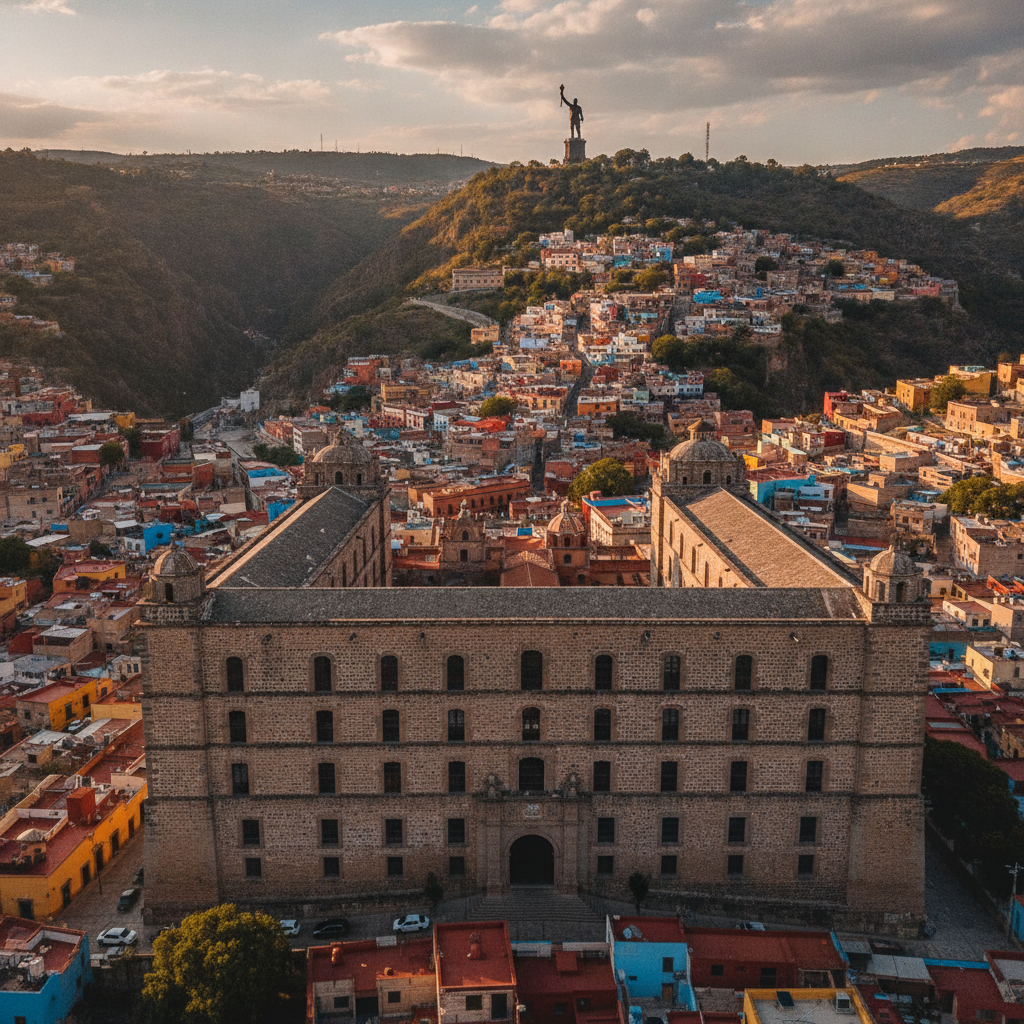
The Alhondiga de Granaditas, the massive neoclassical stone granary completed in 1809 on the orders of the intendant Juan Antonio Riano as a public grain storage facility to stabilize food prices in the Bajio, was never used for its intended purpose, immediately converted to a fortress when the Hidalgo insurgency arrived in Guanajuato in September 1810. The Spanish loyalists and the wealthy creole families of Guanajuato barricaded themselves inside the building with their valuables, correctly fearing the intentions of the 80,000-strong insurgent force that surrounded the city, and held off the initial assault until El Pipila, the young mine worker who crawled to the doors under a protective stone slab, ignited the wooden doors with a pine torch and allowed the insurgents to storm the building. The massacre that followed inside the Alhondiga, in which the insurgents killed the defenders and the wealthy civilians in an uncontrolled act of vengeance against the colonial elite, was the defining atrocity of the independence struggle, destroying the moderate support that the insurgency needed and setting the pattern of class-based violence that would characterize the Revolution of 1910 as well. After the recapture of Guanajuato by the royalist forces in 1811, the decapitated heads of Hidalgo, Allende, Aldama, and Jimenez were displayed on iron hooks on the four corners of the Alhondiga, remaining until 1821. The building is now the Museo Regional de Guanajuato Alhondiga de Granaditas, with permanent exhibitions on the pre-Hispanic cultures of Guanajuato, the colonial mining economy, the independence period, and the iconography of El Pipila as the working-class hero of the national founding narrative.
- 2
El Pipila Monument and the Canyon Viewpoints
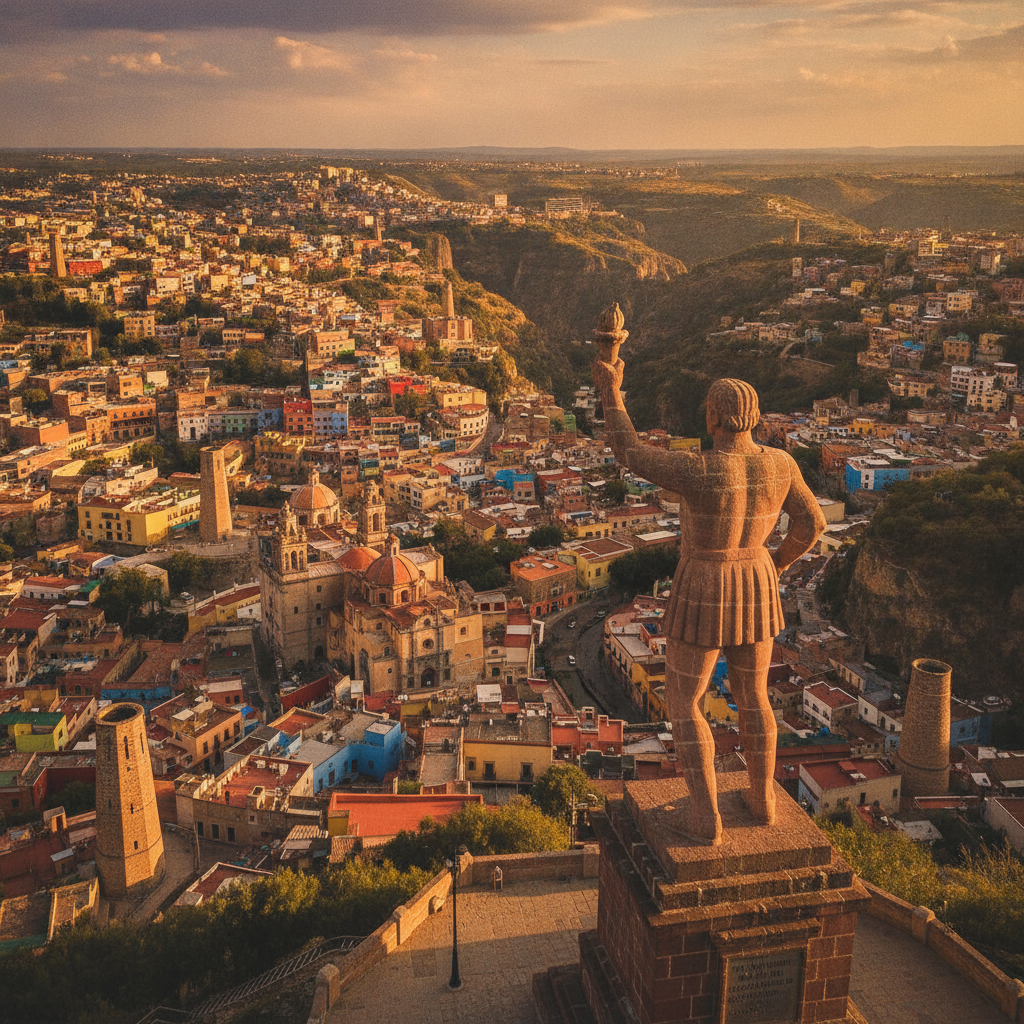
The monument to El Pipila, the stone statue of the miner Juan Jose de los Reyes Martinez on the Cerro de los Sangre Cristo above the historic center, was built in 1939 and stands at 18 metres including its plinth, with El Pipila holding his pine torch above his head in a gesture of defiance that frames the view over the canyon city below. The ascent to the El Pipila viewpoint can be made by the funicular railway that rises from the Jardin Union area to the hillside, by the steep callejones that climb the canyon walls through the upper residential neighborhoods, or by the paved road from the western edge of the city. The viewpoint from El Pipila is the standard panoramic photograph of Guanajuato, showing the colored houses packed into the canyon, the church towers of the Basilica, the Temple of San Diego, and the Templo de la Compania rising above the roofline, and the surrounding hills dotted with the ventilation towers of the historic silver mines. The hillside colonias above the historic center, reached by climbing the callejones beyond the main tourist circuit, contain the working-class neighborhoods where the miners and service workers of Guanajuato live in houses that precariously stack up the canyon slopes, and where the view of the tourist city below is framed by laundry lines and satellite dishes rather than postcard settings. A second viewpoint at the Carretera Panoramica, the ring road that circles the hills surrounding Guanajuato, provides the helicopter-perspective view of the full canyon from above, with the entire historic center visible as a dense colored mosaic in the valley.
- 3
Silver Mining Economy and La Valenciana Mine
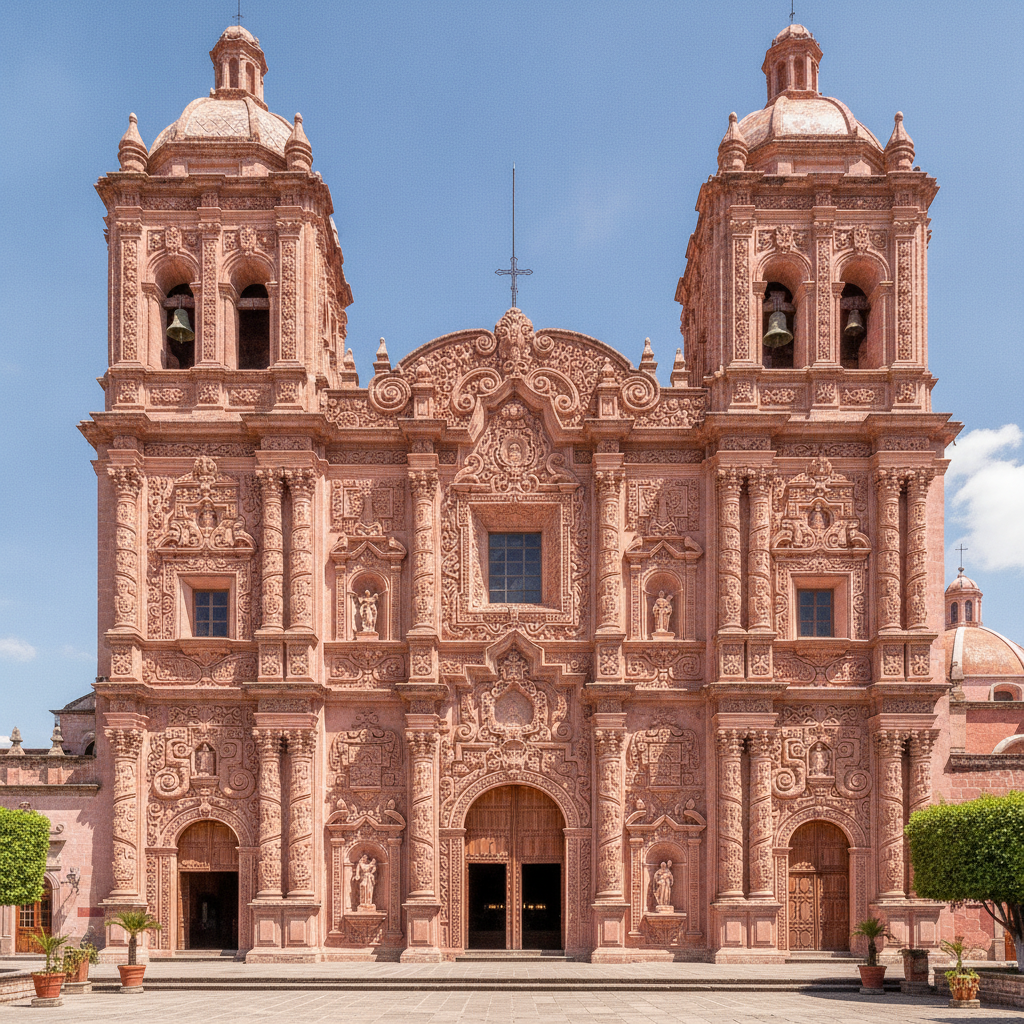
The Valenciana mine, 5 kilometres north of Guanajuato on the road to San Luis de la Paz, is the most significant historic silver mine in Mexico and one of the most productive metal mines in human history, producing an estimated 2 billion pesos worth of silver between its opening in 1760 and the late 19th century, a sum equivalent to roughly one-third of the entire world silver production during the Bourbon colonial period. The mine was opened by Antonio de Obregon y Alcocer, who received a concession from the Spanish crown in 1760 and spent the next decade sinking the main shaft to a depth of 500 metres, eventually employing 3,000 workers in what became the deepest and richest mine in colonial New Spain. The wealth generated by the Valenciana funded the construction of the Templo de San Cayetano de la Valenciana adjacent to the mine, the most elaborate churrigueresque church in Guanajuato state, whose pink cantera facade with its spiral estipite columns and dense sculptural program represents the apex of colonial baroque architecture in the Bajio. The Valenciana mine was reopened for silver and gold production in the 1970s by a Canadian mining company and continues to produce commercially, making it one of the few colonial-era mines still operating in Mexico. The Bocamina San Ramon and Bocamina San Cayetano, former mine entrances now open as tourism sites adjacent to the Valenciana church, allow visitors to descend into the upper levels of the mine workings and understand the physical experience of colonial silver extraction.
- 4
Teatro Juarez Jardin Union and Belle Epoque Guanajuato
The Teatro Juarez, the opera house built on the orders of President Porfirio Diaz between 1873 and 1903 on the edge of the Jardin Union, is the most architecturally extravagant building in Guanajuato, with a neoclassical facade of Doric columns and bronze lions flanked by the Muses in bronze sculpture, and an interior of Moorish-inspired decoration in red, gold, and blue that made it the showpiece of Porfiriato cultural ambition in the provincial cities. The Teatro Juarez was inaugurated in November 1903 with a performance of Aida in the presence of Porfirio Diaz himself, who used the theater circuit of the major Mexican cities as a demonstration that Mexico had achieved the European standard of civilization that his modernization project promised. The Jardin Union, the triangular garden plaza adjacent to the theater with its curved iron benches under the shade trees, is the social heart of Guanajuato, where the University students, tourists, food vendors, and the permanent contingent of street musicians gather throughout the day, and where the University orchestra and various folk music groups perform on the bandstand on weekend evenings. The Templo de San Diego immediately adjacent to the Jardin Union, with its churrigueresque facade in pink cantera stone, is the colonial church that frames the theatrical entrance to the plaza. The University of Guanajuato building, designed in the colonial revival style with its distinctive facade staircase rising to the entrance portal, overlooks the historic center from its hillside position and houses the oldest university in western Mexico, founded in 1732 as a Jesuit college.
- 5
Callejones Underground Tunnels and Urban Navigation
The callejones of Guanajuato, the narrow pedestrian alleys that climb between the levels of the canyon city, connecting the main streets at the valley bottom to the residential neighborhoods at the canyon slopes, are the fundamental element of Guanajuato urban experience, a network of steep stairs and winding passages that make the city impossible to navigate by conventional grid logic and endlessly surprising to explore. The Callejon del Beso, whose name, the Alley of the Kiss, derives from the legend of a Spanish nobleman who discovered his daughter was conducting a secret romance with a mestizo miner from the opposite balcony, stabbing her dead with his dagger while the lover reached across the gap to touch her, is the most visited callejon, marketed with the tradition of couples kissing on the third step from the bottom for seven years of good luck. The underground tunnel network of Guanajuato, built by damming the Guanajuato River and routing it through a tunnel excavated beneath the city center after the catastrophic flood of 1905, was converted in the 1960s to a vehicular road that passes under the historic center, allowing cars to move through the city without congesting the pedestrian streets above. The tunnel system, entered through portals at the east and west edges of the historic center, creates a disorienting urban experience in which drivers navigate two-lane roads carved through volcanic rock beneath the city, emerging at underground plazas with spiral ramps connecting to the surface streets. The tunnel network is the primary reason that Guanajuato's historic center remains navigable on foot; without the underground vehicle route, the car traffic from the surrounding residential areas would overwhelm the colonial streets.
- 6
Mummies Museum and the Festival Internacional Cervantino
The Museo de las Momias de Guanajuato, the museum displaying the naturally mummified bodies exhumed from the Guanajuato municipal pantheon cemetery between 1870 and 1958, is the most visited museum in Mexico after the National Anthropology Museum in Mexico City, receiving approximately 700,000 visitors annually to view the collection of 111 mummies preserved by the alkaline mineral soil of the cemetery. The natural mummification occurred when bodies of families who could not afford the perpetual burial fee were exhumed and found to be preserved rather than decomposed, beginning with the mummy of French doctor Remigio Leroy, exhumed in 1865 and placed on display, a practice that evolved into a tourist attraction over the following century. The mummies, displayed in glass cases in various states of preservation from skeletal to fully fleshed, have been a source of fascination for Mexican and international visitors since the 19th century, famously influencing filmmaker Tim Burton who visited as a child and cited the Guanajuato mummies as an inspiration for his aesthetic. The Festival Internacional Cervantino, the annual international arts festival held in Guanajuato in October since 1972, is one of the largest and most prestigious performing arts festivals in Latin America, drawing theater, dance, opera, and music companies from throughout the world to perform in the open-air plazas, theaters, and churches of the historic center. The festival takes its name from the entremeses, the short theatrical pieces written by Miguel de Cervantes, which University of Guanajuato students began performing in the Plazuela de San Roque in the 1950s, growing into a civic festival and eventually an internationally funded arts event that transforms Guanajuato into a performance space for three weeks each October.
Walk this route with audio
Stories play automatically as you reach each stop — no tapping needed.
More in Guanajuato
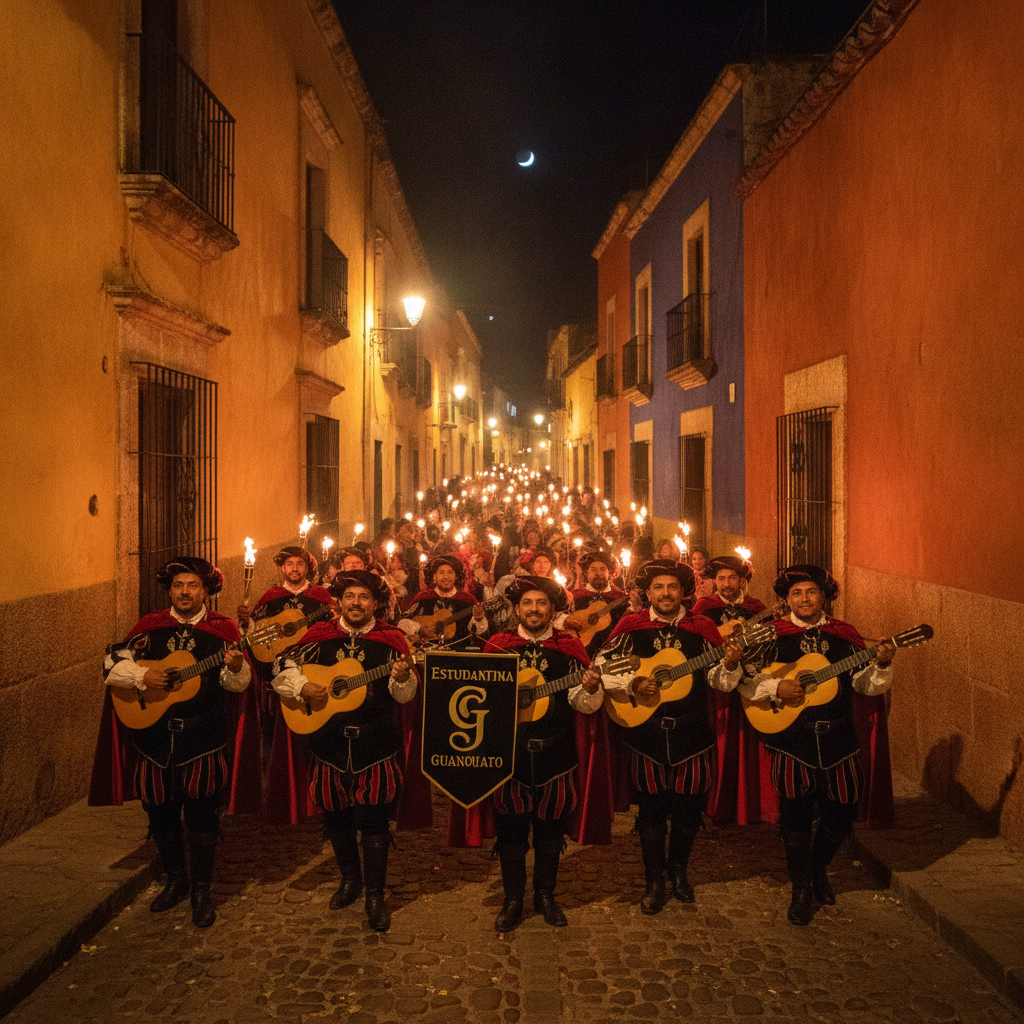
Guanajuato Walking the Callejones by Night Romantic Legends Ghost Stories and the Social Life of a Canyon City Where Every Alley Has a Story and Every Stairway Leads to a Different Century
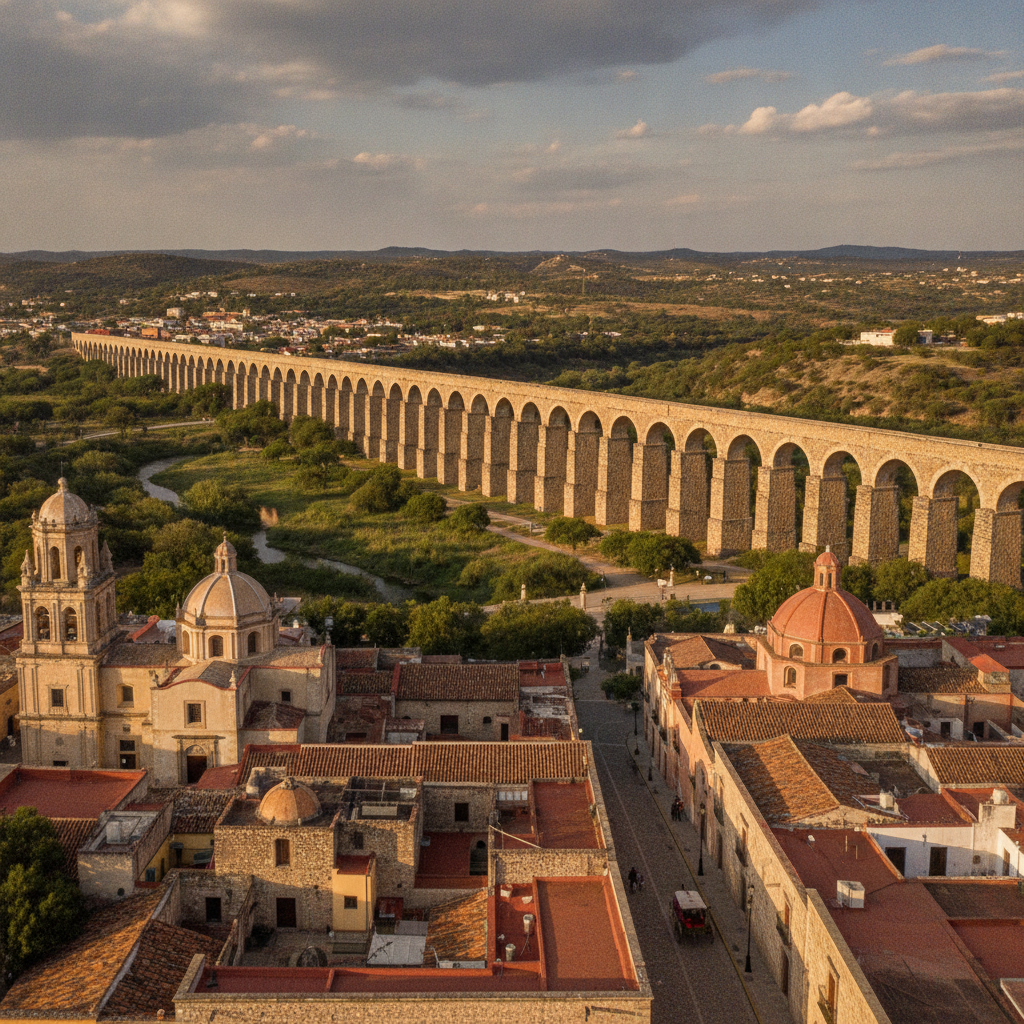
Guanajuato Day Trips Sierra Gorda Queretaro Dolores Hidalgo and the Bajio Heritage Circuit Connecting Colonial Silver Cities Mountains and Hot Springs in the Heart of Central Mexico
The Guanajuato Independence Conspiracy Miguel Hidalgo Ignacio Allende and the Bajio Network That Launched the Mexican War of Independence From a Silver Mining City in September 1810
Guanajuato Practical Guide Getting There Navigation Tips Neighborhoods Safety Climate and How to Survive the Underground Tunnels the Cobblestone Callejones and the Most Disorienting Colonial City in Mexico
Guanajuato Baroque Art Churrigueresque Architecture La Valenciana Church and the Artistic Legacy of a Colonial City That Built the Most Elaborate Religious Buildings in Mexico With Silver Money