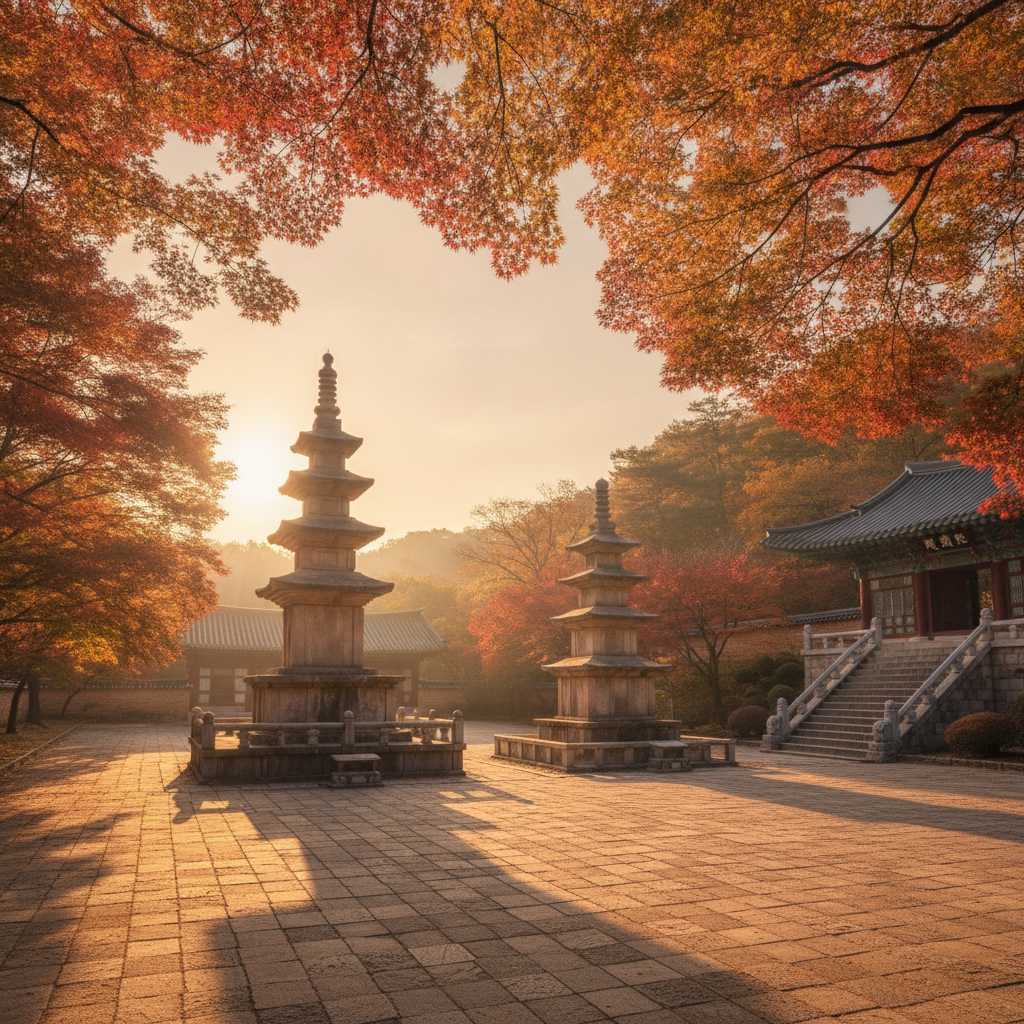
The 60-Metre Wooden Pagoda Burned by the Mongols in a Single Day, the First Silla Gold Crown Found in 1921 by Colonial Archaeologists & the Valley Where 7 Stone Pagodas Stand in 500 Metres
The Hwangnyongsa Nine-Story Pagoda as the tallest wooden structure in Korean history destroyed in 1238 CE; the 1921 Gold Crown Tomb discovery and the colonial period artifact removals still in Japan; the 1973 Cheonmachong excavation's 11,526 artifacts including the first Silla figurative painting; the Tapgok Valley's 7 pagodas in 500 metres as the most concentrated stone pagoda zone in Korea; the Poseokjeong wine-cup water channel as the site where the last Silla king was feasting when Goryeo forces arrived; and the 18:00–19:30 Wolji Pond blue-hour window as the most reliably beautiful Gyeongju photograph.
- 1
Gyeongju's Buddhist Temples on Namsan Mountain
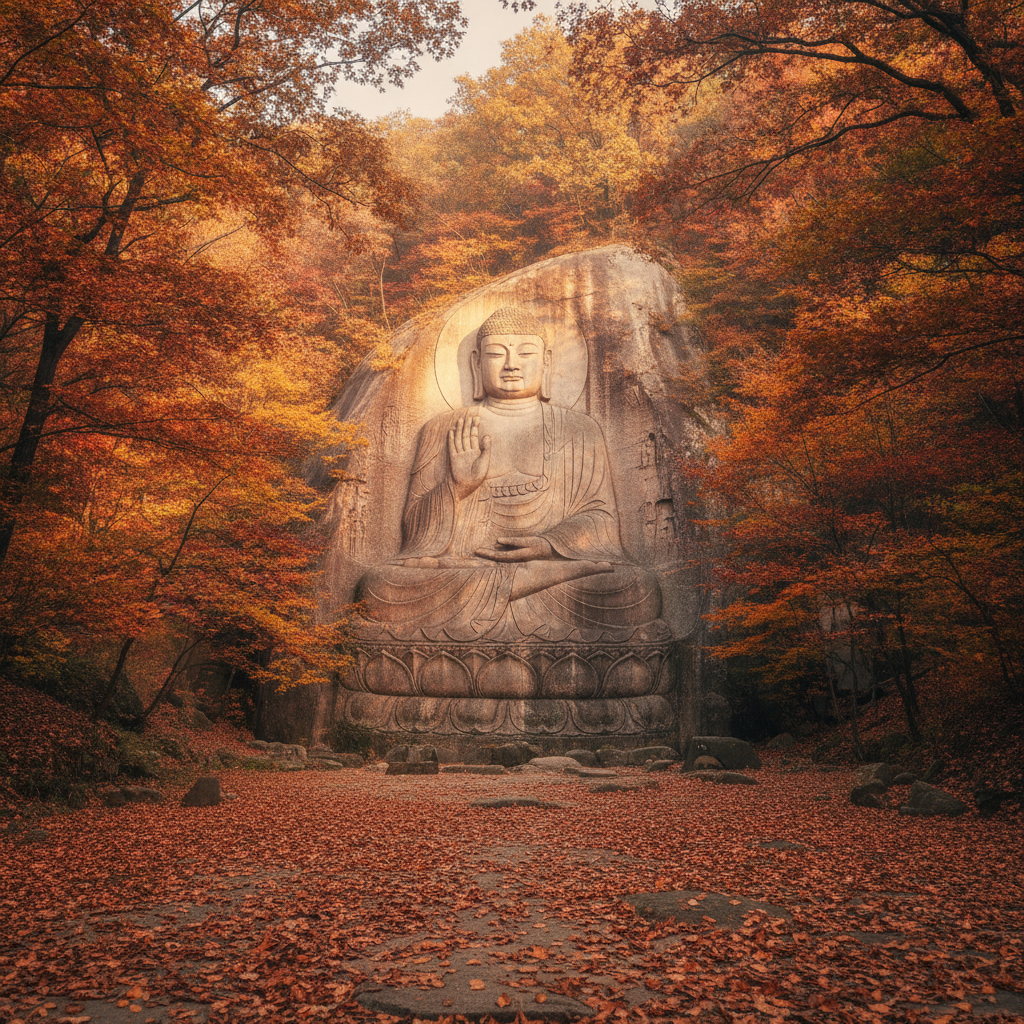
The Namsan Buddhist temple complex (the southern mountain of Gyeongju City that is the richest single outdoor Buddhist art environment in Korea—150 rock-carved Buddhas, 40 stone pagodas, and the remains of 150 temple sites distributed across the mountain's 8 km north-south and 4 km east-west extent): the most rewarding half-day or full-day hiking and art experience in the Gyeongju region. The approach (the Namsan hiking trails accessed from the southern residential districts of Gyeongju City—the most convenient trailhead is the Tongil-ro bus stop south of the city, a 20-minute bicycle ride from the central historic sites): the trail system (12 named trails; the most rewarding first-visit trail is the Baerimsa Valley trail (the western slope trail: 2 hours round trip; moderate difficulty; the highest concentration of rock carvings visible on a single trail)). The Seated Buddha of the Baerimsa Valley (the most important single carving on Namsan—the large relief seated Buddha carved into the vertical cliff face of the Baerimsa Valley: 7 metres tall, carved in the late Unified Silla period (9th century CE): the scale of the carving relative to the natural rock face is the most dramatic encounter with Namsan Buddhist art). The Tapgok Valley (the eastern slope 'Pagoda Valley'—the valley with the highest concentration of stone pagodas per unit area in Korea: 7 stone pagodas in a 500-metre valley walk): the most serene single Namsan valley. The Poseokjeong (포석정—the outdoor stone water channel at the base of the western Namsan slope where the Silla court held outdoor banquet rituals by floating wine cups down the carved stone channel): the site where the last Silla king Gyeongsun was feasting when the Goryeo forces arrived to receive his surrender in 935 CE.
- 2
Gyeongju's Intangible Cultural Heritage
The living intangible cultural heritage of the Gyeongju region (the traditional practices, performing arts, and craft traditions that continue to be practiced in Gyeongju beyond the stone monuments and museum collections): the living heritage that gives the physical sites their human context. The Silla court music (향악, hyang-ak—the traditional music of the Silla court—the music tradition that was maintained at the Silla court and is still performed by the National Gugak Center and the Gyeongju City cultural programme): the gayageum (가야금—the 12-string zither that is the primary instrument of Korean classical music, invented by the Gaya Kingdom (the small kingdom allied with Silla) composer Uruk in the 6th century CE): the gayageum recital performances at the Gyeongju National Museum auditorium. The Gyeongju Hyanggyo (향교—the Confucian school and shrine complex in the center of Gyeongju City—the institution that has maintained the Confucian rites (석전대제, Seokjeonje—the twice-yearly ceremony venerating Confucius and the Korean Confucian scholars) since the Joseon Dynasty). The traditional Gyeongju craft (the Gyeongju region celadon (청자, cheongja) pottery—the continuation of the Goryeo-period celadon tradition at the Gyeongju ceramics village in the Gyeongju rural outskirts): the craft most directly connected to the Silla-Goryeo cultural continuity. The Silla Moonlight Festival (신라달빛기행—the evening heritage walk event held during the spring and autumn full moon periods—the candle-lit walk through the Daereungwon tumuli and the Wolji Pond organized by the Gyeongju Cultural Foundation).
- 3
Gyeongju's Contemporary City Life
The contemporary Gyeongju (the living city that exists alongside the UNESCO archaeological landscape—the modern commercial, university, and residential life of a mid-sized Korean city that happens to be surrounded by royal burial mounds): the side of Gyeongju most invisible in the heritage tourism literature and most useful for a visitor who wants to understand the city as a living place rather than just a heritage destination. The Gyeongju University district (Dongguk University Gyeongju Campus—the primary university in the city; the university campus is built around a collection of Buddhist cultural heritage objects): the student population (approximately 7,000 students at Dongguk University Gyeongju) that supports the cafe, restaurant, and bar culture in the streets around the campus in the eastern city. The Gyeongju commercial center (the Jungang Sijang (the covered traditional market) and the surrounding streets of the Jung-gu district): the mix of traditional market vendors and modern Korean franchise cafes (the Gyeongju franchise cafe penetration—the Korean franchise brands (Starbucks, Hollys Coffee, Ediya) that have opened next to the traditional market and the hanok (traditional house) area in the most jarring heritage-commercial juxtaposition in Korea). The Gyeongju city development (the tension between the heritage protection requirement—the cultural layer law (문화재보호법) that requires archaeological survey before any ground is broken within the Gyeongju historic area) and the economic development pressure (every construction project in the Gyeongju city center risks uncovering Silla-period artifacts that trigger a mandatory excavation halt).
- 4
Gyeongju's Archaeological Excavation History
The excavation history of Gyeongju (the story of how the buried Silla Kingdom was revealed through 100+ years of archaeological work—the discoveries that transformed the understanding of Korean history and the techniques that made them possible): the archaeology dimension that gives depth to every artifact in the Gyeongju National Museum. The early excavations (the Japanese colonial period archaeological surveys (1910–1945)—the Gyeongju tumuli excavations conducted by the Japanese Government-General of Korea's archaeological bureau, including the Gold Crown Tomb (금관총—the first Silla gold crown discovered, in 1921)): the colonial archaeology debate (the Japanese colonial archaeological work in Gyeongju produced the first systematic documentation of the Silla royal tombs but the removal of artifacts to Japanese institutions (some still in Japan in 2026) and the excavation methodology (without systematic soil sampling or stratigraphy recording) are criticized by Korean archaeologists). The 1973 Cheonmachong excavation (the first deliberately planned major royal tomb excavation—the tomb was opened on the occasion of the Gyeongju tourism development project (the Bomun Lake resort construction); the discovery of 11,526 artifacts including the flying horse painting (the painted birch bark saddle flap with a white horse flying through clouds—the first Silla figurative painting discovered): the most important single artifact discovery of the Gyeongju excavation programme. The current Wolseong excavation (the active 2015-ongoing excavation of the Silla royal palace site—the most significant active archaeological project in Korea).
- 5
Gyeongju Photography Guide
The Gyeongju photography guide (the practical guide to photographing the UNESCO heritage sites and the Gyeongju landscape in the most effective conditions—the timing, the light, and the camera position that produce the images most associated with the city): the visual guide for a visitor who wants to take the most representative Gyeongju photographs. The Bulguksa best photography (the approach road from the car park—the avenue of maples and ginkgos framing the Dabotap and Seokgatap pagodas in autumn (mid-October to early November) in the early morning (before 08:00) when the site opens and before the tour groups arrive): the alternative compositions (the Cheongun Bridge (the stone staircase) from the left side in late afternoon light with the main gate visible above). The Daereungwon best photography (the Cheonmachong (open tomb) entrance in the late afternoon when the interior chamber is lit from the entrance—the only inside-the-tomb photograph available in Korea): the exterior tumuli (the mounds best photographed from the Cheomseongdae side of the park in early morning light when the grass mounds are at their most saturated green). The Seokguram best photography (the Buddha photography—a single front-facing exposure of the 3.78-metre granite Buddha in the controlled lighting of the grotto; photography restrictions apply (no flash; tripod required for satisfactory low-light results)). The Wolji Pond best photography (the 18:00–19:30 window immediately after sunset when the blue-hour sky and the illuminated palace buildings produce the clearest pond reflection—the most technically simple and most reliably beautiful Gyeongju night photograph).
- 6
Gyeongju's Hwangnyongsa – The Lost Temple
The Hwangnyongsa (황룡사—the 'Yellow Dragon Temple'—the great temple complex of the Unified Silla period that was the largest Buddhist temple complex ever built in Korea and one of the largest in East Asia): the most important archaeological site in Gyeongju that no longer exists above ground and the most significant loss of Korean architectural heritage in history. The Hwangnyongsa dimensions (the temple complex covered approximately 80,000 m² (8 hectares) in the center of Gyeongju City—larger than the current Bulguksa Temple complex; the main hall (the Geumdang) was the largest Buddhist hall in Korean history): the Nine-Story Wooden Pagoda (the 60-metre wooden pagoda built in 645 CE at Queen Seondeok's commission—the tallest wooden structure in Korean history and one of the tallest wooden structures ever built in East Asia): the pagoda (built to represent Korea's symbolic domination of the 9 neighboring states that threatened Silla): the destruction (the Mongol invasion force burned the Hwangnyongsa complex in 1238 CE during the second Mongol invasion of Korea—the fire that destroyed the Nine-Story Pagoda, the main hall, and the 16.5-metre copper Buddha statue in a single day): the most culturally devastating event in Korean history before the Japanese colonial period. The Hwangnyongsa site today (the grassy field east of the Cheomseongdae where the temple foundation stones are visible—the ongoing excavation has revealed the complete ground plan of the temple complex): the planned Hwangnyongsa reconstruction (the Korean Cultural Heritage Administration has been discussing and planning a partial reconstruction of the Nine-Story Pagoda since 2000; the project remains contentious due to the archaeological disturbance required).
Walk this route with audio
Stories play automatically as you reach each stop — no tapping needed.
More in Gyeongju
The Roman Glass Bowl Found in a Korean Royal Tomb, the Largest Steel Mill in the World 30 km from the Oldest Observatory in East Asia & the Dynasty That Had More Female Rulers Than Any Other in Korean History
The 1-Million-Person City of the 8th Century, the Dome Built Like Mycenae on a Korean Mountain & the Bread Shaped Like a Royal Burial Mound
The 600-Year-Old Village Where the Same Two Clans Still Live, the Warrior Youth Who Unified Korea at Age 16 & the 81,258 Buddhist Woodblocks Carved to Stop the Mongol Invasion
The Observatory Whose Astronomical Function Has Been Debated Since the 1970s, the Female King Who Built It & the School Field Trip That Every Korean Child Takes