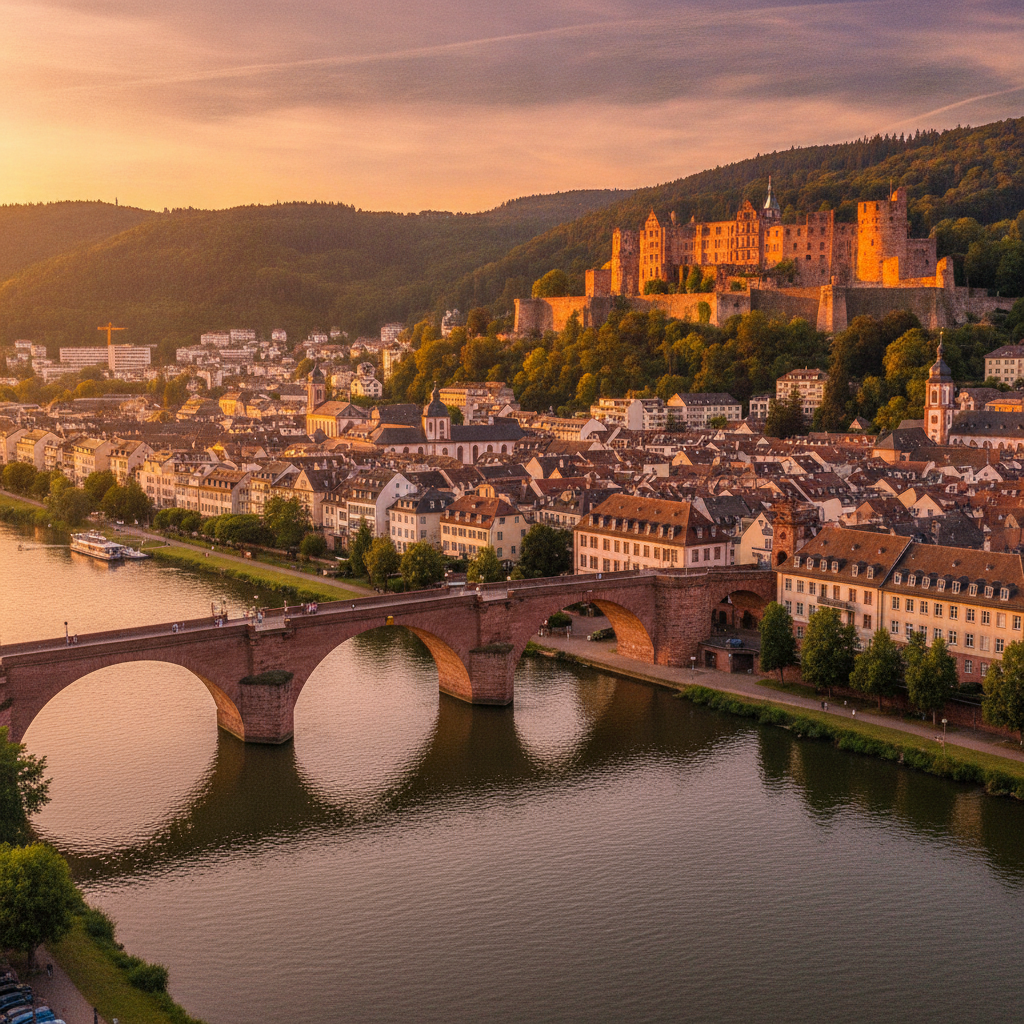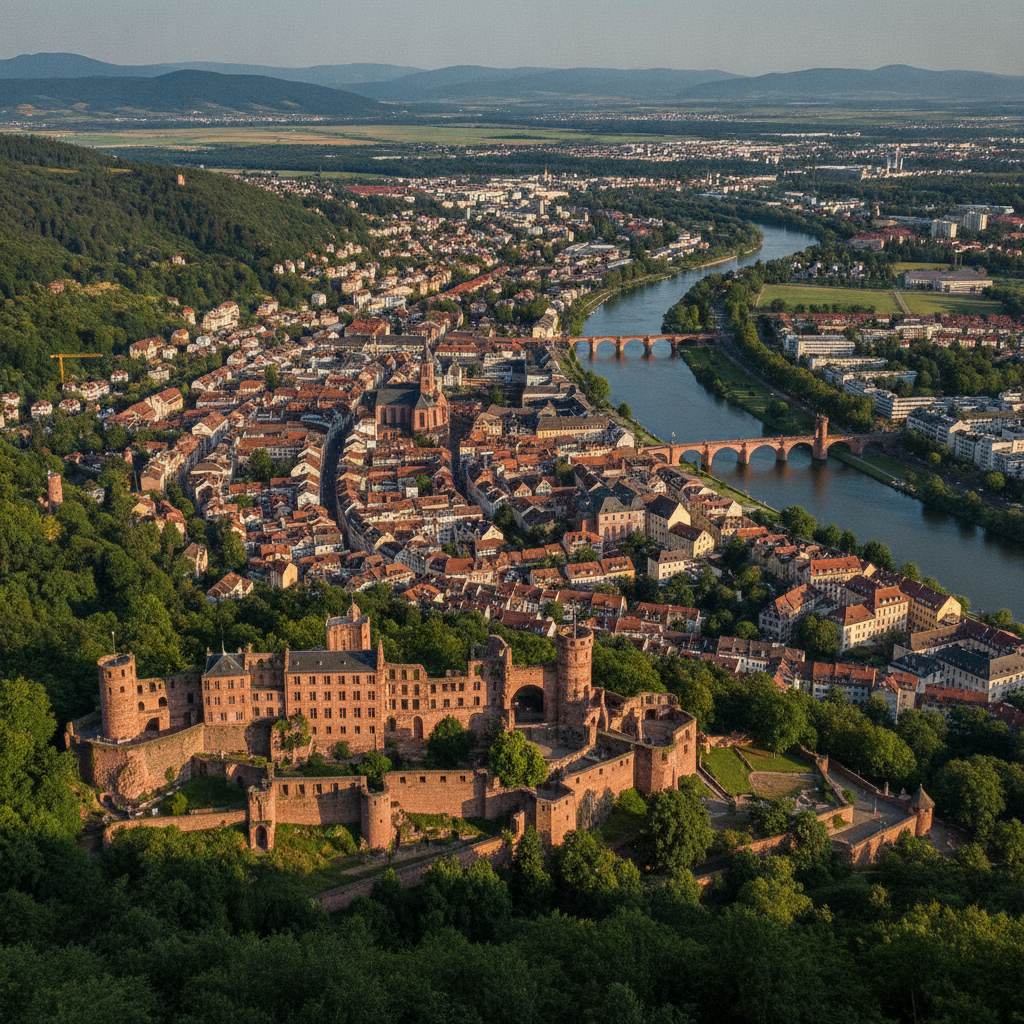
Heidelberg — Königstuhl Summit, Handschuhsheim Village, the Electoral Palatinate & Heidelberg in Literature
The Königstuhl rack railway delivers the most panoramic city summit in Germany; the medieval village of Handschuhsheim is within the city limits; the Electoral Palatinate's Heidelberg Catechism shaped Dutch Calvinism; and the German Romantic poets made Heidelberg world literature.
- 1
The Königstuhl and the Bergbahn — Heidelberg's Summit Cable Car
Königstuhl (the Königstuhl summit at 568m — the highest point of the Heidelberg hills, the most panoramically positioned single summit accessible by public transport from any major German city): the Bergbahn (the Heidelberger Bergbahn — the rack railway from the Heidelberg Marktplatz to the Königstuhl summit in two sections, the lower section (Marktplatz to Molkenkur at 290m) the oldest electric rack railway in Germany, opened 1890, the most historically significant single mountain railway in Baden-Württemberg, the upper section (Molkenkur to the Königstuhl) opened 1907, the €12 return the most cost-efficient single summit access in any German city mountain railway), the Königstuhl summit (the Königstuhl summit at 568m with the TV tower (Fernsehturm) — the summit the most panoramic viewpoint over the Neckar valley, the Rhine plain, and the Heidelberg Altstadt, the view northwest from the summit over the Rhine plain extending to the Vosges Mountains in Alsace (60km) and the Palatinate Hills (50km), the most geographically extensive single panorama from any urban summit in Baden-Württemberg), the Märchenparadies (the Märchenparadies fairy-tale park at the Königstuhl summit — the open-air fairy-tale character display park at the summit, the most unexpected and the most family-visitor-oriented single attraction at the Heidelberg Königstuhl, the 30 fairy-tale scenes the most whimsical single summit feature of any German hill railway terminus), the Molkenkur (the Molkenkur intermediate station at 290m — the hotel and restaurant at the first rack railway stop, the most dramatically positioned mid-hillside restaurant in Heidelberg, the castle visible from the Molkenkur terrace 100m directly above, the most photographic intermediate position between the Altstadt and the summit), the Kohlhof (the Kohlhof forest restaurant at the Königstuhl plateau — the most historically established forest restaurant in the Heidelberg area, the charcoal-kiln heritage (Kohlhof = 'charcoal yard') the most specifically Odenwald industrial heritage food stop, the traditional Baden cuisine the most atmospheric forest dining in Heidelberg, open daily in summer) and the Königstuhl hiking (the circular hiking route from the Königstuhl summit — the 8km circuit: Königstuhl summit east to the Kohlhof, south to the Sattelpfad forest path, west to the Fischbach valley, and north back to the Molkenkur station, the most completely forested single day-hike circuit accessible from the Heidelberg city centre without a car).
- 2
Heidelberg's Handschuhsheim — the Most Atmospheric Village District
Handschuhsheim (the Handschuhsheim district of Heidelberg — the most characteristically pre-industrial village character of any Heidelberg neighbourhood still within the city limits, the most completely preserved Fachwerkhaus (half-timbered house) ensemble in any Heidelberg district): the Tiefburg (the Tiefburg in Handschuhsheim — the 13th-century moated castle in the Handschuhsheim village centre, the most incongruously positioned medieval castle in any Heidelberg residential district, the castle now housing the Handschuhsheim local museum and the most completely water-moated medieval structure accessible within the Heidelberg city limits, the museum the most specifically neighbourhood-history focused local collection in any Heidelberg district, free Sundays), the Stiftskirche (the Stiftskirche St. Vitus in Handschuhsheim — the most completely Romanesque surviving church in the Heidelberg city limits, the 12th-century nave and the 15th-century tower the most architecturally historically layered single church in any Heidelberg district, the Romanesque window capitals the most specifically architectural detail of any medieval church in Heidelberg), the Handschuhsheim Fachwerkhaus (the Fachwerk houses in the Handschuhsheim core — the most intact group of half-timbered domestic architecture in any Heidelberg neighbourhood, the Altes Rathaus (Old Town Hall) of 1621 the most formally civic Fachwerkhaus, the surrounding 17th-century houses the most comprehensively vernacular medieval domestic architecture in the Heidelberg area), the Handschuhsheim wine (the Handschuhsheim wine cooperative — the most conveniently accessible wine co-operative within the Heidelberg city limits, the city-limit vineyard on the Königstuhl slopes south of Handschuhsheim the most urban-viniculture-instructive single wine-growing site in Heidelberg, the co-op wines the most directly locally-grown Heidelberg wine purchase), the Handschuhsheim market garden (the Handschuhsheim market garden tradition — the most historically established vegetable and soft-fruit growing district within any German university city, the Handschuhsheim strawberries the most specifically Heidelberg edible summer seasonal purchase, the asparagus the most celebrated spring produce, the market stalls in the Handschuhsheim village square on Saturday mornings the most neighbourhood-scale traditional market experience in Heidelberg) and the Neuenheim (the Neuenheim district opposite the Altstadt on the Neckar north bank — the most architecturally diverse late-19th-century residential neighbourhood in Heidelberg, the Neuenheimer Landstrasse riverbank promenade the most pleasant combined walking-and-cycling route in Heidelberg, the view from the promenade across the Neckar to the Altstadt and the castle the most classically framed Heidelberg panorama accessible at street level).
- 3
The Electoral Palatinate — Heidelberg as a Capital
Electoral Palatinate (the Kurpfalz — the Electoral Palatinate of the Rhine, the most powerful and the most politically consequential of the German Rhineland electorates in the 16th and 17th centuries, Heidelberg the capital of the most culturally significant Calvinist state in the Holy Roman Empire): the Elector Palatine (the Kurfürsten der Pfalz (Electors Palatine) — the rulers of the Electoral Palatinate from Heidelberg Castle, the most influential single Calvinist ruling house in the Holy Roman Empire, the Heidelberg Catechism of 1563 (the Heidelberger Katechismus — the most widely distributed single Reformed theological text in the German language, the primary confessional document of the Dutch Reformed Church and the most internationally distributed single German-Calvinist theological document) drafted in Heidelberg under Elector Frederick III), the Heidelberg Catechism (the Heidelberger Katechismus of 1563 — the Reformed Protestant catechism drafted in Heidelberg at the instruction of Elector Palatine Frederick III, the most widely used single confessional document in the Dutch, German, and Hungarian Reformed church traditions, the most internationally significant single theological document produced in Heidelberg, the original printing the most symbolically important single document in the Heidelberg heritage for the international Reformed community), the Winter King (King Frederick V 'the Winter King' (Friedrich V) — the Elector Palatine who accepted the Bohemian crown in 1619 and triggered the Thirty Years War, the most consequential single political decision made by a Heidelberg ruler in European history, the Battle of White Mountain (1620) and the subsequent sacking of the Heidelberg Library (the Bibliotheca Palatina — the most important Renaissance library in Germany, transported to the Vatican in 1622) the most catastrophic single event in Heidelberg's intellectual heritage), the Bibliotheca Palatina (the Heidelberger Bibliotheca Palatina — the Palatine Library, the most important single library in the Holy Roman Empire by the end of the 16th century with 3,500 manuscripts and 13,000 printed volumes, seized by the Bavarian Duke Maximilian in 1622 and presented to Pope Gregory XV, the Vatican Library the current depository of the original manuscripts, the most significant single library loss in German academic history, the replica catalogue display at the Heidelberg University Library), the Heidelberg Catechism legacy (the legacy of the Heidelberg Catechism in the Dutch Reformed, German Reformed, and Hungarian Reformed churches — the most internationally far-reaching single theological influence of any document written in Heidelberg, the catechism in use as the primary confessional standard in the Dutch Reformed Church (Gereformeerde Kerken), the most direct connection between Heidelberg and the Dutch national Protestant identity) and the Palatine influence on America (the Palatinate emigration to America — the most significant single German emigrant wave to colonial America: 13,000 Palatine refugees fleeing the devastation of the War of Spanish Succession arrived in New York in 1709, the most concentrated single German immigration event in American colonial history, the Palatine German influence on Pennsylvania German (Pennsylvania Dutch) culture, the most significant single pre-Revolutionary German cultural contribution to American identity).
- 4
The Heidelberg Carlsberg — The Forgotten Ruin Above the City
Carlsberg Heidelberg (the Carlsberg ruins on the Heiligenberg above Heidelberg — the most historically obscure and the most dramatically positioned castle ruin in the Heidelberg hills, the most rarely visited significant heritage site within walking distance of the Heidelberg Altstadt): the Carlsberg history (the Carlsberg (not to be confused with the Danish beer brand) — the 18th-century Baroque summer palace built for Prince-Elector Karl Philipp in 1718 on the Heiligenberg above the Heidelberg Altstadt, the most dramatically positioned summer palace in the Heidelberg hills, the palace used as the summer residence until the Heidelberg court moved permanently to Mannheim in 1720, the palace then abandoned and the stones subsequently quarried for the Heidelberg city buildings — the most directly self-cannibalised Baroque palace in Germany), the Carlsberg ruins (the Carlsberg ruins on the Heiligenberg — the most atmospherically romantic and the most historically overlooked ruins in the Heidelberg area, the surviving stone foundations and the garden terrace walls the only physical remains of the 18th-century palace, the forest having reclaimed the site since 1720, the most specifically 'lost palace' archaeology accessible on foot from the Heidelberg Altstadt in 45 minutes via the Philosophenweg), the Heiligenberg tour (the complete Heiligenberg circuit combining the Philosophenweg, the Carlsberg ruins, the Thingstätte amphitheatre, and the St. Michael monastery ruins — the most historically layered single half-day walking circuit in the Heidelberg area, the circuit covering 4 distinct historical periods: the 9th-century monastery, the 12th-century Celtic hillfort traces, the 1718 Baroque palace ruins, and the 1935 Nazi Thingstätte), the Thingstätte (the Thingstätte amphitheatre at the Heiligenberg — the 1935 NS-Kulturstätte (National Socialist cultural site) built for the mass ritual performances of the 'Thing movement', the most architecturally sinister heritage structure in the Heidelberg hills, the stone seating for 8,000 spectators the most brutally scaled single historical outdoor venue in the Heidelberg landscape, the site now used for occasional community events without ideological reference), the Heiligenberg Celtic fort (the Celtic hillfort on the Heiligenberg — the pre-Roman Iron Age fortification on the plateau, the most archaeologically ancient identifiable human structure on the Heidelberg hills, the earthwork ramparts the most extensively Celtic-archaeology-preserving hill site in the Heidelberg area, the interpretation board at the Heiligenberg summit the most educational single outdoor archaeology display in the Heidelberg hills) and the forest walk (the forest walk from the Philosophenweg to the Carlsberg and back via the Schlangenweg serpentine descent to the Neckar — the most dramatically topographically varied single half-day walk from the Heidelberg Altstadt, the elevation change of 350m the most aerobically challenging single urban forest circuit in Heidelberg, the completion time 3-4 hours for the full circuit including the Carlsberg and Thingstätte detours).
- 5
Heidelberg Architecture — from the Medieval to the Modern
Heidelberg architectural history (the Heidelberg architectural timeline — the most comprehensively multi-period single city architectural sequence accessible on foot in Baden-Württemberg, the city containing significant architecture from the Romanesque through to the 21st century): the Romanesque (the Romanesque in Heidelberg — the Stiftskirche St. Vitus in Handschuhsheim (12th century) and the Peterskirche crypt at the Heidelberg Universitätsplatz (12th century) the 2 most significant surviving Romanesque structures in the Heidelberg city limits, the Peterskirche the oldest continuously used church building in Heidelberg), the Gothic (the Gothic in Heidelberg — the Heiliggeistkirche (Church of the Holy Spirit) at the Marktplatz the most significant Gothic building in Heidelberg, the 15th-century nave and choir the most completely Gothic single church structure in the Altstadt, the Heidelberg Castle east wing the most monumental Gothic secular architecture in the city), the Renaissance (the Renaissance in Heidelberg — the Ottheinrichsbau (1556-1559) the most important single Renaissance palace facade in Germany north of the Alps, the Friedrich Wing of the castle (1601-1607) the most completely articulated Mannerist palace in Germany, the Haus zum Ritter (1592) at Hauptstrasse 178 the most completely surviving Renaissance burgher-house facade in Heidelberg), the Baroque (the Baroque in Heidelberg — the post-1693 rebuilding the most comprehensively Baroque-urban-planned single German city reconstruction, the Hauptstrasse the most complete single Baroque pedestrian street in Germany, the Alte Universität and the Jesuitenkirche the most formally composed Baroque institutional buildings in Heidelberg), the Historicism (the Historicism in Heidelberg — the 19th-century Neuenheim and the Weststadt districts the most architecturally complete Gründerzeit residential neighbourhoods in Heidelberg, the Heidelberg Hauptbahnhof (Main Station) of 1955 the most instructive single example of the post-war German 'reconstruction Historicism' in the Heidelberg area) and the University Science Campus (the Heidelberg University Science Campus at Im Neuenheimer Feld — the most completely modernist single academic campus in any German university city, the campus designed from 1958 onwards the most instructive single sequence of post-war German academic Modernism in Baden-Württemberg, the Klaus Tschira Centre (2013) and the Science Tower the most architecturally significant 21st-century buildings on the campus).
- 6
Heidelberg in Literature and Film — the City as Romantic Archetype
Heidelberg in culture (the Heidelberg cultural legacy — the most internationally literarily referenced German city in the Romantic tradition, the Heidelberg the primary setting and the primary inspiration for the German Romantic movement and the most persistently romanticised single German city in world literature and film): the German Romantics (the Heidelberg Romantic circle — the Heidelberger Romantiker: Clemens Brentano, Achim von Arnim, Joseph Görres, and the brothers Grimm, all active in Heidelberg 1803-1808, the 'Des Knaben Wunderhorn' folk poetry collection by Brentano and von Arnim (1806-1808) the most influential single German Romantic literary publication, the Heidelberg circle the most cohesive single German Romantic intellectual community, the Old University and the Heidelberg wine taverns the primary social meeting points of the Romantics), the 'Heidelberg' poem (the poem 'Heidelberg' by Friedrich Hölderlin (1800) — the most directly city-addressed single poem in German Romantic literature, the poem's invocation of the Neckar, the bridge, and the castle the most precise Romantic literary description of the Heidelberg landscape, the most quoted single literary text in Heidelberg tourist materials), the Alt-Heidelberg (the play 'Alt-Heidelberg' (Old Heidelberg) by Wilhelm Meyer-Förster (1901) and the operetta 'Student Prince' adapted from it (1924) — the most internationally performed single theatrical work set in Heidelberg, the 'Prince Karl Franz' student romance the most internationally distributed single Heidelberg narrative in world entertainment, the operetta the most performed single German-setting operetta in Broadway history before 1950), the Heidelberg in film (the film 'The Student Prince' (1954, MGM) — the most internationally distributed single Heidelberg-set film, Mario Lanza's vocal performance the most recognised single Heidelberg cultural film reference, the operetta songs the most widely distributed single Heidelberg-themed music in the English-speaking world), the Goethe in Heidelberg (Goethe's repeated visits to Heidelberg — the most distinguished single literary visitor to Heidelberg, Goethe's documented 10 visits to Heidelberg from 1775 to 1815, the Heidelberg Romantik Museum in the Heidelberger Schloss the most comprehensively Goethe-Heidelberg focused exhibition in the city) and the Heidelberg Romantik Museum (the Heidelberger Romantik Museum at Hauptstrasse 239 — the most comprehensively literary-Romanticism focused museum in Heidelberg, the permanent exhibition on the Heidelberg Romantic circle, the visiting international writers, and the global cultural impact of the Heidelberg Romantic tradition, the most specifically Heidelberg literary-heritage focused museum in the city, CHF 5 adults, Tuesday-Sunday 10am-6pm).
Walk this route with audio
Stories play automatically as you reach each stop — no tapping needed.
More in heidelberg
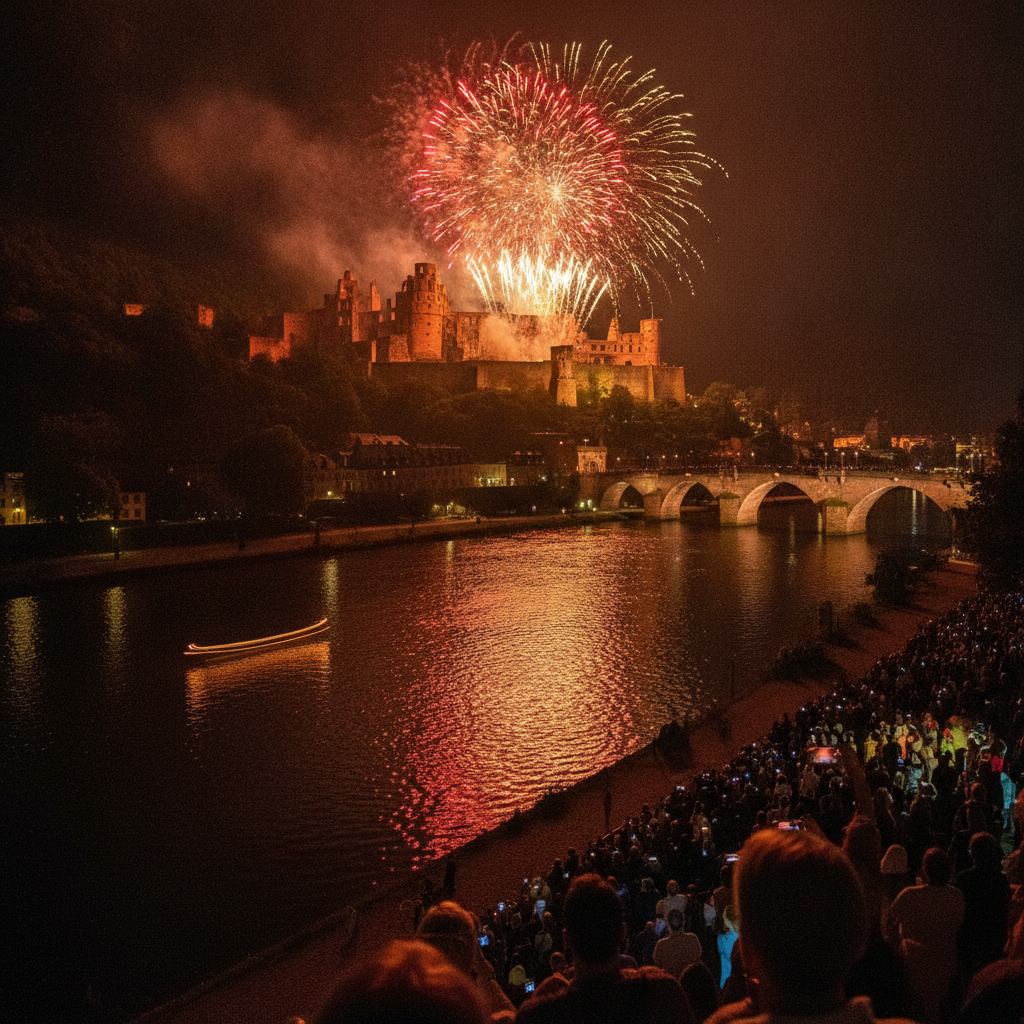
Heidelberg — Castle Illumination, Roman Ladenburg, Baroque Architecture, Odenwald Hiking & Bergstrasse Wine
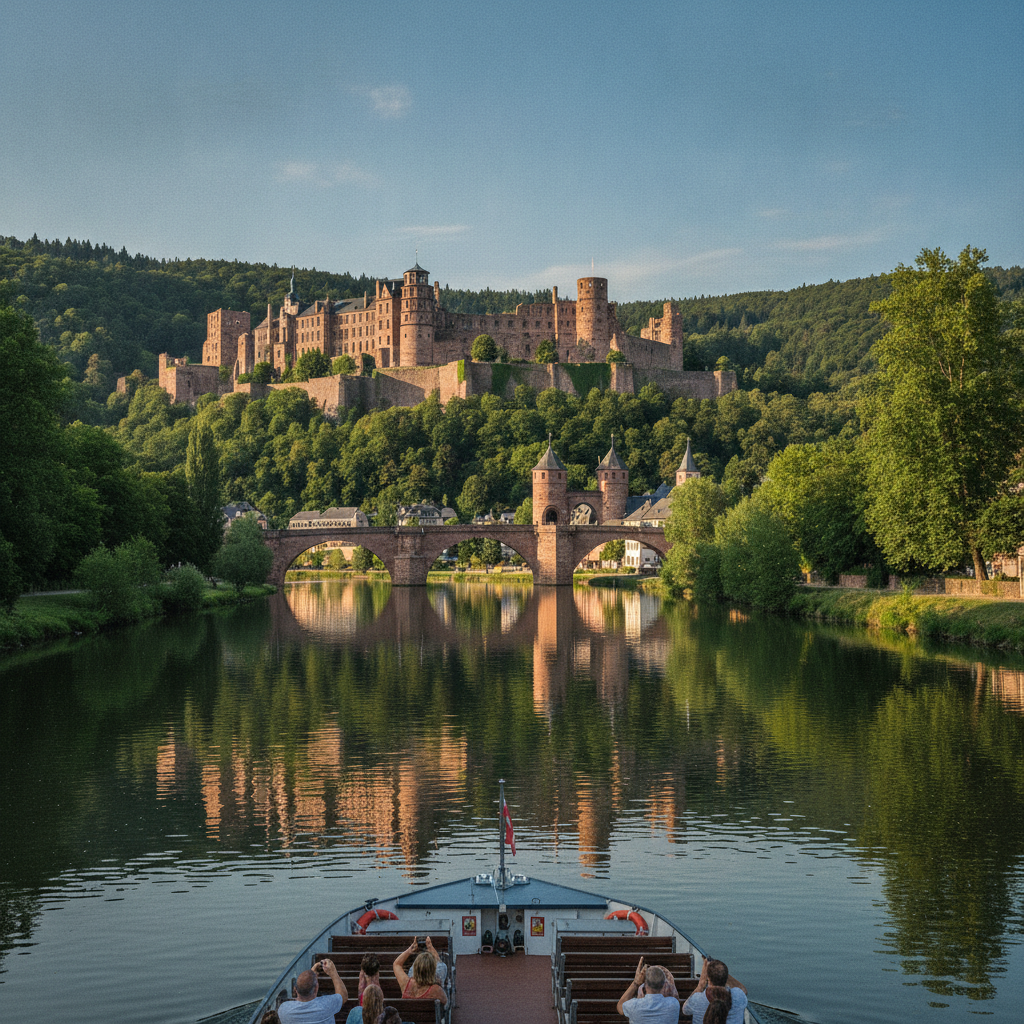
Heidelberg — Neckar Cruise, Mannheim Baroque Palace, Worms Cathedral & Speyer's Romanesque Kaiserdom
Heidelberg — Philosophenweg, Wine Country, Museums, Student Culture & Nightlife
Heidelberg — Churches, Schwetzingen Garden, Christmas Market, Art Scene & the Full Events Calendar