Mekong Delta & Floating Markets — The River World Beyond Saigon
The Mekong Delta (Đồng bằng sông Cửu Long — 'Nine Dragon River Delta' — the vast flat river delta of the Mekong River (Sông Mê Kông) in southwestern Vietnam, covering approximately 39,000 km² and home to approximately 17 million people — the most productive agricultural region in Vietnam, producing approximately 50% of the country's rice and 70% of its fruit and vegetable output): the Mekong Delta is the essential day-trip or overnight destination from Ho Chi Minh City, offering a completely different landscape and lifestyle from the urban bustle of the city.
- 1
Can Tho & Cai Rang Floating Market
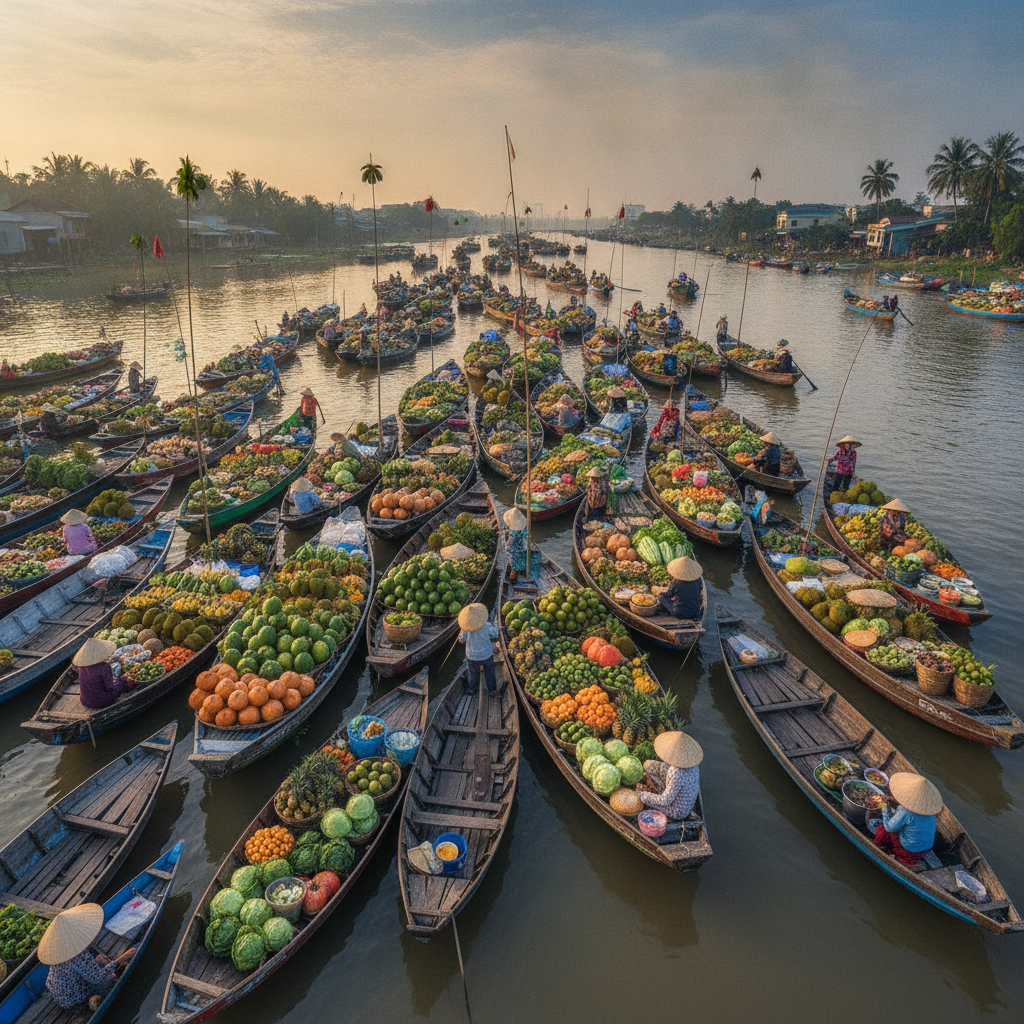
Can Tho (Cần Thơ — the largest city in the Mekong Delta (population approximately 1.2 million), 165 km from Ho Chi Minh City, accessible in 3-3.5 hours by road or coach — the 'capital' of the Mekong Delta and the hub for floating market visits): Can Tho is the jumping-off point for visiting the Cai Rang Floating Market (Chợ nổi Cái Răng — the largest floating market in the Mekong Delta, on the Hau River (Sông Hậu) approximately 6 km south of Can Tho city centre): Cai Rang (active daily from approximately 5 AM to 8-9 AM, after which the market disperses) is the wholesale floating market where boats carrying produce from the surrounding delta farms (watermelons, pineapples, jackfruit, durian, dragon fruit, sweet potatoes, and an enormous variety of tropical produce) converge on the river for wholesale trade, with the bamboo pole system (cây bẹo — the tall pole with a sample of the product tied to the top that each vendor boat displays, the most distinctive visual element of the Mekong floating market tradition) identifying each vendor's merchandise; the tour boats (small wooden motor boats) that carry visitors from Can Tho into the market at dawn (small boat tours of 2-3 hours, including stop at a noodle boat for breakfast phở or bún on the river) provide the most immersive delta experience.
- 2
Ben Tre — The Coconut Province
Ben Tre Province (Bến Tre — 'Ferry of Bamboo', the province directly south of Ho Chi Minh City across the My Tho River (Sông Tiền — the northern main channel of the Mekong Delta), 86 km from Ho Chi Minh City — the province known as 'the land of coconuts' (xứ dừa) due to its approximately 70,000 hectares of coconut palm groves, the largest single-province coconut plantation in Vietnam): Ben Tre is the most popular one-day Mekong Delta destination from Ho Chi Minh City, offering the classic delta experience of: boat trips through the narrow canals (kênh — the man-made irrigation canals between the coconut palm groves and rice paddies, narrow enough in places that the palm fronds touch overhead), visits to traditional cottage industries (the Ben Tre coconut candy workshops (kẹo dừa — coconut candy, the most famous product of Ben Tre, made from coconut milk (nước cốt dừa) and rice malt syrup), the boat building yards, and the fish sauce (nước mắm) producers), and bicycle rides through the delta villages; the iconic Mekong Delta landscape (the flat green rice paddies extending to the horizon, the rivers and canals with their wooden bridges (cầu khỉ — 'monkey bridges', the single-plank bamboo footbridges between the canal banks), and the ubiquitous coconut palms and water hyacinth (lục bình — bình bát — the floating water hyacinth (Eichhornia crassipes) that covers the surface of the Mekong Delta canals in brilliant purple-flowered mats) is best experienced in Ben Tre.
- 3
My Tho & the River Life of the Upper Delta
My Tho (Mỹ Tho — the capital of Tien Giang Province, 70 km from Ho Chi Minh City — the closest major Mekong Delta city to Saigon and the most convenient starting point for a short delta day trip): My Tho (the former capital of the French colonial province of Cochinchina's Mytho territory, with a surviving French colonial market and town hall) is most visited as the embarkation point for river tours of the Mekong Delta's upper channels (the branches of the Mekong close to My Tho, including the Cu Lao Island (Cù Lao Thới Sơn — the river island in the Tien Giang (My Tho) River, reached by flat wooden ferry boat, the island known for its fruit orchards, honey bee farms, and traditional music performances (đờn ca tài tử — the southern Vietnamese traditional music form, a UNESCO Intangible Cultural Heritage since 2013)) and the Phoenix Island (Cù Lao Phụng — the river island that was the home of the Coconut Monk (Ông Đạo Dừa — the Vietnamese monk Nguyễn Thành Nam who lived as an ascetic on the island from 1945, subsisting (reportedly) only on coconut products and meditating for years at a time, the ruins of his island temple complex visible today))); the river life visible from the tour boats on the My Tho River (the cargo vessels, fishing boats, water hyacinth cutters, and ferries that continue the centuries-old river commerce of the delta) is the most authentic Mekong Delta experience accessible in a single day from Ho Chi Minh City.
- 4
Vinh Long & the Central Delta Provinces
Vinh Long (Vĩnh Long — the province in the central Mekong Delta, 150 km from Ho Chi Minh City — the delta province known for its fruit orchards and its An Binh Island homestay experiences): the An Binh Island (Cù Lao An Bình — the river island in the Co Chien River (Sông Cổ Chiên), accessible by ferry from Vinh Long town in 5 minutes — one of the last areas of the Mekong Delta where visitors can stay overnight in a traditional Vietnamese homestay (nhà nghỉ tại gia) in a delta farmhouse surrounded by fruit orchards and canal paddies) is the best available overnight experience in the Mekong Delta within easy reach of Ho Chi Minh City; the fruit orchards of the central delta (the longan (nhãn), rambutan (chôm chôm), mangosteen (măng cụt), durian (sầu riêng), pomelo (bưởi), and jackfruit (mít) orchards of the An Binh Island and the surrounding delta provinces — the most productive tropical fruit growing region in Vietnam) are the source of the majority of the fresh tropical fruit available in the markets of Ho Chi Minh City and exported throughout Asia.
- 5
Chau Doc & the Cambodian Border Region
Chau Doc (Châu Đốc — the provincial capital of An Giang Province in the far western Mekong Delta, 245 km from Ho Chi Minh City, on the Hau River (Sông Hậu) 5 km from the Cambodian border — the gateway to Cambodia via the Mekong River and the most culturally diverse city in the Mekong Delta): Chau Doc (the city with significant Khmer (Cambodian), Cham Muslim (Chăm Hồi giáo — the descendants of the Cham Kingdom of coastal Vietnam who converted to Islam and retreated to the Mekong Delta), and Vietnamese Hoa (ethnic Chinese) communities alongside the Vietnamese Buddhist majority) is distinguished by the floating fish farm villages (làng cá bè — the communities living on floating houses above submerged fish pens (bè cá) on the Hau River, the fish (mainly catfish (cá tra — Pangasianodon hypophthalmus, the catfish that Vietnam exports as 'basa fish' to international markets) raised in the submerged cages below the floating houses in a form of aquaculture unique to the Mekong Delta)); Sam Mountain (Núi Sam — the 230-metre isolated hill visible for many kilometres across the flat delta plain, topped with the Tay An Temple (Chùa Tây An) and the Lady Xu Temple (Miếu Bà Chúa Xứ — the most important pilgrimage temple in southern Vietnam, attracting approximately 2 million pilgrims per year)).
- 6
Mekong Delta Rice Culture & Vietnamese Agriculture
The Mekong Delta rice culture (the agricultural system that has fed Vietnam and has been a major factor in Vietnam's emergence as the world's second-largest rice exporter (approximately 6-7 million tonnes of rice exported per year, trailing only Thailand)): the Mekong Delta rice production system (the flat alluvial delta plain where three crops of rice per year are possible due to the constant availability of water from the Mekong River and the year-round warm temperatures, producing approximately 24 million tonnes of rice per year from approximately 1.8 million hectares of rice paddies in the delta — approximately 50% of Vietnam's total rice production) is the most intensive rice-growing system in Southeast Asia; the traditional forms of rice cultivation visible in the Mekong Delta (the flooded rice paddies (ruộng lúa) in the flat landscape, the water buffalo (con trâu) used in traditional farming (though increasingly replaced by mechanical rice transplanters (máy cấy) and combine harvesters (máy gặt)), the rice mills (xay xát lúa gạo — the mechanical rice hulling mills in every major delta town that process the paddy rice into white rice for consumption and export), and the rice straw (rơm rạ — the straw left after the rice harvest, used as fuel, animal fodder, and mushroom growing medium) are the defining landscape elements of the delta.
Walk this route with audio
Stories play automatically as you reach each stop — no tapping needed.
More in ho-chi-minh-city
Saigon River, District 2 & the New Face of Ho Chi Minh City
Phở, Bánh Mì & Saigon Street Food — Vietnam on a Plate
Ben Thanh Market, District 1 & the Colonial Heart of Saigon
Saigon After Dark — Rooftop Bars, Night Markets & the City That Never Sleeps
Jade Emperor Pagoda & Saigon's Temple Culture