Mong Kok: Ladies' Market, Goldfish Market, Flower Market & Bird Garden
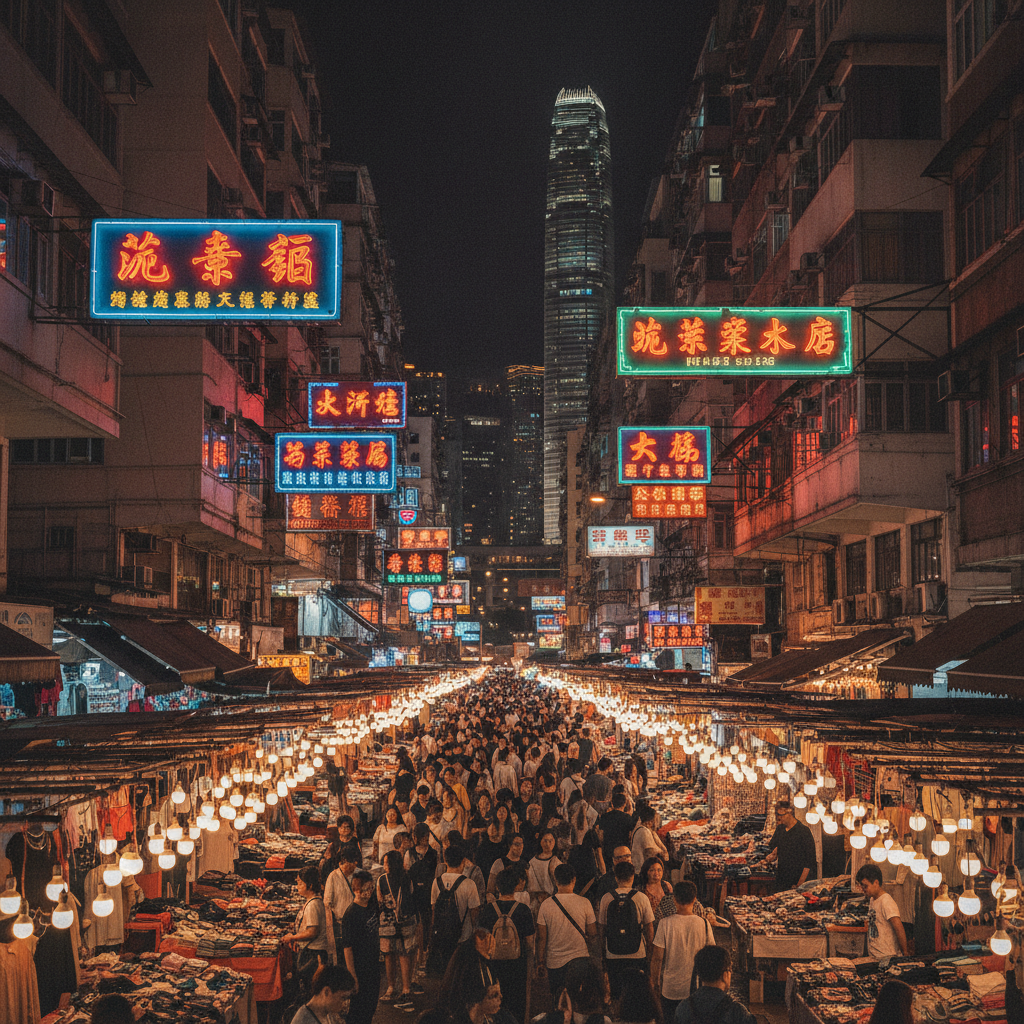
Mong Kok (旺角, 'prosperous corner') holds the Guinness World Record as the most densely populated urban area in the world, with 130,000 people per square kilometre, and is home to the most famous street markets in Kowloon: the Ladies' Market (Tung Choi Street), the Goldfish Market, the Flower Market, the Bird Garden, and the Sneaker Street of Fa Yuen Street — each a specialist market operating in its own dedicated street.
- 1
Ladies' Market (Tung Choi Street) — Mong Kok
The Ladies' Market (Tung Choi Street (女人街), Mong Kok, the 1-kilometre section of Tung Choi Street between Argyle Street and Dundas Street that operates as an outdoor market every day from approximately noon to 11:30pm, with approximately 100 stalls lining both sides of the road selling women's and children's clothing, accessories, handbags, household goods, toys, and a wide range of cheap consumer goods; despite the name, the market sells goods for men and children as well and is aimed at the local population as much as at tourists; the market has been operating in this location since the early 1970s when street hawking was formally permitted here; the Ladies' Market is named for its historical association with women's clothing but the range of goods is entirely eclectic; the market is most atmospheric in the evening when the stalls are lit by bare electric bulbs and the street fills with shoppers, hawkers, and the competing sound systems of adjacent electronics stalls; bargaining is expected and prices can typically be reduced by 30-50% from the initial quoted price through negotiation).
- 2
Goldfish Market (Tung Choi Street North) & Sneaker Street (Fa Yuen Street)
The Goldfish Market (the upper section of Tung Choi Street, north of Prince Edward MTR Station, also known as the 'Aquarium Street' or '金魚街', the 200-metre block of Tung Choi Street between Prince Edward Road and Boundary Street that is lined entirely with aquarium shops selling tropical and ornamental fish, marine invertebrates, live corals, aquarium equipment, and a variety of other aquatic animals; the market is the primary retail destination for the aquarium trade in Kowloon and is one of the most unusual and visually distinctive specialist street markets in Asia: the entire frontage of every shop on both sides of the street is covered with clear plastic bags of water containing individual fish hanging from metal racks, creating a corridor of suspended aquatic life unique to Hong Kong; goldfish in Cantonese culture are particularly associated with good fortune and prosperity, and ornamental goldfish are a common gift for home and business openings) — adjacent to Fa Yuen Street (Sneaker Street, 波鞋街, the 400-metre section of Fa Yuen Street between Argyle Street and Prince Edward Road, lined with shops selling sports shoes and trainers at prices significantly below official retail; the street has been the primary wholesale and discount retail destination for athletic footwear in Hong Kong since the 1980s and is the source of the used sports shoe secondary market in Hong Kong).
- 3
Flower Market (Flower Market Road, Prince Edward) & Bird Garden
The Flower Market (Flower Market Road (花墟道), Prince Edward, the 300-metre section of Flower Market Road between Prince Edward Road West and Boundary Street, lined with approximately 50 wholesale and retail flower shops that together constitute the most fragrant street in Hong Kong; the market operates daily from approximately 7am to 7pm, with the largest volume of trade in the early morning when florists and hotel buyers purchase in bulk; the flower market is particularly busy in the week before Chinese New Year when demand for flowers — especially peach blossom (桃花), kumquat trees (金桔), narcissus (水仙), and chrysanthemum — drives prices to their annual peak, and the entire road is decorated with flower arrangements; the market has been in operation on Flower Market Road since 1929) — adjacent to the Yuen Po Street Bird Garden (Yuen Po Street, Prince Edward, the 0.5-hectare garden that serves as the centre of Hong Kong's ornamental bird trade and bird-keeping culture: the Chinese tradition of keeping songbirds as pets has been practised in Hong Kong since the earliest Cantonese settlement; the garden contains approximately 70 shops selling live birds (predominantly hwamei, red-billed leiothrix, Japanese white-eyes, and various species of sparrow and finch), handmade bamboo bird cages (a specialist craft in which Hong Kong craftsmen are among the most skilled in the world), dried insects (as bird food), and other bird accessories; the garden is most animated in the early morning when bird keepers bring their birds to 'air' them by hanging their cages on the communal racks in the garden and socialising with other bird keepers — a practice called 耍雀 (sau cheuk) that dates back centuries in Cantonese culture).
- 4
Sham Shui Po — Electronics, Fabric & Vintage Markets
Sham Shui Po (深水埗, the district immediately west of Mong Kok along the Kowloon waterfront — the poorest district in Kowloon and historically the primary destination for the lowest-income workers and immigrants in Hong Kong, but also one of the most interesting shopping districts for specialist goods: the Apliu Street Flea Market (Apliu Street, Sham Shui Po, the street flea market running the full 500-metre length of Apliu Street, selling second-hand electronics, mobile phones, electronic components, vintage cameras, old radios, and electrical equipment — the most concentrated electronics flea market in Asia and a destination for hardware engineers and electronics enthusiasts from across the Pearl River Delta region); the Golden Computer Arcade and Computer Centre (the adjacent shopping malls at 146-152 Fuk Wa Street and 188 Fuk Wa Street, Sham Shui Po, the primary retail location for computer hardware, components, and software at the lowest prices in Hong Kong, the equivalent of Guangzhou's SEG Plaza in the personal computer trade); and the fabric market (Ki Lung Street and Cheung Sha Wan Road, selling wholesale fabrics, notions, haberdashery, and garment-making supplies at wholesale prices, the centre of Hong Kong's garment manufacturing supply chain).
- 5
Langham Place Mall & Mong Kok Commercial Density
Langham Place (8 Argyle Street, Mong Kok, the 59-storey mixed-use tower and podium mall opened in 2004, designed by Jerde Partnership International — the Californian architects also responsible for the Fremont Street Experience in Las Vegas and Universal CityWalk — and comprising a 15-storey retail mall with a distinctive spiral atrium and the 665-room Cordis Hong Kong hotel; Langham Place was the first major international shopping mall to open in Mong Kok and was built as part of the Mong Kok East urban renewal scheme; it is notable architecturally for the 'digital sky' roof installation in the atrium — a 50-metre tall glass ceiling with a built-in LED display showing animated sky imagery — and for a pedestrian link to the Mong Kok East MTR station that was the first direct mall-to-MTR connection in Kowloon) — Mong Kok itself (旺角, the 2.02 square kilometre district containing a resident population of 262,000 people — a residential density of 130,000 per square kilometre — is the most densely populated urban district in the world; the density is even higher on the street level because the commercial streets of Mong Kok, particularly the market streets, attract millions of shoppers from across the Kowloon peninsula and from across the border; the IKEA store in Mong Kok is consistently cited as one of the highest-revenue IKEA stores in the world, primarily because no customer in Mong Kok has storage space to spare).
- 6
Boundary Street & Historic Kowloon Boundaries
Boundary Street (the 3.3-kilometre east-west street that forms the northern boundary of Kowloon as it was originally ceded to Britain — the section of Kowloon ceded in perpetuity by the Convention of Peking in 1860, comprising the Kowloon peninsula south of Boundary Street and Stonecutters Island — running from Lai Chi Kok Bay in the west to the Kowloon Bay waterfront in the east; the areas north of Boundary Street (now the districts of Wong Tai Sin, San Po Kong, Sham Shui Po, Mong Kok, and Tsuen Wan) were leased to Britain as the New Territories in 1898 under the Second Convention of Peking for a 99-year term expiring in 1997 — the lease whose expiry in 1997 triggered the negotiations between Britain and China that led to the 1984 Sino-British Joint Declaration and ultimately the handover of sovereignty of the entire territory of Hong Kong (including the originally ceded areas) to China on 1 July 1997; Boundary Street today is a busy commercial street with no visible demarcation of the historical boundary, though the Hong Kong Museum of History in Tsim Sha Tsui maintains a detailed exhibition on the history of the territory's borders).
Walk this route with audio
Stories play automatically as you reach each stop — no tapping needed.
More in hongkong
Star Ferry, Tsim Sha Tsui Waterfront & Victoria Harbour: The Soul of Hong Kong
Victoria Peak, Peak Tram & Central: Hong Kong's Defining Panorama
Lantau Island: Big Buddha, Ngong Ping 360 Cable Car & Po Lin Monastery
Cheung Chau & Lamma Island: Hong Kong's Car-Free Outlying Islands
Central, SoHo & the Mid-Levels Escalator: Hong Kong's Vertical City