Victoria Peak, Peak Tram & Central: Hong Kong's Defining Panorama
Victoria Peak (552 metres, the highest point on Hong Kong Island and the most visited tourist attraction in Hong Kong: 7 million visitors per year) towers over Central and the entire urban panorama of one of the world's great harbour cities. The Peak Tram (opened 1888, the oldest funicular railway in Asia) ascends 373 vertical metres in 8 minutes through the forested slopes of the Mid-Levels to deliver visitors to the most famous urban view in Asia.
- 1
Peak Tram Lower Terminus, Garden Road (1888)
The Peak Tram Lower Terminus (Garden Road, Central, the original lower station of the Peak Tramway, Hong Kong's oldest public transport system, opened 28 May 1888, the first funicular railway in Asia and the third in the world) — the tramway was originally built by Phineas Ryrie and Sir Paul Chater to provide a fast connection between the Central business district and the Peak, where Hong Kong's colonial elite had established summer residences from the 1860s to escape the oppressive summer heat of the lower levels; the original passengers were pulled by hemp rope up a gradient as steep as 27 degrees; the journey took 8 minutes in 1888 and still takes 8 minutes today in the rebuilt 2021 tram, though the capacity has increased from 30 to 210 passengers per car. The current terminus building (2023, the fourth terminal on the site, a $700 million HKD redevelopment incorporating a new 10-storey retail complex) replaced the beloved 1915 Colonial-style building. The tram operates on a single track with two passing loops, running continuously from 7am to midnight.
- 2
The Peak Tower & Sky Terrace 428
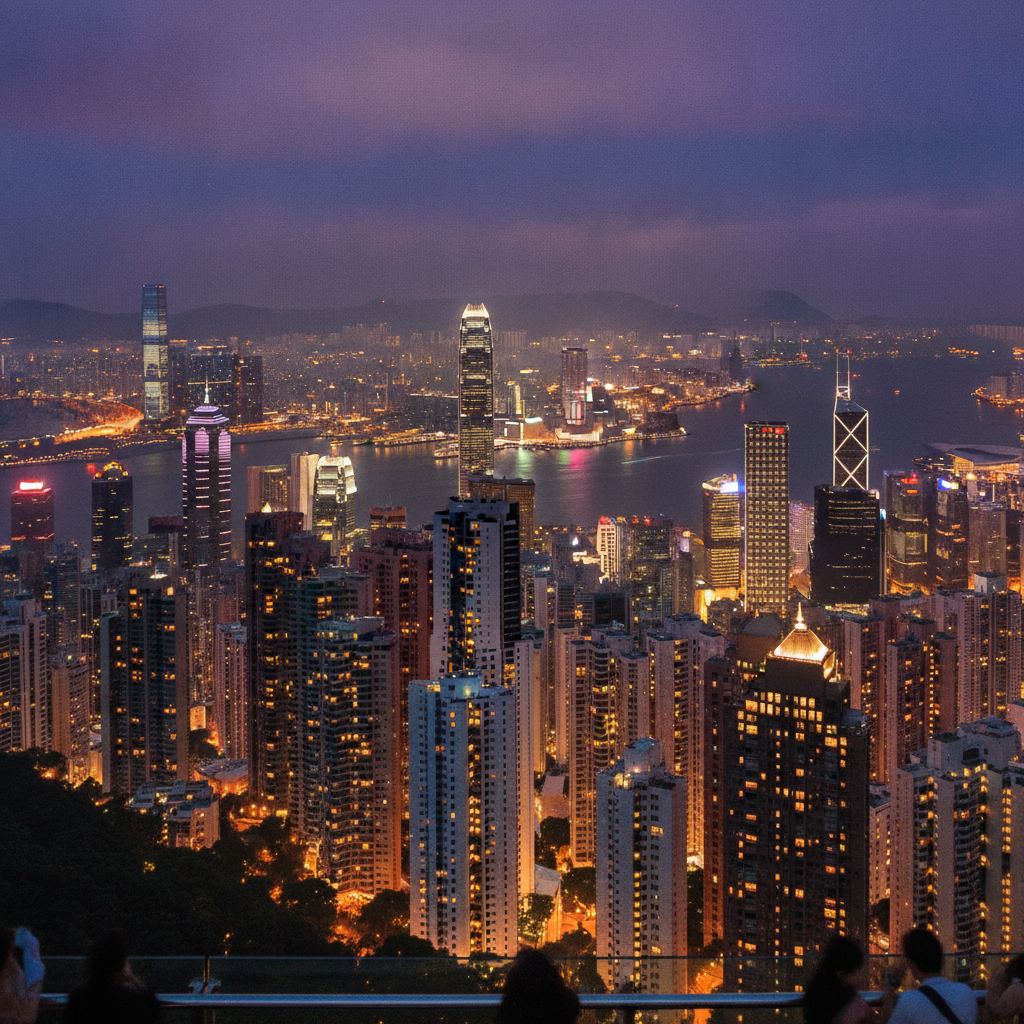
The Peak Tower (128 Peak Road, Victoria Peak, the wok-shaped building at the upper terminus of the Peak Tram, designed by Terry Farrell and Partners and opened in 1997, the year of Hong Kong's handover to China) — sits at an elevation of 396 metres and is topped by the Sky Terrace 428 (named for its altitude of 428 metres above sea level, reached by an additional elevator from the tram platform), the highest viewing terrace open to the public in Hong Kong and the platform from which the canonical photograph of the Hong Kong skyline — with the harbour, the Kowloon peninsula, and on clear days the New Territories hills beyond — is taken. The view from Sky Terrace 428 was voted the 'World's Best View' by Condé Nast Traveler readers in 2019 and 'Asia's Greatest View' by Time magazine in 2012. The rotating restaurant on the Peak Tower's top floor (Peak Lookout, 121 Peak Road, in the 1901 colonial sedan chair station building below the main tower) has been serving British colonial-era food to Hong Kong visitors since 1947.
- 3
Lugard Road Circular Walk & Pok Fu Lam Country Park
Lugard Road (the 3.5-kilometre circular walking path that encircles Victoria Peak, passing through forested hill slopes at approximately 400 metres elevation, named for Governor Sir Frederick Lugard who opened it in 1913) — provides Hong Kong's finest free walking experience: the northern section of the path delivers a continuous panoramic view of the entire Hong Kong harbour from Central to Quarry Bay, while the southern section descends through Pok Fu Lam Country Park (established 1977, the first country park established on Hong Kong Island, covering 27 square kilometres of the Island's western hills and containing the Pok Fu Lam Reservoir — the first reservoir built in Hong Kong, 1863, which provided the first piped water supply in colonial Hong Kong) into the increasingly rural western slopes of Hong Kong Island, where century-old camphor and ficus trees have grown through and around the original stone retaining walls built by colonial labour in the 1890s. The 4-kilometre loop can be walked clockwise (anti-clockwise provides the harbour view from the beginning) in approximately 1.5 hours.
- 4
The Peak Galleria & Victoria Peak Garden
The Peak Galleria (118 Peak Road, the seven-storey shopping mall immediately below the Peak Tower on the site of the original 1888 Peak Hotel) — contains the outdoor viewing terrace (Level 7, free admission) that provides an alternative and in many ways superior view of the southern coast of Hong Kong Island, encompassing the Lamma Island Channel, the South China Sea, and on clear days the island of Lantau to the southwest — a view that is invisible from Sky Terrace 428, which faces exclusively north. Victoria Peak Garden (Mount Austin Road, a 5-minute walk from the Peak Galleria, the gardens of the colonial Governor's summer residence known as Mountain Lodge, which was demolished in 1946 after Japanese troops used it as a communication centre during the 1941-45 occupation; the garden walls, stone terracing, foundation outlines, and ornamental gateway from the original 1900 Lodge are preserved as a monument by the Antiquities and Monuments Office) offer a tranquil alternative to the commercial bustle of the Peak Tower precinct, with formal garden beds and the highest picnic lawns accessible from public transport in Hong Kong.
- 5
Central Business District & HSBC / Standard Chartered Building
Central (the heart of Hong Kong's financial district and the administrative centre of the city, occupying the narrow coastal strip between Victoria Harbour and the Peak foothills, built almost entirely on land reclaimed from the harbour since 1842) — is defined architecturally by two landmark towers: the HSBC Main Building (1 Queen's Road Central, 1985, Norman Foster, the first building designed by a British architect to use a completely column-free floor plate achieved by hanging floors from external masts; at the time of completion the most expensive building ever constructed, at HKD 5.2 billion; the lobby incorporates a public right-of-way, a vestige of the former tram route that the building replaced, allowing any member of the public to walk through the building's ground floor — a unique urban design feature) and the Bank of China Tower (1 Garden Road, 1990, I.M. Pei, the 70-storey triangular prism that became Hong Kong's most controversial building because its knife-like angles were considered bad feng shui and were said to direct negative energy toward the adjacent Government House — the Governor's official residence — and the HSBC building; the knife-blade reflections are alleged to have triggered the economic downturn of the early 1990s in Hong Kong business mythology).
- 6
Central Market (1938/2021) & Peel Street Food Heritage
Central Market (80 Des Voeux Road Central, the 1938 Bauhaus-style former wet market building, the only Bauhaus-style market building in Hong Kong, one of only three surviving pre-war market buildings in Hong Kong, closed as a wet market in 2003 after 65 years of operation and controversially preserved after a campaign by heritage groups that prevented its demolition; reopened in 2021 as a curated food and lifestyle market retaining the original terrazzo floors, market stalls, and ventilation louvers of the 1938 building) — anchors the Peel Street food heritage zone (Peel Street, Graham Street, and Lyndhurst Terrace: a cluster of streets above Central Market that preserve the most authentic colonial-era streetscape remaining in the Central district, including the Graham Street Market (the oldest continuously-operating street market in Hong Kong, established in 1842, the same year as the founding of the colony, with vendors still selling fresh produce from the same plots they have occupied for up to four generations) and a concentration of pre-war shophouses that survived both the Japanese occupation and the post-war redevelopment that destroyed most of Central's colonial fabric.
Walk this route with audio
Stories play automatically as you reach each stop — no tapping needed.
More in hongkong
Star Ferry, Tsim Sha Tsui Waterfront & Victoria Harbour: The Soul of Hong Kong
Lantau Island: Big Buddha, Ngong Ping 360 Cable Car & Po Lin Monastery
Mong Kok: Ladies' Market, Goldfish Market, Flower Market & Bird Garden
Cheung Chau & Lamma Island: Hong Kong's Car-Free Outlying Islands
Central, SoHo & the Mid-Levels Escalator: Hong Kong's Vertical City