Jaipur's Dynasties: Astronomer Kings, the Most Beautiful Woman in the World & the Floating Water Palace
Trace four centuries of Rajput ambition—Maharaja Man Singh I allying with Akbar through his aunt's marriage to build Amber Fort with Mughal wealth, astronomer-king Jai Singh II founding a grid-planned city and building five stone observatories to correct European tables, Maharani Gayatri Devi winning history's largest election margin before Indira Gandhi imprisoned her, the Jaipur polo season on one of Asia's finest grounds, and the five-storey Jal Mahal floating palace where four storeys lie permanently underwater.
- 1
The Kachwaha Rajputs – Amber's Dynasty & Mughal Alliances
The Kachwaha clan—Jaipur's ruling dynasty from the 12th century to Indian independence (1949)—achieved prominence by allying with the Mughal Empire under Akbar (r. 1556–1605). Raja Bharmal gave his daughter to Akbar in marriage in 1562—the first Rajput princess to marry a Mughal emperor—establishing a pattern of Rajput-Mughal intermarriage that gave the Kachwahas privileged positions as generals and administrators of the empire. Raja Man Singh I (Akbar's commander-in-chief) used Mughal wealth to build Amber Fort; Jai Singh II (who founded Jaipur city in 1727) was one of the most brilliant administrators of the declining Mughal period.
- 2
Maharaja Sawai Jai Singh II – Astronomer King
Maharaja Sawai Jai Singh II (1688–1743)—the ruler who founded Jaipur in 1727 and built the Jantar Mantar observatories—was one of the most intellectually accomplished rulers in Indian history. He corresponded with Portuguese Jesuits and European astronomers, owned a copy of Euclid's Elements in Sanskrit translation, and built five stone observatories across India to verify and correct European astronomical tables. The title 'Sawai' (meaning 'one and a quarter'—implying superiority) was granted by Emperor Muhammad Shah; every subsequent Jaipur maharaja bears the title. His planned city of Jaipur—laid out on the Shilpa Shastra grid plan—is one of the finest examples of pre-modern Indian urban design.
- 3
The Maharani Gayatri Devi – Princess, Politician & Fashion Icon
Gayatri Devi (1919–2009)—third wife of Maharaja Sawai Man Singh II, later a politician and fashion icon—was one of the most glamorous figures of 20th-century India. Vogue named her one of the ten most beautiful women in the world; Cecil Beaton photographed her; and in 1962 she was elected to the Indian Parliament by a margin of 192,000 votes—for decades the largest electoral victory in world history. She was imprisoned for 5 months during Indira Gandhi's 1975 Emergency on tax evasion charges (widely seen as political persecution). Her memoir 'A Princess Remembers' (1976) is the finest account of Rajput royal life in the 20th century.
- 4
Jaipur's Polo Tradition – The Sport of Maharajas
Polo—a Central Asian equestrian sport adopted by Rajput warriors—was the dominant sport of Indian royalty; Jaipur was and remains India's polo capital. Maharaja Sawai Man Singh II was one of the finest polo players of the 20th century, playing for India in international tournaments and developing the 'Jaipur style' of attacking polo. The Jaipur Polo Ground (one of the finest in Asia) hosts the Jaipur Polo Season (October–February); the Maharaja Sawai Bhawani Singh Cup is the most prestigious tournament. Polo ponies in Jaipur are bred from Marwari horses (the indigenous Rajasthani breed with distinctive inward-curving ears); learning polo at one of Jaipur's polo clubs is offered to visitors at around ₹3,000–5,000/hour.
- 5
Jal Mahal – The Floating Palace
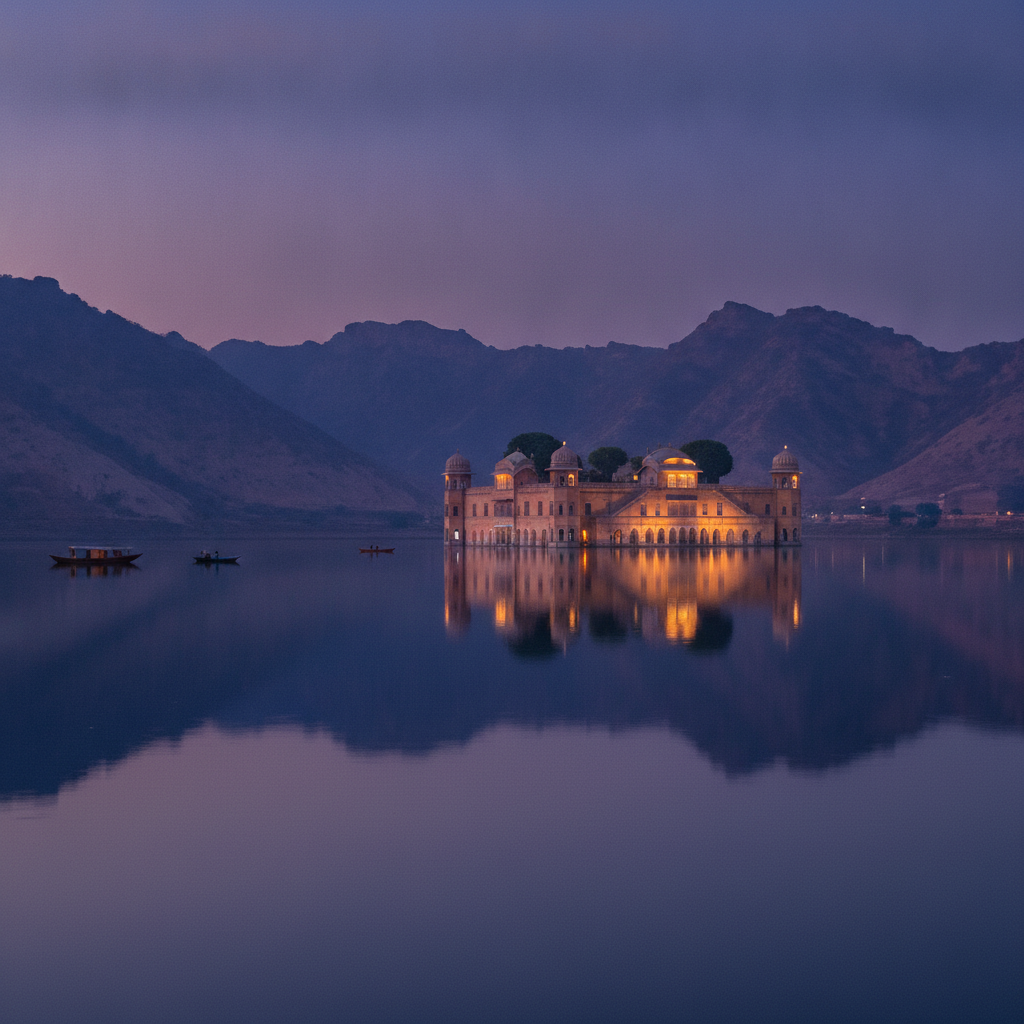
Jal Mahal ('Water Palace')—a five-storey Rajput-Mughal palace in the middle of Man Sagar Lake, 6 km north of Jaipur—appears to float on the lake, though four of its five storeys are submerged. Built in the 18th century as a summer retreat and duck-hunting lodge for the Jaipur maharajas, the palace was recently restored (2010) and is now viewable only from the lakeshore (entry is not currently permitted to visitors). Man Sagar Lake is a migratory bird sanctuary; thousands of flamingos and pelicans are visible in season (November–February). The view of Jal Mahal against the Aravalli hills at dusk—palace perfectly mirrored in the still water—is one of Jaipur's most photographed scenes.
- 6
Galtaji – The Monkey Temple & Ancient Water System
Galtaji—10 km east of Jaipur, tucked into a cleft in the Aravalli hills—is an ancient Hindu pilgrimage complex of tanks (step tanks), temples, and pavilions fed by natural springs, inhabited by large troops of rhesus macaques (hence the informal name 'Monkey Temple'). The complex was built between the 10th and 17th centuries; the seven kunds (sacred tanks) are connected by channels fed by a natural spring from the hilltop. The Galta kund is believed to be one of the most sacred bathing sites in Rajasthan—pilgrims bathe here during Makar Sankranti (January) in large numbers. The site is rarely crowded with foreign tourists; the atmosphere—monkeys everywhere, sadhus bathing, temple bells—is an authentic pilgrimage experience.
Walk this route with audio
Stories play automatically as you reach each stop — no tapping needed.
More in Jaipur
Jaipur Living: Dal Baati Churma, Hand-Block Textiles, the World's Largest Free Literary Festival & Elephant Ethics
Jaipur's Hinterland: Tiger Spotting in Ruins, the World's Largest Camel Fair & Sufi Pilgrimage at Ajmer
Jaipur Essentials: Amber Fort's Mirror Palace, the Palace of Winds & the World's Largest Stone Sundial
Jaipur Unfiltered: Palace-Hotels, Water Crisis, the Most Beautiful Cinema in India & Women's Safety