The Island with 18,000 Gods, the Adults-Only Sculpture Park on a Family Honeymoon Destination & the Volcanic Fire That Burns 100,000 People's Winter Away
The Jeju shamanic tradition of 18,000 local gods managed by the female simbang shaman; Jeju-eo's UNESCO critically endangered status with only elderly fluent speakers; the dol hareubang's 1754 origin as gate guardians with 47 originals preserved in 3 locations; Jeju Loveland's 700,000 annual visitors to the Hongik University graduates' erotic sculpture garden; the Saebyeol Oreum February fire festival as the most dramatic single Jeju event; and the Seongpanak Trail autumn foliage in October as the best Hallasan hiking window.
- 1
Jeju's Oreum Hiking – 360 Volcanic Cones
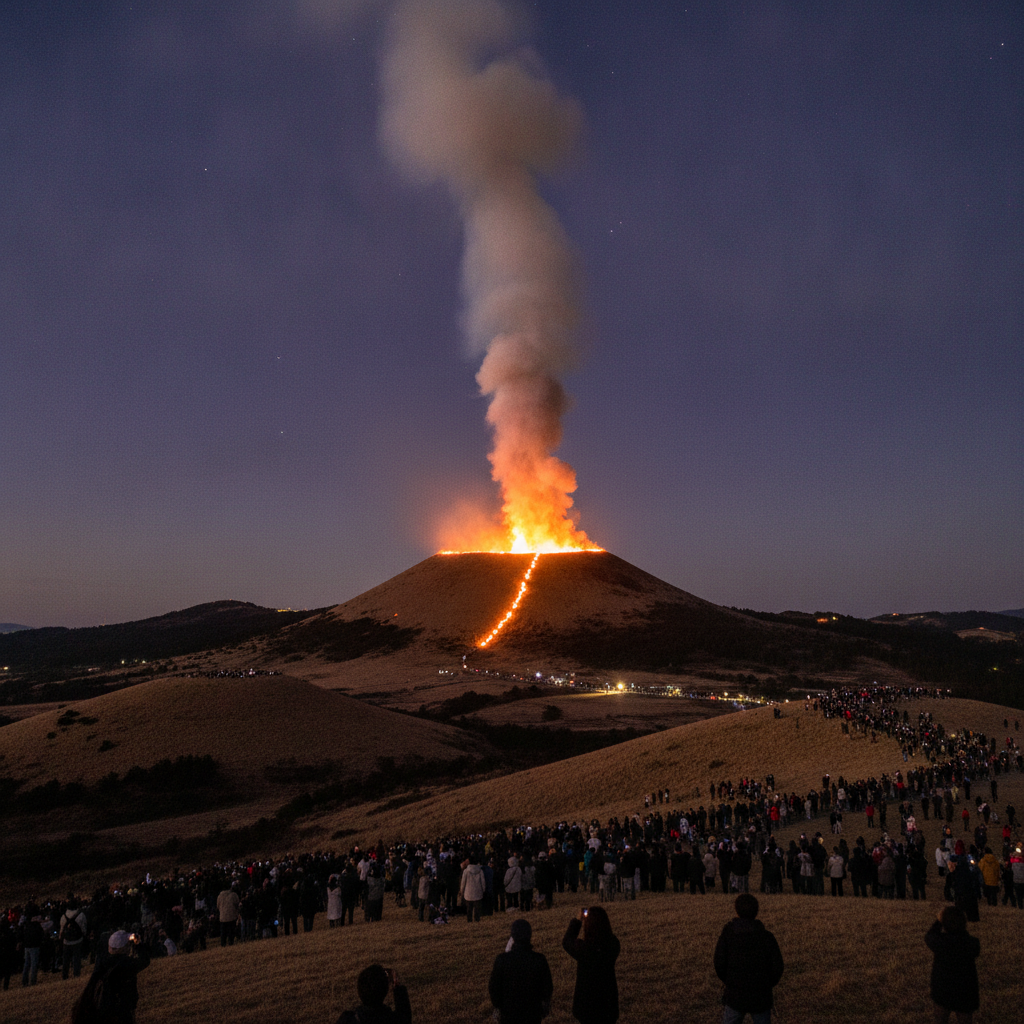
The oreum (오름—the Jeju term for the 360+ parasitic volcanic cones that dot the island landscape—the term is unique to Jeju and has no direct equivalent in standard Korean or in any other language): the hiking on Jeju's smaller mountains that provides the most immersive experience of the island's volcanic character at lower altitude and with less commitment than the Hallasan summit trails. The Darangshi Oreum (다랑쉬오름—the 382-metre cone in the eastern part of Jeju, known as the 'Queen of the Oreums' for its symmetric cone shape and its 100-metre deep crater): the 45-minute ascent from the car park follows the crater rim path with views over the eastern Jeju landscape and the Seongsan Ilchulbong tuff cone visible on the horizon. The Saebyeol Oreum (새별오름—the five-peaked oreum in the western grassland area—the oreum most associated with the annual Jeju Fire Festival (the Jeongwol Daeboreum Fire Festival in February when the dried grass of the western oreum is burned in a controlled fire that produces the most dramatic natural spectacle visible on Jeju): the fire festival burn on the Saebyeol Oreum draws approximately 100,000 visitors. The Geocheorak Oreum (the oreum in the Hallasan foothills notable for its dense winter camelia forest—the forest of 500-year-old wild camelia trees on the oreum slopes that bloom in February). The Songdang Shrine complex (the traditional Jeju shamanic shrine at the base of Songdang Oreum in Gujwa—the most important of the 18,000 Jeju village shrines (당, dang) in the shamanic religious tradition of Jeju (muism)—the Jeju shamanic tradition (the most intact shamanic religious practice in Korea) where the mudang (무당, shaman) performs rituals to the 18,000 Jeju gods).
- 2
Jeju's Shamanic Culture & Stone Grandfather Statues
The Jeju cultural identity (the island culture that has maintained traditions distinct from the Korean mainland for most of its history—the Jeju language (Jeju-eo—a language or dialect related to Korean but mutually unintelligible with standard Korean, classified as critically endangered by UNESCO with approximately 5,000–10,000 fluent speakers (elderly residents only)) and the Jeju shamanic religious tradition (the most intact animist religious practice in Korea, organized around the 18,000 local gods (신, sin) managed by the Jeju female shaman (심방, simbang))): the religious and linguistic heritage that makes Jeju culturally distinct within Korea. The dol hareubang (돌하르방—literally 'stone grandfather'—the large carved basalt tuff statues with bulging eyes, a flat mushroom-shaped hat, and hands clasped on the abdomen): the most recognizable symbol of Jeju Island and the most universally sold souvenir: the dol hareubang statues were erected in front of the 3 Jeju city gates in 1754 under the order of the Joseon governor Jeong Eon-yu (the original 47 dol hareubang statues are preserved in 3 locations across Jeju City; replicas are sold in every Jeju souvenir shop in sizes from 5cm to 2m): the dol hareubang's function was protective—the statues guarded the city gates against evil spirits. The Jeju Folklore Museum (the museum in Jeju City that holds the most complete collection of Jeju shamanic ritual objects, traditional household implements, and historical documents related to Jeju's distinct cultural history).
- 3
Seogwipo – Jeju's Second City & Garden District
Seogwipo City (서귀포시—the second city of Jeju, located on the southern coast of the island): the city with the most comfortable subtropical climate on Jeju (the south-facing aspect of Seogwipo's coastline and the protection from the northern cold winds by the Hallasan massif give Seogwipo a warmer and sunnier climate than the northern Jeju City—the mean annual temperature is 16.6°C vs 15.8°C in Jeju City): the garden and leisure city of the island. The Yeomiji Botanical Garden (the 3-hectare tropical botanical garden in Seogwipo's Jungmun resort area—the largest glass-enclosed botanical garden in Asia (the central glass dome: 4,550 m²)—the botanical garden that most directly exploits Jeju's subtropical climate to maintain plants that cannot survive outdoors on the Korean mainland). The Oedolgae Rock (외돌개—the 20-metre isolated basalt sea stack at the Seogwipo coastline—the single rock pillar rising from the sea on the rocky shore, surrounded by crashing waves; the most-visited single natural landmark in Seogwipo): the legend of Oedolgae (the rock is said to be the petrified form of the grandmother who stood at the shore watching for her fishing husband to return—the husband never returned from the sea, and the grandmother's grief transformed her to stone). The Jungmun Beach & Resort Area (the planned resort district on the Seogwipo coast—the concentration of international hotels (the Hyatt Regency Jeju, the Lotte Jeju, the ICC Jeju conference center): the most complete resort infrastructure on the island).
- 4
Jeju's Loveland & Unconventional Attractions
The unexpected Jeju (the side of the island that has developed a parallel attraction economy targeting the domestic Korean tourism market with themed parks and unconventional installations that are distinct from the natural and cultural heritage sites): the most surprising dimension of one of Korea's most visited destinations. Jeju Loveland (제주 러브랜드—the outdoor sculpture park on the outskirts of Jeju City, opened in 2004, consisting of 140 erotic sculptures created by graduating students of Hongik University): the most unusual museum in South Korea—a family-friendly island destination's adults-only outdoor sculpture garden that receives approximately 700,000 visitors annually (only adults 18+ are admitted): the sculptures (the anatomically explicit and often humorous sculptures in various sexual positions, set in a manicured garden): the park's existence on a honeymoon-island is explained by Jeju's historical identity as the primary honeymoon destination in Korea (a position it held from the 1970s to the 2000s before international travel became affordable). The Jeju Bunjae Artpia (the bonsai art park in Hallim—the collection of 2,000+ bonsai trees maintained in the open-air park alongside the Hyeopjae Beach): the largest bonsai collection in Korea and the most serene counterpoint to the volcanic landscape. The Maze Land (the hedge maze near Gimnyeong on the northern coast—the largest hedge maze in Korea): the Jeju teddy bear museum, chocolate museum, and Harry Potter experience (the themed museums in the Seogwipo Jungmun resort area that target the family domestic tourism market).
- 5
Jeju's Hallasan Winter & Seasonal Calendar
The Jeju seasonal calendar (the subtropical island's seasonal variation—more dramatic than any other part of Korea due to the interaction between the East China Sea maritime climate and the Hallasan mountain mass): the complete year-round guide to timing a Jeju visit. Winter (December–February): the most dramatic season on Hallasan (the summit is snow-covered from November to March; the Gwaneumsa and Seongpanak summit trails close when snow depth exceeds safety limits (usually November–late April); the lower trails (the Yeongsil and Eorimok trails reaching 1,700m but not the summit) remain open and provide the best Hallasan snow scenery without summit exposure): the Jeju Fire Festival (the Saebyeol Oreum fire—the February Jeongwol Daeboreum controlled burn of the western oreum grassland: the most dramatic single event on the Jeju calendar). Spring (March–May): the camelia season (February–March—the wild camelia trees of Jeju bloom earlier than the cherry blossom and provide the most distinctive spring colour on the island): the Jeju Camellia Arboretum (the most complete camellia collection in Korea). Summer (June–August): the beach season with the highest tourist density; the Hyeopjae and Hamdeok beaches at full capacity July–August. Autumn (September–November): the best hiking season on Hallasan (the summit trails open; the autumn foliage on the Seongpanak Trail (mid-October to early November) is the most rewarding Hallasan hiking window of the year): the tangerine harvest (the Jeju tangerine orchards ripen October–December—the peak harvest window for farm visits).
- 6
Jeju's Art & Design Scene
The Jeju contemporary arts and design scene (the island that has attracted both Korean and international artists and architects to build museums, galleries, and creative spaces in the dramatic landscape): the cultural infrastructure that makes Jeju more than a nature destination. The Jeju Museum of Art (the museum in Nohyeong-dong, Jeju City—the primary public contemporary art museum on the island, with a strong permanent collection of Korean contemporary art and a programme of international exhibitions that reflects Jeju's ambition to position itself as an Asian arts destination). The Bonte Museum (the Hallim-area museum dedicated to the dol hareubang (stone grandfather) tradition and Jeju cultural heritage—housed in a purpose-built building by the Korean architect Cho Jin-man that won the Korean Architectural Award 2008): the museum that provides the deepest single-building engagement with Jeju cultural identity. The Jeju Glass Museum (the Aewol-area museum of blown glass art in a purpose-built pavilion—the collection of international glass art and the glass-blowing demonstration workshops). The Bunker de Lumieres (the immersive digital art installation in a converted Japanese military bunker complex near Seogwipo—the Korean branch of the Carrières de Lumières/Atelier des Lumières concept (the immersive projected-art experience originally from Provence and Paris): the most technologically innovative cultural venue in Jeju. The Jeju Stone Park (제주돌문화공원—the landscape art park in Gyorae-ri near the Hallasan foothills that recreates the Jeju volcanic stone landscape at monumental scale).
Walk this route with audio
Stories play automatically as you reach each stop — no tapping needed.
More in Jeju
The Only Region in South Korea Where You Can Enter Without a Korean Visa, the Best-Selling Water in Korea Bottled from a Hallasan Volcano Spring & the 1.8-Million-Year Geological Timeline Underfoot
The Free-Diving Women With a 90% Population Decline Since the 1960s, the World's Largest Lava Column in an Accessible Cave & the Waterfall That Falls Directly Into the Sea
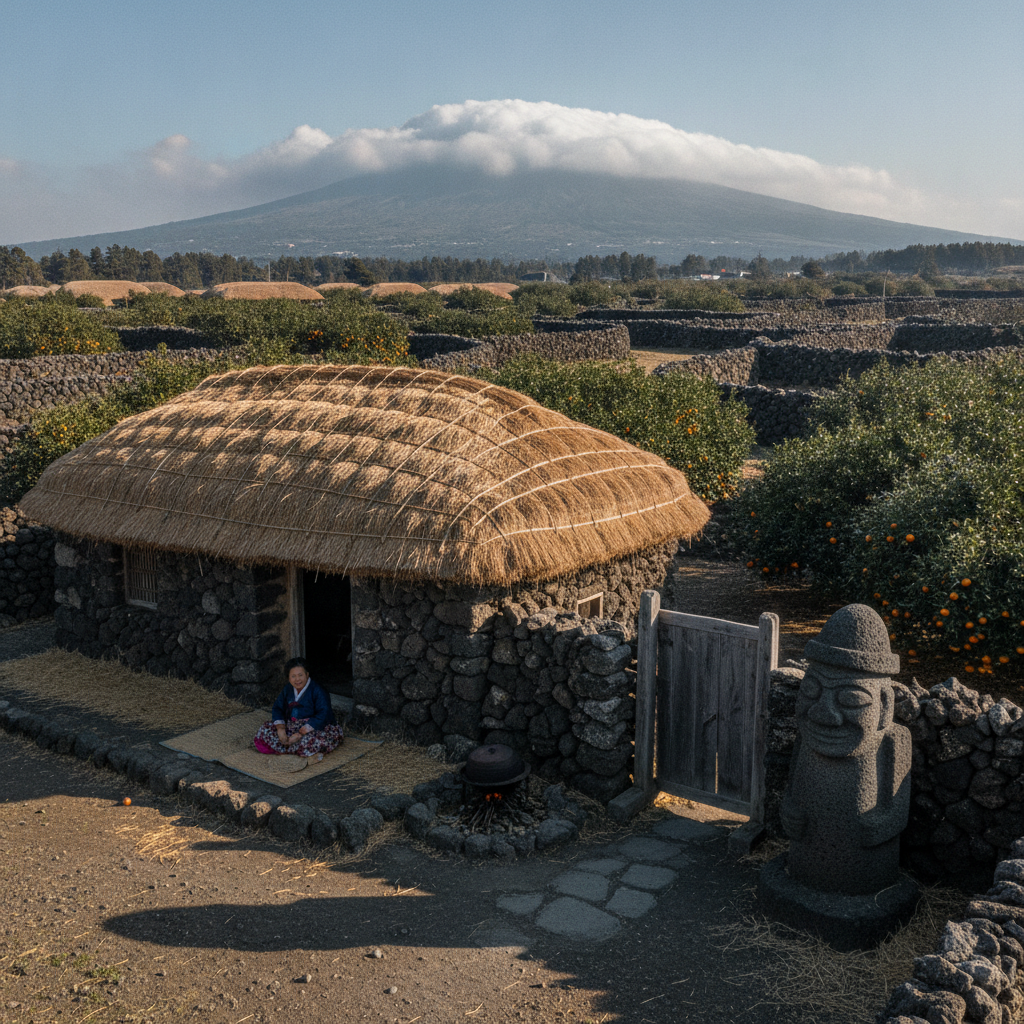
The Island With 22,000 km of Stone Walls (Half the Earth's Circumference), the First Korean Region to Commit to 100% Renewable Energy & the Mountain Under Cloud 200 Days a Year
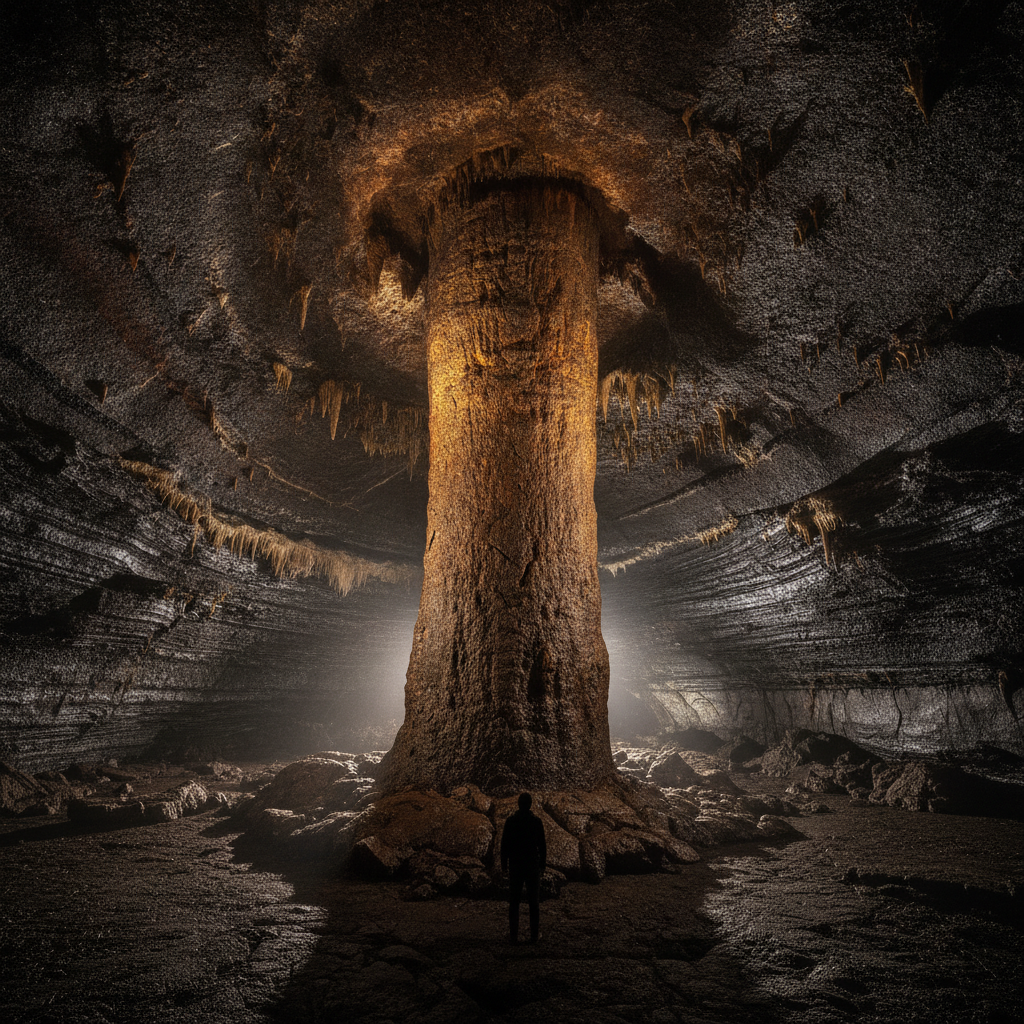
The 250,000-Year-Old Cave That Drained Itself Empty, the 1948 Massacre That Killed 10% of the Island's Population & the Only Road in Korea That Crosses 1,950 Metres