Komodo's Conservation Reality: Sea Rangers vs. Blast Fishers, the Sape Strait's 1,300m Cold Upwelling & Ngada Villages' Ngadhu-Bhaga Pairs
100 BTNK rangers patrolling 1,733 km² of sea—an impossible ratio; the MCS Sea Ranger programme retraining former blast fishermen as conservation patrol boat operators; 2,000 Bugis fishing community members living inside the park boundary who predate the park's 1980 establishment and whose eviction is legally and politically impossible; the Sape Strait's 1,300-metre depth producing 16°C cold upwellings that require a 5mm wetsuit at equatorial latitude and support species normally found in temperate seas; 20,000 Javan deer and wild buffalo maintaining the golden dry-season savannah that the Komodo dragon dominates as sole large predator; and Bena village's 45 ngadhu-bhaga ancestor pairs in a Catholic-animist village where the liturgical calendar and the adat ceremony honour schedule run simultaneously.
- 1
The Komodo National Park Conservation Challenge
Komodo National Park—a UNESCO World Heritage Site since 1991, managed by the Indonesian Ministry of Environment and Forestry through the Balai Taman Nasional Komodo (BTNK)—faces a series of conservation challenges that have made it one of the most contested protected areas in Indonesia. The illegal fishing: the park's marine zone has been subject to intensive illegal fishing throughout its existence—blast fishing (dynamite fishing that destroys coral reef structure), cyanide fishing (used to stun fish for the live reef fish trade), shark finning, and the collection of protected species (sea cucumbers, Napoleon wrasse, sea horses) for the Chinese traditional medicine and food market. The ranger capacity: the BTNK has approximately 100 rangers to patrol 1,733 km² of sea (an area roughly 10 times the size of the terrestrial park)—a coverage ratio that makes effective patrol impossible; the MCS (Marine Conservation Society) Sea Ranger programme, funded by international donors, has supplemented ranger capacity with community-based patrol boats operated by former fishermen trained as rangers. The overcrowding problem: the national park received approximately 176,000 visitors in 2019—a figure the park management considers excessive for the carrying capacity of key sites (Rinca's Loh Buaya, Komodo's Loh Liang, and Manta Point). The proposed closure of Komodo island: repeatedly discussed since 2019, each time drawing protests from the local fishing community (approximately 2,000 people living in the traditional fishing villages within the park boundary—descendants of Bugis fishermen who settled the islands before the park's establishment).
- 2
Labuan Bajo's Dive Industry & the Komodo Marine Scene
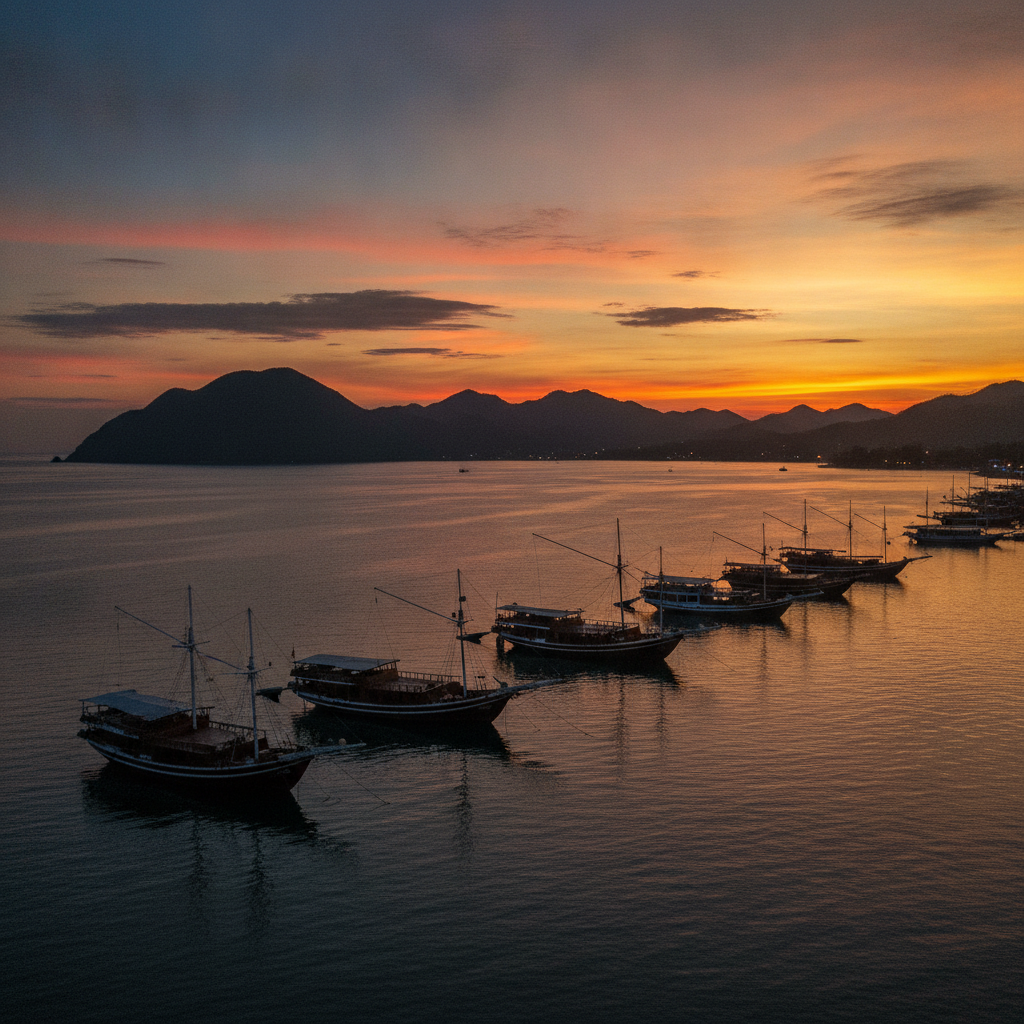
The Komodo dive industry—concentrated in Labuan Bajo with approximately 30 active dive operators offering day trips and liveaboard packages—is the economic engine of the entire Labuan Bajo economy and the primary reason for the destination's international profile. The operator landscape: established operators including Komodo Dive Centre (one of the longest-running), Wicked Diving (a well-regarded liveaboard operator), Dive Komodo (PADI 5-Star), and a dozen boutique operators—competing on price, boat quality, dive guide expertise, and itinerary variation. The business model: the standard offering is a day trip (3 dives—approximately Rp 600,000–800,000/person including park fees, boat, equipment, and lunch) or liveaboard (2–4 nights, all-inclusive, targeting the international dive travel market). The dive guide culture: the best Komodo dive guides have encyclopaedic knowledge of specific dive site conditions—reading the tidal current charts (diving in Komodo is strongly current-dependent, and sites that are spectacular on a flood current can be dangerous on an ebb), locating specific species (pygmy seahorses at specific coral heads, blue-ringed octopus in the rubble zones, thresher sharks at dawn in specific channel locations). The Komodo marine calendar: the dry season (April–November) brings best visibility; the wet season (December–March) brings warmer water (better for nudibranch and macro life); the south Komodo cold upwellings are present year-round but most intense June–October.
- 3
Sape Strait & the Remote Eastern Park
The Sape Strait—the deep channel (maximum depth 1,300 metres) separating Flores from Sumbawa, through which the powerful tidal currents of the Komodo area flow—is the hydrological engine of the Komodo marine park: the 5–7 knot tidal currents that flush through the strait twice daily are responsible for the cold upwellings, the nutrient richness, and the extraordinary marine biodiversity of the park. The eastern park sites: the area east of Komodo island (including Gili Banta, Gili Lawa Darat, Gili Lawa Laut, and the Horseshoe Bay area) is the least visited part of the national park—liveaboard itineraries that spend 4+ nights sometimes reach these sites. The Horseshoe Bay: a nearly enclosed bay in the eastern Komodo area with extremely cold water (16–18°C from the deep upwellings—full 5mm wetsuit essential) but extraordinary fish density; the cold water supports species more typical of temperate waters (including the bizarre-looking Komodo coral grouper, only found in this thermal regime). The remote islands: several very small islands in the eastern park (uninhabited, no ranger station) are occasionally visited by private charters for camping—a possibility for organised groups with self-sufficient equipment, arranged through the BTNK with special permits. The eastern approach: for travellers arriving from Sumbawa by ferry (via the Sape-Labuan Bajo route—12 hours by slow ferry from Sape port in east Sumbawa), the eastern park is the first part of Komodo encountered.
- 4
Komodo Island's Savannah Ecosystem & the Prey Species
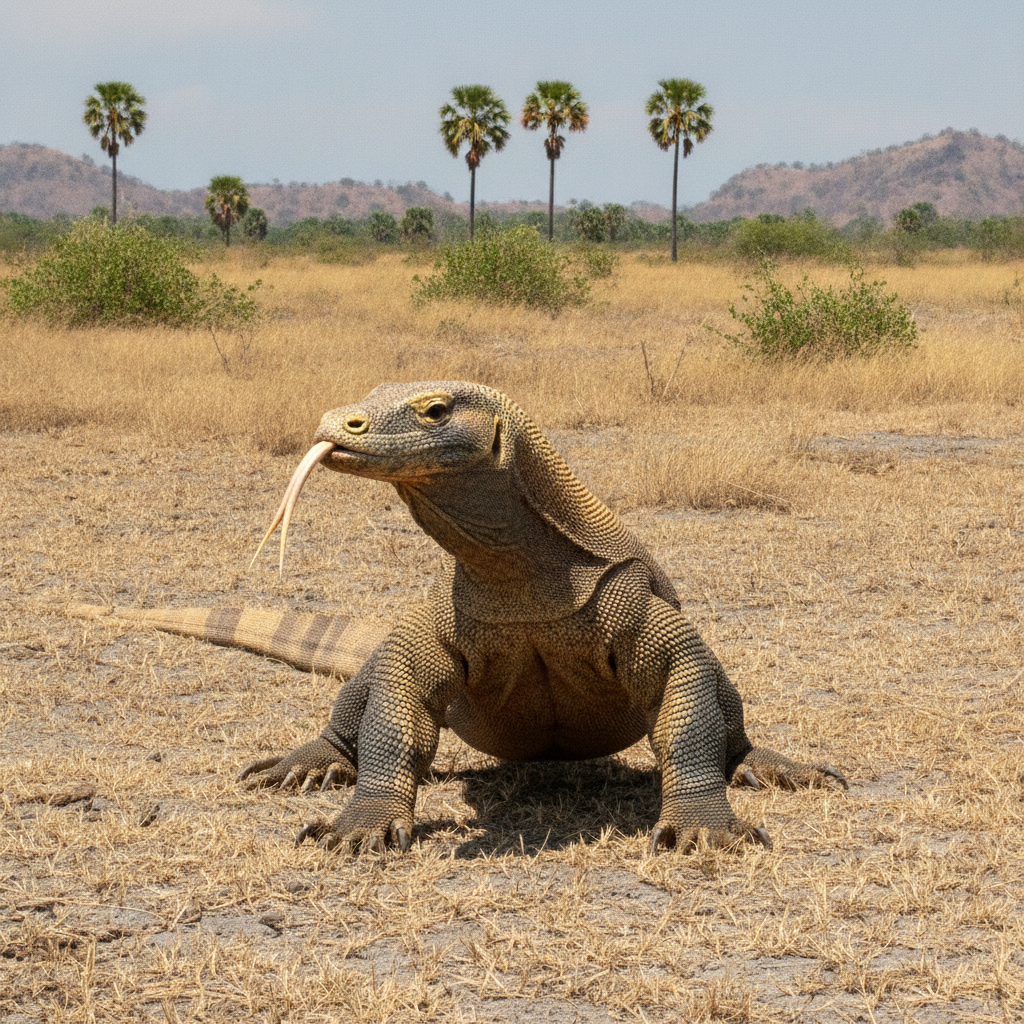
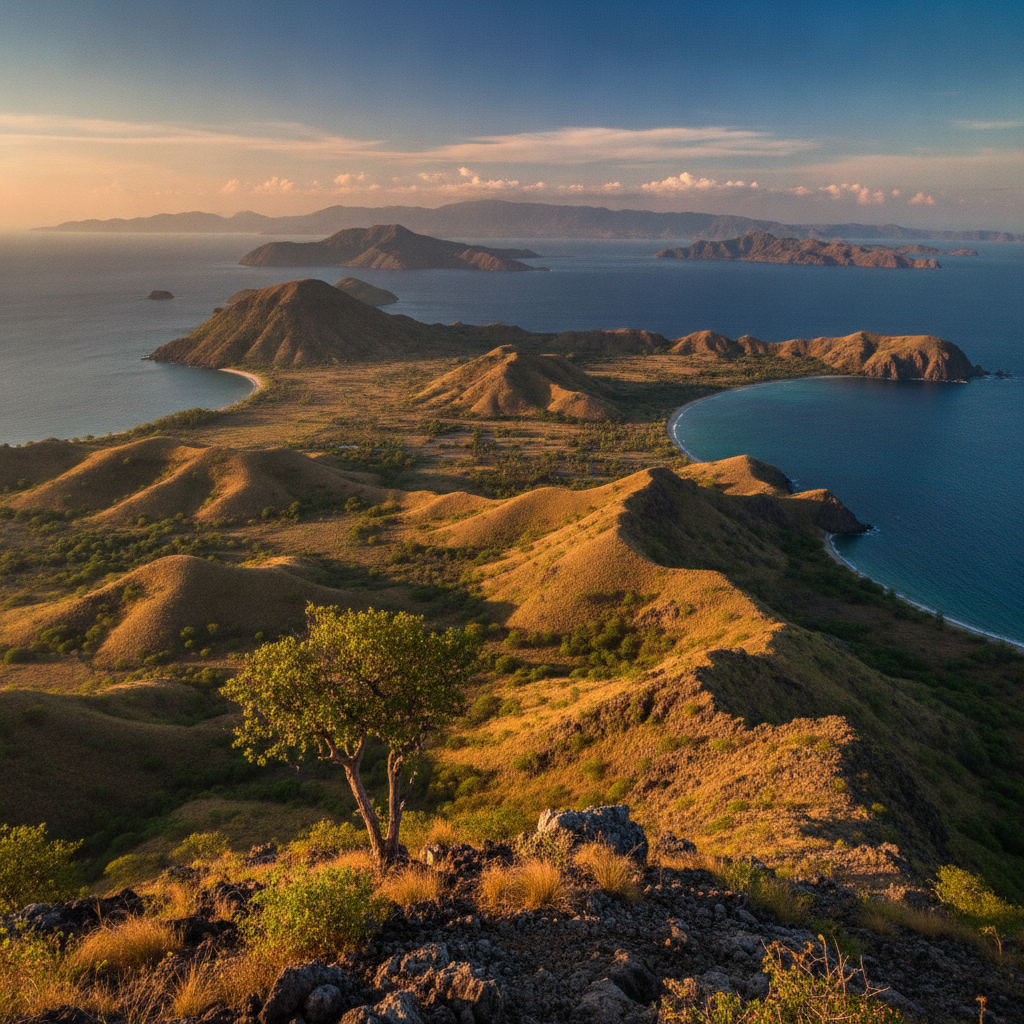
The terrestrial ecosystem of Komodo island—a mosaic of open savannah, monsoon forest, and mangrove coastal areas—is defined by the extreme seasonality of the eastern Indonesian climate: a long dry season (April–November) when the savannah grasses turn golden and brown, and a short wet season (December–March) when the hills briefly green. The prey species: the Komodo dragon's primary prey species on Komodo island are the Javan deer (Rusa timorensis—the dominant large prey species, with an estimated 15,000–20,000 individuals in the park), water buffalo (Bubalus bubalis—introduced to the islands, now wild; the most dangerous prey for Komodo dragons because of their fighting ability; a dragon attacking a buffalo typically inflicts a wound and then follows the buffalo for days until it weakens), wild boar (Sus scrofa—present but less common than deer), and smaller mammals and birds. The ecological relationship: the Komodo dragon is the sole large predator on Komodo island—in the absence of any competing carnivore, the dragon has an ecological dominance that shapes the entire terrestrial food web. The vegetation: the savannah vegetation (dominated by Zoysia grass, Aristida grass, and Palmyra palms) is maintained by the dry climate and by the grazing pressure of the deer and buffalo populations; the transition from savannah to forest occurs at approximately 500 metres altitude, where the Zyzyphus mauritiana scrub gives way to monsoon forest.
- 5
Ngada Villages & Bajawa – Flores Spiritual Landscape
The Ngada highlands of central Flores—centred on the market town of Bajawa (at 1,050 metres altitude, 200 km east of Labuan Bajo, accessible by 4-hour bus on the Trans-Flores Highway)—are home to the most intact traditional ceremonial village culture in Flores: a living community of Catholic-animist syncretism where village life is structured by both the Catholic liturgical calendar and the adat (customary law) ceremonies honouring ancestors. The ngadhu and bhaga: the defining visual element of Ngada villages—a pair of structures representing male and female ancestral spirits: the ngadhu (a thatched parasol mounted on a carved post, decorated with carved faces and buffalo horns—the male ancestor representation) and the bhaga (a miniature thatched house—the female ancestor representation); each clan has its own ngadhu-bhaga pair, and they are maintained and re-consecrated at regular intervals. The most visited villages: Bena (8 km south of Bajawa—a traditional Ngada village preserved in its complete layout, with 45 ngadhu-bhaga pairs, traditional mbaru gendang clan houses, and an active ceremonial life; the village has UNESCO recognition as a living cultural heritage site); Luba (adjacent to Bena); and Wogo (15 km from Bajawa, with a similar layout). The Gunung Inerie volcano: the 2,245-metre active volcano adjacent to Bajawa is visible from Bena village and provides a dramatic backdrop; a 4-hour trek to the summit (via the Manulalu trailhead) provides one of the finest volcanic summit views in Flores.
- 6
Travelling Through the Park Responsibly – Ethics & Environmental Impact
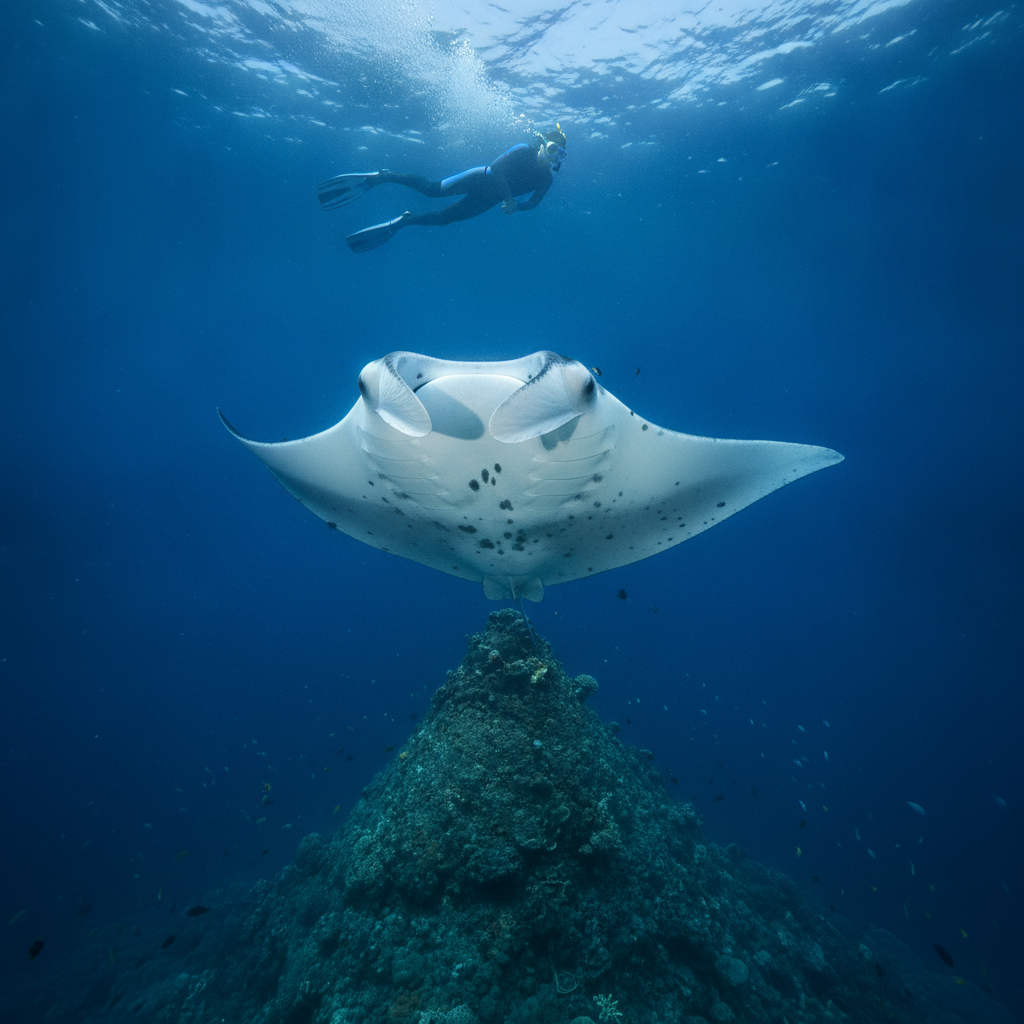
The tourism industry in Komodo National Park—which has grown from a few thousand visitors annually in the 1990s to 176,000 in 2019 and is projected to grow further—creates both the economic foundation for conservation and the primary threat to the ecosystem it is intended to protect. The ethical tensions: photographing Komodo dragons (permitted, but guides advise against using flash—the dragons' eyesight is more sensitive to sudden light changes than human eyes, and startled dragons are unpredictable); maintaining distance (the recommended 3-metre minimum distance is consistently ignored at Rinca's compound, where dragons and tourists are occasionally less than 1 metre apart); entering the water at Manta Point (snorkellers must not touch or chase mantas—the cleaning station depends on the mantas feeling safe enough to linger); purchasing coral or marine souvenirs from local vendors (directly incentivising illegal coral collection from the park reef). The liveaboard footprint: a 3-night liveaboard for 8 passengers typically uses 200–300 litres of diesel fuel (for engines and generators), generates 200 kg of waste (including food waste disposed at sea on many operators), and anchors in seagrass beds at overnight stops. The carbon offsetting: several Labuan Bajo operators now offer carbon offsets through certified Indonesian reforestation projects. The recommendation: choosing operators with demonstrated conservation commitment (members of the Komodo Tourism Association's Code of Conduct, or operators supporting the Sea Ranger programme) meaningfully affects the park's conservation outcome.
Walk this route with audio
Stories play automatically as you reach each stop — no tapping needed.
More in Komodo
Komodo's Pelagic World: Orca Hunting Whale Shark Juveniles in the Sape Strait, 500,000 Flying Foxes at Kalong & the Road to Sumba's Pasola
Komodo's Overlooked Depths: Larantuka's 500-Year-Old Portuguese Easter Procession, Yellow-Crested Cockatoo & the IUCN's 2021 Climate Verdict
Komodo's Wider World: Kelimutu's Three-Colour Volcanic Soul Lakes, Wae Rebo's Conical 5-Floor Village Houses & Phinisi Liveaboard Bugis Crew
Komodo Complete: The 338m Gunung Ara Summit Panorama, Flores Sea Sperm Whales & the UNESCO 'In Danger' Warning That Stopped the Jurassic Park Resort