La Paz History: From Inca Settlement to the Seat of Government
La Paz was founded by the Spanish on October 20, 1548, on the site of the Inca settlement of Chuquiago Marka in the canyon of the Choqueyapu River, chosen because the canyon provided shelter from the bitter altiplano winds and the river provided water and alluvial gold. The city grew as the commercial center of the Audiencia de Charcas, benefiting from the silver trade from Potosi. The great rebellion of Tupac Katari in 1781, which besieged the city for 184 days with an indigenous army of over 40,000 warriors, came closer to destroying it than any subsequent event. After independence in 1825, La Paz competed with Sucre as the national capital before effectively becoming the seat of government following the Federal War of 1899.
- 1
Spanish Foundation and the Colonial Silver Trade
The Spanish founded Nuestra Senora de La Paz on October 20, 1548, in the Choqueyapu canyon specifically because the valley provided alluvial gold and the sheltered location promised relief from the brutal altiplano climate. The original founding party led by Alonzo de Mendoza had been traveling the route between Lima and Potosi and recognized the strategic value of the canyon as a stopping point and supply base for the silver trade. The city grew rapidly as the Potosi silver mining economy created enormous demand for food, coca leaves, textiles, and transport animals, all of which were produced or traded through the La Paz commercial zone. The coca trade from the subtropical Yungas valleys below La Paz to the Potosi miners was the most valuable component of this economy; the demand for coca to sustain the extreme labor of the mines consumed the entire output of the Yungas growing regions and made La Paz merchants wealthy as the trade intermediaries.
- 2
The 1781 Siege: Tupac Katari and the Near Destruction of the City
Julian Apaza, who took the name Tupac Katari in reference to both the 18th century Peruvian rebel Tupac Amaru II and the earlier Bolivian rebel Tomás Katari, besieged La Paz for 184 days in 1781 with an Aymara army estimated at 40,000 warriors in the most sustained indigenous military challenge to Spanish colonial rule in the Americas. The siege cut the city off from all supplies for six months, causing severe starvation among the Spanish and mestizo population inside the walls; estimates suggest that between 10,000 and 15,000 civilians died of hunger during the siege. Spanish relief forces eventually broke the siege; Tupac Katari was captured, drawn and quartered in the plaza of Penas on November 15, 1781, with his reported final words Volveré y seré millones, meaning I will return and I will be millions, becoming a foundational statement of Bolivian indigenous resistance identity. The memory of the siege is central to La Paz historical consciousness and the rebel figures are honored in national nomenclature throughout the city.
- 3
Bolivian Independence and the Capital Question: Sucre versus La Paz
Bolivia declared independence from Spain on August 6, 1825, and named its constitutional capital Sucre, the city in the southern highlands where the Supreme Court and the formal government institutions were established. La Paz, however, was the larger and more economically important city, the seat of the executive government, and the commercial hub of the country. The rivalry between the two cities was resolved violently in the Federal War of 1898 to 1899, when La Paz-based federalist forces under Jose Manuel Pando defeated the Sucre-based unitarian government in a brief civil conflict that resulted in the transfer of the executive and legislative branches of government to La Paz while Sucre retained the Supreme Court and the nominal constitutional capital status. The compromise has never been fully resolved: Bolivia technically has two capitals, with Sucre still described as the constitutional capital in some framings, a source of ongoing political friction between the two cities and their regional constituencies.
- 4
The Cholets: Freddy Mamani and Neo-Andean Architecture
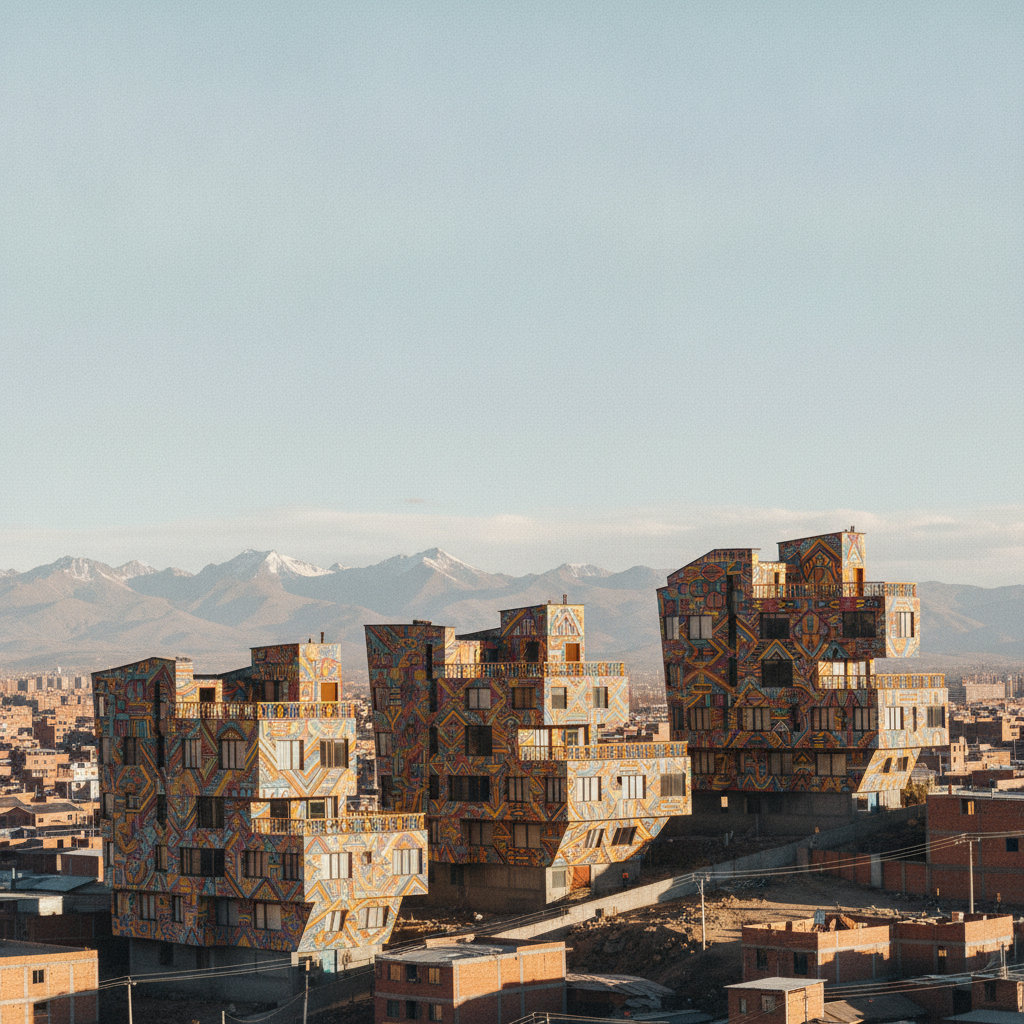
The cholets, the ornate multi-story commercial and residential buildings designed by self-taught architect Freddy Mamani Silvestre that have transformed the El Alto and upper La Paz streetscape since 2005, represent one of the most remarkable architectural movements of the 21st century: a deliberate assertion of Aymara aesthetic identity in built form. The buildings, combining ground-floor commercial space with upper-level event halls, salons, and apartments, are covered in bright colors, geometric patterns derived from pre-Columbian textiles and iconography, and reflective glass panels in combinations that reject the grey uniformity of conventional concrete block construction. Mamani has designed over 100 buildings in this style; his imitators have multiplied the style across El Alto into a distinct urban aesthetic that architectural critics increasingly describe as neo-Andean or Cosmic Andean. The buildings are owned by wealthy Aymara merchants and business owners, making them a direct expression of the economic empowerment of the El Alto Aymara community over the past two decades.
- 5
The Gas War: 2003 and the Political Earthquake
The Bolivian Gas War of 2003, a series of popular protests centered in El Alto against the government plan to export natural gas to the United States through a Chilean port, resulted in at least 67 deaths when government security forces fired on protesters and culminated in the resignation and flight of President Gonzalo Sanchez de Lozada. The conflict crystallized around the historical resonance of allowing Chilean control of Bolivian resource export following the loss of Bolivia Pacific coast to Chile in the War of the Pacific 120 years earlier; protesters blocked roads from El Alto, effectively cutting La Paz off from the altiplano in a replay of the Tupac Katari siege tactics of 1781. The Gas War brought down two successive governments and created the political space for the rise of Evo Morales and the Movement for Socialism, which swept to power in the 2005 election. The Plaza San Francisco and the El Alto streets where the confrontations occurred became sites of political memory for the subsequent Morales government.
- 6
Sucre: The White City and the Constitutional Capital
Sucre, 700 kilometers southeast of La Paz at a more comfortable 2,750 meters altitude, is the most beautiful colonial city in Bolivia and the formal constitutional capital, with a UNESCO-protected historic center of whitewashed colonial architecture that has given it the nickname the White City. The House of Freedom, where the Bolivian declaration of independence was signed on August 6, 1825, is the most significant historical monument and functions as a national shrine. The Jurassic Park equivalent of Bolivia, the Parque Cretácico, is located at a cement quarry outside Sucre where the world largest concentration of dinosaur footprints on a single surface was discovered in 1994; a vertical cliff face covered in the tracks of more than 300 individual dinosaurs is accessible on a guided tour. The textile market and the Centro para Capacitacion en Artesania Textil provide access to the extraordinary weaving traditions of the Jalq a and Tarabuco communities around Sucre, producing some of the finest indigenous textile work in the Americas.
Walk this route with audio
Stories play automatically as you reach each stop — no tapping needed.
More in La Paz
La Paz Adventure: Death Road Cycling, Cholita Wrestling, and Urban Zip Lines
La Paz: The World Highest Seat of Government and the City in a Canyon
La Paz Aymara Culture: Language, Cosmology, and Living Indigenous Traditions
La Paz Practical Guide: Altitude, Neighborhoods, Transport, and Bolivia Circuit
La Paz Arts, Music, and the Cholita Wrestling Scene