Grand Canyon, Valley of Fire & Desert Escapes from Las Vegas
Las Vegas is uniquely situated as a base for exploring some of the most spectacular desert landscapes on Earth — within a 5-hour drive of the city lie the Grand Canyon (the most visited natural landmark in the United States), Zion National Park, Bryce Canyon, the Valley of Fire, Red Rock Canyon, and the Hoover Dam.
- 1
Grand Canyon — The Greatest Geological Spectacle
Grand Canyon National Park (the 4,926 km² national park in northwestern Arizona, approximately 440 km (274 miles) from Las Vegas by road (approximately 4.5 hours' drive via US-93 and AZ-64) or approximately 50 minutes by helicopter tour — the most visited natural landmark in the United States, receiving approximately 5.9 million visitors per year): the Grand Canyon (the gorge carved by the Colorado River over approximately 5-6 million years through the Colorado Plateau (the high-elevation (1,500-2,500 metres) desert plateau covering the Four Corners region of Utah, Colorado, Arizona, and New Mexico), exposing approximately 2 billion years of the Earth's geological history in the canyon walls — the canyon measures 446 km (277 miles) in length, up to 29 km (18 miles) in width, and attains a maximum depth of 1,857 metres (6,093 feet)): the South Rim (the primary visitor destination of the Grand Canyon, accessible year-round (the North Rim is open only May-October), at an elevation of approximately 2,100 metres (6,900 feet)) offers the classic Grand Canyon views (the panorama from Mather Point (the first overlook encountered by most visitors arriving from the south entrance), the Bright Angel Trail (the most popular hiking trail in the Grand Canyon, descending from the South Rim trailhead at 2,099 metres to the Colorado River at 741 metres — a descent of 1,358 metres over 15.5 km (9.6 miles)), and the Desert View Watchtower (the 1932 Mary Colter-designed stone observation tower at the eastern end of the South Rim — the finest historic building in the park and the finest viewpoint for the eastern Grand Canyon and the Colorado River Gorge below).
- 2
Hoover Dam — The Engineering Wonder of the 20th Century
Hoover Dam (the concrete arch-gravity dam on the Colorado River at the Nevada-Arizona border, 58 km (36 miles) southeast of Las Vegas — the most technically impressive dam in the United States and the most-visited dam in the world (approximately 1 million visitors per year)): the Hoover Dam (built 1931-1936 at a cost of approximately $49 million (approximately $900 million in 2024 dollars), by a consortium of six construction companies (the 'Six Companies, Inc.') at the peak of the Great Depression, employing an average of 3,500 workers per day and a total of approximately 21,000 workers over the course of construction): the statistics (726 feet (221 metres) tall (the tallest dam in the Western Hemisphere when completed, and still the tallest arch-gravity dam in the US), 1,244 feet (379 metres) long at the crest, containing 3.25 million cubic yards (2.48 million cubic metres) of concrete (enough to build a two-lane highway from New York to Los Angeles), the creation of Lake Mead (the largest reservoir in the United States by water volume when full — 36.7 km³ (26.12 million acre-feet), though current water levels are approximately 30-40% of capacity due to the Colorado River Basin drought)) explain why the Hoover Dam was named one of the Seven Wonders of the Modern World by the American Society of Civil Engineers in 1994; the powerplant (the 17 turbine generators producing approximately 4 billion kilowatt-hours of electricity per year — enough to serve 1.3 million homes in Nevada, Arizona, and California) can be toured in the Power Plant Tour (the most informative tour available at the dam).
- 3
Valley of Fire State Park — Mars on Earth
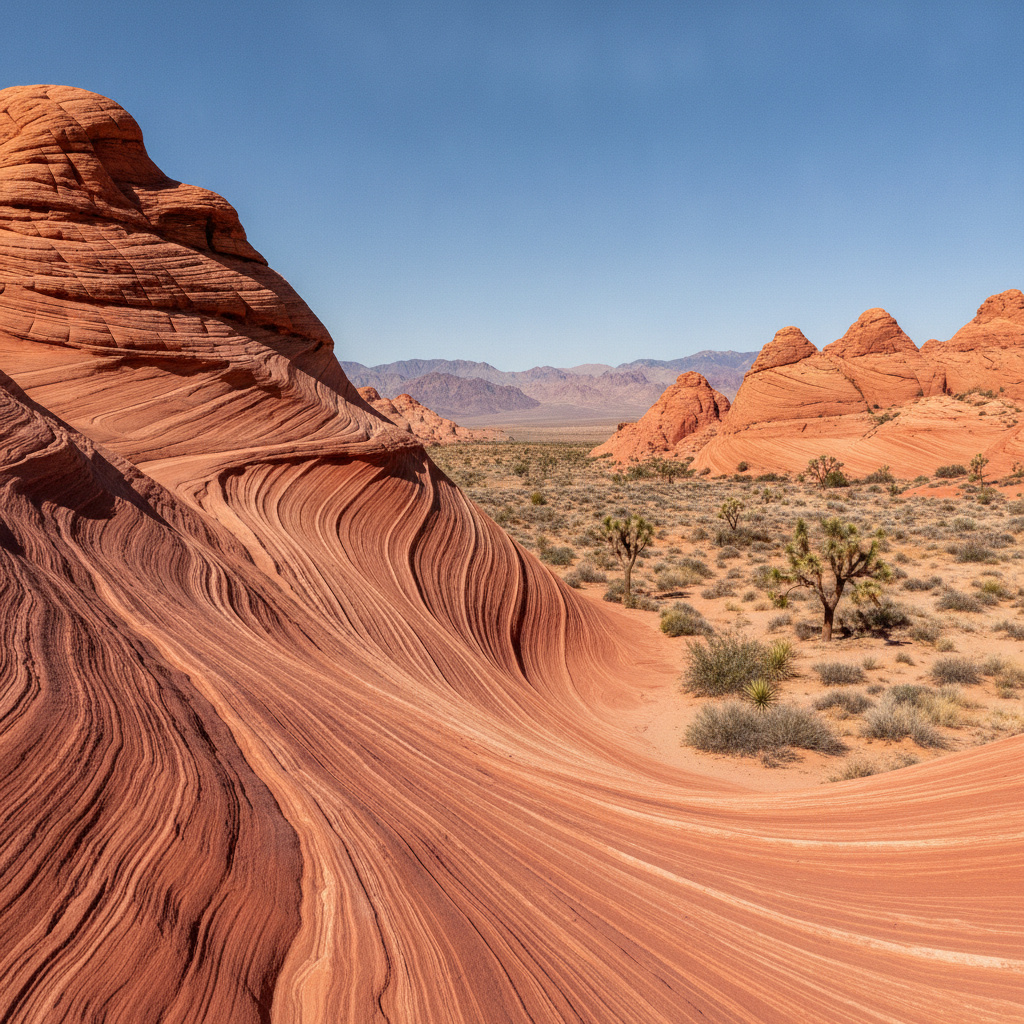
Valley of Fire State Park (the 42,000-acre (17,000-hectare) Nevada state park 80 km (50 miles) northeast of Las Vegas in the Mojave Desert — Nevada's oldest state park (established 1935) and the most dramatically scenic landscape within an hour's drive of Las Vegas): the Valley of Fire (the desert landscape carved from brilliant red Aztec sandstone (the 150-million-year-old lithified sand dunes of the Jurassic period — the characteristic bright orange-red colour coming from the iron oxide (hematite) content of the Navajo sandstone formation, the same geological formation as the famous red rock landscapes of Capitol Reef and Zion National Parks in Utah)) features some of the most otherworldly rock formations in the American Southwest: the Elephant Rock (the free-standing elephant-shaped sandstone formation near the east entrance), the Seven Sisters (the group of red sandstone peaks near the east entrance), the Fire Wave (the undulating layers of white, red, and pink sandstone creating a wave pattern in the rock — the most photographed single formation in the park), the Atlatl Rock (the sandstone cliff with prehistoric Anasazi petroglyphs (the ancient rock carvings made by the Anasazi (Ancestral Puebloans) and later the Southern Paiute people, who occupied the Valley of Fire for over 4,000 years before European contact)); the Cabins (the 1935 stone cabins built by the Civilian Conservation Corps (CCC) at the centre of the park, the finest example of New Deal-era CCC rustic architecture in Nevada) and Mouse's Tank (the natural water basin hidden in a narrow canyon, named for a Paiute outlaw of the 1890s).
- 4
Red Rock Canyon — Desert Climbing & Scenic Drives
Red Rock Canyon National Conservation Area (the 197,000-acre (79,700-hectare) National Conservation Area administered by the Bureau of Land Management (BLM), 26 km (16 miles) west of Las Vegas — the most accessible dramatic landscape from Las Vegas and the finest rock climbing destination in the American Southwest outside of Yosemite): the Calico Hills (the distinctive orange-red and white Aztec sandstone formations on the eastern edge of the canyon, rising abruptly from the Mojave Desert floor — the most photographed feature of Red Rock Canyon and the backdrop for Las Vegas's most recognizable natural scenery): the 13-mile (21 km) Scenic Loop Drive (the one-way paved loop road through the most dramatic portion of Red Rock Canyon, with 13 signed overlooks and trailheads): the rock climbing (Red Rock Canyon is considered the finest sandstone sport climbing destination in the United States, with over 2,000 established climbing routes on the Calico Hills and the Wilson Cliffs (the dramatic 1,000-metre limestone escarpment forming the western wall of the Red Rock Canyon area — the escarpment face contains some of the longest multi-pitch climbing routes in the American Southwest)); the hiking trails (the 3.5-mile (5.6 km) Calico Hills Trail, the 2.2-mile (3.5 km) Calico Tanks Trail to a natural rock water tank with views over the Las Vegas Valley, and the 7.4-mile (11.9 km) Keystone Thrust Trail along the base of the Wilson Cliffs) are the finest desert hiking near Las Vegas.
- 5
Lake Mead & Water Recreation in the Desert
Lake Mead National Recreation Area (the 1.5 million-acre (607,000-hectare) National Recreation Area surrounding Lake Mead (the reservoir created by the Hoover Dam) and Lake Mohave (the reservoir created by Davis Dam on the Colorado River downstream) — the most visited National Recreation Area in the United States, receiving approximately 7-8 million visitors per year): Lake Mead (the largest reservoir in the United States when full, covering approximately 640 km² (247 sq miles) with a shoreline of 885 km (550 miles) — though the current (2020s) drought has reduced the lake to approximately 30-35% of its historic maximum capacity, exposing previously submerged shoreline features including the foundations of the town of St. Thomas (the Mormon settlement on the Muddy River that was drowned by the rising waters of Lake Mead in 1938, and re-exposed in 2002-2022 during the prolonged drought) and the famous 'bathtub ring' (the white calcium carbonate and other mineral deposits marking the historic high-water line on the canyon walls, extending as much as 60 metres (200 feet) above the current water level in 2022 — the most visible physical evidence of the Colorado River Basin water crisis)): the water recreation on Lake Mead (the boat rentals from Las Vegas Boat Harbor at Hemmenway Harbor, the house boat rentals (the most unique accommodation option in the Las Vegas area), the water skiing, wake boarding, jet skiing, and swimming beaches (Boulder Beach — the most popular swimming beach on Lake Mead, with fine white sand, calm shallow water, and the dramatic desert canyon backdrop)).
- 6
Zion & Bryce Canyon — Utah's Greatest National Parks
Zion National Park (the 593 km² national park in southwestern Utah, 260 km (160 miles) from Las Vegas — the most visited national park in the United States in 2021 (5.04 million visitors), surpassing the Grand Canyon): the Narrows (the hike through the Virgin River Gorge (the slot canyon where the Virgin River has carved a canyon as narrow as 6 metres (20 feet) wide and as tall as 300 metres (1,000 feet) — the most famous and most photographed hike in Zion National Park, requiring visitors to wade through the river since there is no trail — the water temperature typically 10-13°C (50-55°F) year-round)) and Angels Landing (the 2.4-mile (3.9 km) round-trip hike from the canyon floor to the narrow sandstone fin at 1,488 metres (4,882 feet) above sea level — the final section requiring hikers to use fixed chains bolted to the rock face to ascend the sheer-sided fin, the most exhilarating (and terrifying) accessible hike in the American Southwest) are the two most iconic experiences at Zion; Bryce Canyon National Park (the 145 km² national park 140 km (87 miles) northeast of Zion (approximately 4.5 hours from Las Vegas) — the highest concentration of hoodoos (the tall thin spires of rock carved from the soft Claron limestone by frost-thaw action — Bryce Canyon has more hoodoos than any other place on Earth) in the world, at elevations of 2,400-2,700 metres (8,000-9,000 feet) — the 'Silent City' (the main amphitheatre of hoodoos viewed from the Rim Trail between Inspiration Point and Bryce Point) is the most surreal landscape in the American Southwest.
Walk this route with audio
Stories play automatically as you reach each stop — no tapping needed.
More in las-vegas

Las Vegas Nightclubs, EDM & the World's Greatest DJ Culture
Neon Museum, Wedding Chapels & Downtown Las Vegas Arts

Poker, Blackjack & the Science of Las Vegas Gambling
Sinatra, the Rat Pack & the Golden Age of Las Vegas
Las Vegas Pool Parties, Spas & the Ultimate Resort Experience