Cascais & Estoril: The Portuguese Riviera by the Sintra Line
The 40-km stretch of Atlantic coastline west of Lisbon — known as the Portuguese Riviera — was the playground of European royalty, exiled monarchs, and wartime spies in the 20th century, and remains one of the most beautiful coastal day-trips from any European capital. The Sintra line train from Cais do Sodré takes 33 minutes to Cascais; the journey passes through the resort towns of Estoril and Monte Estoril before ending at the old fishing village turned yachting and surfing destination. The combination of sandy beaches, dramatic sea cliffs, excellent seafood, and the faded glamour of early 20th-century casino and villa architecture makes this route unique.
- 1
Estoril Casino (Casino do Estoril)
The Casino do Estoril — opened 1916, rebuilt in its current modernist form in 1968 — is the largest casino in Europe by gaming floor area and one of the defining landmarks of the Portuguese Riviera. During World War II, when Portugal was nominally neutral but in practice a critical transit point between Axis and Allied Europe, Estoril was home to an extraordinary concentration of spies, exiled royals, and intelligence operatives from every major power. Ian Fleming, who visited the casino as a British naval intelligence officer, later used Estoril as the model for the casino scenes in Casino Royale (1953) — the first James Bond novel. The casino's palm-lined formal gardens descend from the railway station to the seafront in an Art Deco promenade that remains virtually unchanged from the 1930s.
- 2
Cascais Bay (Baía de Cascais)
The Baía de Cascais, the horseshoe-shaped bay at the western end of the Sintra rail line, combines three sandy beaches (Praia da Rainha, Praia da Ribeira, Praia dos Pescadores) with the working harbor of the old fishing village that was a royal summer residence from 1870 until the end of the Portuguese monarchy in 1910. The bay's shallow, calm waters and reliable Atlantic breezes made it a prime windsurfing and kitesurfing destination from the 1980s; the Cascais Sailing World Championship takes place here annually. The Casa de Santa Maria (1902), a Romantic-style villa built for the Count of Castro Guimarães and donated to the municipality, overlooks the north end of the bay and contains the Municipal Museum of Cascais and an important collection of Moorish and Portuguese decorative arts.
- 3
Cascais Old Town (Centro Histórico)
The old town of Cascais — a tight cluster of cobblestone streets, whitewashed buildings with painted tile facades, seafood restaurants, and the 16th-century Citadel (Cidadela de Cascais) — retains considerable authenticity despite the tourist pressure of the summer months. The covered fish market (Mercado da Vila) was recently renovated as a food hall while maintaining its original Pombaline structure. The Museu dos Condes de Castro Guimarães (1902, neo-Manueline and Romantic Revival) holds an important collection of Indo-Portuguese furniture, azulejos, paintings, and decorative arts accumulated by the Counts of Castro Guimarães over three generations. The Avenida Dom Carlos I, the tree-lined promenade connecting the train station to the citadel, is lined with small restaurants and galleries and is the social spine of the town.
- 4
Boca do Inferno ('Hell's Mouth')
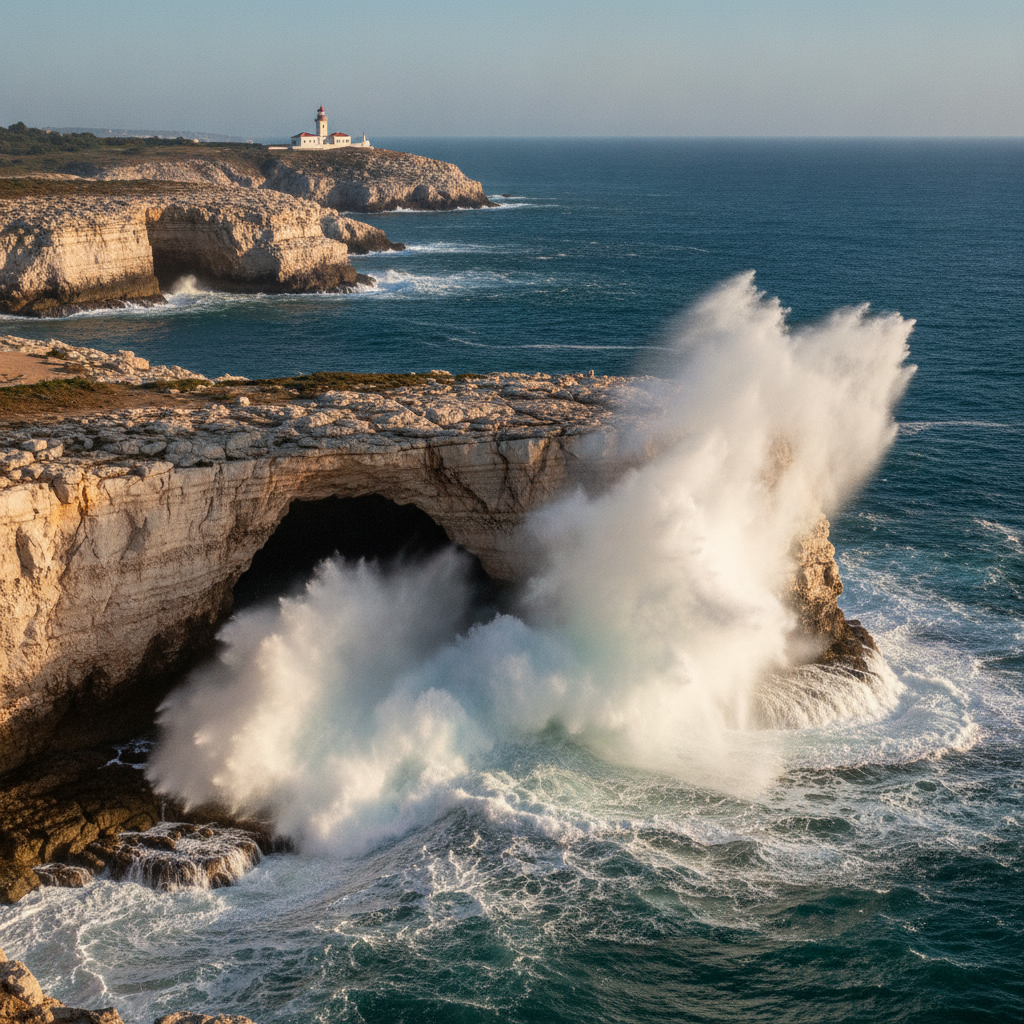
The Boca do Inferno ('Hell's Mouth'), 2 km west of Cascais along the Marginal cliff path, is an eroded sea cave in the limestone headland where Atlantic waves crash through a natural arch with enormous force, shooting spray 20 meters into the air during storms and producing a deep boom audible hundreds of meters away. The name was given by 18th-century fishermen frightened of the site; the playwright/poet Raul Brandão (1867-1930) described it in his novel Os Pescadores (1923) as the most frightening and beautiful sight on the Portuguese coast. The Aleister Crowley staged his own fake death here in 1930 — leaving his cigarette case on the cliff with a suicide note and disappearing, later resurfacing in Germany — generating one of the great hoaxes of early 20th-century Europe. The cliff path continues west 8 km to the Cabo da Roca lighthouse, the westernmost point of continental Europe (38.78°N, 9.5°W).
- 5
Cascais Marina
The Cascais Marina, rebuilt in its current form in 1999 with 650 berths, is one of the principal Atlantic sailing marinas on the Iberian Peninsula — home base for the Cascais Sailing World Championship (held annually since 1976) and the Ocean Race (formerly the Volvo Ocean Race), which uses Cascais as a leg stopover. The marina's waterfront is lined with seafood restaurants, bars, and the Farol Design Hotel (a 19th-century lighthouse keeper's quarters converted to a boutique hotel in 2001 by the architect Carlos Henrique Cruz). The Clube Naval de Cascais (1893), one of the oldest yacht clubs in Portugal, maintains its historic Art Nouveau clubhouse at the marina entrance. The stretch of coast between the marina and the Boca do Inferno is lined with 19th-century villas belonging to the old Portuguese nobility and to the wave of European exiled royal families who settled on the Estoril Coast after World War I.
- 6
Guincho Beach (Praia do Guincho)
Praia do Guincho, 10 km west of Cascais in the Sintra-Cascais Natural Park, is one of the most dramatic and wild beaches within easy reach of a European capital — a 2-km arc of Atlantic-facing sand backed by sand dunes and the Serra de Sintra, with consistent strong winds that make it one of Europe's premier kitesurfing and windsurfing destinations. The beach was classified as a natural protected area in 1981, prohibiting any commercial development within the dune system, and remains virtually undeveloped beyond the historic Hotel do Guincho (1942, originally an Iron Age fort converted successively into a Napoleonic fortress and a fishing post before its current use). The Fortaleza do Guincho restaurant in the hotel is one of the most acclaimed seafood restaurants in Portugal, holding a Michelin star since 2002. The drive along the Marginal from Cascais to Guincho on the EN247 coastal road — passing the lighthouse, the Boca do Inferno, and the Cape Raso headland — is one of the most scenic short drives in Western Europe.
Walk this route with audio
Stories play automatically as you reach each stop — no tapping needed.
More in lisbon
Alfama & São Jorge Castle: Lisbon's Moorish Heart
Parque das Nações: Expo '98 and Lisbon's City of the Future
Tram 28, Estrela & Campo de Ourique: Lisbon's Most Scenic Ride
LX Factory, Alcântara & the 25 de Abril Bridge: Industrial Lisbon Reborn
Mouraria, Intendente & Graça: Lisbon's Most Authentic Neighbourhoods