Parque das Nações: Expo '98 and Lisbon's City of the Future
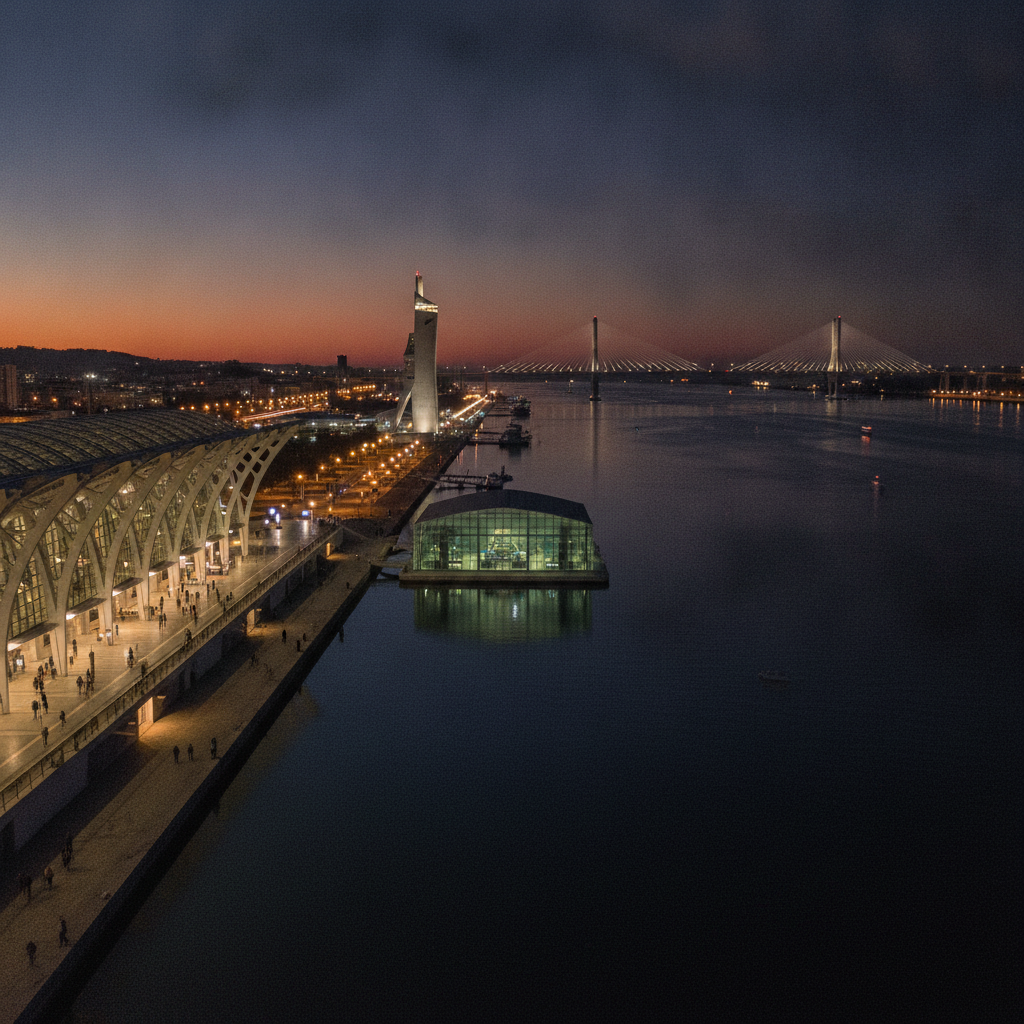
The Parque das Nações ('Park of Nations'), in the northeastern part of Lisbon along the Tagus waterfront, was built on the site of a derelict industrial wasteland and contaminated oil refinery for the 1998 World Exposition (EXPO '98), themed 'The Oceans: A Heritage for the Future'. The event attracted 11 million visitors and left behind the most significant urban regeneration project in Portuguese history — a new city district of contemporary architecture, riverside promenades, cultural pavilions, and public spaces that has become home to over 25,000 residents and the location of Lisbon's most ambitious contemporary buildings.
- 1
Oriente Station (Gare do Oriente)
The Gare do Oriente, designed by the Spanish architect Santiago Calatrava and opened for EXPO '98, is arguably the most architecturally significant railway station built in Europe since the 19th century. The concrete-and-steel main hall — eight levels high and 238 meters long — is structured as a forest of tree-like columns that branch into a vaulted glass-and-steel roof, creating a space of extraordinary lightness and complexity that serves as Lisbon's main intercity rail hub. The station handles all long-distance trains to Porto, the Algarve, and Spain, as well as suburban rail, Metro, and bus connections. The Calatrava roof's structural logic (each column is a concrete trunk bearing steel branches bearing the glass roof panels) is visible from inside as a structural poem; from outside the station's form reads as a crystalline pavilion at the entry to the EXPO site.
- 2
Lisbon Oceanarium (Oceanário de Lisboa)
The Lisbon Oceanarium, designed by the American architect Peter Chermayeff and built on a jetty in the Tagus estuary for EXPO '98, is the most important aquarium in Iberia and one of the finest in the world. Its central element is a 5-million-liter central tank representing the Open Ocean — the largest in Europe — in which over 8,000 animals (including massive rays, schools of tuna, and sand tiger sharks) circle in an environment designed to represent the mid-Atlantic. Around this central tank, four smaller habitats represent the Atlantic, Pacific, Indian, and Antarctic oceans with their characteristic fauna and flora. The building sits on the water — its glass pavilion is surrounded by the estuary on three sides — creating the illusion of being submerged when viewed from inside.
- 3
Portugal Pavilion (Pavilhão de Portugal)
The Portugal Pavilion, designed by Álvaro Siza Vieira (Portugal's most celebrated architect and Pritzker Prize laureate, 1992) as the Portuguese national pavilion for EXPO '98, is a masterwork of geometric understatement that stands as a counterpoint to the expressive drama of the Calatrava station. The pavilion's defining element is the 65-meter concrete canopy suspended between two porticoes — a concrete 'sail' only 20 cm thick that spans the ceremonial square between the two wings, creating a covered outdoor plaza. The canopy's geometry (slightly sagging under its own weight, like a cloth or a catenary curve) was a structural engineering challenge achieved by mixing the concrete mix with lead pellets. The pavilion now houses the Council of Ministers.
- 4
Vasco da Gama Tower & Casino Lisboa
The Vasco da Gama Tower, at 145 meters the tallest building in Lisbon, was built as the Exposition's signature observation tower and now houses a luxury hotel (Myriad). Its viewing platform offers the widest panorama of the Tagus estuary and the full 17.2 km span of the Vasco da Gama cable-stayed bridge (1998), the second longest bridge in Europe when built and still the longest in Portugal. The Casino Lisboa, designed by João Luís Carrilho da Graça, is the largest casino in Portugal and one of the largest in Europe, its pavilion-like form set within a lake of shallow water that reflects the building and the surrounding towers.
- 5
Vasco da Gama Bridge & Tejo Waterfront
The Vasco da Gama Bridge, the 17.2 km cable-stayed bridge crossing the Tagus estuary from Lisbon to Alcochete, was inaugurated for EXPO '98 on the 500th anniversary of Vasco da Gama's arrival in India. It is the longest bridge in the European Union. The bridge was designed to withstand a 7.5 magnitude earthquake and has 47 meters of clearance above the water to allow ocean liners to pass beneath. The Parque das Nações waterfront promenade, running 3 km from the Oriente station to the Vasco da Gama Tower along the Tagus, is lined with restaurants, cafés, and leisure facilities and has become one of the most popular evening destinations in Lisbon.
- 6
Atlantic Pavilion (Altice Arena) & Pavilhão do Conhecimento
The Atlântico (now Altice Arena), designed by Regino Cruz and inaugurated for EXPO '98, is Portugal's largest indoor arena (capacity 20,000) and one of the busiest concert venues in Europe — the host venue for concerts by Bruce Springsteen, Beyoncé, U2, and the Eurovision Song Contest 2018. The adjacent Pavilhão do Conhecimento (Knowledge Pavilion), a science museum housed in the EXPO pavilion designed by João Luís Carrilho da Graça, offers one of the best interactive science experiences in Iberia with hands-on experiments in physics, mathematics, and natural sciences across 600+ exhibits.
Walk this route with audio
Stories play automatically as you reach each stop — no tapping needed.
More in lisbon
Alfama & São Jorge Castle: Lisbon's Moorish Heart
Tram 28, Estrela & Campo de Ourique: Lisbon's Most Scenic Ride
LX Factory, Alcântara & the 25 de Abril Bridge: Industrial Lisbon Reborn
Cascais & Estoril: The Portuguese Riviera by the Sintra Line
Mouraria, Intendente & Graça: Lisbon's Most Authentic Neighbourhoods