Museum District & Hyde Park: Science, Art & the Great Outdoors
South Kensington's 'Albertopolis'—the cluster of world-class cultural institutions built with the profits from the 1851 Great Exhibition—contains the Natural History Museum, the Victoria & Albert Museum (the world's largest museum of art and design) and the Science Museum, all free to enter and all within a 10-minute walk of each other. Add Hyde Park (the most famous Royal Park, with Speakers' Corner and the Serpentine Gallery) and Kensington Palace to make this a full day of some of London's richest public culture, most of it completely free.
- 1
Natural History Museum — A Cathedral of Life
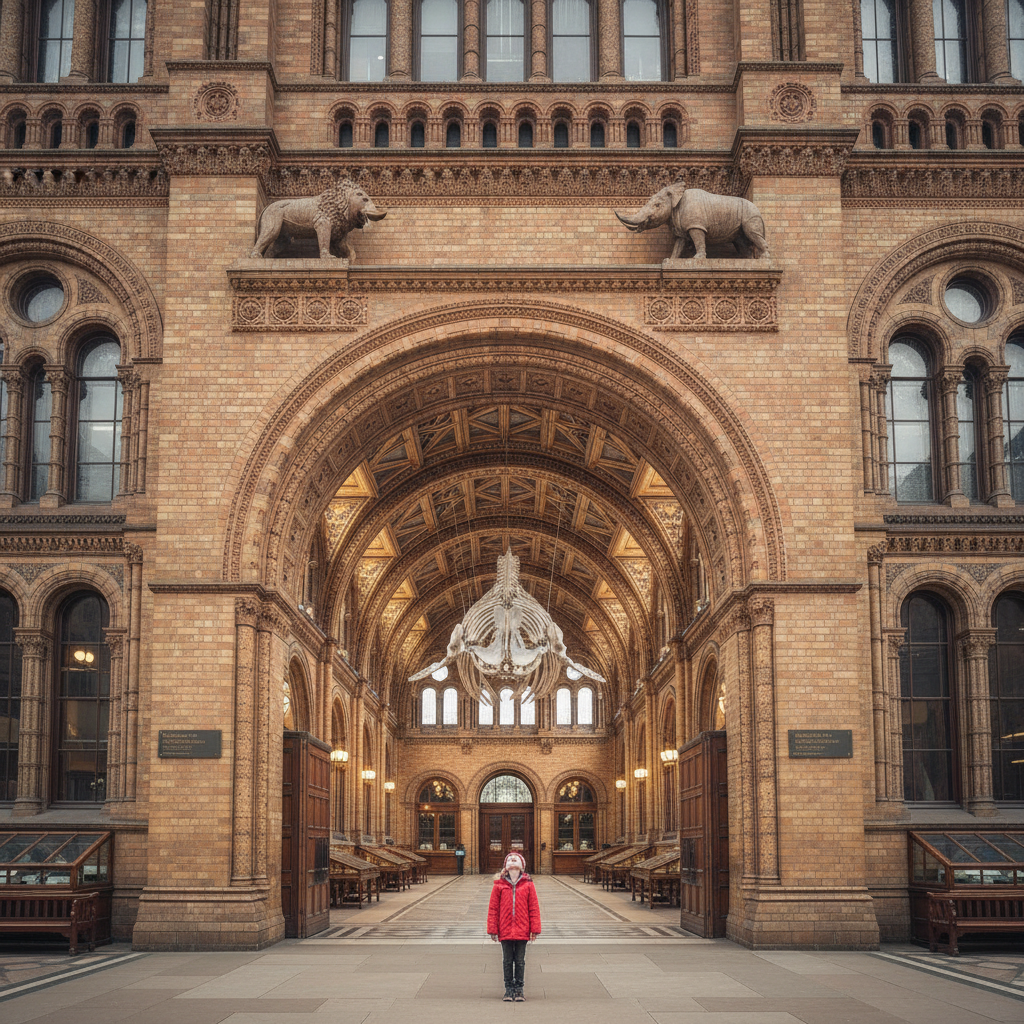
The Natural History Museum on Cromwell Road is one of the most spectacular museum buildings in the world: a Romanesque cathedral-like structure in terracotta brick designed by Alfred Waterhouse (1881), whose exterior is covered in carved stone animals and plants from floor to parapet. Inside, the Central Hall—now dominated by the skeleton of a 25-metre blue whale suspended from the ceiling—sets the tone: this is a museum designed to inspire awe. The collection is enormous (80 million specimens) and spans geology, botany, entomology, mineralogy and zoology. Essential rooms: the Dinosaur Gallery (the T. rex animatronic model has scared children since 1992), the Vault (gems and minerals), and the Darwin Centre (the collections building where a 26-metre giant squid is preserved in a tank). Free entry. The museum gets crowded on weekends—go early.
- 2
Victoria & Albert Museum — The World's Greatest Art & Design Collection
The Victoria and Albert Museum (V&A) holds the world's greatest collection of applied art and design—clothing, ceramics, jewellery, furniture, glass, textiles, sculpture and photography, from ancient Egypt to the present day, from every culture on Earth. The building itself—a sequence of Victorian courtyards and galleries linked by a bewildering internal geography—could easily absorb a week. Essential highlights: the Cast Courts (full-sized plaster casts of the greatest European sculptures, including a 13-metre-high Trajan's Column), the Raphael Cartoons (seven full-sized paintings made as tapestry designs for the Sistine Chapel), the Jewellery Gallery (7,000 pieces across five centuries), and the British Galleries (the complete furnishings of English domestic life 1500–1900). Free entry. The café (in the Victorian courtyard) is excellent.
- 3
Science Museum — From Steam Engines to Space Rockets
The Science Museum is adjacent to the Natural History Museum and covers the history of science and technology from the earliest mechanical devices to the present day. The ground floor—a vast hall of industrial machines—contains Stephenson's Rocket (1829, the most famous early steam locomotive), Arkwright's spinning frame, Babbage's Difference Engine, and a full-scale reconstruction of the Apollo 10 command module. The Flight Gallery has a Spitfire, a Hurricane and a Vickers Vimy (the first plane to cross the Atlantic, 1919). The Space Exploration gallery has original Saturn V rocket engines. Free entry. Allow two hours minimum; the interactive galleries on the upper floors are excellent for children.
- 4
Hyde Park & the Serpentine
Hyde Park—350 hectares of parkland adjoining Kensington Gardens—is the most famous of London's Royal Parks, bought by Henry VIII from Westminster Abbey in 1536. The Serpentine—an artificial lake created in 1730—has rowing boats and pedalos for rent, a lido (outdoor heated swimming area, open June–September), and the Diana Memorial Fountain. The Serpentine Gallery (in Hyde Park) and the Serpentine Sackler Gallery (across the bridge in Kensington Gardens) both present major contemporary art exhibitions; both are free. Speakers' Corner at the north-east corner of Hyde Park (near Marble Arch) has been the traditional site of public oratory since the 1860s—on Sundays anyone can turn up and speak on any topic.
- 5
Kensington Palace — Where Diana Lived
Kensington Palace at the western edge of Kensington Gardens has been a royal residence since 1689 when William III bought it to avoid the river fog that aggravated his asthma. In the 20th century it became famous as the home of Princess Diana (1981–1997), and her apartments have been preserved as a museum within the palace. The Sunken Garden outside the palace is particularly beautiful in summer; the flower beds were redesigned in 2017 as a memorial to Diana using her favourite flowers. The state rooms—the King's Gallery, the Cupola Room, the Queen's Bedchamber—are richly decorated and give a vivid picture of royal life in the 17th and 18th centuries. Entry is paid.
- 6
Holland Park — London's Most Beautiful Small Park
Walk 15 minutes west from Kensington Palace to Holland Park—a small formal park occupying the grounds of the 17th-century Holland House (destroyed in the Blitz, only the east wing survives). The park contains: the Kyoto Garden (a formal Japanese garden presented by the Kyoto Chamber of Commerce in 1991, with a waterfall, koi pond and resident peacocks), a woodland area with over 100 species of trees, an adventure playground, a rooftop theatre (open-air opera in summer), and the Design Museum in the refurbished Holland House. This is one of the quietest and most beautiful green spaces in central London—popular with locals rather than tourists. Free entry.
Walk this route with audio
Stories play automatically as you reach each stop — no tapping needed.
More in london
The Square Mile: City of London Pub Walk
Greenwich & the Prime Meridian: Time, Ships & the Edge of the World
Literary Bloomsbury & Covent Garden: Books, Philosophers & Street Theatre
East End & Brick Lane: Street Art, Bagels & Bangladeshi Curry
South Bank Arts Trail: Waterloo to Borough Market