South Bank Arts Trail: Waterloo to Borough Market
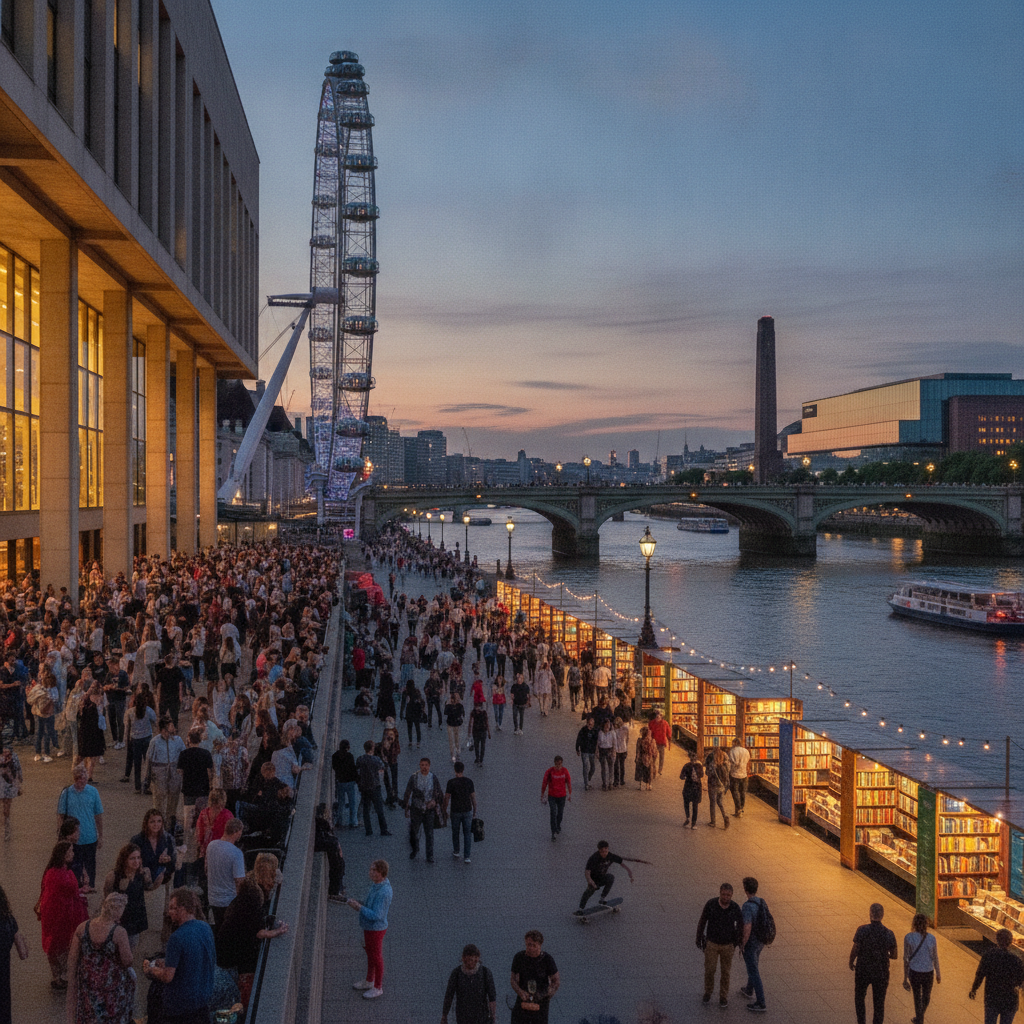
The South Bank is London's arts and culture quarter—a 2-kilometre stretch of riverside walkway that links the Southbank Centre (home to the Royal Festival Hall, the Hayward Gallery and the National Theatre) with Tate Modern and Borough Market. It is also London's most democratic public space: free to walk, lined with outdoor cafés, book stalls under Waterloo Bridge (operating since 1982), street performers, and—under the concrete arches near the NFT—the oldest surviving skate park in Europe. Best on a summer evening when the terraces fill and the river catches the last light.
- 1
Waterloo Station & the London Eye
Start at Waterloo—London's busiest mainline station and a transport hub connecting to the South Bank. Exit onto the South Bank riverside walkway and walk east. The London Eye—the 135-metre observation wheel built for the millennium in 2000—is directly ahead on the riverbank. Pods (fully enclosed glass gondolas) rotate on a 30-minute cycle giving views of up to 40km on a clear day. Tickets are expensive (£35+) and best booked in advance; the views are magnificent but you can see similar views for free from the Tate Modern's roof or the Waterloo Bridge walkway. The Shell Centre garden and the newly developed waterfront around County Hall offer good riverside walks without the crowds.
- 2
Royal Festival Hall — The South Bank's Heart
The Royal Festival Hall was built for the 1951 Festival of Britain as a post-war gesture of optimism and has been at the centre of London's classical music, jazz and world music scene ever since. The building—one of the few Grade I listed post-war buildings in England—has excellent acoustics and hosts the London Philharmonic and Philharmonia orchestras as resident companies. The building is free to enter: the main foyer has good restaurants and bars (the Skylon on the 3rd floor is excellent for dinner with river views), and the outdoor terrace along the river is one of the best free spots to watch the sunset over the Thames. Check the programme—there are often free foyer concerts.
- 3
Hayward Gallery & the Underbelly Skate Park
The Hayward Gallery—a Brutalist concrete building from 1968, part of the Southbank Centre complex—hosts major temporary international art exhibitions. It's not always open (check in advance) but when it is, the exhibitions are consistently excellent: recent shows have included retrospectives of Bridget Riley, Lee Krasner and a major survey of 20th-century Japanese photography. Under the concrete terraces directly in front of the gallery is the Underbelly—an area of concrete banks, ledges and rails that has been a skateboarding spot since 1973, making it the oldest surviving skatepark in Europe. The secondhand book market under Waterloo Bridge (open daily, rain or shine) is 250 metres east.
- 4
National Theatre — Britain's Public Stage
The National Theatre—three theatres in a Brutalist concrete complex designed by Denys Lasdun (1976)—is Britain's most important publicly funded theatre, presenting new writing, classic revivals and large-scale musicals on its three stages (the Olivier, the Lyttelton and the Dorfman). Tickets are affordable relative to the West End, but the best productions sell out fast; book through the NT website. Free events in the foyer and riverside are common. The NT bookshop is the best theatre bookshop in London. The backstage tours (book in advance) give access to the fly tower, workshops and rehearsal rooms. Even without a ticket, the building's exterior and the concrete terraces around it are worth experiencing—at night they are lit up dramatically.
- 5
Tate Modern — The Turbine Hall & the View
The Tate Modern is housed in the former Bankside Power Station, a massive 1950s brick building whose Turbine Hall—the former generating space, 35 metres high and 152 metres long—is used for a rotating programme of large-scale commissions. Recent commissions have included Ai Weiwei's Sunflower Seeds (100 million hand-crafted porcelain sunflower seeds covering the floor), Carsten Höller's Test Site (giant slides from the 5th floor to the ground), and Olafur Eliasson's Weather Project (a giant artificial sun filling the hall with orange light). The permanent collection—free—covers international modern and contemporary art from 1900. The 10th-floor viewing gallery of the Switch House extension (Level 10 lift) has the best view in the South Bank: St Paul's, the City, the bridges.
- 6
Borough Market — London's Ancient Food Market
End at Borough Market, a five-minute walk east of Tate Modern under the Victorian railway viaduct. Borough Market has traded on or near this site since at least 1014 and is London's most important specialist food market. Thursday to Saturday it operates at full tilt: 100+ stalls of cheese, charcuterie, bread, pastries, vegetables, fish, meat, chocolates, condiments, olives, street food from every culture on Earth. The Saturday market is the most spectacular. Best visited hungry: stop at the Monmouth Coffee stall for a filter coffee, the Kappacasein for a raclette or toasted cheese sandwich, the Spanish charcuterie stall for a plate of jamón, and Neal's Yard Dairy for British cheeses. The railway arches around the market contain excellent permanent restaurants.
Walk this route with audio
Stories play automatically as you reach each stop — no tapping needed.
More in london
The Square Mile: City of London Pub Walk
Greenwich & the Prime Meridian: Time, Ships & the Edge of the World
Literary Bloomsbury & Covent Garden: Books, Philosophers & Street Theatre
East End & Brick Lane: Street Art, Bagels & Bangladeshi Curry
Museum District & Hyde Park: Science, Art & the Great Outdoors