Tower Bridge, Southwark & the Thames Path
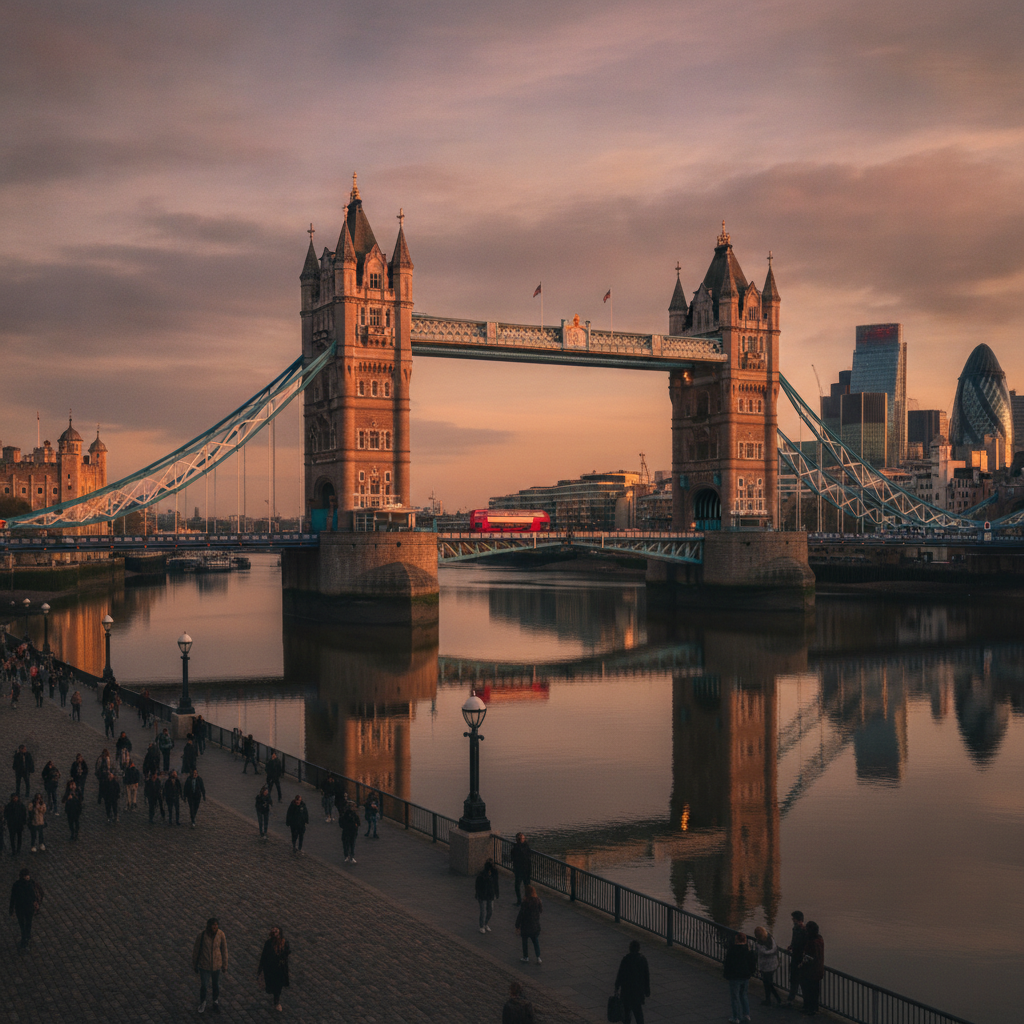
The stretch of the Thames between London Bridge and Blackfriars is the most historically dense mile in Britain. On the north bank: the Tower of London, where Henry VIII sent his wives to be executed, where the Crown Jewels are kept, and where ravens have been resident since at least the 17th century. Cross Tower Bridge—a Victorian masterpiece built in 1894—to reach the south bank, where Borough Market, Shakespeare's Globe and Tate Modern line the river in a sequence of food, theatre and art that is uniquely London. End at St Paul's Cathedral, Wren's masterpiece that survived the Blitz.
- 1
Tower Bridge — Victorian Engineering's Greatest Show
Tower Bridge is not London Bridge—a common confusion that has led many tourists to the wrong structure entirely (London Bridge is the plain grey one upstream). Tower Bridge, opened in 1894, is a bascule bridge: its two central spans lift hydraulically to allow tall ships through, as they still do several times a week. The bridge is a masterpiece of Victorian Gothic engineering, its towers clad in Portland stone over a steel skeleton. The Tower Bridge Exhibition (paid entry) includes the high-level glass walkways—walk across 42 metres above the river with the Thames traffic below your feet—and the original Victorian engine rooms, still immaculate. Book tickets online.
- 2
Tower of London — A Thousand Years of English History
The Tower of London is not one tower but a complex of 21 towers built and expanded over 1,000 years from William the Conqueror's White Tower (1078) to the 13th-century outer walls. It has been a royal palace, a prison, an execution site, an armoury, a zoo (the royal menagerie was kept here until 1835), and is now home to the Crown Jewels. The Jewel House holds the Sovereign's Orb, the Sceptre with the Cross, and the Imperial State Crown—worn at coronations and the State Opening of Parliament—along with the Koh-i-Noor diamond. Allow three hours minimum. The Yeoman Warder (Beefeater) tours, included with entry, are excellent. Book well in advance.
- 3
Borough Market — London's Greatest Food Market
Cross London Bridge to the south bank and walk west to Borough Market—operating on this site since at least 1014, making it one of the oldest food markets in Britain. Today it is London's finest specialist food market: 100+ stalls selling cheese from Neal's Yard, salt beef from Monmouth Coffee, charcuterie, street food from every corner of the world, fresh produce, bread, pies, and anything else you might want to eat. The market is at its busiest Thursday–Saturday; weekends draw large crowds but the atmosphere is festive. The area around the market—Bermondsey Street, Maltby Street—has some of London's best independent restaurants and wine bars.
- 4
Shakespeare's Globe — Theatre on the Riverbank
A faithful reconstruction of the 1599 original Globe Theatre (which burned down in 1613), the current Globe was built in 1997 close to the site of the original, using historically accurate materials and methods—green oak beams, thatched roof, hand-made bricks. The theatre performs Shakespeare's plays in the open air from May to October, with 700 standing 'groundling' tickets (£5) available at the door. Even if there's no performance, the guided tour (45 minutes) is excellent and includes access to the Sam Wanamaker Playhouse—a beautiful candlelit Jacobean indoor theatre next door. The adjacent exhibition explains Elizabethan theatre and life.
- 5
Tate Modern — Art in a Power Station
Tate Modern occupies the former Bankside Power Station—a huge 1950s brick cathedral designed by Giles Gilbert Scott (who also designed the red telephone box). The Turbine Hall—the cavernous former generating space—hosts massive commissioned installations by artists including Louise Bourgeois, Olafur Eliasson and Carsten Höller. The permanent collection covers international modern and contemporary art from 1900 to the present, displayed thematically rather than chronologically. The Switch House extension (2016) adds nine more floors. Everything except special exhibitions is free. The 10th-floor viewing platform has a panoramic view of St Paul's and the City skyline.
- 6
St Paul's Cathedral — Wren's Masterpiece that Survived the Blitz
Cross the Millennium Bridge from Tate Modern to reach St Paul's Cathedral—the masterpiece of Sir Christopher Wren, built 1675–1710 after the Great Fire of London destroyed the medieval cathedral. The dome—one of the largest in the world—was famously photographed surrounded by smoke and flames during the Blitz, becoming a symbol of London's resilience. Inside: the Whispering Gallery (dome interior, where whispers travel 34 metres around the curved wall), the Stone Gallery (outdoor) and the Golden Gallery at the very top for the best elevated view in the City. Nelson and Wellington are both buried in the crypt. Services are held daily; the cathedral is open to tourists when services are not in progress.
Walk this route with audio
Stories play automatically as you reach each stop — no tapping needed.
More in london
The Square Mile: City of London Pub Walk
Greenwich & the Prime Meridian: Time, Ships & the Edge of the World
Literary Bloomsbury & Covent Garden: Books, Philosophers & Street Theatre
East End & Brick Lane: Street Art, Bagels & Bangladeshi Curry
South Bank Arts Trail: Waterloo to Borough Market