Beverly Hills, Rodeo Drive & West Hollywood: The Sunset Strip
Beverly Hills (incorporated 1914, population 32,000) and West Hollywood (incorporated 1984, population 35,000) — two independent municipalities entirely surrounded by the City of Los Angeles — define the intersection of wealth, celebrity culture, and entertainment industry that has made the 90210 ZIP code the most famous address in the world. Rodeo Drive and the Sunset Strip are the commercial axes of this world.
- 1
Rodeo Drive & Beverly Hills Golden Triangle
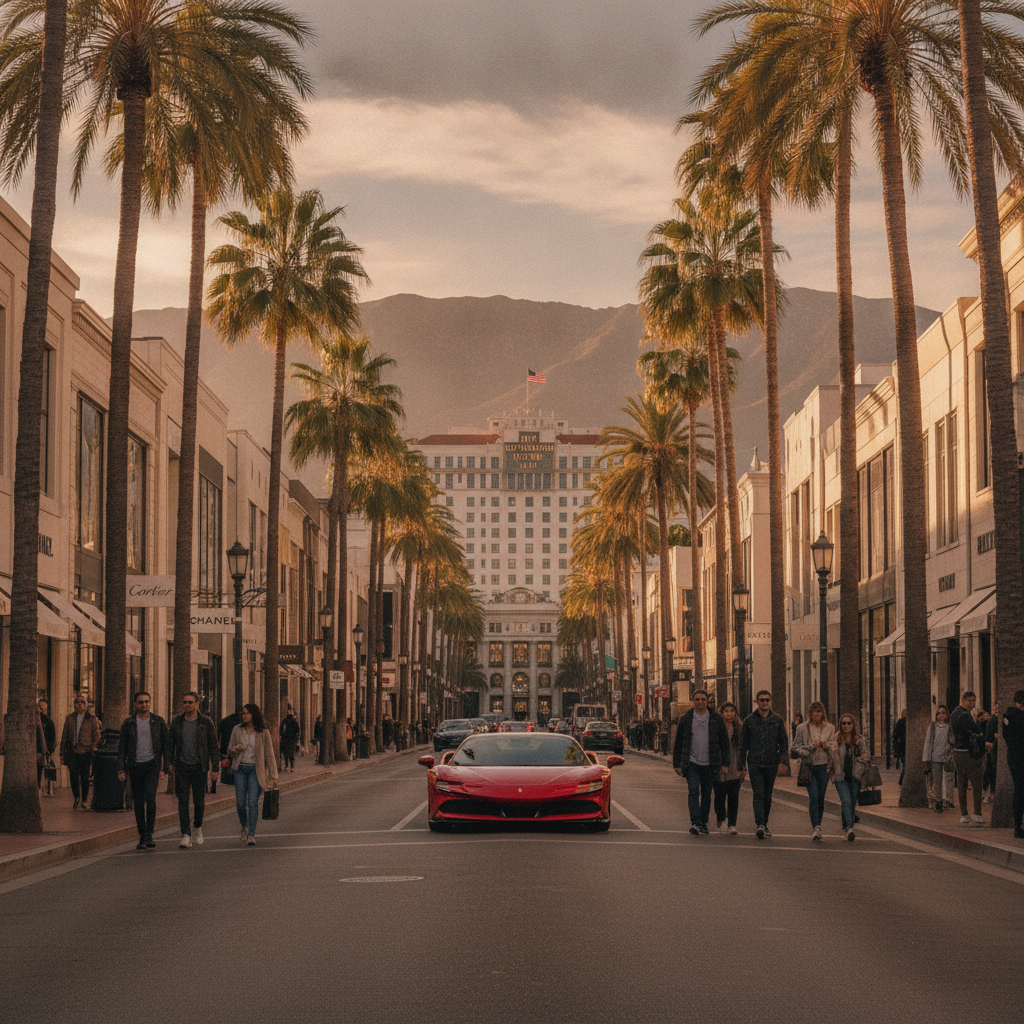
Rodeo Drive (pronounced 'ro-DAY-oh', not 'ro-dee-oh') — the three-block stretch of Rodeo Drive between Wilshire and Santa Monica Boulevards, lined with flagship stores of every major global luxury brand (Chanel, Gucci, Cartier, Hermès, Prada, Louis Vuitton, Bulgari, Tiffany, Valentino) — is the most expensive retail real estate in California and one of the most expensive in the world (rents regularly exceed $2,000 per square foot per year). The street was named for the Rancho Rodeo de las Aguas (the 'roundup place of the waters'), an 1839 Mexican land grant that covered most of present-day Beverly Hills, where two streams converged and created a natural gathering place for livestock. Beverly Hills was incorporated in 1914 by a group of wealthy residents who wanted their own city services (particularly oil wells and water); it was almost annexed by Los Angeles in 1923 before the residents voted to remain independent by a margin of 337 to 337 (tied, independence prevailed by default). The two-story Via Rodeo (1990, architect Morey, a fake Baroque street alongside the real Rodeo Drive) is a shopping center designed to look like an Italian pedestrian street.
- 2
Beverly Hills Hotel (1912) & The Pink Palace
The Beverly Hills Hotel (9641 Sunset Boulevard, opened January 1, 1912 — twelve years before Beverly Hills was a recognizable city — making it the oldest building in Beverly Hills) — a Mission Revival pink and green stucco hotel nicknamed 'the Pink Palace' — was built by the Rodeo Land and Water Company as an attraction to draw wealthy buyers to the then-remote canyon property. The hotel became the social center of the Hollywood entertainment industry from the 1920s onward: every major film star of the 20th century stayed or lived here (Marlene Dietrich, Howard Hughes, Marilyn Monroe, Elizabeth Taylor and Richard Burton conducted their first affair in Bungalow 5, John Lennon and Yoko Ono honeymoon). The Polo Lounge (named for the celebrities who played polo at the Will Rogers estate nearby) has been the power breakfast restaurant of Hollywood for 90 years. The hotel passed through various owners (including the Sultan of Brunei in 1992, who briefly banned same-sex couples) and is now owned by the Dorchester Collection.
- 3
Greystone Mansion (1928) & Beverly Hills Parks
Greystone Mansion (905 Loma Vista Drive, Beverly Hills, 1928, architect Gordon Kaufmann) — a 46,000 square foot Tudor Revival mansion built by oil magnate Edward Doheny Sr. as a wedding gift for his son Edward Doheny Jr. — is famous for the murder-suicide that occurred just 55 days after the Doheny family moved in: Edward Doheny Jr. was shot and killed by his personal secretary Hugh Plunkett (the motive — a suspected homosexual relationship or a blackmail plot related to the Teapot Dome Scandal involving Edward Sr. — has never been definitively established). The mansion was purchased by the City of Beverly Hills in 1965 and is now a public park; the house has appeared in dozens of films, including There Will Be Blood (2007), The Social Network (2010), and X-Men (2000). The city also operates the Beverly Gardens Park (1 mile of manicured park along Santa Monica Boulevard, containing the Electric Fountain, a Beverly Hills landmark since 1931) and Beverly Hills Civic Center (1931, Stiles Clements, Spanish Renaissance Revival).
- 4
Sunset Strip (1.5 miles, West Hollywood)
The Sunset Strip (the 1.5-mile unincorporated section of Sunset Boulevard between Crescent Heights Boulevard and Doheny Drive that runs through what is now West Hollywood — unincorporated County territory in the 1930s-1980s, meaning it had no city zoning restrictions and minimal police presence) — was the entertainment and nightlife center of Los Angeles from the 1930s through the 1990s, home to the Cocoanut Grove at the Ambassador Hotel (1921-1989, site of Robert F. Kennedy's assassination on June 5, 1968), the Garden of Allah bungalow apartments (1919-1959), Ciro's (1940-1957), the Trocadero (1934-1946), the Mocambo (1941-1958), and the Sunset Tower Hotel. The Strip's second golden age (1960s-1980s) was defined by the rock music clubs: the Whisky a Go Go (1964, first discotheque in the US, hosted the Doors, Led Zeppelin, Janis Joplin), the Roxy Theatre (1973), the Troubadour (West Hollywood, 1957), and the Viper Room (1993, Johnny Depp co-owner, site of River Phoenix's death on Halloween 1993). The large format billboards that line the Strip — erected since the 1920s to advertise films, albums, and television shows — are considered cultural landmarks protected by West Hollywood municipal code.
- 5
Chateau Marmont (1929) & Hollywood Mythology
Chateau Marmont (8221 Sunset Boulevard, West Hollywood, opened 1929, designed by architect Arnold Weitzman as an apartment building inspired by the Château d'Amboise in the Loire Valley, converted to a hotel in 1931) — the most mythologized hotel in Hollywood — is famous for the concentrated density of significant historical events that have occurred within its walls: John Belushi died of a drug overdose in Bungalow 3 on March 5, 1982; Jim Morrison lived in a bungalow for several months before The Doors' first album; Led Zeppelin rode motorcycles through the lobby; Greta Garbo lived in Suite 64 for two years; F. Scott Fitzgerald lived in Bungalow 4 while writing The Last Tycoon (1940-1941, when he collapsed of a heart attack at nearby Schwab's Pharmacy — which has itself since been demolished). The hotel is privately owned (Harry Drucker since 1975) and maintains a strict policy of guest privacy; Harry Cohn of Columbia Pictures famously advised Marilyn Monroe that if she must get in trouble, to 'do it at the Chateau Marmont.'
- 6
Pacific Design Center (1975/1988/2013) & West Hollywood Design District
The Pacific Design Center (8687 Melrose Avenue, West Hollywood) — three color-coded buildings (Blue Building 1975, Red Building 1988, Green Building 2013, designed by Cesar Pelli and the Pelli Clarke Pelli firm) — is the largest design center on the West Coast of the United States: 1.2 million square feet of showrooms for furniture, fabric, lighting, flooring, kitchen, and bath product trade showrooms (open primarily to the design trade, with some public events). The Blue Building ('the Blue Whale,' a massive blue glass hulk at the corner of Melrose and San Vicente) was one of the most controversial buildings in Los Angeles when it opened in 1975 — critics called it an alien intrusion into the low-scale residential neighborhood; it has since been incorporated into the visual identity of the Melrose/West Hollywood neighborhood. The surrounding West Hollywood Design District (Melrose Avenue between La Cienega and Doheny) is the most concentrated cluster of furniture, design, and art galleries in the western United States.
Walk this route with audio
Stories play automatically as you reach each stop — no tapping needed.
More in losangeles
The Getty Center, Brentwood & Malibu: Art Above Los Angeles
Hollywood Boulevard: Walk of Fame, TCL Chinese Theatre & Dolby Theatre
Downtown LA: Grand Central Market, Bradbury Building & Arts District
Anaheim & Orange County: Disneyland, Knott's Berry Farm & Angel Stadium
LACMA, La Brea Tar Pits & Miracle Mile: Museum Row on Wilshire