Anaheim & Orange County: Disneyland, Knott's Berry Farm & Angel Stadium
Anaheim (founded 1857 as a German immigrant wine colony, incorporated 1876, population 350,000) — 30 miles south of downtown Los Angeles in Orange County, linked to LA by the I-5 (the Santa Ana Freeway, the busiest section of freeway in America until the 405 was widened) — is the theme park capital of the western United States: home to Disneyland (the original Disney park, 1955, the most visited theme park in North America), Disney California Adventure (2001), and nearby Knott's Berry Farm (1920, the first commercial theme park in the United States, predating Disneyland by 35 years).
- 1
Disneyland Resort (July 17, 1955) — Walt Disney's Original Vision
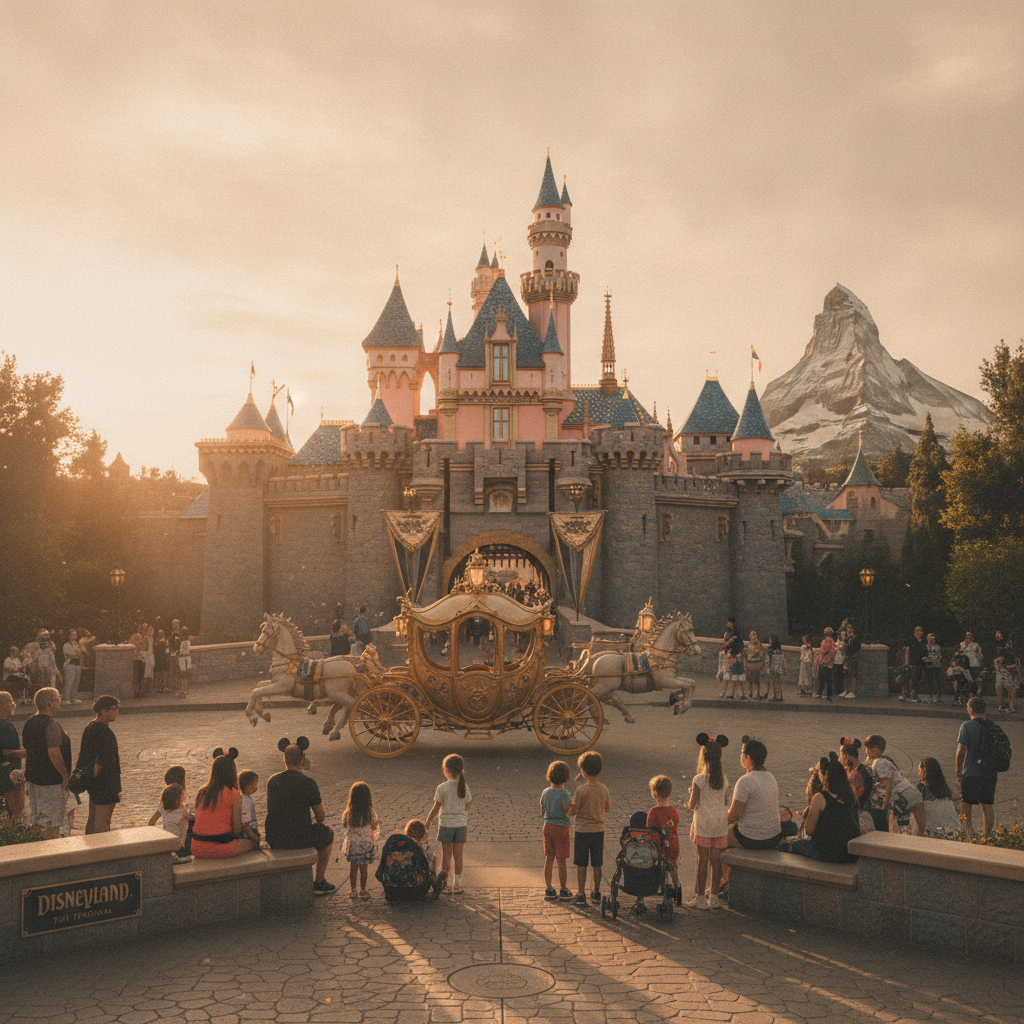
Disneyland (1313 South Harbor Boulevard, Anaheim, opened July 17, 1955, designed by Walt Disney and WED Enterprises with architect Welton Becket) — the first Disney theme park and the template for every theme park built since — was conceived by Walt Disney after a visit to Copenhagen's Tivoli Gardens (1951) and his frustration with existing American amusement parks: 'dirty, with tattooed men and a couple of rides and a hot dog stand... I felt there should be something built where the parents and the children could have fun together.' Disneyland opened on July 17, 1955 with 28 attractions (Sleeping Beauty Castle had not yet received its pink color, which was added in 1959), broadcast live on ABC with Ronald Reagan, Art Linkletter, and Bob Cummings as hosts — a chaotic premiere day (the tarmac on Main Street was still wet, causing women's high heels to sink in). The original 160-acre park has been continuously expanded and now covers 500 acres as the Disneyland Resort (including Disney California Adventure, 2001, and the Downtown Disney district). The park receives approximately 18-20 million visitors per year, making it the most-visited theme park in North America. Star Wars: Galaxy's Edge (2019, the most expensive theme park area ever built at $1 billion, 14 acres) is the most recent major expansion.
- 2
Main Street USA & Sleeping Beauty Castle (1955)
Main Street USA — the entry corridor to Disneyland, designed to evoke a small Midwestern American town around 1900 (based loosely on Walt Disney's hometown of Marceline, Missouri) — is the first immersive themed environment in any theme park, establishing the vocabulary of 'forced perspective' (buildings are at full scale at street level and progressively smaller at upper floors to create a feeling of greater height), 'hidden infrastructure' (utility corridors, service entrances, and employee areas kept invisible to guests), and 'narrative environment' (the park tells a story that begins at the entry and unfolds as guests move through the space). The proportions of Main Street USA are carefully calculated: the buildings are at 7/8 scale on the ground floor, 5/8 scale on the second floor, and 1/2 scale on the third floor, so the street feels grand but not intimidating. Sleeping Beauty Castle (1955, the centerpiece of the park and the most photographed single structure in Disneyland) was designed by Herb Ryman in one weekend at Walt Disney's request; it stands 77 feet tall and was inspired by Neuschwanstein Castle in Bavaria (the original 'fairy tale castle' that Disney and other theme park designers have returned to repeatedly).
- 3
Knott's Berry Farm (1920) — America's First Theme Park
Knott's Berry Farm (8039 Beach Boulevard, Buena Park, 4 miles northwest of Disneyland, opened as a roadside berry stand in 1920 by Walter Knott) — the first commercial theme park in the United States, predating Disneyland by 35 years — began when Walter Knott, a Depression-era farmer, sold boysenberries (a hybrid fruit he and horticulturalist Rudolph Boysen had developed at the farm) and his wife Cordelia's fried chicken dinners from a roadside stand. The lines grew so long that Walter began adding attractions to entertain waiting customers: a replica Gold Rush town (Ghost Town, 1940), a steam train (1952), and a stagecoach ride (1950). By 1968 Knott's was charging admission and had become a full theme park. The park is now owned by Cedar Fair (2002) and has 40+ rides including GhostRider (1998, a wooden roller coaster ranked among the best in the world), HangTime (2018), and the Voyage of the Geyser (2002). The Knott's Scary Farm Halloween event (since 1973) was the first commercial Halloween event in the United States and is now the most attended Halloween event in the world (50+ mazes, 1 million+ visitors per October).
- 4
Angel Stadium of Anaheim (1966/1998) & Anaheim Ducks
Angel Stadium of Anaheim (2000 East Gene Autry Way, Anaheim, opened April 19, 1966 as Anaheim Stadium, renovated 1997-1998 as Angel Stadium) — home of the Los Angeles Angels of Anaheim (founded 1961 as the Los Angeles Angels, renamed California Angels 1965, Anaheim Angels 1997, Los Angeles Angels of Anaheim 2005) — is one of the oldest active Major League Baseball stadiums in the United States and the most dramatic in California: surrounded by the artificial rock formation 'The California Spectacular' (a massive rock pile with a geyser, a waterfall, and a 'Big A' scoreboard) in centerfield. The 1994 Northridge earthquake damaged the stadium roof and led to the 1998 renovation (reducing capacity from 64,593 to 45,050). The Angels won their only World Series in 2002 (defeating the San Francisco Giants in Game 7). The Anaheim Ducks (NHL) play at the adjacent Honda Center (1993, 18,336 capacity), visible from the stadium parking lot; the Ducks won the Stanley Cup in 2007.
- 5
Orange County & South OC Beach Towns
Orange County (incorporated 1889, population 3.2 million, GDP of $280+ billion — larger than most countries) — the suburban county between Los Angeles County and San Diego County along the Pacific coast — is the economic engine of Southern California outside Los Angeles: home to the main campus of UCI (University of California, Irvine, founded 1965), a major biomedical and technology industry cluster (the 'tech coast'), and the most affluent collection of beach communities in California: Newport Beach (the wealthiest city in California by per-capita income), Laguna Beach (the original arts colony of Southern California, founded 1903), and Huntington Beach ('Surf City USA,' the most active surfing community on the US mainland). The cities of Newport Beach and Irvine are regularly ranked among the safest cities in the United States. Orange County's current reputation as a conservative Republican stronghold (it voted Republican in every presidential election from 1936 to 2016, when it swung Democratic for the first time in 80 years) makes its political realignment in 2018 (all four Congressional districts swung Democratic) one of the most significant electoral shifts in California history.
- 6
Crystal Cathedral / Christ Cathedral (1980) & Garden Grove
The Crystal Cathedral (Christ Cathedral since 2013, 13280 Chapman Avenue, Garden Grove, 3 miles south of Disneyland, opened 1980, designed by Philip Johnson and John Burgee) — a 2,736-seat all-glass church (10,000 panes of tempered glass on a space-frame steel structure, 415 feet long) built for televangelist Robert H. Schuller's Hour of Power TV ministry (the longest-running religious TV program in American history, 1970-2014) — is one of the most extraordinary buildings in Southern California: the largest glass building in the world at the time of its construction, with a pipe organ with 16,000 pipes, two 90-foot video screens, and a $60 million construction cost. The Hour of Power broadcast was watched by 20 million viewers weekly at its peak in the 1980s. The Schuller family's Crystal Cathedral Ministries declared bankruptcy in 2010 (debts of $43 million) and the property was purchased by the Roman Catholic Diocese of Orange in 2012; Philip Johnson's building has been converted for Catholic services as Christ Cathedral, the co-cathedral of the Diocese.
Walk this route with audio
Stories play automatically as you reach each stop — no tapping needed.
More in losangeles
The Getty Center, Brentwood & Malibu: Art Above Los Angeles
Hollywood Boulevard: Walk of Fame, TCL Chinese Theatre & Dolby Theatre
Downtown LA: Grand Central Market, Bradbury Building & Arts District
LACMA, La Brea Tar Pits & Miracle Mile: Museum Row on Wilshire
Pasadena: Huntington Library, Rose Bowl & Old Town